The first powered flight
1903 Kitty Hawk, North Carolina, United States
In short
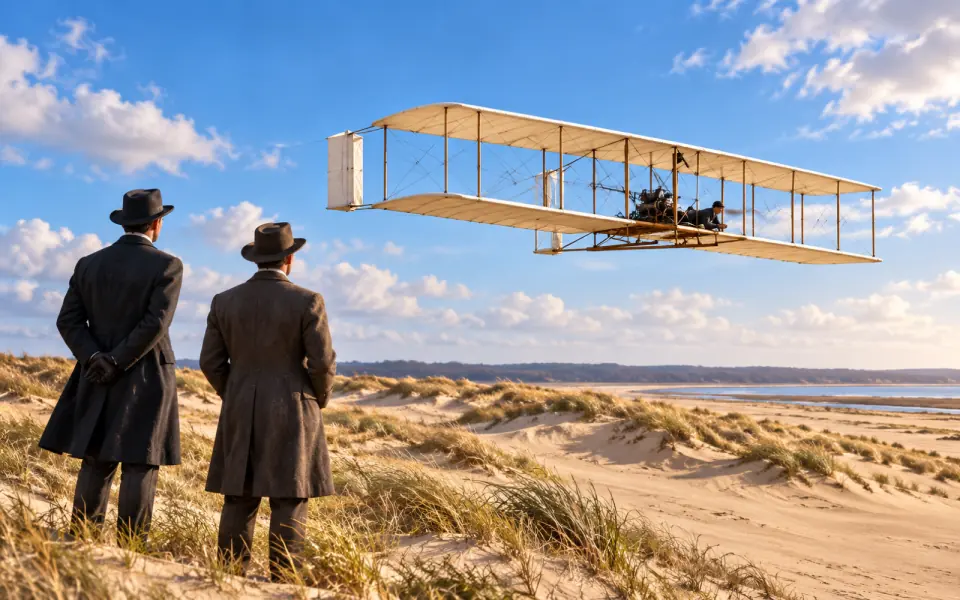
Orville and Wilbur Wright had a bicycle shop in Ohio, in the United States, and studied flight with gliders and a small wind tunnel. They built the Flyer, an aeroplane of wood and cloth with a light engine and two propellers. On 17 December 1903, on the dunes near Kitty Hawk, in North Carolina, Orville flew for 12 seconds. That same day Wilbur made a flight of almost a minute.
Why it matters It was the first controlled flight of a powered aeroplane heavier than air, the beginning of aviation.
Source: Smithsonian National Air and Space Museum, “1903 Wright Flyer”
Study card about 5 minutes of reading
The story
Two brothers and a bicycle shop
Wilbur and Orville Wright were two brothers from Dayton, Ohio, in the United States. They had no university degrees and were not rich: they ran a bicycle shop, building and repairing their customers' two-wheelers. But they were very curious, and they had a passion: flight. As boys they had been given a toy with a paper-and-cane propeller that rose into the air when an elastic band was released, and they had never forgotten it.
When they read that the German Otto Lilienthal, a pioneer of glider flights, had died in an accident in 1896, they decided to study the problem seriously. They wrote to the Smithsonian Institution to get everything that had been published about flight, and they studied it. They soon realised that the hardest problem was not getting off the ground, but controlling the aeroplane once it was in the air.
Learning to steer in the air
Bicycles had taught them something important: to stay balanced, you have to learn to lean and turn in the right way. The Wrights thought an aeroplane should behave in the same way. In 1899 they tried slightly twisting the tips of the wings so that the machine tilted to the right or to the left, and then they added a vertical rudder and a horizontal one: it was a three-axis control system, still at the heart of how every aeroplane flies today.
They looked for a place with steady winds and soft sand dunes to cushion falls, and found it at Kitty Hawk, a fishing village on the coast of North Carolina. Between 1900 and 1902 they went back every year with better and better gliders. They even built a small wind tunnel inside a wooden box, with a fan driven by an engine, to test two hundred wing shapes and find out which worked best. They discovered that many figures in the books of those who came before them were wrong, and they did the calculations themselves.
The Flyer
For 1903 only an engine was missing. No maker sold one that was light and powerful enough, so they had one built by their mechanic, Charlie Taylor: a small aluminium petrol engine with about twelve horsepower. They also studied propellers as if they were wings that spin round, and made them with great care. The Flyer, a biplane of spruce wood and cloth, with two propellers behind the wings and the pilot lying on his stomach, was ready.
On the morning of 17 December 1903, at Kitty Hawk, a cold, strong wind was blowing. With the help of five local people, the brothers carried the Flyer onto its wooden rail. Orville lay down at the controls and at 10:35 the aeroplane lifted off the ground. It flew for twelve seconds and for about 37 metres, a shorter distance than the wing of a big airliner today, but it was the first flight of an aeroplane with a person on board, driven by an engine and able to be steered. A witness managed to take a photograph, which became famous.
That day there were three more flights, with the two brothers taking turns. The last one, by Wilbur, lasted 59 seconds and covered 260 metres. Soon afterwards a gust of wind overturned the Flyer, which was damaged. Orville sent a telegram to their father, a bishop, saying that the flight had been a success and that they would be home for Christmas.
From a field in Dayton to the world
For two years almost nobody believed the Wright brothers, partly because they did not want to show their aeroplane before they had patented their ideas. They kept improving the design in a field near Dayton, and in 1905 their third aeroplane flew for 39 minutes. In 1908 Wilbur went to France and made public flights at Le Mans: the European pilots, amazed, realised how far ahead the Wrights were. Soon afterwards, in America, the army bought one of their aeroplanes.
Why it happened
People had dreamed of flying for centuries: Leonardo da Vinci had drawn flying machines, and in the 19th century balloons and gliders had appeared. But there was still no aeroplane with an engine and a way of steering it.
Success was made possible by the technical knowledge of the time, such as small petrol engines, already used in cars, and by the Wrights' long series of tests. For them, understanding the problem mattered more than having big machines: they studied the wind, did calculations and built instruments to take measurements. Their passion for mechanics, born in the bicycle shop, did the rest.
What changed
The flight of 1903 opened the age of aviation. In a few years aeroplanes improved quickly: in 1909 Louis Blériot crossed the English Channel, and during the First World War aeroplanes were used in battle. In 1927 Charles Lindbergh flew across the Atlantic alone. A little later the first commercial airlines were born.
Today aeroplanes carry billions of people every year, and they have shrunk distances around the world: a journey that took weeks by sea now takes a few hours. But aviation has also added to pollution, and today people are looking for cleaner aircraft, with hydrogen or electric engines.
The techniques invented by the Wrights, such as three-axis control and well-designed propellers, have remained essential. In 2021 a small helicopter, Ingenuity, flew on Mars, the first flight on another world, carrying a fragment of cloth from the original Flyer as a tribute to the two brothers.
Key people and places
People
- Wilbur Wright
- American inventor (1867–1912): together with his brother he built the first powered aeroplane.
- Orville Wright
- American inventor (1871–1948): he piloted the first flight, on 17 December 1903.
- Charlie Taylor
- American mechanic (1868–1956): he built the Flyer's engine.
- Otto Lilienthal
- German engineer (1848–1896): a pioneer of glider flight who inspired the Wrights.
- Louis Blériot
- French aviator and engineer (1872–1936): in 1909 he flew across the English Channel.
Places
- Kitty Hawk, North Carolina (United States)
- The village on the Atlantic coast where the Wrights made their flights.
- Dayton, Ohio (United States)
- The Wright brothers' home town, where they had their bicycle shop.
Good to know
- The Wrights' first flight lasted twelve seconds, less than a quarter of a minute.
- The pilot lay on his stomach on the wing, to reduce air resistance.
- The Flyer's engine had about 12 horsepower: less than a moped today.
- The original Flyer is on display at the Smithsonian National Air and Space Museum in Washington.
- A small piece of cloth from the Flyer flew to Mars with the little helicopter Ingenuity in 2021.
Find out more
- Smithsonian National Air and Space Museum, “Wright Flyer” airandspace.si.edu
- National Park Service, Wright Brothers National Memorial nps.gov
- Wikipedia, “Wright brothers” en.wikipedia.org
- Wikipedia, “Wright Flyer” en.wikipedia.org
Related events
- The first modern motor car1886 · Age of revolutionsA few years earlier the first modern car had appeared, with a petrol engine.
- The first public steam railway1825 · Age of revolutionsThe locomotive had been the first great machine for travelling faster.
- The Moon landing1969 · TodayThe Wrights' flight paved the way, sixty-six years later, for the Moon landing.
- Leonardo designs machinesabout 1485 · Early modern ageLeonardo had imagined flying machines four centuries earlier.
Before and after, in the era “Early 20th century”
Event 1 of 25
- You are hereThe first powered flight1903
 AfterSpecial relativity1905
 AfterMaria Montessori's Children's House1907
 AfterAbstract artabout 1910
 AfterMarie Curie and her two Nobel Prizes1911
 AfterThe First World War1914–1918
 AfterThe Russian Revolution1917
 AfterRadio for everyoneabout 1920
 AfterJazz spreadsabout 1920
 AfterInsulin against diabetes1922
 AfterTotalitarian regimes in Europe1922
 AfterTalking pictures1927
 AfterThe discovery of penicillin1928
 AfterThe Great Depression1929
 AfterPicasso's Guernica1937
 AfterThe Second World War1939–1945
 AfterThe Shoahabout 1941–1945
 AfterAnne Frank writes her diary1942
 AfterFermi and the first atomic pile1942
 AfterThe Italian Resistance1943–1945
 AfterThe Italian Republic and votes for women1946
 AfterThe first general-purpose electronic computer1946
 AfterThe Italian Constitution1948
 AfterPost-war rebuildingabout 1948
 AfterTelevision spreadsabout 1950
Listen / Read next
- Music to read by: Cinematic JourneyEpic film-style music, no lyrics, by Ciro Simone IrmiciSpotifyYouTube Music
Meanwhile, elsewhere in the world
Other events of the era “Early 20th century”
- Special relativity
- Maria Montessori's Children's House
- Abstract art
- Marie Curie and her two Nobel Prizes
- The First World War
- The Russian Revolution
- Radio for everyone
- Jazz spreads
- Insulin against diabetes
- Totalitarian regimes in Europe
- Talking pictures
- The discovery of penicillin
- The Great Depression
- Picasso's Guernica
- The Second World War
- The Shoah
- Anne Frank writes her diary
- Fermi and the first atomic pile
- The Italian Resistance
- The Italian Republic and votes for women
- The first general-purpose electronic computer
- The Italian Constitution
- Post-war rebuilding
- Television spreads
