Marie Curie and her two Nobel Prizes
1911 Paris, France
In short
Maria Skłodowska, born in Warsaw, moved to Paris to study, because in Poland women could not go to university. With her husband Pierre Curie she discovered two new elements: polonium, named in honour of her homeland, and radium. In 1903 she received the Nobel Prize in Physics together with Pierre and Henri Becquerel, and in 1911 the prize in Chemistry. She was the first person to win two Nobel Prizes.
Why it matters Her research on radioactivity opened new paths for physics and medicine.
Source: The Nobel Prize, “Marie Curie – Facts”
Study card about 5 minutes of reading
The story
A Polish student in Paris
Maria Skłodowska was born in Warsaw in 1867, in a Poland that did not then exist as an independent state: the city was part of the Russian Empire, and Polish schools were controlled by the foreign government. Her father taught physics and mathematics; her mother died when Maria was still a child. Maria was the best in her class, but university was closed to women. Hidden away in private flats, students followed secret courses in Polish, in what was called “the Flying University”.
Maria and her sister Bronisława made a pact: Maria would work as a governess to pay for her sister's medical studies in Paris, and then her sister would help her. For some years Maria worked as a governess for a family in the countryside, and in the meantime she carried on studying on her own. In 1891, aged twenty-four, she left for Paris and enrolled at the Sorbonne, using the French name Marie. She lived in a small attic with no heating, often eating only bread and tea. She graduated in physics, first in her class, and then in mathematics, second.
Pierre and the mysterious rays
In Paris she met Pierre Curie, a good-natured physicist with a passion for crystals and magnetism. They married in 1895 and began to work together. In 1896 the French scientist Henri Becquerel discovered that uranium salts gave off invisible rays that could darken a photographic plate even in the dark. Nobody could explain it. Marie chose that puzzle as the subject of her doctoral thesis.
With an instrument Pierre had built to measure very weak electric currents, she measured the rays from many materials. She noticed that their strength depended only on the amount of uranium, and not on how it was combined with other substances: it had to be a property of the atom itself. For this phenomenon she coined a new word: “radioactivity”. Then she made a surprising discovery: a mineral, pitchblende, gave off many more rays than the uranium it contained. It had to be hiding another element, still unknown and much more powerful.
Four years in a shed
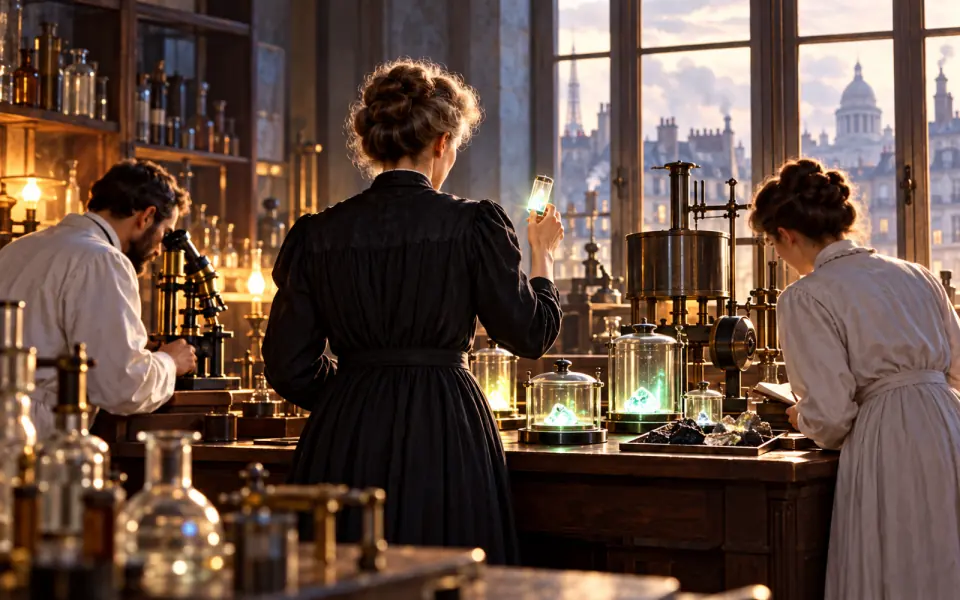
In 1898 Marie and Pierre announced two new elements: polonium, named in honour of occupied Poland, and radium, from the Latin for “ray”. But their colleagues wanted proof: they had to obtain an amount large enough to weigh. To extract a few crumbs of radium, tonnes of pitchblende were needed. The Curies worked in an old shed belonging to the university, cold in winter and boiling in summer, with broken windows. For hours Marie stirred the mineral in big cauldrons with a long iron rod. After four years, in 1902, she managed to isolate a decigram of pure radium chloride.
That powder glowed with a faint blue light when it was dark. The Curies went to look at it in the evening, in their shed, as if it were a treasure. Nobody then knew that radiation could be harmful.
The Nobel Prizes
In 1903 the Nobel Prize in Physics was awarded to Becquerel and to the Curies. At first the committee was thinking of honouring only the men, but Pierre pointed out that the credit belonged to Marie as well, and her name was added. In 1906, though, Pierre died in an accident in Paris, run over by a horse-drawn cart. Marie was devastated, but she carried on with the work and took his place as a professor at the Sorbonne: she was the first woman to teach at that university.
In 1911 she was awarded a second Nobel Prize, this time in Chemistry, for discovering polonium and radium and for isolating radium. She was the first person to win the Nobel Prize twice, and she remains the only one to have won it in two different sciences, physics and chemistry.
The “little Curies”
During the First World War Marie realised that X-rays could save the lives of the wounded, because they showed where bullets and broken bones were. She had about twenty cars fitted with X-ray equipment and took them to the front, driving one herself. They were called “little Curies”. With her daughter Irène, then seventeen, and other women she had trained, she helped to examine more than a million wounded soldiers.
Why it happened
Marie Curie was driven by great curiosity and by unusual determination. At a time when it was almost impossible for women to study and do research, she overcame the obstacles through hard work and self-belief.
Physics was on the eve of a turning point: within a few years X-rays (1895), radioactivity (1896) and the electron (1897) were discovered. Every new discovery cast doubt on the idea that the atom was the last, indivisible piece of matter.
What changed
The discovery of radioactivity changed science: atoms were not unchangeable, they could transform. From this came nuclear physics, with its applications, good and bad, from atomic energy to weapons. Nuclear medicine was born too: radiotherapy uses radiation to destroy the cells of tumours, and X-rays let us see inside the body every day.
The dangers were not yet known: Marie carried test tubes of radium in her pocket and kept samples on her bedside table. She died on 4 July 1934 of a blood disease, almost certainly caused by radiation. Her laboratory notebooks are still radioactive, and are kept in lead boxes.
Her daughter Irène, with her husband Frédéric Joliot, received the Nobel Prize in Chemistry in 1935. In 1995 France honoured Marie and Pierre by moving their remains to the Panthéon, and Marie was the first woman buried there for her own achievements. Her name lives on in curium, a chemical element, and in a unit for measuring radioactivity.
Key people and places
People
- Marie Curie
- Polish-born French physicist and chemist (1867–1934): she discovered polonium and radium; two Nobel Prizes.
- Pierre Curie
- French physicist (1859–1906): Marie's husband and partner in research; Nobel Prize in Physics in 1903.
- Henri Becquerel
- French physicist (1852–1908): he discovered the radioactivity of uranium; Nobel Prize in 1903.
- Irène Joliot-Curie
- French chemist (1897–1956): Marie's daughter; Nobel Prize in Chemistry in 1935.
- Bronisława Skłodowska
- Polish doctor (1865–1939): Marie's sister, who helped her move to Paris.
Places
- Warsaw, Poland
- Marie Curie's home town.
- The Sorbonne, Paris
- The university where she studied, did her research and taught.
Good to know
- Marie Curie is the only person to have won the Nobel Prize in two different sciences: physics (1903) and chemistry (1911).
- The word “radioactivity” was coined by her.
- Polonium is named after Poland, Marie's native country.
- Her laboratory notebooks are still radioactive and are kept in lead boxes.
- During the First World War she herself drove a car with X-ray equipment to help the wounded.
Find out more
- The Nobel Prize, “Marie Curie – Facts” nobelprize.org
- Wikipedia, “Marie Curie” en.wikipedia.org
- Wikipedia, “Radioactivity” en.wikipedia.org
Related events
- Special relativity1905 · Early 20th centuryAt the same time, Einstein was changing physics with relativity.
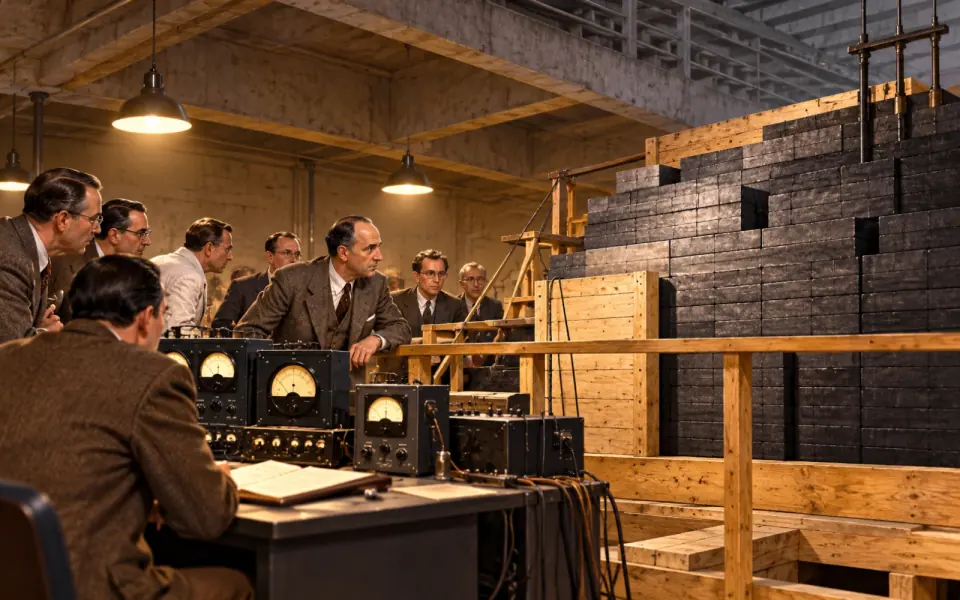
- Fermi and the first atomic pile1942 · Early 20th centuryFrom the discovery of radioactivity came Fermi's nuclear energy.
- The First World War1914–1918 · Early 20th centuryWith her X-ray equipment, Marie helped the wounded of the Great War.
- A practical electric light bulb1879 · Age of revolutionsThe electric light bulb had already brought the science of electricity into homes.
Before and after, in the era “Early 20th century”
Event 5 of 25
 BeforeThe first powered flight1903
 BeforeSpecial relativity1905
 BeforeMaria Montessori's Children's House1907
 BeforeAbstract artabout 1910
- You are hereMarie Curie and her two Nobel Prizes1911
 AfterThe First World War1914–1918
 AfterThe Russian Revolution1917
 AfterRadio for everyoneabout 1920
 AfterJazz spreadsabout 1920
 AfterInsulin against diabetes1922
 AfterTotalitarian regimes in Europe1922
 AfterTalking pictures1927
 AfterThe discovery of penicillin1928
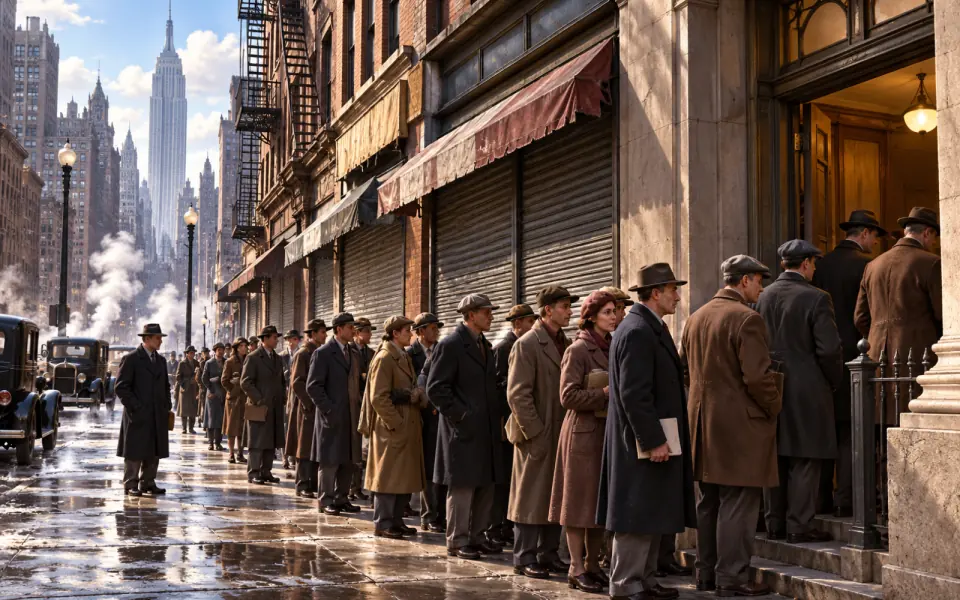 AfterThe Great Depression1929
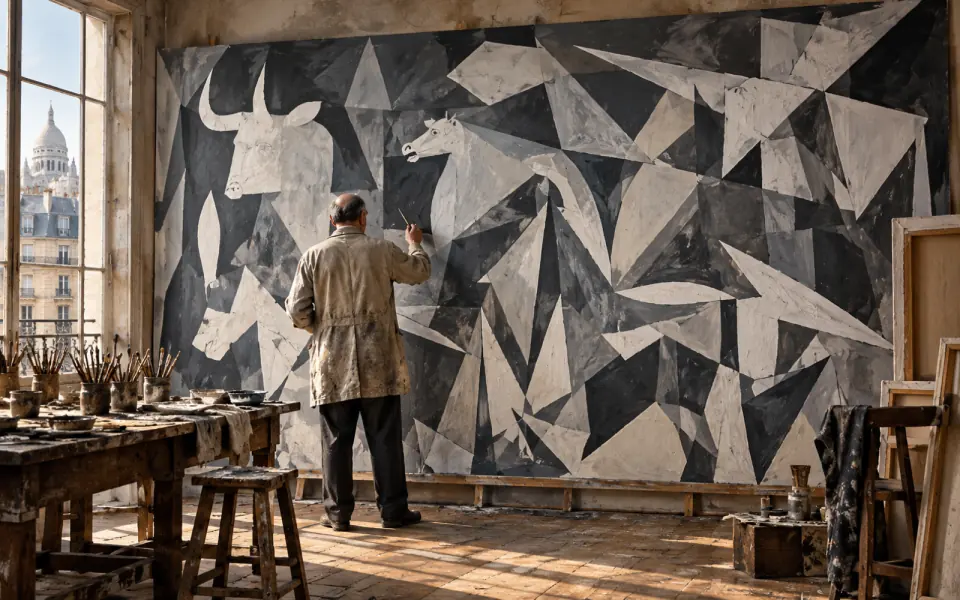 AfterPicasso's Guernica1937
 AfterThe Second World War1939–1945
 AfterThe Shoahabout 1941–1945
 AfterAnne Frank writes her diary1942
 AfterFermi and the first atomic pile1942
 AfterThe Italian Resistance1943–1945
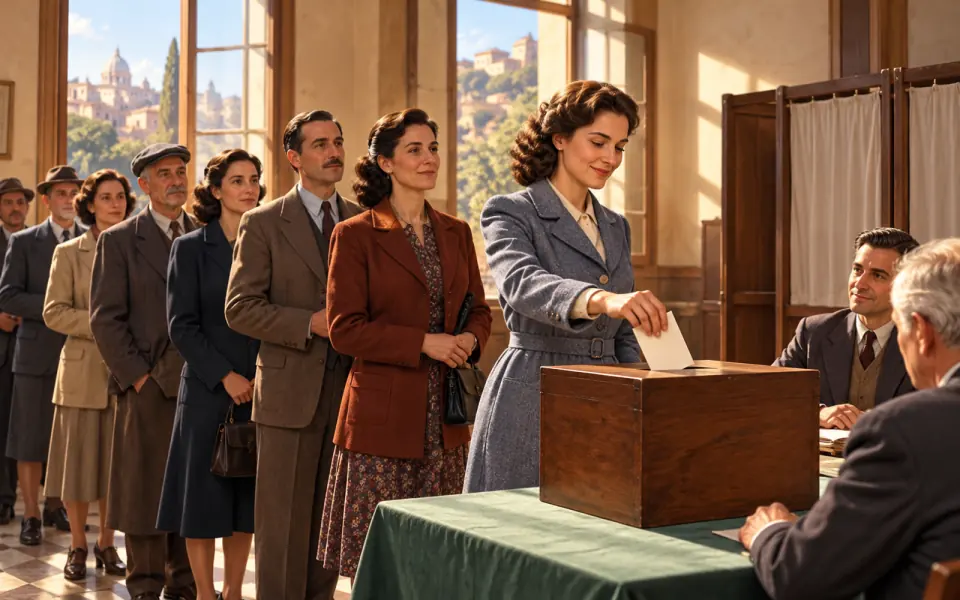 AfterThe Italian Republic and votes for women1946
 AfterThe first general-purpose electronic computer1946
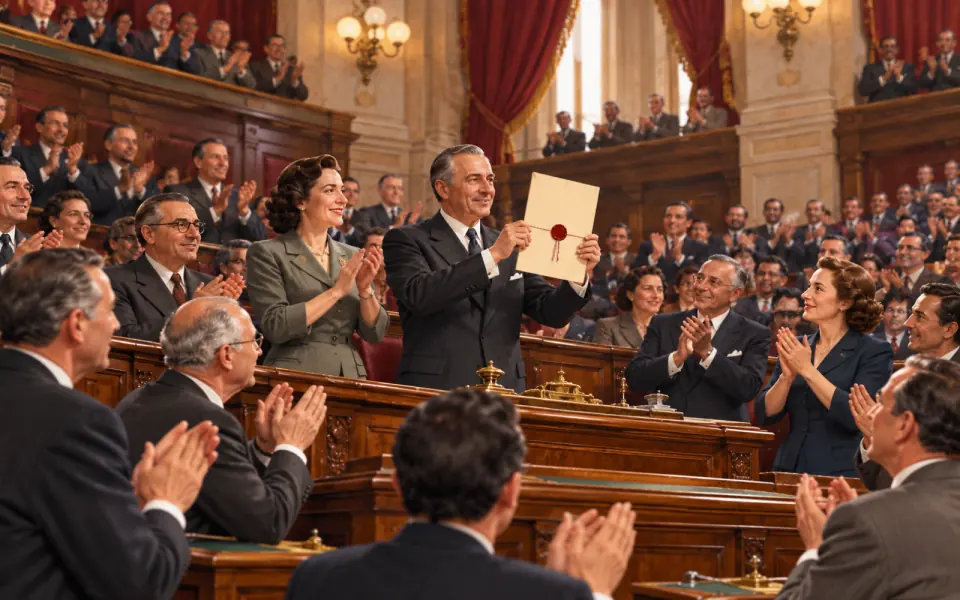 AfterThe Italian Constitution1948
 AfterPost-war rebuildingabout 1948
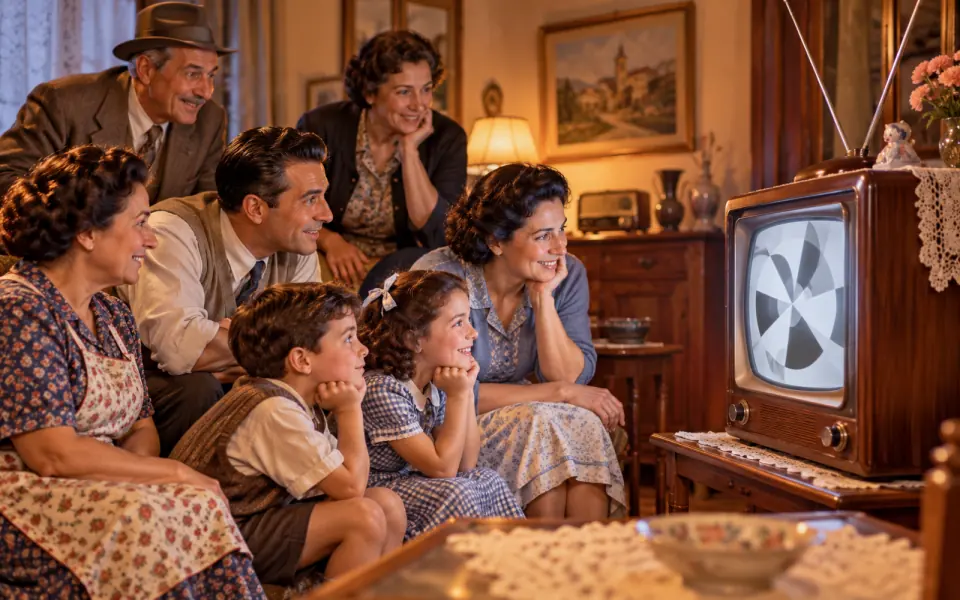 AfterTelevision spreadsabout 1950
Listen / Read next
- Music to read by: Cinematic JourneyEpic film-style music, no lyrics, by Ciro Simone IrmiciSpotifyYouTube Music
Meanwhile, elsewhere in the world
Other events of the era “Early 20th century”
- The first powered flight
- Special relativity
- Maria Montessori's Children's House
- Abstract art
- The First World War
- The Russian Revolution
- Radio for everyone
- Jazz spreads
- Insulin against diabetes
- Totalitarian regimes in Europe
- Talking pictures
- The discovery of penicillin
- The Great Depression
- Picasso's Guernica
- The Second World War
- The Shoah
- Anne Frank writes her diary
- Fermi and the first atomic pile
- The Italian Resistance
- The Italian Republic and votes for women
- The first general-purpose electronic computer
- The Italian Constitution
- Post-war rebuilding
- Television spreads
