Fermi and the first atomic pile
1942 University of Chicago, United States
In short
Enrico Fermi, a physicist from Rome who won the Nobel Prize in 1938, left Italy that year partly because the racial laws targeted his wife Laura, who was Jewish. In the United States, under the stands of a sports stadium at the University of Chicago, he and his team built a huge pile of graphite and uranium blocks. On 2 December 1942 he achieved the first controlled nuclear chain reaction: the energy held in the nuclei of atoms was released a little at a time, without exploding.
Why it matters It opened the way both to nuclear power stations and, sadly, to atomic weapons.
Source: Treccani, entry “Fermi, Enrico”
Study card about 5 minutes of reading
The story
The boy from Rome
Enrico Fermi was born in Rome in 1901 and from boyhood showed an extraordinary talent for mathematics and physics. At seventeen he won a competition to enter the Scuola Normale in Pisa, and he graduated a little after turning twenty. At only twenty-five he became professor of physics at the University of Rome, where, in the old institute in Via Panisperna, he brought together a group of brilliant young scholars, whom their friends called “the Via Panisperna boys”: Edoardo Amaldi, Emilio Segrè, Franco Rasetti, Ettore Majorana and others. Fermi, nicknamed “the Pope” because he seemed never to make a mistake, was a teacher who explained every problem in simple words.
In 1934 Fermi and his group discovered something important: by bombarding atoms with neutrons, particles with no electric charge, new radioactive elements could be produced. They also noticed that the effect became much stronger if the neutrons first passed through paraffin or water, which slowed them down. For this work Fermi received the Nobel Prize in Physics in 1938.
Escape from Italy
In 1938 the Fascist regime passed the racial laws. Fermi's wife, Laura, was Jewish, so the family was at risk. When Fermi went to Stockholm to collect the Nobel Prize, he never went back to Italy: from Sweden he sailed with his wife and two children to the United States, where he got a post at Columbia University in New York. Many European scientists, fleeing persecution, ended up in America, and their work was extremely important.
The discovery of fission
At the end of 1938 two German chemists, Otto Hahn and Fritz Strassmann, found that when uranium was bombarded with neutrons, the atom split into two smaller pieces, releasing a great deal of energy. The phenomenon was explained by the Austrian physicist Lise Meitner and her nephew Otto Frisch, and was called nuclear fission. Scientists realised at once that fission could produce a chain reaction: the neutrons released by one atom could split others, and so on, releasing an enormous amount of energy.
It was the beginning of the Second World War. Scientists feared that Nazi Germany might build an atomic bomb. In August 1939 the Hungarian physicist Leo Szilárd and Albert Einstein wrote to the American president Roosevelt to warn him. So the United States decided to start a huge secret programme, which would become the Manhattan Project.
Under the Chicago stadium
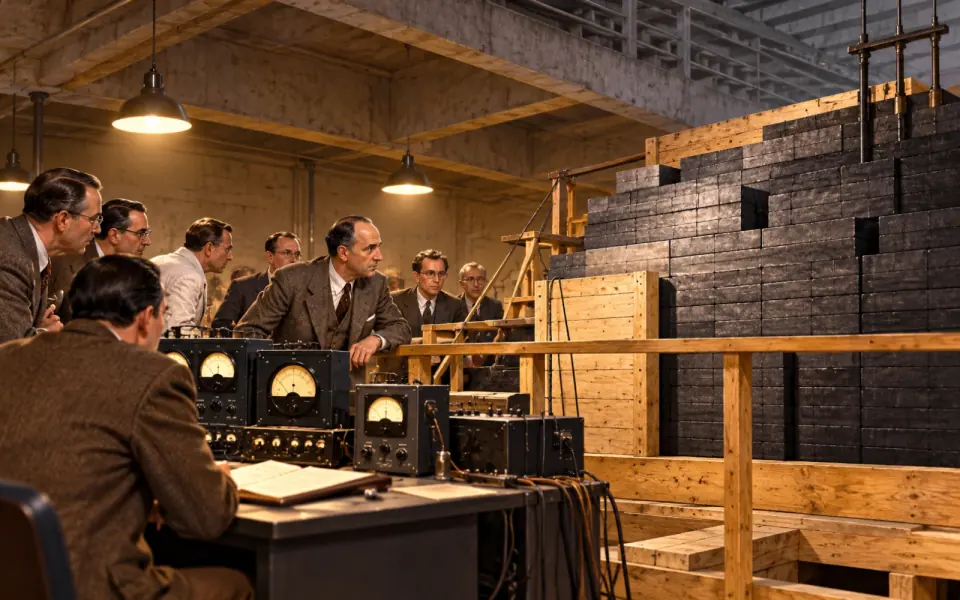
To build a bomb, it first had to be shown that a chain reaction could be controlled. Fermi, who had moved to the University of Chicago, led a team that built an “atomic pile”, that is, a reactor, in a very strange place: an old squash court under the stands of the university stadium. The pile was a huge mass of graphite blocks, a form of carbon that slows neutrons, with pieces of uranium inside. To control it there were cadmium rods, a metal that absorbs neutrons: pulled out, the reaction started; pushed back in, it stopped. Fermi and his colleagues built the pile layer by layer, for weeks, and measured everything with great care.
On 2 December 1942 the team gathered in silence for the experiment. Fermi had the rods drawn out, a little at a time, checking with his slide rule how the number of neutrons grew. At twenty-five past three in the afternoon the chain reaction kept itself going: the pile worked! Fermi let it run for a few minutes (about half an hour in all from the start), then shut it down. It was the first time that human beings had controlled the energy of the atom. To celebrate, the physicists drank red wine from paper cups, and one of them phoned a project official: “The Italian navigator has landed in the new world.” “How did he find the natives?” asked the other. “Very friendly.”
After the experiment
Fermi's work helped to build the first atomic bomb at Los Alamos, in the New Mexico desert, which was tested on 16 July 1945 and used on 6 and 9 August 1945 against two Japanese cities. Fermi, who took part in the project, was after the war one of the first to remind people of the dangers of nuclear weapons. He died in Chicago in 1954, aged fifty-three.
Why it happened
Fermi's pile came from the discovery of fission and from the fear that Nazi Germany would get the bomb first. Scientists, many of them refugees from Europe, pushed governments to invest. The Manhattan Project came to employ more than a hundred thousand people across the country.
It was also possible because physicists like Fermi combined theoretical and experimental work: he could do the calculations with pencil and paper and build the apparatus with his own hands. In Chicago what was needed was exactly a person who could explain things to everyone, a calm and precise coordinator.
What changed
The 1942 experiment opened the nuclear age, with very different effects. On the one hand it led to atomic weapons, which changed world politics: since Hiroshima and Nagasaki, the world has lived with the fear of nuclear war, and that is why there is an international treaty (1968) that tries to stop them from spreading.
On the other hand it made it possible to use nuclear energy peacefully: from the 1950s power stations were built that produce electricity without releasing carbon dioxide. Today about ten per cent of the world's electricity comes from nuclear power stations. But difficult questions have arisen too: safety, after accidents such as Chernobyl (1986) and Fukushima (2011), and radioactive waste, which stays dangerous for thousands of years. In Italy, in two referendums, in 1987 and 2011, citizens chose not to use this energy.
The same principles are also used in medicine, in treatments for cancer, and in research. In honour of Fermi, a chemical element is called “fermium”, and a space telescope for gamma rays is called “Fermi”.
Key people and places
People
- Enrico Fermi
- Italian physicist (1901–1954): he led the first atomic pile; Nobel Prize in Physics in 1938.
- Laura Fermi
- Enrico's wife (1907–1977): a writer, she described the life of her husband and the family.
- Leo Szilárd
- Hungarian physicist (1898–1964): he had the idea of the chain reaction and promoted the letter to Roosevelt.
- Edoardo Amaldi
- Italian physicist (1908–1989): Fermi's collaborator, he was one of the founders of CERN and INFN.
- Ettore Majorana
- Italian physicist (1906–disappeared 1938): the most brilliant of the Via Panisperna boys, he vanished mysteriously.
Places
- Via Panisperna, Rome
- Where Fermi worked with his group of young physicists.
- Stagg Field, University of Chicago
- The place where the first atomic pile worked on 2 December 1942.
Good to know
- His colleagues called Fermi “the Pope” because he seemed never to make a mistake.
- The first atomic pile was made of graphite blocks with pieces of uranium inside.
- On 2 December 1942 the first atomic pile ran for a few minutes, about half an hour in all from the start.
- To celebrate, the physicists drank wine from paper cups.
- Chemical element number 100 is called “fermium” in honour of Fermi.
Find out more
- The Nobel Prize, “Enrico Fermi – Facts” nobelprize.org
- Wikipedia, “Enrico Fermi” en.wikipedia.org
- Wikipedia, “Chicago Pile-1” en.wikipedia.org
- Wikipedia, “Via Panisperna boys” en.wikipedia.org
Related events
- Special relativity1905 · Early 20th centuryEinstein's formula E = mc² explains where nuclear energy comes from.
- Marie Curie and her two Nobel Prizes1911 · Early 20th centuryMarie Curie had discovered radioactivity.
- The Second World War1939–1945 · Early 20th centuryFermi's experiment took place during the Second World War.
- Birth of the European Community1957 · TodayEuratom, in 1957, was created to use nuclear energy peacefully.
Before and after, in the era “Early 20th century”
Event 19 of 25
 BeforeThe first powered flight1903
 BeforeSpecial relativity1905
 BeforeMaria Montessori's Children's House1907
 BeforeAbstract artabout 1910
 BeforeMarie Curie and her two Nobel Prizes1911
 BeforeThe First World War1914–1918
 BeforeThe Russian Revolution1917
 BeforeRadio for everyoneabout 1920
 BeforeJazz spreadsabout 1920
 BeforeInsulin against diabetes1922
 BeforeTotalitarian regimes in Europe1922
 BeforeTalking pictures1927
 BeforeThe discovery of penicillin1928
 BeforeThe Great Depression1929
 BeforePicasso's Guernica1937
 BeforeThe Second World War1939–1945
 BeforeThe Shoahabout 1941–1945
 BeforeAnne Frank writes her diary1942
- You are hereFermi and the first atomic pile1942
 AfterThe Italian Resistance1943–1945
 AfterThe Italian Republic and votes for women1946
 AfterThe first general-purpose electronic computer1946
 AfterThe Italian Constitution1948
 AfterPost-war rebuildingabout 1948
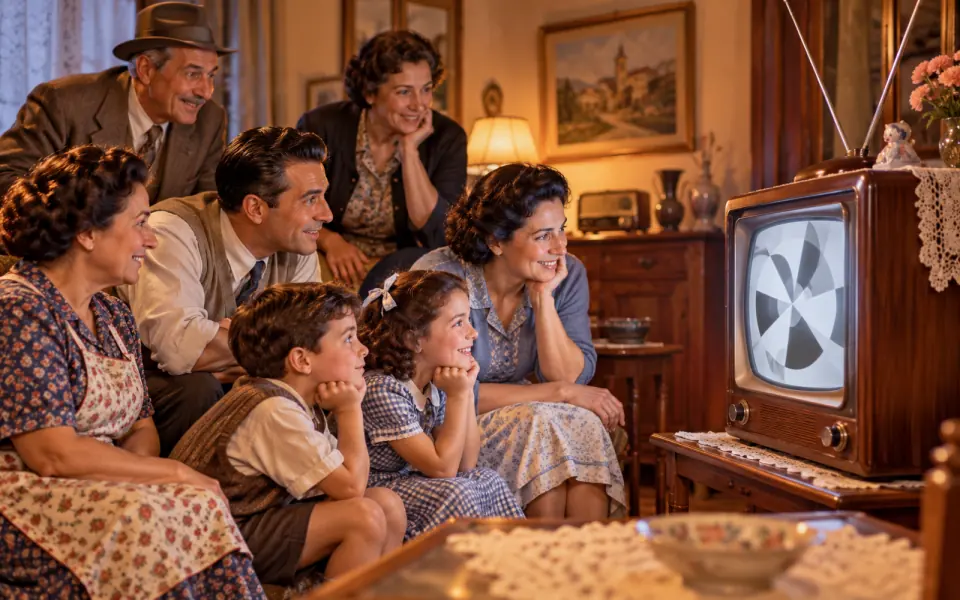 AfterTelevision spreadsabout 1950
Listen / Read next
- Music to read by: Cinematic JourneyEpic film-style music, no lyrics, by Ciro Simone IrmiciSpotifyYouTube Music
Meanwhile, elsewhere in the world
Other events of the era “Early 20th century”
- The first powered flight
- Special relativity
- Maria Montessori's Children's House
- Abstract art
- Marie Curie and her two Nobel Prizes
- The First World War
- The Russian Revolution
- Radio for everyone
- Jazz spreads
- Insulin against diabetes
- Totalitarian regimes in Europe
- Talking pictures
- The discovery of penicillin
- The Great Depression
- Picasso's Guernica
- The Second World War
- The Shoah
- Anne Frank writes her diary
- The Italian Resistance
- The Italian Republic and votes for women
- The first general-purpose electronic computer
- The Italian Constitution
- Post-war rebuilding
- Television spreads
