The Italian Republic and votes for women
1946 Rome, Italy
In short
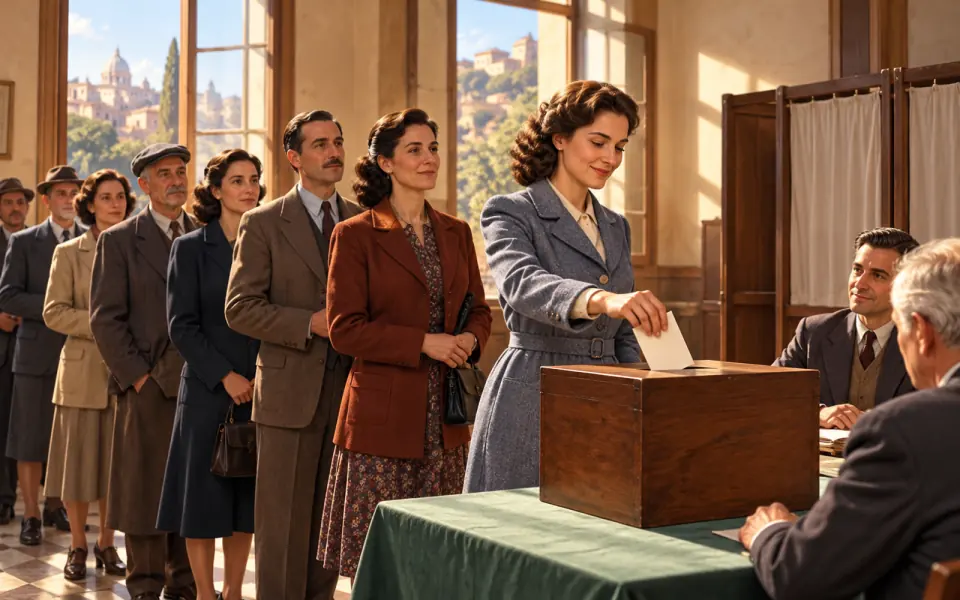
On 2 and 3 June 1946 Italians voted in a referendum to choose between monarchy and republic. For the first time in a national vote, women went to the polls too, and turnout was very high. The republic won with about 12.7 million votes against 10.7 million, and King Umberto II left Italy. In the same vote the Constituent Assembly was elected, with 21 women among its 556 members.
Why it matters On 2 June Italy celebrates Republic Day, the birthday of democratic Italy.
Study card about 5 minutes of reading
The story
After the war, a choice
In the spring of 1945 the war ended, and Italy faced a big question: what kind of state did it want? For almost a century, since 1861, Italy had been a monarchy, ruled by the House of Savoy. But many Italians could not forgive King Victor Emmanuel III for backing Fascism for twenty years, for signing the racial laws and for fleeing on 8 September 1943, leaving the country in chaos. On 9 May 1946 the king abdicated in favour of his son, Umberto II, hoping to save the monarchy. But the decision belonged to the people.
The government, led by Alcide De Gasperi, decided to hold a referendum on 2 June 1946: Italians would choose between monarchy and republic. On the same day they would also elect a Constituent Assembly, given the job of writing the new Constitution.
Votes for women
Until then, in Italy, only men voted, and not even all of them: in 1912 the vote had been extended to almost all men over the age of majority. Women were excluded. For decades, in many countries, women had been demanding the right to vote: New Zealand had been the first, in 1893; Britain had granted it in 1918 (with limits) and the United States in 1920; France in 1944. In Italy women had been talking about it since the 19th century, but governments, even Fascist ones, had always refused.
During the Resistance, hundreds of thousands of women had taken part in the struggle and shown their courage: it would have been unthinkable to go on excluding them. On 1 February 1945, with a decree based on a proposal by De Gasperi and Palmiro Togliatti, women's right to vote was recognised. A second decree, of 10 March 1946, laid down that they could also be elected. On 10 March 1946, in the local elections of some cities, Italian women went to vote for the first time in history.
2 and 3 June 1946
On 2 June 1946, and the day after, almost all Italians, men and women, went to the polls: nearly 90 per cent of those entitled to vote did so. Voters queued outside the polling stations in schools, ballot paper in hand, often in their Sunday best. For many women it was the first time they had entered a voting booth: they would remember it as a moment of joy and pride.
On the referendum ballot papers there were two symbols: the turreted head of Italy, for the Republic, and the Savoy coat of arms, for the monarchy. In the end, the Republic got about twelve million seven hundred thousand votes, and the monarchy about ten million seven hundred thousand: 54 per cent against 46. The result was much disputed, especially in the south, where the monarchy won, and only on 18 June did the Court of Cassation proclaim the outcome definitively. On 13 June Umberto II had already left Italy for Portugal, to avoid a conflict, urging everyone to accept the verdict.
The “founding mothers”
In the same elections Italians chose the 556 members of the Constituent Assembly: among them, for the first time, were twenty-one women, who went down in history as the “founding mothers” (madri costituenti). They belonged to different parties: Communists, Christian Democrats, Socialists, one from the Common Man Front. Among them were Nilde Iotti, Teresa Noce, Lina Merlin and Maria Federici. The youngest was Teresa Mattei, aged twenty-five, who proposed giving mimosa flowers to women on 8 March. Five of them joined the small committee that prepared the text of the Constitution.
On 25 June the Assembly met for the first time in Rome. On 28 June it chose Enrico De Nicola, a lawyer from Naples, as provisional head of state. Italy was officially a Republic.
Why it happened
The end of the monarchy was the result of Italians' judgement on the Fascist regime and on the war: the House of Savoy had tied its name to the dictatorship and to defeat. After the fall of Fascism, the anti-Fascist parties had agreed that the people should decide.
Votes for women were the fruit of a long battle by women and men, and of women's part in the Resistance. In every country, equal political rights have been won gradually, with great effort.
What changed
The birth of the Republic marked the end of more than eighty years of monarchy and the beginning of democratic life. The Savoys, barred from the national territory by the Constitution, were able to return to Italy only in 2002. 2 June has been celebrated since 1947 and has been a national holiday, Republic Day, by law since 1949, with the military parade in Rome and the ceremony at the Altare della Patria.
With votes for women, half of the population finally had a voice. Women in politics, very few at the start, have increased over time, but equality is still a goal to be reached: in 2022 for the first time a woman, Giorgia Meloni, became prime minister.
The Constituent Assembly worked for a year and a half and wrote the Constitution, which came into force on 1 January 1948 and is still the fundamental law of the country today.
Key people and places
People
- Alcide De Gasperi
- Italian politician (1881–1954): he led the government that organised the referendum.
- Umberto II
- The last king of Italy (1904–1983): he reigned from 9 May to 13 June 1946.
- Enrico De Nicola
- Lawyer from Naples (1877–1959): provisional head of state and then first President of the Republic.
- Nilde Iotti
- Italian politician (1920–1999): one of the 21 women of the Constituent Assembly, later the first woman President of the Chamber of Deputies.
- Teresa Mattei
- Italian partisan and politician (1921–2013): the youngest member of the Constituent Assembly, she came up with the mimosa for 8 March.
Places
- Quirinal Palace, Rome
- It was the residence of the kings of Italy and since 1947 has been the seat of the President of the Republic.
- Palazzo Montecitorio, Rome
- The building where the Constituent Assembly met on 25 June 1946.
Good to know
- In the referendum of 2 June 1946 the Republic got about 54% of the votes.
- On 10 March 1946 Italian women voted for the first time, in the local elections.
- 21 women were elected to the Constituent Assembly, the “founding mothers”.
- Teresa Mattei, aged 25, proposed giving mimosa on 8 March.
- King Umberto II reigned for a little over a month, from 9 May to 13 June 1946.
Find out more
- Wikipedia, “1946 Italian institutional referendum” en.wikipedia.org
- Wikipedia, “Women’s suffrage in Italy” en.wikipedia.org
- Wikipedia, “Italian Constituent Assembly” en.wikipedia.org
Related events
- The Italian Resistance1943–1945 · Early 20th centuryThe Resistance had prepared the birth of the Republic.
- The Italian Constitution1948 · Early 20th centuryThe Constitution, written by the Constituent Assembly, came into force in 1948.
- Martin Luther King and civil rights1963 · TodayIn the same years other peoples were fighting for civil rights.
- The unification of Italy1861 · Age of revolutionsThe unification of Italy, in 1861, had created the monarchy of the Savoys.
Before and after, in the era “Early 20th century”
Event 21 of 25
 BeforeThe first powered flight1903
 BeforeSpecial relativity1905
 BeforeMaria Montessori's Children's House1907
 BeforeAbstract artabout 1910
 BeforeMarie Curie and her two Nobel Prizes1911
 BeforeThe First World War1914–1918
 BeforeThe Russian Revolution1917
 BeforeRadio for everyoneabout 1920
 BeforeJazz spreadsabout 1920
 BeforeInsulin against diabetes1922
 BeforeTotalitarian regimes in Europe1922
 BeforeTalking pictures1927
 BeforeThe discovery of penicillin1928
 BeforeThe Great Depression1929
 BeforePicasso's Guernica1937
 BeforeThe Second World War1939–1945
 BeforeThe Shoahabout 1941–1945
 BeforeAnne Frank writes her diary1942
 BeforeFermi and the first atomic pile1942
 BeforeThe Italian Resistance1943–1945
- You are hereThe Italian Republic and votes for women1946
 AfterThe first general-purpose electronic computer1946
 AfterThe Italian Constitution1948
 AfterPost-war rebuildingabout 1948
 AfterTelevision spreadsabout 1950
Listen / Read next
- Music to read by: Cinematic JourneyEpic film-style music, no lyrics, by Ciro Simone IrmiciSpotifyYouTube Music
Meanwhile, elsewhere in the world
Other events of the era “Early 20th century”
- The first powered flight
- Special relativity
- Maria Montessori's Children's House
- Abstract art
- Marie Curie and her two Nobel Prizes
- The First World War
- The Russian Revolution
- Radio for everyone
- Jazz spreads
- Insulin against diabetes
- Totalitarian regimes in Europe
- Talking pictures
- The discovery of penicillin
- The Great Depression
- Picasso's Guernica
- The Second World War
- The Shoah
- Anne Frank writes her diary
- Fermi and the first atomic pile
- The Italian Resistance
- The first general-purpose electronic computer
- The Italian Constitution
- Post-war rebuilding
- Television spreads
