Jazz spreads
about 1920 New Orleans, United States
In short
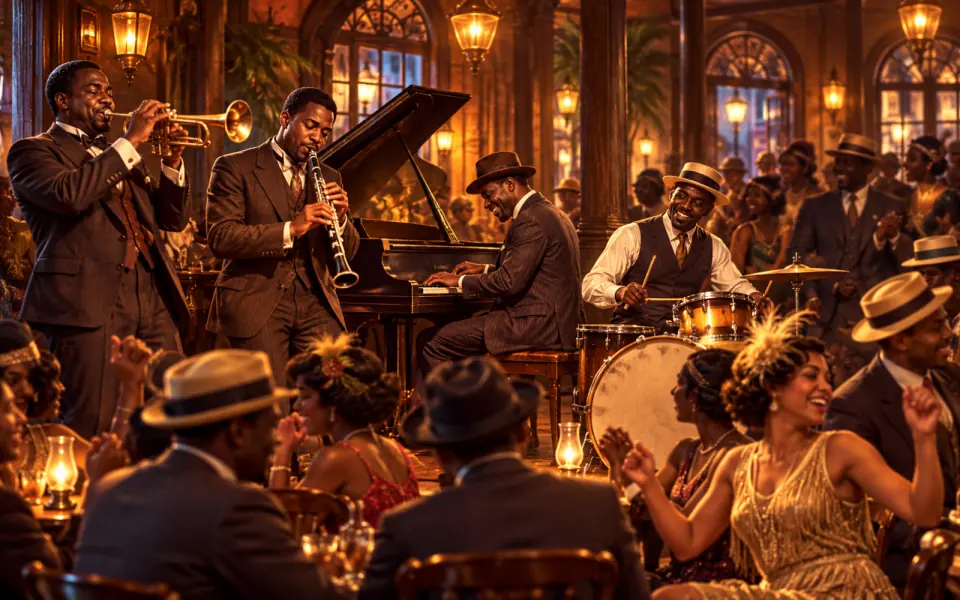
Jazz was born in New Orleans, in the United States, when African American music, such as the blues and spirituals, met brass bands and dances of European origin. One of its features is improvisation: the musicians make up tunes as they play. In the 1920s it spread around the world thanks to records and radio, so much so that the decade was called the ‘Jazz Age’. The trumpeter Louis Armstrong became one of its stars.
Why it matters Jazz has influenced almost all the popular music that came after it, from rock to pop.
Source: Encyclopaedia Britannica, “jazz”
Study card about 5 minutes of reading
The story
From Congo Square to New Orleans
Jazz was born in the United States, in New Orleans, a port city in Louisiana where people of many different origins met: descendants of Africans brought to America as slaves, French-speaking Creoles, Europeans, people from the Caribbean. Here, from the 19th century, in Congo Square, a square where enslaved people could gather on Sundays, drums were played and African songs were sung. Meanwhile spirituals were sung in churches and work songs on the plantations, and after the end of slavery the blues was born, a music that came from the suffering and hope of African Americans, with its “sad” notes and its sense of freedom.
At the end of the 19th century ragtime was added, a piano music with a bouncing rhythm, along with street bands, who played at parades, parties and funerals. In the early 1900s the musicians of New Orleans, with trumpets, clarinets, trombones, banjos, double basses and drums, began to mix all this together. A cornet player, Buddy Bolden, was considered the first “king of jazz”, although no recordings of him survive.
What jazz is
The most important feature of jazz is improvisation: the musicians do not just play written notes, but invent music on the spot, starting from a theme, answering one another as if in a conversation. It has a very special rhythm, called “swing”, which makes you want to move, with unexpected accents, and it uses “blue notes”, slightly flattened notes full of expression. Every musician has their own sound, and a jazz solo is never the same twice.
The record and the Jazz Age
On 26 February 1917 a group of white musicians from New Orleans, the Original Dixieland Jass Band, made what is considered the first jazz record in history. The record was a huge success, and the new music spread across the country with records and radio. In the following years, many African American musicians, to escape poverty and segregation in the South, moved to cities in the North, such as Chicago and New York. With the great wave of movement called the “Great Migration”, jazz arrived there too.
The 1920s were called “the Jazz Age”. In America Prohibition was in force, and drinking alcohol was forbidden; in many secret clubs people danced and listened to live music, and orchestras played new rhythms, such as the Charleston. Writers, such as F. Scott Fitzgerald, described this season of parties, fashion and freedom. For many parents, though, that music was scandalous: they thought it vulgar and dangerous.
The greats
Among the leading figures was Louis Armstrong, born in New Orleans, probably in 1901, to a poor family. He learned to play the cornet in a reformatory, and was then noticed by the cornet king of the day, Joe “King” Oliver, who took him to Chicago. With his bright sound, his incredible trumpet playing and his gravelly voice, he changed jazz, turning it from group music into music of great soloists. He also did “scat”, singing nonsense syllables like an instrument. In New York, in the Harlem district, Duke Ellington, an elegant pianist and composer, created a rich and refined music with his orchestra at the Cotton Club. The singer Bessie Smith, known as “the Empress of the Blues”, was one of the best-loved voices of the age, and later Ella Fitzgerald took vocal jazz to very high peaks.
Jazz crossed the ocean: in 1918 the band of an African American regiment, the “Harlem Hellfighters”, played it for the French during the war, and in Paris in the 1920s it became fashionable; the dancer and singer Josephine Baker was a great success. In Italy it arrived with orchestras and records, although the Fascist regime later saw it as foreign music to be viewed with suspicion.
Why it happened
Jazz was born from a meeting of cultures, in the segregated society of the South. African Americans had a rich musical tradition, based on rhythm and improvisation, brought from Africa and transformed during slavery. In New Orleans, because of its history as a port and a mixed city, these traditions met European instruments and music.
Technological and social changes mattered too: the spread of records and radio, the big cities of the North, the dance halls. The very need to invent, to make do with what you have, led the musicians to create a free and creative music.
What changed
Jazz was the first great American popular music, and it influenced all the music of the 20th century. In the 1930s came the swing of the big bands, such as Benny Goodman's. In the 1940s the bebop of Charlie Parker and Dizzy Gillespie led to a faster and more complex jazz. In the 1950s Miles Davis recorded “Kind of Blue” (1959), one of the best-selling records in the history of jazz. Since then jazz has taken a thousand forms, from more electronic jazz to jazz inspired by music from all over the world.
Jazz also had a social importance: it was a voice of pride and freedom for African Americans, and in clubs musicians, white and Black, played together before the laws allowed it everywhere. It has influenced rock, rhythm and blues, soul, funk and hip hop.
In 2011 UNESCO established International Jazz Day, celebrated every 30 April since 2012, recognising it as a music that unites peoples and cultures. All over the world there are festivals, schools and clubs, and many Italian musicians too, such as Enrico Rava, Paolo Fresu and Stefano Bollani, are admired everywhere.
Key people and places
People
- Louis Armstrong
- American trumpeter and singer (1901–1971): one of the greatest jazz musicians.
- Duke Ellington
- American pianist, composer and bandleader (1899–1974): he led a famous orchestra in Harlem.
- Bessie Smith
- American singer (1894–1937): known as “the Empress of the Blues”.
- Jelly Roll Morton
- American pianist and composer (1890–1941): one of the first great jazz musicians of New Orleans.
- Ella Fitzgerald
- American singer (1917–1996): one of the greatest voices in jazz, famous for her skill at scat.
Places
- Congo Square, New Orleans
- The square where, in the 19th century, enslaved people gathered to play and sing.
- Harlem, New York
- The African American district where famous clubs such as the Cotton Club were born.
Good to know
- What is considered the first jazz record in history was made on 26 February 1917.
- Improvisation is the main feature of jazz: every solo is different.
- Louis Armstrong learned to play the cornet in a reformatory in New Orleans.
- The 1920s are called “the Jazz Age”.
- 30 April is International Jazz Day, established by UNESCO in 2011 and celebrated since 2012.
Find out more
- Wikipedia, “Jazz” en.wikipedia.org
- UNESCO, “International Jazz Day” unesco.org
- Wikipedia, “Louis Armstrong” en.wikipedia.org
- Wikipedia, “Duke Ellington” en.wikipedia.org
Related events
- Radio for everyoneabout 1920 · Early 20th centuryRadio and records spread jazz all over the world.
- Talking pictures1927 · Early 20th centuryThe first talking film, “The Jazz Singer”, came out in 1927.
- The Beatles1963 · TodayRock and the Beatles are grandchildren of the blues and jazz.
- Totalitarian regimes in Europe1922 · Early 20th centuryFascism in Italy viewed American music with suspicion.
Before and after, in the era “Early 20th century”
Event 9 of 25
 BeforeThe first powered flight1903
 BeforeSpecial relativity1905
 BeforeMaria Montessori's Children's House1907
 BeforeAbstract artabout 1910
 BeforeMarie Curie and her two Nobel Prizes1911
 BeforeThe First World War1914–1918
 BeforeThe Russian Revolution1917
 BeforeRadio for everyoneabout 1920
- You are hereJazz spreadsabout 1920
 AfterInsulin against diabetes1922
 AfterTotalitarian regimes in Europe1922
 AfterTalking pictures1927
 AfterThe discovery of penicillin1928
 AfterThe Great Depression1929
 AfterPicasso's Guernica1937
 AfterThe Second World War1939–1945
 AfterThe Shoahabout 1941–1945
 AfterAnne Frank writes her diary1942
 AfterFermi and the first atomic pile1942
 AfterThe Italian Resistance1943–1945
 AfterThe Italian Republic and votes for women1946
 AfterThe first general-purpose electronic computer1946
 AfterThe Italian Constitution1948
 AfterPost-war rebuildingabout 1948
 AfterTelevision spreadsabout 1950
Listen / Read next
- Music to read by: Cinematic JourneyEpic film-style music, no lyrics, by Ciro Simone IrmiciSpotifyYouTube Music
Meanwhile, elsewhere in the world
Other events of the era “Early 20th century”
- The first powered flight
- Special relativity
- Maria Montessori's Children's House
- Abstract art
- Marie Curie and her two Nobel Prizes
- The First World War
- The Russian Revolution
- Radio for everyone
- Insulin against diabetes
- Totalitarian regimes in Europe
- Talking pictures
- The discovery of penicillin
- The Great Depression
- Picasso's Guernica
- The Second World War
- The Shoah
- Anne Frank writes her diary
- Fermi and the first atomic pile
- The Italian Resistance
- The Italian Republic and votes for women
- The first general-purpose electronic computer
- The Italian Constitution
- Post-war rebuilding
- Television spreads
