Picasso's Guernica
1937 Painted in Paris; now in the Reina Sofía Museum, Madrid, Spain
In short
On 26 April 1937, during the Spanish Civil War, the small Basque town of Guernica was bombed by German and Italian aircraft allied with General Franco. Pablo Picasso, who lived in Paris, painted an enormous picture in a few weeks, almost eight metres long, only in white, black and grey. It shows desperate people and animals, a mother with her baby, a screaming horse. Today the work hangs in the Reina Sofía Museum in Madrid.
Why it matters It has become one of the strongest symbols of the rejection of war.
Source: Museo Nacional Centro de Arte Reina Sofía, “Guernica”
Study card about 5 minutes of reading
The story
A civil war in Spain
In July 1936 part of the Spanish army, led by General Francisco Franco, rose up against the government of the Republic, elected only a few months earlier. It was the start of a civil war that lasted almost three years and split the country in two: on one side the Republicans, defenders of democracy, supported by workers, peasants and the Soviet Union; on the other Franco's Nationalists, who had the backing of the Church, many landowners and large parts of the army.
The war drew the attention of the whole world, because it was like a dress rehearsal for the Second World War. Hitler's Nazi Germany and Mussolini's Fascist Italy sent Franco aeroplanes, weapons and soldiers. On the other side, volunteers from many countries, called the “International Brigades”, came to fight for the Republic, convinced that they were defending freedom for everyone.
26 April 1937
Guernica (Gernika in Basque) is a small town in the Basque Country, in northern Spain, a place dear to the Basques because an oak tree stands there under which assemblies had met for centuries. On the afternoon of 26 April 1937, a Monday and market day, the town was full of farmers who had come to sell their produce. At half past four, German aircraft of the Condor Legion and Italian ones, supporting Franco, began to bomb, in waves, for about three hours. Most of the town was destroyed by the bombs and the fires that followed.
Nobody knows exactly how many people died: estimates range from a few hundred to more than a thousand, and historians still argue about it. But the news went round the world, because it was one of the first air raids on a town in which it was mostly civilians who suffered. For many people it was a warning of what could happen anywhere.
Picasso paints
Pablo Picasso, born in Málaga, Spain, in 1881, had lived in France for a long time and was already one of the most famous artists in the world. The Republican government had asked him for a large painting for the Spanish pavilion at the 1937 International Exposition in Paris. Picasso could not decide what to paint. When he learned about the bombing from the newspapers, he made up his mind: he would tell what had happened at Guernica.
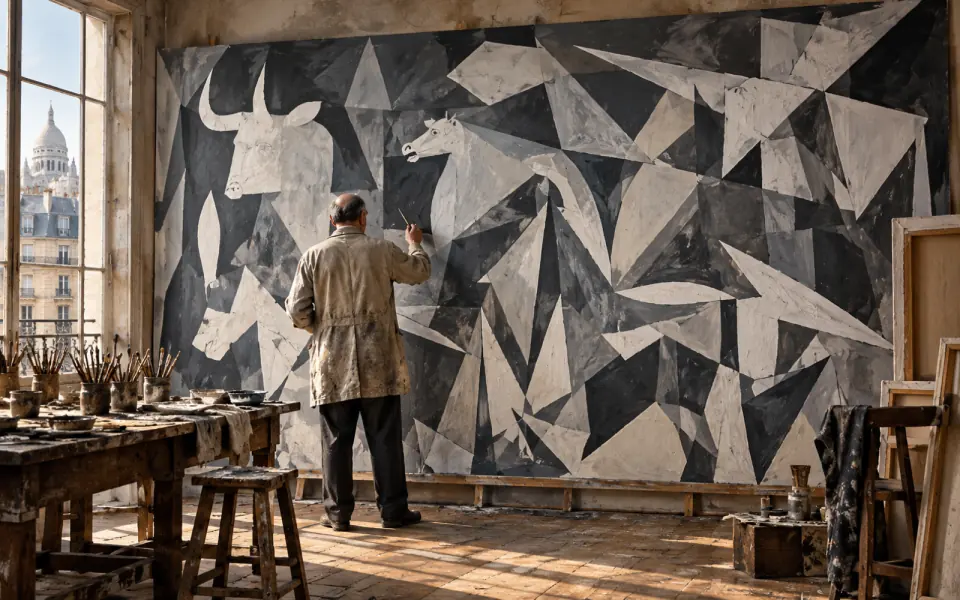
He started work on 1 May, in a studio in Paris, and in little more than a month, with very few second thoughts, he finished a gigantic painting, almost eight metres long and about three and a half metres high. He used only white, black and grey, like the photographs in the newspapers. His partner, the photographer Dora Maar, took pictures of the painting at every stage, and so today we can see how it changed.
What you can see
The painting shows no aeroplanes and no bombs. There are suffering figures, drawn with broken and distorted shapes. In the centre there is a horse wounded by a spear, screaming; on the left a mother cries out in pain, holding her dead child; on the right a woman fleeing from the flames and another who is falling; at the bottom a soldier, lying on the ground, with a broken sword and a flower in his hand. Above, a light bulb shaped like an eye, and a hand holding a lamp, seem to light up the scene, as if to say: look! On the left there is a bull, which has several meanings, perhaps brutal force, or perhaps the Spanish people.
Picasso said he did not want to explain everything. The painting works like this: it does not tell one particular event, but shows the suffering of every war, and so it speaks to everyone, even to people who do not know the history.
Why it happened
Picasso painted Guernica because the war, and the news of a massacre of civilians, shook him deeply. He was an artist who rarely dealt with politics, but he understood that he could use his fame to let the world know what was happening in Spain.
The bombing had a military purpose, because the town was near the front, but also an aim of intimidation: striking the population to break the Basques' resistance. What was new about it was the violence of aerial bombing against ordinary people, which became more and more common in the Second World War.
What changed
After the Paris Exposition, the painting toured Europe and the United States to raise money for Spanish refugees. Picasso wanted it not to return to Spain until freedom had returned. So it stayed in New York, at the Museum of Modern Art, from 1939 to 1981. Franco died in 1975, Spain became a democracy, and in 1981 the painting returned to Madrid, where it is now in the Reina Sofía Museum.
Guernica has become the world symbol against war and against violence towards civilians. A tapestry copy hung at the entrance to the Security Council chamber of the United Nations in New York until 2021, when it was returned to the Rockefeller family who had lent it: in 2003, when a war in Iraq was being discussed, it was covered with a cloth during a press conference.
Every year huge numbers of visitors stop in front of the painting, in the museum room in Madrid. Seen today, it invites us to think about how necessary it is to protect civilians in every conflict.
Key people and places
People
- Pablo Picasso
- Spanish painter and sculptor (1881–1973): he painted Guernica in 1937.
- Dora Maar
- French photographer and painter (1907–1997): Picasso's partner, she documented the stages of the painting.
- Francisco Franco
- Spanish general (1892–1975): he led the Nationalists and ruled Spain as a dictator from 1939 to 1975.
- Josep Lluís Sert
- Catalan architect (1902–1983): he designed the Spanish pavilion in Paris.
- Joan Miró
- Catalan painter (1893–1983): he made a large mural painting for the same pavilion.
Places
- Guernica (Gernika), Basque Country
- The town bombed on 26 April 1937.
- Museo Reina Sofía, Madrid
- The museum where the painting is kept today.
Good to know
- Guernica is a painting almost eight metres long and about three and a half metres high (349.3 × 776.5 cm).
- Picasso painted it in little more than a month, using only white, black and grey.
- The painting stayed in New York from 1939 to 1981 and returned to Spain after the end of the dictatorship.
- On the left of the painting there is a mother holding her dead child; in the centre, a wounded horse.
- In 2003 a cloth covered the tapestry copy of Guernica at the UN in New York during a press conference on the war in Iraq; the tapestry was removed in 2021.
Find out more
- Museo Reina Sofía, “Guernica” museoreinasofia.es
- Wikipedia, “Guernica (Picasso)” en.wikipedia.org
- Wikipedia, “Bombing of Guernica” en.wikipedia.org
- Wikipedia, “Spanish Civil War” en.wikipedia.org
Related events
- The Second World War1939–1945 · Early 20th centuryA few years later, the whole of Europe was drawn into the Second World War.
- Totalitarian regimes in Europe1922 · Early 20th centuryThe same totalitarian regimes backed Franco.
- Abstract artabout 1910 · Early 20th centuryPicasso and Kandinsky were among the great renewers of 20th-century art.
- Martin Luther King and civil rights1963 · TodayArt has also supported the struggles for civil rights.
Before and after, in the era “Early 20th century”
Event 15 of 25
 BeforeThe first powered flight1903
 BeforeSpecial relativity1905
 BeforeMaria Montessori's Children's House1907
 BeforeAbstract artabout 1910
 BeforeMarie Curie and her two Nobel Prizes1911
 BeforeThe First World War1914–1918
 BeforeThe Russian Revolution1917
 BeforeRadio for everyoneabout 1920
 BeforeJazz spreadsabout 1920
 BeforeInsulin against diabetes1922
 BeforeTotalitarian regimes in Europe1922
 BeforeTalking pictures1927
 BeforeThe discovery of penicillin1928
 BeforeThe Great Depression1929
- You are herePicasso's Guernica1937
 AfterThe Second World War1939–1945
 AfterThe Shoahabout 1941–1945
 AfterAnne Frank writes her diary1942
 AfterFermi and the first atomic pile1942
 AfterThe Italian Resistance1943–1945
 AfterThe Italian Republic and votes for women1946
 AfterThe first general-purpose electronic computer1946
 AfterThe Italian Constitution1948
 AfterPost-war rebuildingabout 1948
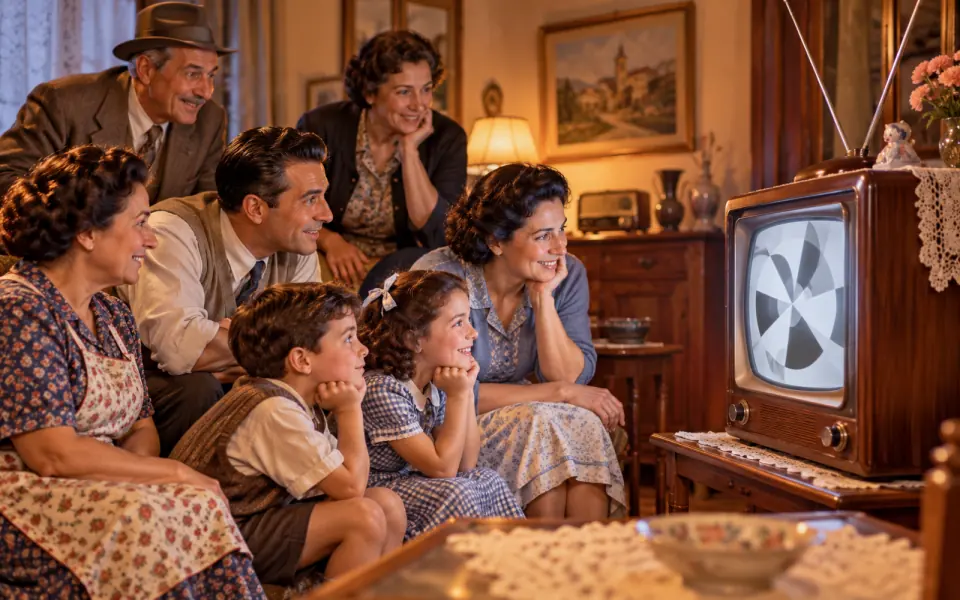 AfterTelevision spreadsabout 1950
Listen / Read next
- Music to read by: Cinematic JourneyEpic film-style music, no lyrics, by Ciro Simone IrmiciSpotifyYouTube Music
Meanwhile, elsewhere in the world
Other events of the era “Early 20th century”
- The first powered flight
- Special relativity
- Maria Montessori's Children's House
- Abstract art
- Marie Curie and her two Nobel Prizes
- The First World War
- The Russian Revolution
- Radio for everyone
- Jazz spreads
- Insulin against diabetes
- Totalitarian regimes in Europe
- Talking pictures
- The discovery of penicillin
- The Great Depression
- The Second World War
- The Shoah
- Anne Frank writes her diary
- Fermi and the first atomic pile
- The Italian Resistance
- The Italian Republic and votes for women
- The first general-purpose electronic computer
- The Italian Constitution
- Post-war rebuilding
- Television spreads
