The first general-purpose electronic computer
1946 University of Pennsylvania, Philadelphia, United States
In short
ENIAC was shown to the public in February 1946 at the University of Pennsylvania, in Philadelphia. It filled a whole room, weighed about 30 tonnes and ran on almost 18,000 electronic valves. It could do thousands of calculations a second and, by changing its connections, solve different problems. It was programmed by six young women mathematicians, whose names stayed almost unknown for decades.
Why it matters It is the ancestor of the computers, tablets and smartphones that today fit in one hand.
Source: University of Pennsylvania, Penn Today, “The world's first general purpose computer turns 75”
Study card about 5 minutes of reading
The story
When “computer” meant a person
Until the middle of the 20th century the word “computer” did not mean a machine, but a person: someone who did calculations. In offices of science and war there were rooms full of human “computers”, often women, who with pencils, paper and simple calculating machines produced tables of numbers for guns, for stars, for aeroplane designs. During the Second World War the calculations multiplied: to hit a target accurately, American artillery needed tables showing how to tilt the gun depending on distance, wind and height. Each table took days of work, and hundreds were needed.
At the University of Pennsylvania, in Philadelphia, a physicist, John Mauchly, and a young electronic engineer, John Presper Eckert, had an idea: to build an electronic machine that would do those calculations in a few seconds. The American army, convinced, paid for the project, and in 1943 they began work, with a team of engineers and technicians.
A giant of electronic tubes
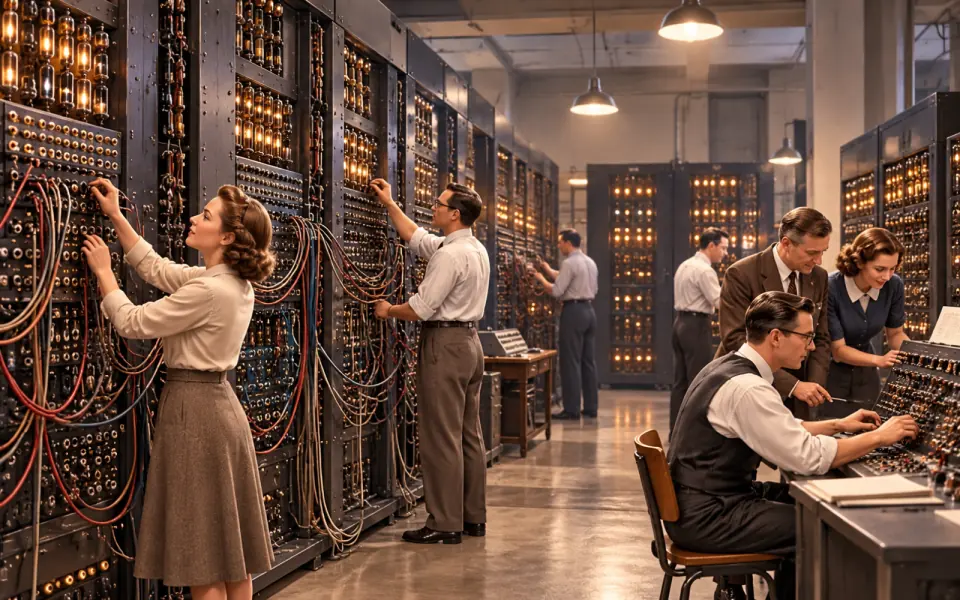
The machine was called ENIAC, from the initials of “Electronic Numerical Integrator and Computer”. It was finished at the end of 1945, and shown to the public on 14 February 1946. It was a monster: it filled a large hall of over a hundred square metres, weighed about 27–30 tonnes and used 150 kilowatts of electricity, more than a hundred homes. Inside it were almost eighteen thousand thermionic valves, glass tubes that worked as switches, together with thousands of other components and kilometres of wires. The valves got very hot, and every now and then one burned out: the technicians had to find it and replace it.
But it was very fast: it did about five thousand additions a second, a thousand times faster than the machines of the time. A trajectory calculation that took days by hand could be done by ENIAC in under a minute. At the presentation, the newspapers called it an “electronic brain”. The first real job it did, at the end of 1945, was a secret calculation for a nuclear weapons project.
The women programmers
ENIAC had no stored program: to make it do a job, its modules had to be connected to each other with cables, like in an old telephone exchange, and hundreds of switches had to be set. Every new problem took days of work. This work was done by six young women mathematicians, chosen from the human “computers” already working at the university: Kay McNulty, Betty Jennings, Betty Snyder, Marlyn Wescoff, Fran Bilas and Ruth Lichterman. They had to learn by themselves, from the machine's diagrams, how it worked and how to give it instructions: they were the first programmers in history. At the presentation, however, their names were never mentioned, and only many years later was their role recognised.
It was not the only one
ENIAC was the first big “general” electronic computer, that is, able to solve many kinds of problem, but it was not the only one. In England, at Bletchley Park, during the war, technicians had built Colossus to decipher German secret messages, also electronic, but specialised. In Germany Konrad Zuse had built machines with electromechanical relays, and at Harvard the American Howard Aiken built the Mark I, big and slow. The English mathematician Alan Turing had imagined as early as 1936 a “universal machine”, able to carry out any calculation, an idea that is the basis of modern computers.
A decisive step was taken by John von Neumann, who in 1945 described a machine in which the program too, not just the data, was kept in memory: all you had to do was change the program, without rewiring the cables. The first computer of this kind ran in Manchester, in June 1948.
Why it happened
Electronic computers were born of war: fast calculations were needed for guns, for secret codes and for nuclear weapons. The government invested a lot of money, and engineers, mathematicians and physicists came together in the universities.
The technology that made ENIAC possible was the valve, already used in radio and telephone. People had realised that, used as a switch, it could do sums faster than any mechanical part, which had to move.
What changed
ENIAC worked until 1955 and was used to study the weather, atomic energy and random numbers. It showed that computers could do much more than a calculator, and after it commercial computers appeared within a few years, such as the UNIVAC (1951), used to predict the results of the 1952 American elections.
In 1947 the transistor was invented, which replaced valves and made computers smaller, faster and more reliable; then came integrated circuits and, in 1971, the microprocessor. In a few decades, machines as big as a room have become desktop computers and then phones that we carry in our pockets, billions of times more powerful than ENIAC.
The women who had programmed ENIAC opened the way for many others. Among them, the American Grace Hopper devised the first programming languages close to human language. In Italy the first big computer, the CEP, was built in Pisa in 1961, and Olivetti, with the ELEA 9003 (1959), was among the first companies in the world to make modern ones.
Key people and places
People
- John Mauchly
- American physicist (1907–1980): he conceived ENIAC with Eckert.
- John Presper Eckert
- American engineer (1919–1995): he designed the circuits of ENIAC.
- Kay McNulty
- American mathematician (1921–2006): one of the six first programmers of ENIAC.
- Alan Turing
- English mathematician (1912–1954): in 1936 he imagined the “universal machine”.
- Grace Hopper
- American computer scientist (1906–1992): she invented one of the first compilers and inspired the COBOL language.
Places
- Moore School of Electrical Engineering, Philadelphia
- The school of the University of Pennsylvania where ENIAC was built.
- Bletchley Park, England
- The centre where, during the war, secret messages were deciphered with machines such as Colossus.
Good to know
- ENIAC weighed about 27–30 tonnes and filled a large hall of over a hundred square metres.
- It had almost eighteen thousand electronic valves, and every now and then one burned out.
- The first programmers of ENIAC were six young women mathematicians.
- To program it you had to connect cables and set switches, like in an old telephone exchange.
- Until the 1940s “computer” meant a person who did calculations.
Find out more
- Wikipedia, “ENIAC” en.wikipedia.org
- Wikipedia, “Colossus computer” en.wikipedia.org
- Wikipedia, “Alan Turing” en.wikipedia.org
- Wikipedia, “Grace Hopper” en.wikipedia.org
Related events
- The personal computer1977 · TodayThirty years later, in 1977, personal computers arrived.
- The internet's first ARPANET links1969 · TodayIn 1969 computers began to be linked in a network with ARPANET.
- Fermi and the first atomic pile1942 · Early 20th centuryThe Manhattan Project used computers for calculations on nuclear energy.
- The modern smartphone2007 · TodayToday a smartphone is far more powerful than ENIAC.
Before and after, in the era “Early 20th century”
Event 22 of 25
 BeforeThe first powered flight1903
 BeforeSpecial relativity1905
 BeforeMaria Montessori's Children's House1907
 BeforeAbstract artabout 1910
 BeforeMarie Curie and her two Nobel Prizes1911
 BeforeThe First World War1914–1918
 BeforeThe Russian Revolution1917
 BeforeRadio for everyoneabout 1920
 BeforeJazz spreadsabout 1920
 BeforeInsulin against diabetes1922
 BeforeTotalitarian regimes in Europe1922
 BeforeTalking pictures1927
 BeforeThe discovery of penicillin1928
 BeforeThe Great Depression1929
 BeforePicasso's Guernica1937
 BeforeThe Second World War1939–1945
 BeforeThe Shoahabout 1941–1945
 BeforeAnne Frank writes her diary1942
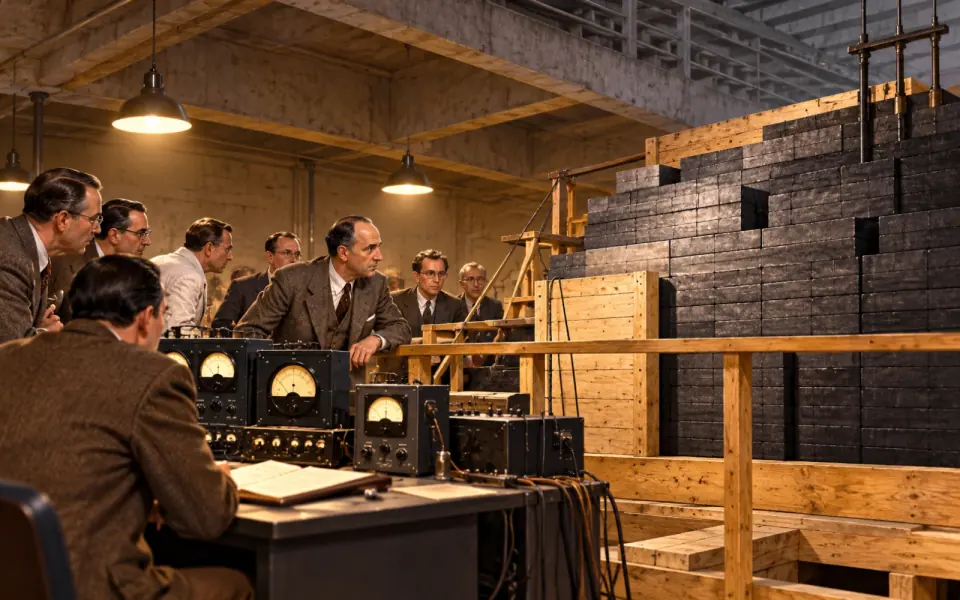 BeforeFermi and the first atomic pile1942
 BeforeThe Italian Resistance1943–1945
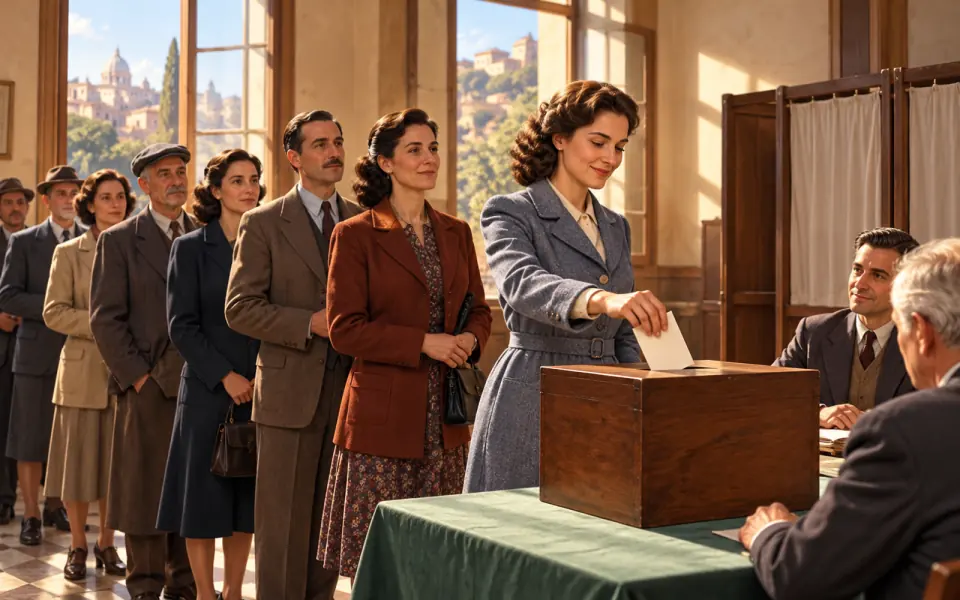 BeforeThe Italian Republic and votes for women1946
- You are hereThe first general-purpose electronic computer1946
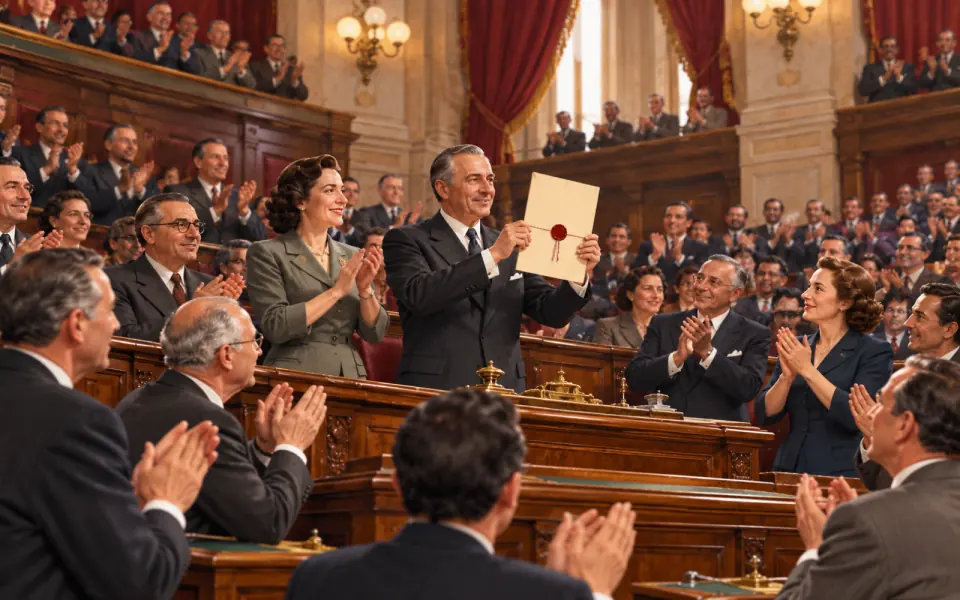 AfterThe Italian Constitution1948
 AfterPost-war rebuildingabout 1948
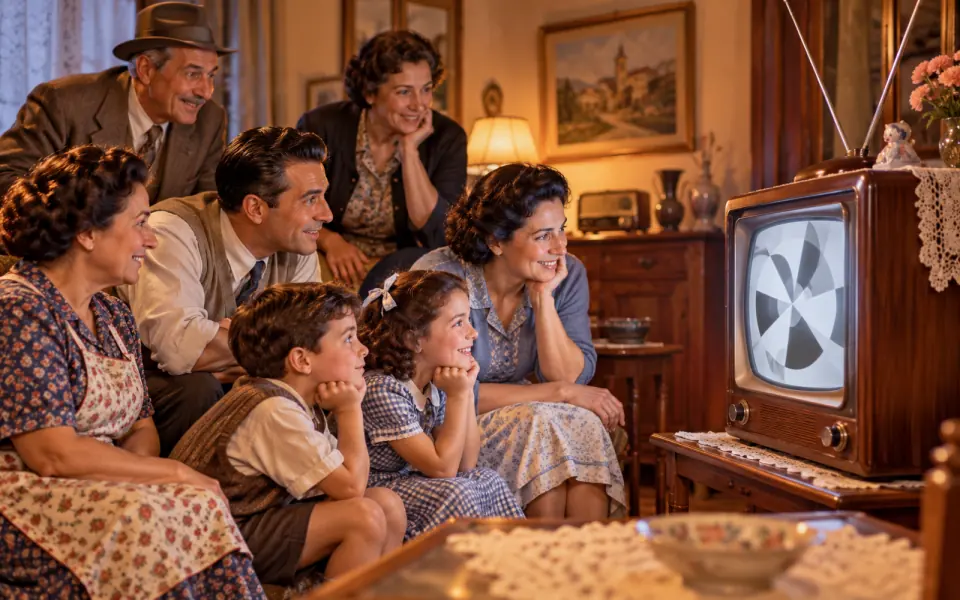 AfterTelevision spreadsabout 1950
Listen / Read next
- Music to read by: Cinematic JourneyEpic film-style music, no lyrics, by Ciro Simone IrmiciSpotifyYouTube Music
Meanwhile, elsewhere in the world
Other events of the era “Early 20th century”
- The first powered flight
- Special relativity
- Maria Montessori's Children's House
- Abstract art
- Marie Curie and her two Nobel Prizes
- The First World War
- The Russian Revolution
- Radio for everyone
- Jazz spreads
- Insulin against diabetes
- Totalitarian regimes in Europe
- Talking pictures
- The discovery of penicillin
- The Great Depression
- Picasso's Guernica
- The Second World War
- The Shoah
- Anne Frank writes her diary
- Fermi and the first atomic pile
- The Italian Resistance
- The Italian Republic and votes for women
- The Italian Constitution
- Post-war rebuilding
- Television spreads
