Leonardo designs machines
about 1485 Milan, Italy
In short
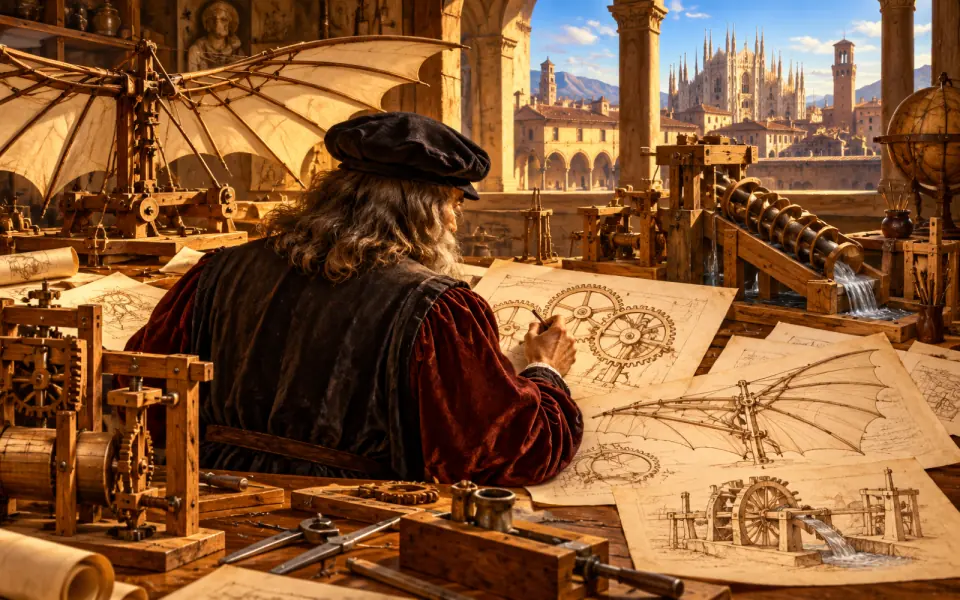
Leonardo da Vinci, born in 1452 near Vinci, in Tuscany, moved to Milan to the court of Ludovico Sforza, known as ‘the Moor’. He filled thousands of notebook pages with drawings of flying machines, gears, bridges and weapons of war, often writing from right to left, in mirror writing. Many designs were never built, but they show a boundless curiosity. He was also a painter: in Milan he painted The Last Supper.
Why it matters Leonardo has become the symbol of someone who brings together art, science and invention.
Source: Treccani, entry “Leonardo da Vinci”
Study card about 5 minutes of reading
The story
A job-seeker with a special letter
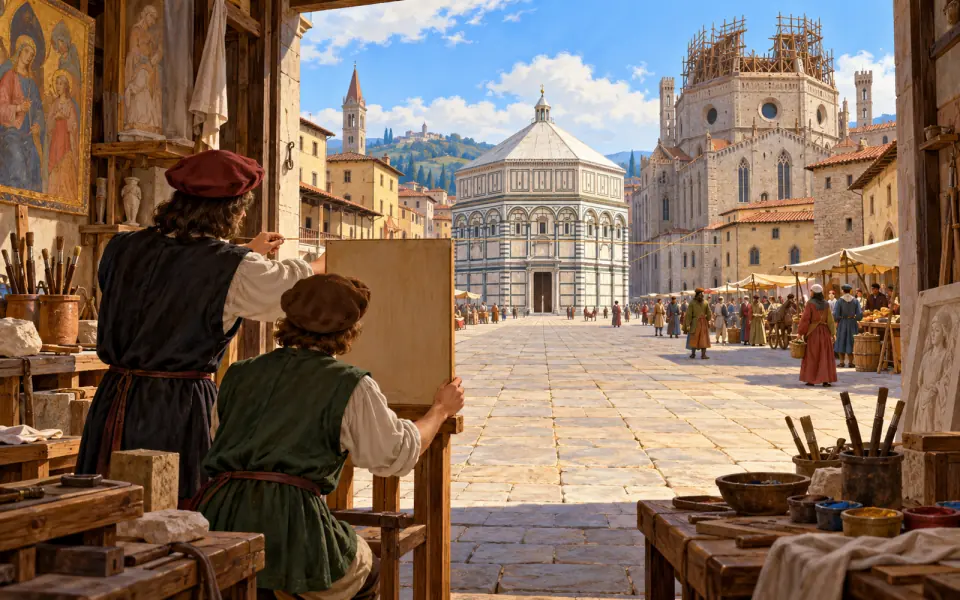
Leonardo da Vinci was born in 1452 near Vinci, a village in Tuscany. He learned to paint in Florence, in the workshop of the artist Andrea del Verrocchio, where colours were prepared, statues were carved and technology and mechanics were studied too. Around 1482, at the age of thirty, he left Florence and went to Milan, to the court of Duke Ludovico Sforza, known as “il Moro”, one of the most powerful rulers in Italy.
To get hired, Leonardo wrote the duke a letter. He did not present himself as a painter, but as a military engineer: he listed about ten things he could do, such as bridges that were easy to carry, weapons for besieging cities, armoured covered wagons and machines for throwing stones. Only at the end did he mention that he was also a sculptor and painter. The text we know is a copy, and it is not known whether it was sent in this exact form.
The notebooks
In the thirty-odd years that followed, Leonardo filled thousands of sheets with drawings and notes. He wrote from right to left, with the letters reversed as in a mirror: reading them takes a mirror, or a lot of patience. Perhaps he did it because he was left-handed and so did not smudge the ink, but nobody can say for certain. Many sheets are collected in the Codex Atlanticus, kept in the Biblioteca Ambrosiana in Milan.
In those pages there are machines of every kind: pumps, water wheels, winches, clocks, carts, musical instruments. There are also more fantastic designs, such as a “mechanical wing” that was meant to make a man fly by flapping like a bird, an aerial screw that looks like a helicopter, a huge crossbow, a tank made of shields, and a pyramid-shaped parachute.
The parachute and the wings
Leonardo's parachute, drawn around 1485, was a linen cloth stretched over a wooden pyramid frame. In 2000 a man, Adrian Nicholas, built a faithful copy and jumped from a hot-air balloon at over two thousand metres: he came down for a long stretch, then released the very heavy frame and landed with a modern parachute; the idea was proved all the same. Flying machines with wings, on the other hand, could not work: the muscles of a human being are not strong enough to hold him up in the air.
But Leonardo did not just design things: he observed. He studied the flight of birds, the flow of rivers, the beating of the heart, the muscles of the body, flowers and rocks. He dissected dozens of corpses to understand how a human being is built, and drew what he saw with astonishing precision.
In Milan Leonardo also worked on water. The city had a network of navigable canals, the Navigli, and he studied how to make boats go up and down between different levels with locks. Historians debate how far the invention of some solutions is really his, but his drawings of gates and canals show how much the subject mattered to him.
What he did not do
Almost none of his machines was built while he was alive. He often left works half done, and some important jobs, such as the great bronze horse for Ludovico il Moro, were never finished: a clay model seven metres tall was destroyed in 1499, when the French took Milan. In the same period, however, he painted the “Last Supper” in Milan (1495–1498).
After Milan he lived in Florence, in Rome and finally in France, at Amboise, where he died on 2 May 1519 in the service of King Francis I. His notebooks passed from hand to hand and were partly scattered. Two volumes, the Madrid Codices, were found in the National Library of Spain only in 1966, after being forgotten for centuries.
Why it happened
The Italian courts of the 15th century wanted artists and engineers who could combine beauty and technical skill: a lord could use them for festivals, portraits, fortifications and weapons. For a curious man like Leonardo it was a chance to see and do many things.
His training in Verrocchio's workshop, where manual work and study went together, had taught him to observe carefully and to try things out with his hands.
What changed
Leonardo has become the symbol of the Renaissance man, able to do art and science together. His notes show a new way of working: observe, draw, try and correct.
Even though his machines did not change the technology of his time, his drawings foreshadow ideas that would be carried out only centuries later, such as the parachute, flying machines and various hydraulic devices. His studies of anatomy were published much later.
His paintings, such as the “Mona Lisa” and the “Last Supper”, are among the most famous in the world. The “Last Supper” began to decay early, because Leonardo had tried a new technique on a dry wall; today it survives thanks to long restorations.
Key people and places
People
- Leonardo da Vinci
- Painter, engineer and scholar (1452–1519): he left drawings and notes on a huge number of subjects.
- Ludovico Sforza, known as il Moro
- Duke of Milan from 1494 and its ruler in practice already from 1480 (1452–1508): he had Leonardo at his court.
- Andrea del Verrocchio
- Florentine sculptor and painter (1435–1488): Leonardo's teacher.
- Adrian Nicholas
- British skydiver: in 2000 he tested a copy of Leonardo's parachute.
Places
- Milan
- Lombard city where Leonardo lived for nearly twenty years, at the court of the Sforza.
- Biblioteca Ambrosiana
- The Milan library that keeps the Codex Atlanticus.
- Amboise (France)
- The French town where Leonardo died in 1519.
Good to know
- Leonardo wrote from right to left, with the letters reversed as in a mirror.
- The Codex Atlanticus holds over a thousand sheets of drawings and notes.
- In 2000 Leonardo's parachute was really tested: it came down for a long stretch, but the man reached the ground with a modern parachute.
- The Madrid Codices were found only in 1966.
- The great bronze horse for Ludovico il Moro was never cast.
Find out more
- Wikipedia, “Leonardo da Vinci” en.wikipedia.org
- Wikipedia, “Codex Atlanticus” en.wikipedia.org
- Wikipedia, “Ludovico Sforza” en.wikipedia.org
- Wikipedia, “Codex Madrid (Leonardo)” en.wikipedia.org
Related events
- Renaissance perspectiveabout 1420 · Early modern ageLeonardo applied perspective and studied it for a long time.
- Lorenzo de' Medici in Florence1469 · Early modern ageLeonardo trained in the Florence of the Medici.
- Michelangelo carves David1504 · Early modern ageMichelangelo, Leonardo's rival, carved the David.
- Raphael paints the Vatican Rooms1508 · Early modern ageRaphael also learned from Leonardo.
Before and after, in the era “Early modern age”
Event 6 of 25
 BeforeRenaissance perspectiveabout 1420
 BeforeBrunelleschi completes the dome1436
 BeforeThe fall of Constantinople1453
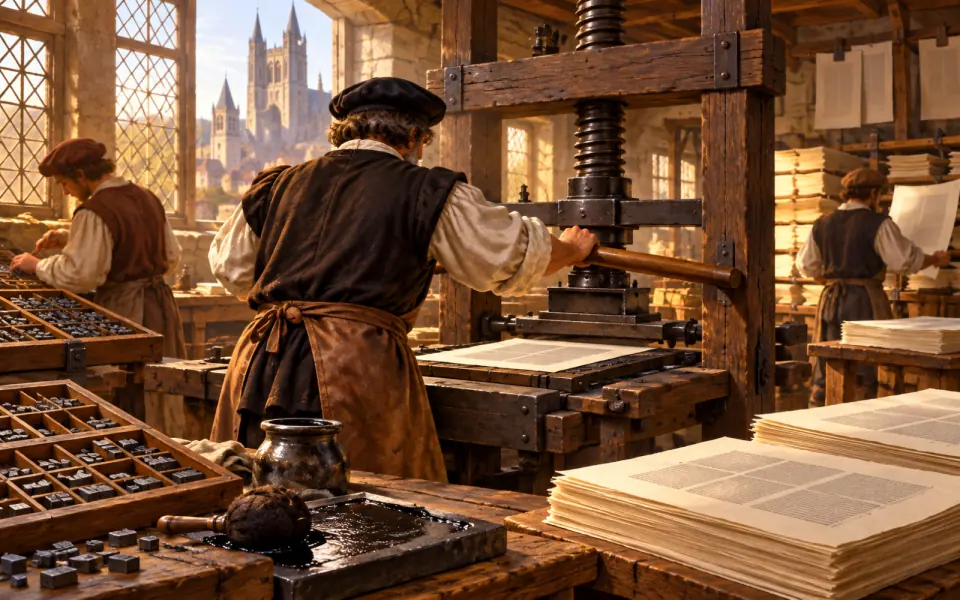 BeforeGutenberg prints the Bibleabout 1455
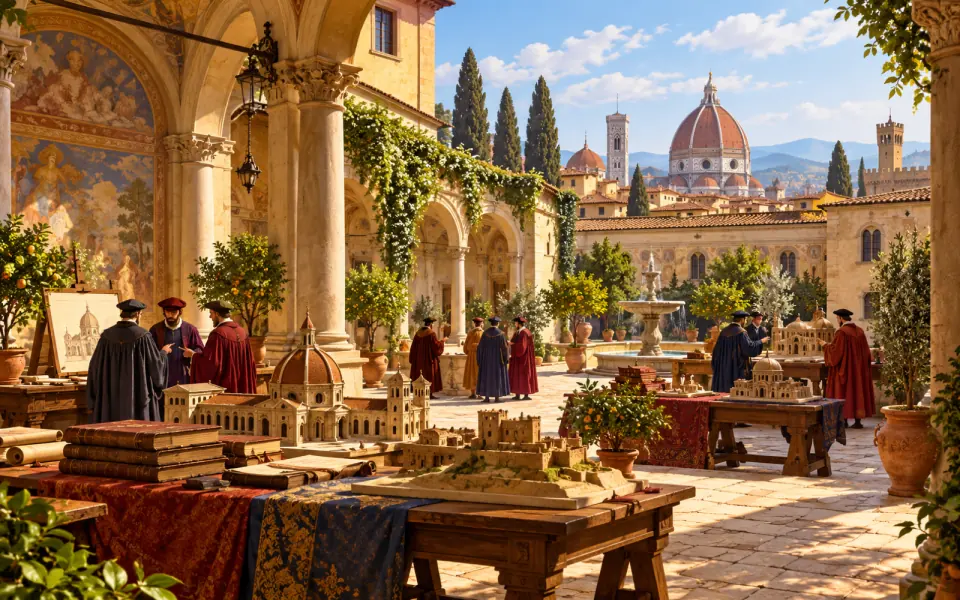 BeforeLorenzo de' Medici in Florence1469
- You are hereLeonardo designs machinesabout 1485
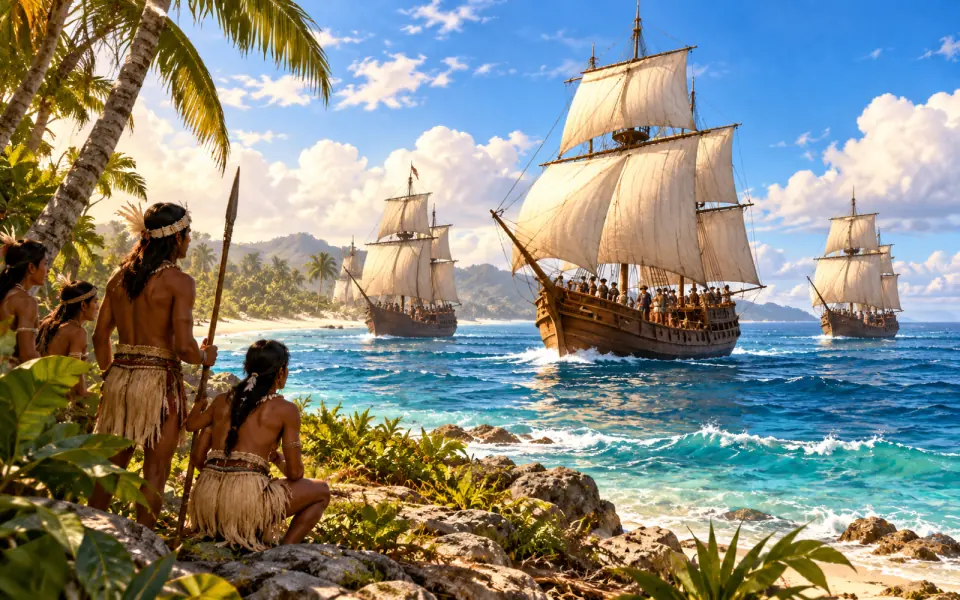 AfterColumbus's voyage1492
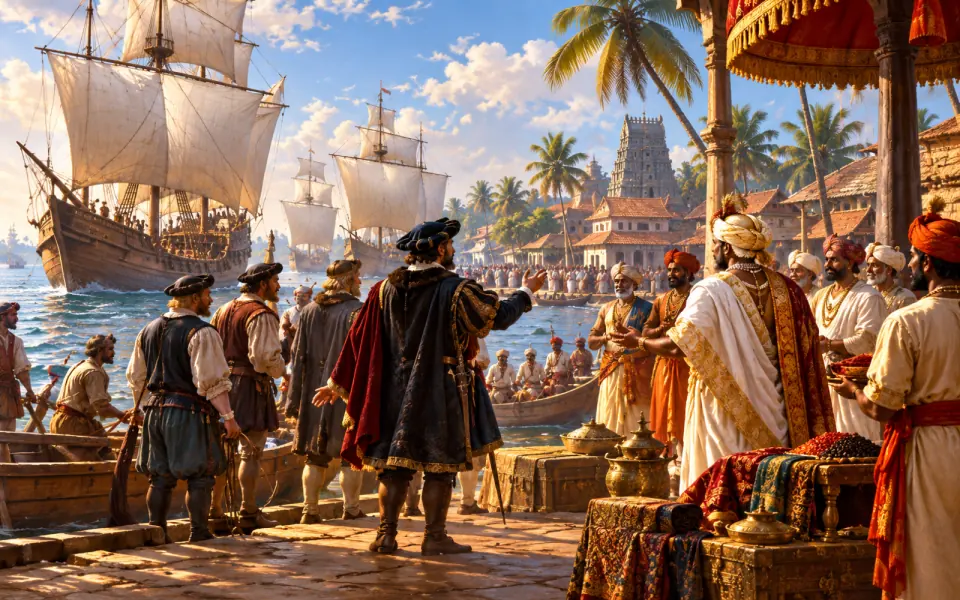 AfterVasco da Gama reaches India1498
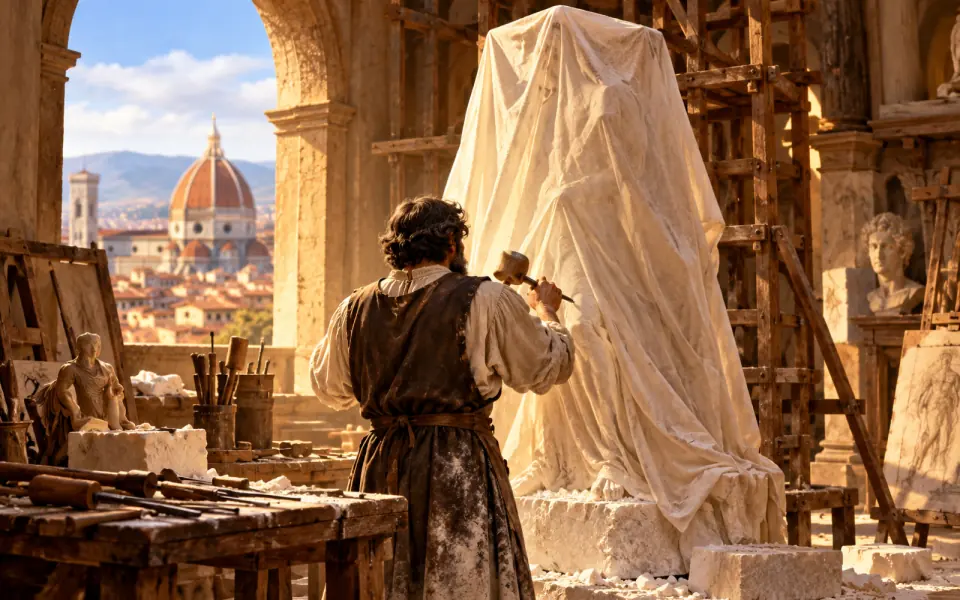 AfterMichelangelo carves David1504
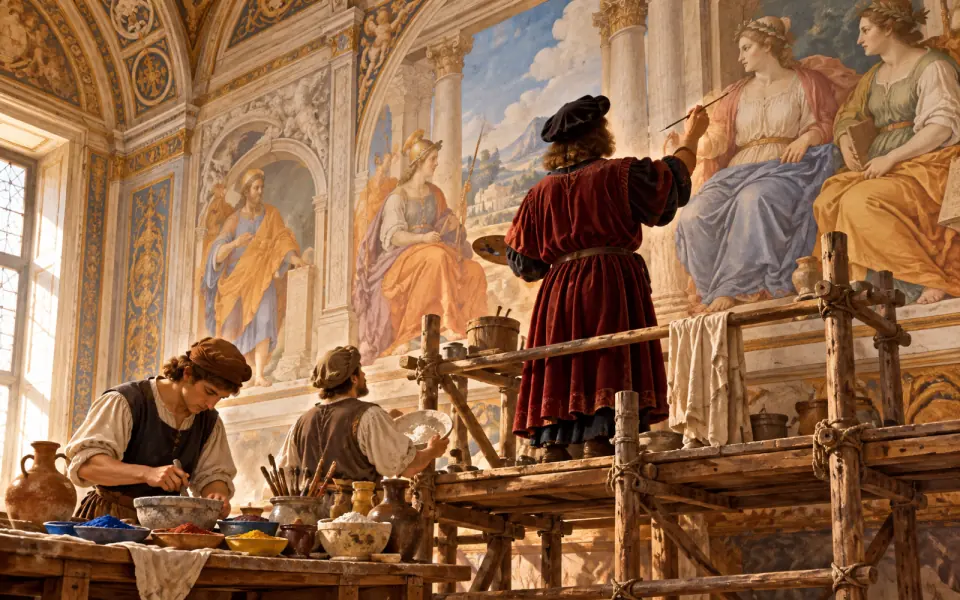 AfterRaphael paints the Vatican Rooms1508
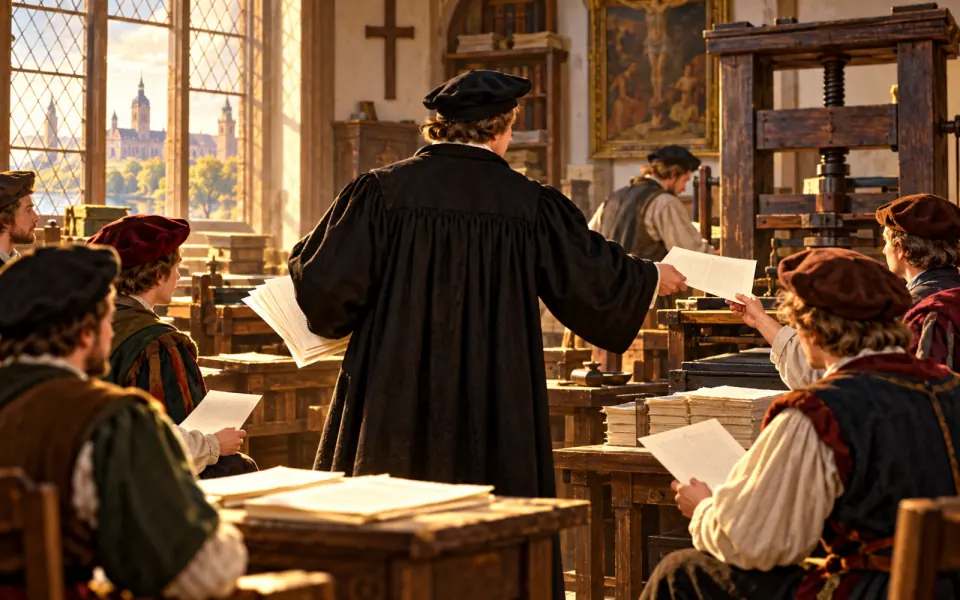 AfterLuther and the Reformation1517
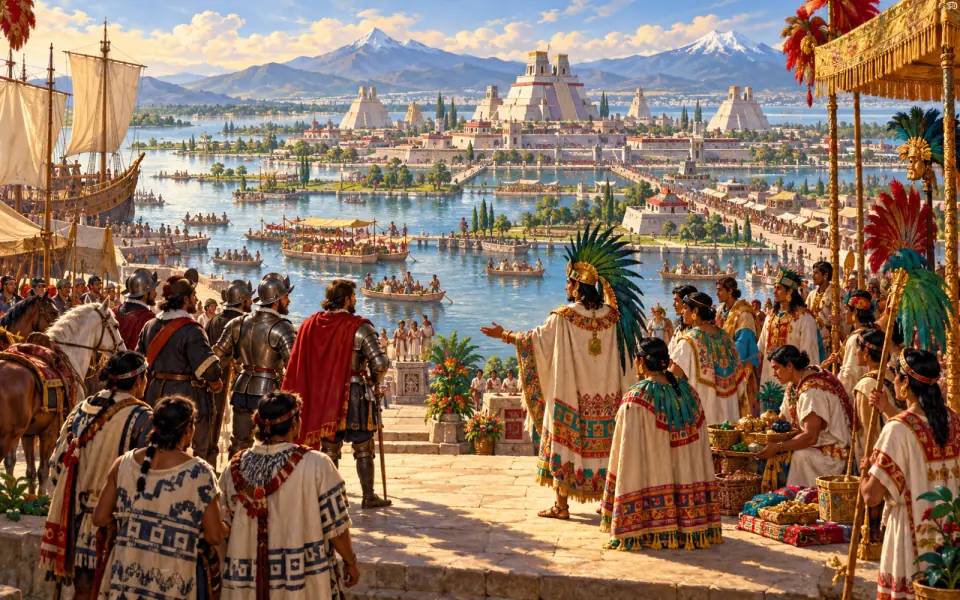 AfterThe conquest of Tenochtitlán1521
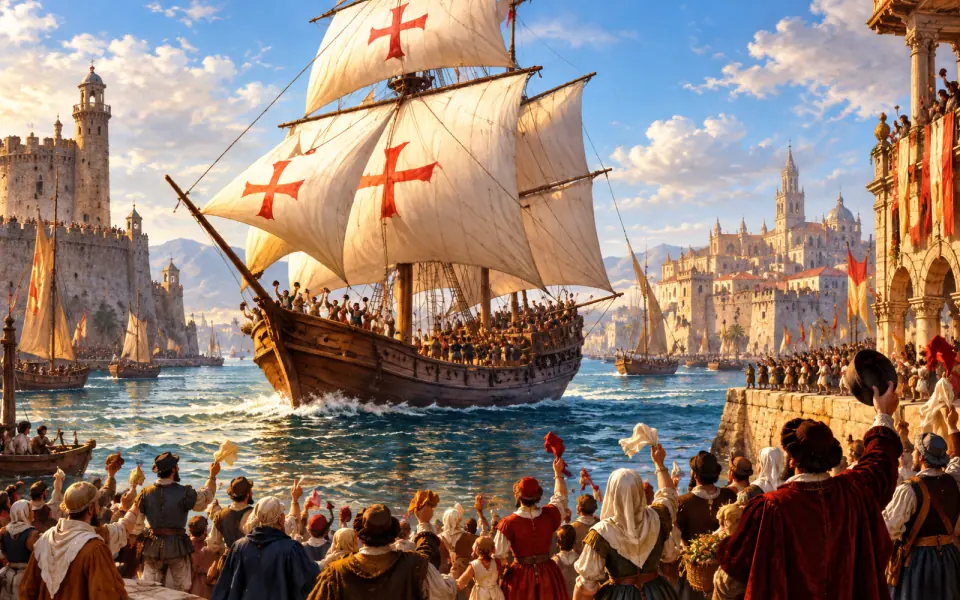 AfterThe first voyage round the world1522
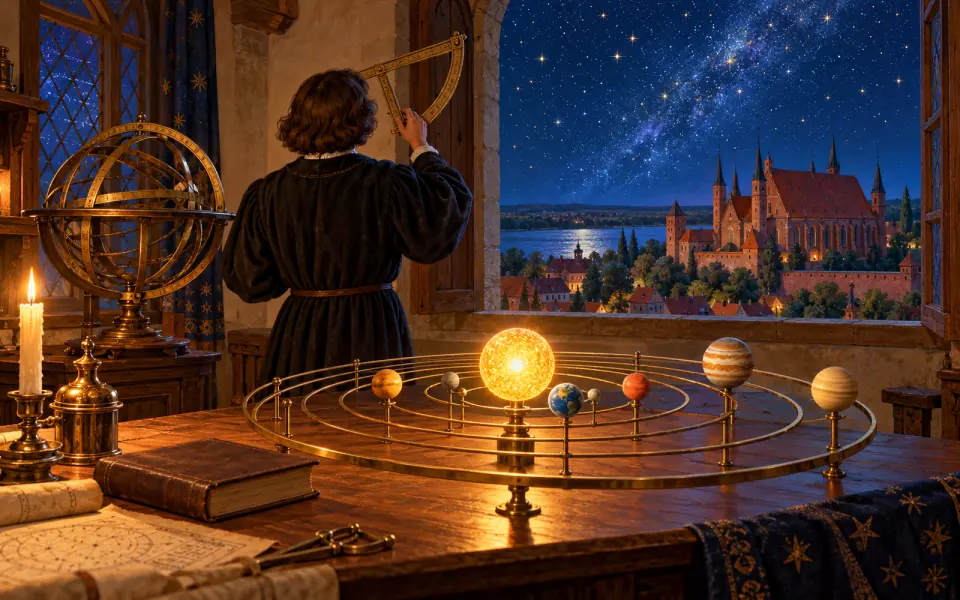 AfterCopernicus puts the Sun at the centre1543
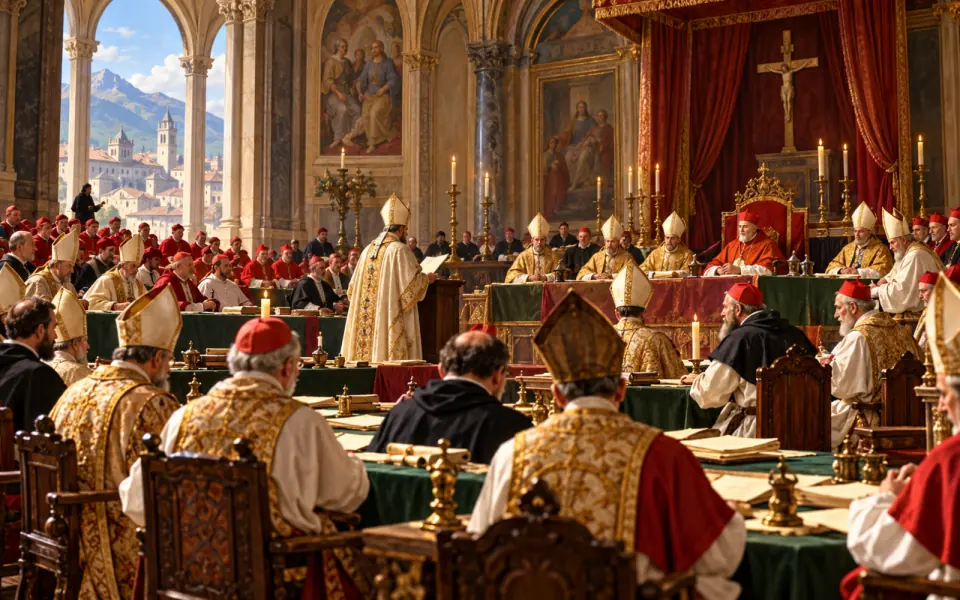 AfterThe Council of Trent1545–1563
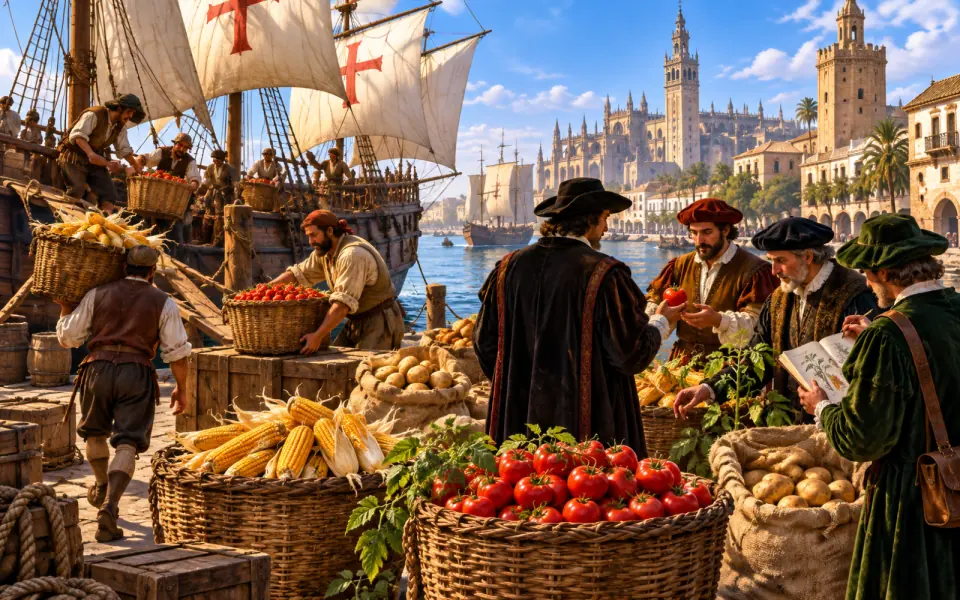 AfterTomatoes, maize and potatoes reach Europeabout 1550
 AfterThe Gregorian calendar1582
 AfterShakespeare's theatreabout 1590
 AfterRegular newspapers1605
 AfterGalileo turns his telescope to the sky1609
 AfterKepler describes the orbits1609
 AfterArtemisia Gentileschiabout 1612
 AfterHarvey studies the circulation of the blood1628
 AfterScientific academies1660
 AfterNewton publishes the Principia1687
Listen / Read next
- Music to read by: Cinematic JourneyEpic film-style music, no lyrics, by Ciro Simone IrmiciSpotifyYouTube Music
Meanwhile, elsewhere in the world
Other events of the era “Early modern age”
- Renaissance perspective
- Brunelleschi completes the dome
- The fall of Constantinople
- Gutenberg prints the Bible
- Lorenzo de' Medici in Florence
- Columbus's voyage
- Vasco da Gama reaches India
- Michelangelo carves David
- Raphael paints the Vatican Rooms
- Luther and the Reformation
- The conquest of Tenochtitlán
- The first voyage round the world
- Copernicus puts the Sun at the centre
- The Council of Trent
- Tomatoes, maize and potatoes reach Europe
- The Gregorian calendar
- Shakespeare's theatre
- Regular newspapers
- Galileo turns his telescope to the sky
- Kepler describes the orbits
- Artemisia Gentileschi
- Harvey studies the circulation of the blood
- Scientific academies
- Newton publishes the Principia
