Radio for everyone
about 1920 Pittsburgh, United States (and then the whole world)
In short
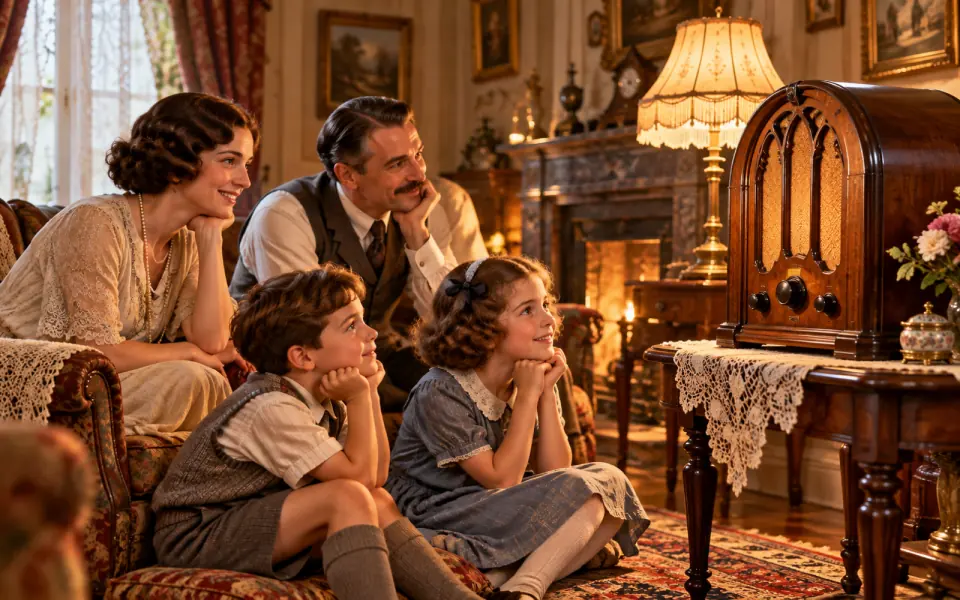
As early as the late 1800s Guglielmo Marconi, a young inventor from Bologna, had managed to send signals without wires, using radio waves. After the First World War, stations sprang up broadcasting music, news and programmes for anyone with a set: one of the first was KDKA in Pittsburgh, in the United States, in 1920. In Italy regular broadcasts began in 1924. In the evenings many families gathered round the radio as they do today in front of a screen.
Why it matters For the first time millions of people could listen to the same voice or the same song at the same moment.
Source: Treccani, entry “Radiodiffusione”
Study card about 5 minutes of reading
The story
Invisible waves
In 1895 a young man from Bologna, twenty-one-year-old Guglielmo Marconi, carried out an experiment at the family villa in Pontecchio, in the hills near Bologna. He had built a device that produced electromagnetic waves, which had already been studied by other scientists, such as Heinrich Hertz. He sent a signal more than a kilometre away, beyond a hill, where no wire or cable could carry it: an assistant, to confirm he had received it, fired a rifle shot. Wireless telegraphy was born.
In Italy nobody was interested, so Marconi, with his Irish mother, moved to England. There his invention was an immediate success, above all with the navy, which saw how useful it could be for communicating with ships at sea. In 1901 Marconi wanted to try something the experts thought impossible: sending a signal from one side of the Atlantic to the other. From Cornwall, in England, a signal was sent that repeated the letter “S”, three dots in Morse code. In Newfoundland, in Canada, Marconi, by his own account (some historians doubt it), managed to hear, with his assistants, the three tiny, separate “ticks” in the receiver. It was 12 December 1901. In 1909 he received the Nobel Prize in Physics.
A telegram that saves lives
Wireless communication soon became essential at sea. In April 1912, when the liner Titanic struck an iceberg, the radio operator sent out calls for help, which were picked up by a nearby ship, the Carpathia: she arrived within a few hours and saved more than seven hundred people. After the tragedy, the law required all large ships to have a radio and an operator always on duty.
From telegraphy to the voice
Until then radio waves carried only signals, dots and dashes in Morse code. In the following years, with new inventions, such as the valve called the “triode” by the American Lee de Forest (1906), which made it possible to amplify signals, it became possible to transmit sounds, music and voices as well. During the First World War radio was used to communicate in military operations, and after the war many enthusiasts in America built receivers at home and enjoyed listening to faraway messages.
2 November 1920
One of the first radio stations with regular broadcasts, KDKA in Pittsburgh, Pennsylvania, began transmitting on 2 November 1920, the evening of the American presidential election. In this way anyone with a radio could listen to the results live: Warren Harding beat James Cox. There were few listeners at first, but the idea proved a winner. Within two years more than five hundred stations had appeared in the United States, and families were buying sets to listen to music, news, baseball games, children's programmes and stories.
Other countries soon followed. In England the BBC was born in 1922. In Italy the first broadcast was on 6 October 1924, from a room in Rome, with an announcement by the announcer Maria Luisa Boncompagni, and a concert was transmitted. The first name of the broadcaster was URI (Unione radiofonica italiana), then EIAR from 1927 and finally RAI from 1944.
A window on the world
At first the sets were expensive and were listened to with headphones, one person at a time; then loudspeakers arrived, and music could fill the whole room. In the 1920s and 1930s radio entered every home and every village, where before only the newspaper arrived, when it arrived at all. Families gathered around the set on winter evenings to listen to programmes, songs, radio plays and news. In 1938 Orson Welles broadcast the novel “The War of the Worlds” as if it were a news bulletin, and some listeners were frightened, thinking that the Martians were landing.
Why it happened
Radio came from a series of scientific discoveries: electromagnetic waves, predicted by Maxwell's theory in 1865 and shown to exist by Hertz in 1888, were later used by Marconi. What made it a success was the needs of shipping, businesses and armies, which wanted to communicate over a distance.
Marconi was not the only one: other inventors such as Nikola Tesla, Oliver Lodge and Alexander Popov were working on similar ideas, and for years people argued over who was first. His merit was to turn experiments into a practical system, bringing together technical skill, a spirit of enterprise and excellent organisation.
What changed
Radio was the first mass medium to reach people directly at home and at the same moment: a whole country could hear the same speech, the same song, the same match. This changed music, which reached new people, politics, in which leaders spoke directly to citizens, and journalism, which could give news in real time.
Governments saw the power of radio at once, even in dangerous ways: totalitarian regimes used it for propaganda, while during the Second World War broadcasts such as “Radio London” brought hope to occupied peoples and information to those who were resisting.
With the transistor, invented in 1947, radios became small and portable in the 1950s. Today radio has not disappeared: you can listen in the car, over the Internet and on your phone. And the idea of transmitting through the air has led to technologies such as the mobile phone, Wi-Fi and television.
Key people and places
People
- Guglielmo Marconi
- Italian inventor and businessman (1874–1937): he developed wireless telegraphy; Nobel Prize in Physics in 1909.
- Heinrich Hertz
- German physicist (1857–1894): in 1888 he proved that electromagnetic waves exist.
- Lee de Forest
- American inventor (1873–1961): he created the triode, a valve that amplifies signals.
- Reginald Fessenden
- Canadian-American inventor (1866–1932): in 1906 he made one of the first voice broadcasts by radio.
- Orson Welles
- American actor and director (1915–1985): in 1938 he broadcast “The War of the Worlds” on the radio.
Places
- Villa Griffone, Pontecchio Marconi (Bologna)
- The villa where Marconi carried out his first experiments in 1895.
- Pittsburgh, Pennsylvania (United States)
- The city of KDKA, one of the first radio stations with regular broadcasts.
Good to know
- The first radio signal across the Atlantic, in 1901, was the letter “S” in Morse code.
- Marconi received the Nobel Prize in Physics in 1909.
- KDKA in Pittsburgh began broadcasting on 2 November 1920, the evening of the American presidential election.
- In Italy regular radio broadcasts began on 6 October 1924.
- In 1912, thanks to radio, the ship Carpathia rescued more than seven hundred survivors of the Titanic.
Find out more
- The Nobel Prize, “Guglielmo Marconi – Facts” nobelprize.org
- Wikipedia, “Guglielmo Marconi” en.wikipedia.org
- Wikipedia, “Radio” en.wikipedia.org
- Wikipedia, “History of radio” en.wikipedia.org
Related events
- The electric telegraph1844 · Age of revolutionsThe electric telegraph had been the first step in long-distance communication.
- Television spreadsabout 1950 · Early 20th centuryAfter radio came television, with pictures and sound.
- Talking pictures1927 · Early 20th centurySound cinema was born in the same years.
- The internet's first ARPANET links1969 · TodayThe Internet and Wi-Fi are descendants of radio waves.
Before and after, in the era “Early 20th century”
Event 8 of 25
 BeforeThe first powered flight1903
 BeforeSpecial relativity1905
 BeforeMaria Montessori's Children's House1907
 BeforeAbstract artabout 1910
 BeforeMarie Curie and her two Nobel Prizes1911
 BeforeThe First World War1914–1918
 BeforeThe Russian Revolution1917
- You are hereRadio for everyoneabout 1920
 AfterJazz spreadsabout 1920
 AfterInsulin against diabetes1922
 AfterTotalitarian regimes in Europe1922
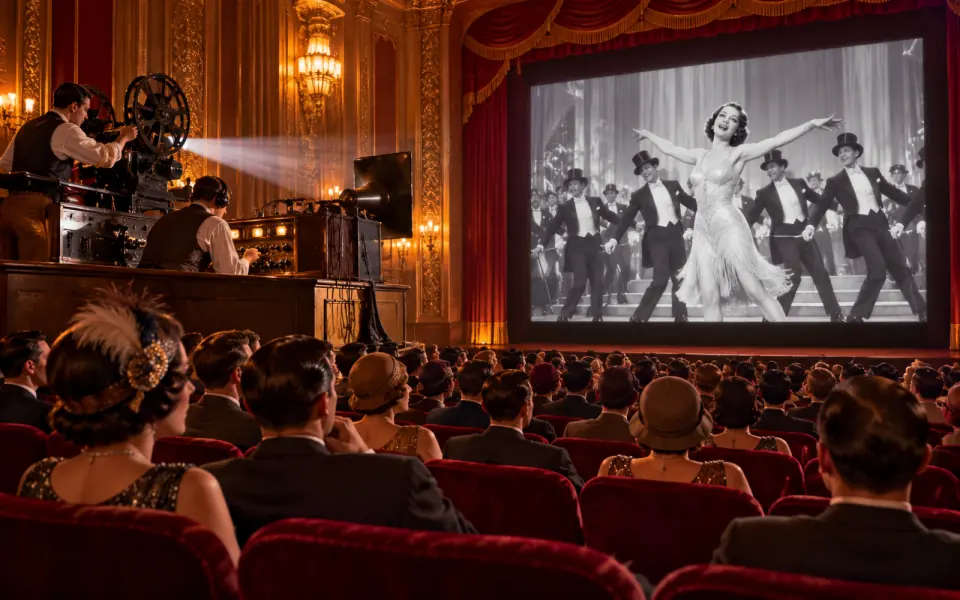 AfterTalking pictures1927
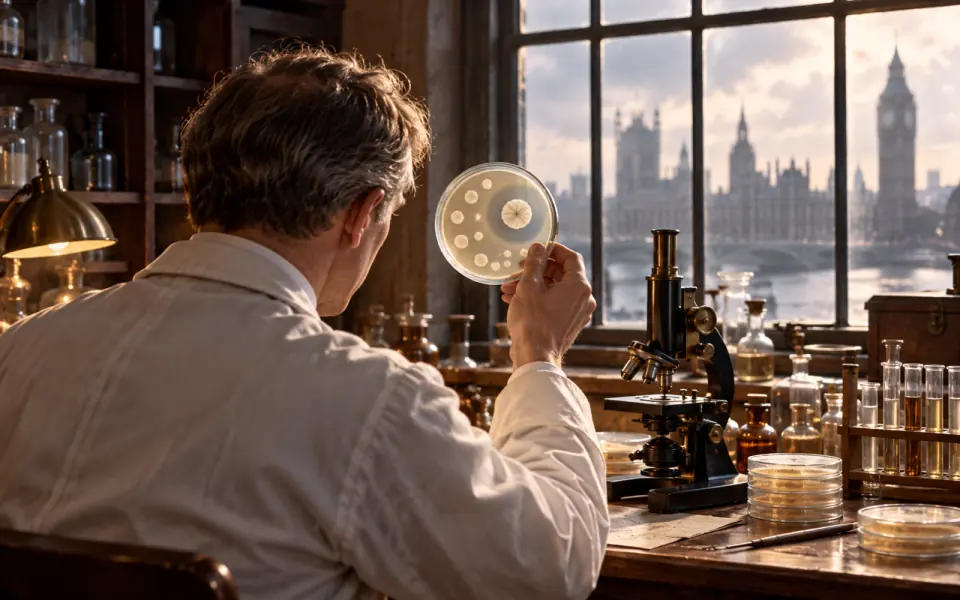 AfterThe discovery of penicillin1928
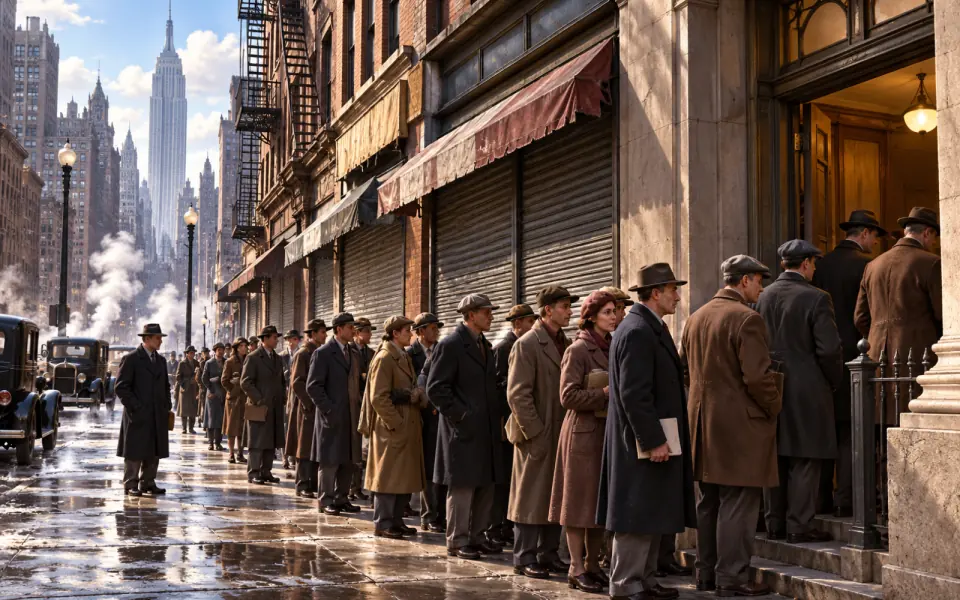 AfterThe Great Depression1929
 AfterPicasso's Guernica1937
 AfterThe Second World War1939–1945
 AfterThe Shoahabout 1941–1945
 AfterAnne Frank writes her diary1942
 AfterFermi and the first atomic pile1942
 AfterThe Italian Resistance1943–1945
 AfterThe Italian Republic and votes for women1946
 AfterThe first general-purpose electronic computer1946
 AfterThe Italian Constitution1948
 AfterPost-war rebuildingabout 1948
 AfterTelevision spreadsabout 1950
Listen / Read next
- Music to read by: Cinematic JourneyEpic film-style music, no lyrics, by Ciro Simone IrmiciSpotifyYouTube Music
Meanwhile, elsewhere in the world
Other events of the era “Early 20th century”
- The first powered flight
- Special relativity
- Maria Montessori's Children's House
- Abstract art
- Marie Curie and her two Nobel Prizes
- The First World War
- The Russian Revolution
- Jazz spreads
- Insulin against diabetes
- Totalitarian regimes in Europe
- Talking pictures
- The discovery of penicillin
- The Great Depression
- Picasso's Guernica
- The Second World War
- The Shoah
- Anne Frank writes her diary
- Fermi and the first atomic pile
- The Italian Resistance
- The Italian Republic and votes for women
- The first general-purpose electronic computer
- The Italian Constitution
- Post-war rebuilding
- Television spreads
