The first modern motor car
1886 Mannheim, Germany
In short
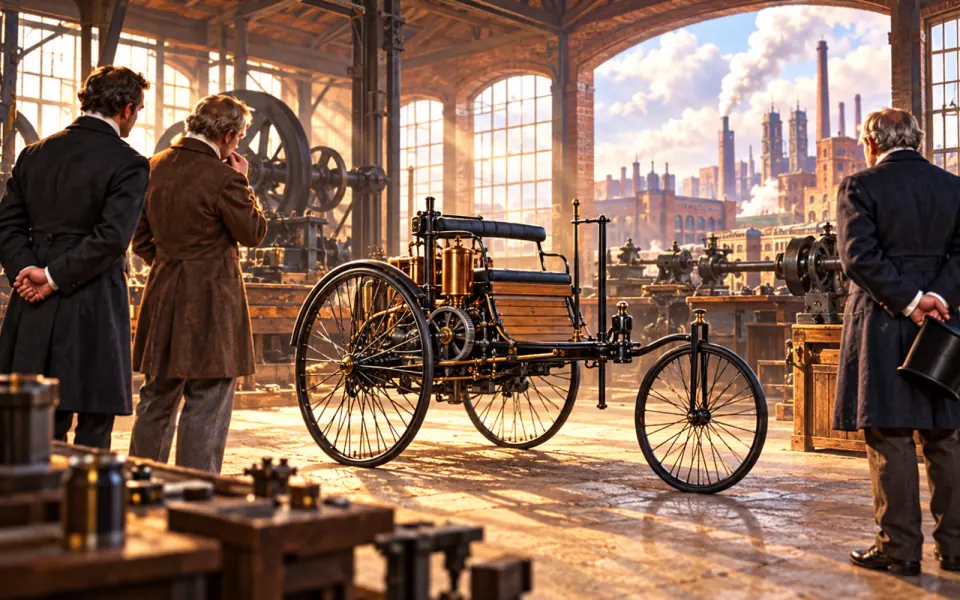
The German engineer Karl Benz built a three-wheeled vehicle driven by a petrol engine, and in 1886 he was granted the patent. His Motorwagen had less than one horsepower and went only a little faster than a person running. In 1888 his wife Bertha drove it more than a hundred kilometres, from Mannheim to Pforzheim, with their two sons, to prove that it worked. On the way she bought fuel at a chemist's.
Why it matters From that first vehicle came the motor car, which in the 20th century changed cities, work and travel.
Source: Encyclopaedia Britannica, “Karl Benz”
Study card about 5 minutes of reading
The story
Roads without engines
At the end of the 19th century, in town and country, people got around on foot, on horseback, in carriages, by bicycle, on horse-drawn trams or, for long distances, by train. The streets were full of horses, and of a problem nobody knew how to solve: tons of dung and the smell. Meanwhile engines were being born. The steam engine was huge and slow to start, and not suited to a small vehicle. A light, powerful engine was needed.
The solution was the internal combustion engine, in which a fuel is burned inside a cylinder, pushing a piston. In 1876 the German Nikolaus Otto built a four-stroke gas engine: intake, compression, explosion and exhaust. It worked well, but it used gas, which you cannot carry with you. The right idea was to use a liquid fuel, such as petrol, a product of oil that was then used mostly for removing stains.
Karl Benz
Karl Benz was born in 1844 in Karlsruhe, in Germany, the son of a locomotive driver who died when he was two. His mother, with great sacrifices, paid for his studies. He became an engineer and opened a small engine factory in Mannheim. For years he had dreamed of a “carriage without horses”, and he worked with a single-cylinder engine that burned petrol: light, with about one horsepower, a horizontal flywheel and electric ignition.
Benz did not simply put an engine on a carriage: he understood that the vehicle and the engine had to be designed together. He built a small three-wheeled vehicle, with a frame of steel tubes and spoked wheels like those of a bicycle, with the rear wheels driven by a chain and a single seat. On 29 January 1886 he applied for a patent for it, granted on 2 November with the number 37435: it is considered the birth certificate of the automobile. The vehicle was called the “Benz Patent-Motorwagen”, meaning “patented motor car”.
In the same period, in another German city, Stuttgart, two other Germans, Gottlieb Daimler and his collaborator Wilhelm Maybach, built another machine, with a similar engine mounted on a four-wheeled carriage (1886) and, the year before, on a wooden bicycle, the first motorcycle. The two groups did not know each other: later their companies would merge, creating Mercedes-Benz.
Bertha's first trip
At first people found the machine noisy, dangerous and useless. Benz was a perfectionist, and doubted it himself: he tested it only at night and in secret. It was his wife Bertha who gave him the decisive push. One morning in August 1888, at dawn, without telling him, she took the machine, with their two teenage sons Eugen and Richard, and set off from Mannheim to visit her mother at Pforzheim, more than a hundred kilometres away. It was the first long journey in an automobile.
It was a journey full of surprises. The tank was small, and Bertha had to buy a cleaning solvent, “ligroin”, at a chemist's in Wiesloch, which is therefore considered the world's first filling station. When a fuel pipe got blocked, she cleared it with a hatpin; when a wire came bare, she insulated it with a garter; and when the wooden brakes wore out, she had a cobbler fit pieces of leather: these were the first brake pads. She arrived in the evening, and sent her husband a telegram to let him know. The journey got all Germany talking and showed that the automobile worked.
From the car for a few to the car for everyone
The first cars were expensive, reserved for a few rich people. In 1908 the American Henry Ford introduced the “Model T”, simple, sturdy and cheap, and from 1913 he had it built on an assembly line, in which the work passes in front of the workers, who always repeat the same operation. The building time fell from twelve hours to less than two, and the price dropped: millions of Americans could afford a car.
In Italy the first petrol-engined vehicle was the tricycle of the engineer Enrico Bernardi of Padua (1894), and in 1899 Fiat was founded in Turin, the “Fabbrica italiana automobili Torino” (“Italian Automobile Factory of Turin”).
Why it happened
The automobile came from the meeting of the internal combustion engine and the need for a personal vehicle, able to go wherever you want, without rails. Oil, discovered in Pennsylvania in 1859, provided the fuel.
It was the invention of many people: Benz, Daimler, Maybach, but also the Frenchman Panhard and others. In many countries, engineers and mechanics were working on light engines. Benz had the merit of being the first to patent a petrol-engined vehicle designed as a whole.
What changed
The automobile changed the world. It allowed free and fast travel and changed cities: roads, motorways, car parks, petrol stations and residential districts far from the centre were built. Gigantic industries were born, from car factories to makers of tyres, steel and oil, and millions of jobs. In Italy the car, with the Fiat 500 and 600, was the symbol of the economic boom.
It also had a negative side: accidents, which cause many deaths every year, air pollution, traffic and carbon dioxide emissions, which contribute to the warming of the Earth. It is estimated that there are about one and a half billion vehicles in the world.
Today the automobile is changing again, with electric cars, which give off no exhaust gas, driver-assistance systems and shared transport. It is interesting to remember that even the first electric cars already existed at the end of the 19th century. Bertha Benz's journey is a reminder that to change things you need courage and a willingness to try.
Key people and places
People
- Karl Benz
- German engineer (1844–1929): in 1886 he built and patented the first petrol-driven automobile.
- Bertha Benz
- German businesswoman (1849–1944): in 1888 she made the first long journey in an automobile.
- Gottlieb Daimler
- German engineer (1834–1900): with Maybach he built light engines and four-wheeled vehicles.
- Wilhelm Maybach
- German engineer (1846–1929): he worked with Daimler and invented the spray carburettor.
- Henry Ford
- American businessman (1863–1947): he made the automobile affordable with the assembly line.
Places
- Mannheim, Germany
- The city where Karl Benz had his workshop and from which Bertha Benz set out in 1888.
- Wiesloch, Germany
- The town where Bertha bought fuel at a chemist's: the first “filling station”.
Good to know
- Benz's patent, applied for on 29 January 1886 and granted on 2 November, has the number 37435.
- In 1888 Bertha Benz travelled more than a hundred kilometres with her sons, without her husband: the first long journey in an automobile.
- Bertha used a hatpin to clear the fuel pipe and a garter to insulate a wire.
- With Ford's assembly line the time to build a car fell from twelve hours to less than two.
- Fiat was founded in Turin in 1899.
Find out more
- Mercedes-Benz, “Benz Patent-Motorwagen” group.mercedes-benz.com
- Wikipedia, “Benz Patent-Motorwagen” en.wikipedia.org
- Wikipedia, “Bertha Benz” en.wikipedia.org
- Wikipedia, “History of the automobile” en.wikipedia.org
Related events
- The first public steam railway1825 · Age of revolutionsBefore the car, the locomotive had revolutionised travel.
- A practical electric light bulb1879 · Age of revolutionsElectricity and the engine changed life in the same period.
- The first powered flight1903 · Early 20th centuryA few years later, the Wrights' flight opened the age of aviation.
- The Paris Agreement on climate2015 · TodayToday we try to reduce engine emissions to protect the climate.
Before and after, in the era “Age of revolutions”
Event 24 of 25
 BeforeNewcomen's steam engine1712
 BeforeThe European Enlightenmentabout 1720
 BeforeDiderot's Encyclopédie1751
 BeforeWatt's steam engine1769
 BeforeThe American Revolution1776–1783
 BeforeThe first hot-air balloon flight1783
 BeforeThe French Revolution1789–1799
 BeforeThe metric system1795
 BeforeJenner's vaccine1796
 BeforeVolta's battery1800
 BeforeNapoleon becomes emperor1804
 BeforeThe Congress of Vienna1815
 BeforeThe first public steam railway1825
 BeforeNiépce's photographabout 1826
 BeforeManzoni's The Betrothed1827
 BeforeThe electric telegraph1844
 BeforeThe revolutions of 18481848
 BeforeDarwin publishes On the Origin of Species1859
 BeforeThe Expedition of the Thousand1860
 BeforeThe unification of Italy1861
 BeforeThe labour movementabout 1864
 BeforeCompulsory primary school (Coppino law)1877
 BeforeA practical electric light bulb1879
- You are hereThe first modern motor car1886
 AfterThe Lumière brothers' cinema1895
Listen / Read next
- Music to read by: Cinematic JourneyEpic film-style music, no lyrics, by Ciro Simone IrmiciSpotifyYouTube Music
Meanwhile, elsewhere in the world
Other events of the era “Age of revolutions”
- Newcomen's steam engine
- The European Enlightenment
- Diderot's Encyclopédie
- Watt's steam engine
- The American Revolution
- The first hot-air balloon flight
- The French Revolution
- The metric system
- Jenner's vaccine
- Volta's battery
- Napoleon becomes emperor
- The Congress of Vienna
- The first public steam railway
- Niépce's photograph
- Manzoni's The Betrothed
- The electric telegraph
- The revolutions of 1848
- Darwin publishes On the Origin of Species
- The Expedition of the Thousand
- The unification of Italy
- The labour movement
- Compulsory primary school (Coppino law)
- A practical electric light bulb
- The Lumière brothers' cinema
