The Italian Constitution
1948 Palazzo Montecitorio, Rome, Italy
In short
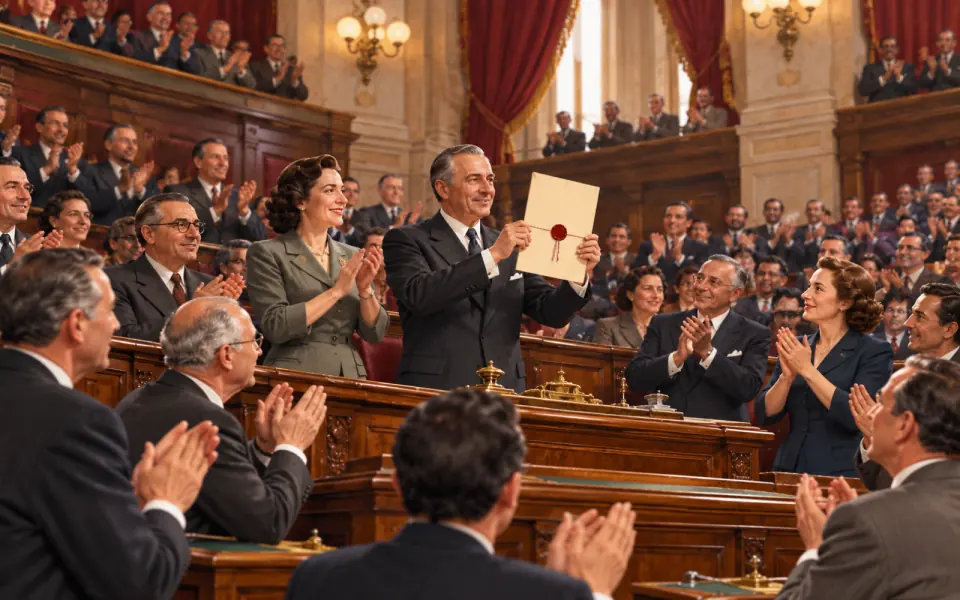
The Constituent Assembly worked for a year and a half to write the basic rules of the new Italy. The Constitution was approved on 22 December 1947 and came into force on 1 January 1948. Its 139 articles say that Italy is a democratic Republic founded on work, that all citizens are equal before the law and that Italy rejects war. It also states that school is open to all and that the first years of education are compulsory and free.
Why it matters It is the country's most important law: every other law must respect it.
Source: Senato della Repubblica, “La Costituzione”
Study card about 5 minutes of reading
The story
Writing everyone's rules
After 2 June 1946, the Constituent Assembly, elected by the Italians, had an enormous task: to write the Constitution, that is, the fundamental law on which the new Republic was to stand. It was a difficult task, because the Assembly was made up of people with very different ideas: Christian Democrats, Communists, Socialists, Liberals, Republicans, members of the Common Man Front. They had fought Fascism, but they disagreed on many things about the society they wanted to build.
To prepare the text a committee of seventy-five members was set up, called the “Committee of 75”, divided into three subcommittees. From 1947 the president of the Assembly was Umberto Terracini, an anti-Fascist lawyer who had spent years in prison under Fascism. They worked for a year and a half, in long discussions, and every article was weighed word by word. In the end the various groups, respecting one another, reached an agreement that took account of all the ideas, and that was based on some shared values: freedom, equality, social justice, peace.
22 December 1947
On 22 December 1947 the Assembly approved the final text with 453 votes in favour and 62 against. The provisional head of state, Enrico De Nicola, promulgated it on 27 December, and the Constitution came into force on 1 January 1948. An original copy of the text is kept in Rome, in the historical archive of the Quirinal. It has 139 articles, plus some transitional and final provisions.
How it is built
The Constitution opens with the twelve “fundamental principles”, the most important rules. Article 1 says: “Italy is a democratic Republic, founded on labour. Sovereignty belongs to the people, who exercise it in the forms and within the limits of the Constitution.” That is, power belongs to the citizens, who exercise it by voting. Article 3 states that all citizens have equal dignity and are equal before the law, without distinction of sex, race, language, religion or political opinion, and that the Republic must remove the obstacles that stop equality from being real. Article 9 promotes culture and research and protects the landscape and the artistic heritage. Article 11 declares that “Italy rejects war as an instrument of aggression against the freedom of other peoples and as a means of settling international disputes”.
The first part deals with the rights and duties of citizens: personal freedom, freedom of thought and of the press, the right to health, to education (“schools are open to everyone”), to work, the right to strike, the duty to pay taxes fairly and to defend the homeland. The second part describes how the State is organised: Parliament, the government, the President of the Republic, the judges, the regions, the provinces and the municipalities.
To prevent anyone from changing the rules at will, the Italian Constitution is “rigid”: to amend it, long procedures and very large majorities are needed. A Constitutional Court, made up of judges, checks that laws conform to the Constitution. It was set up in 1956.
A Constitution against the past
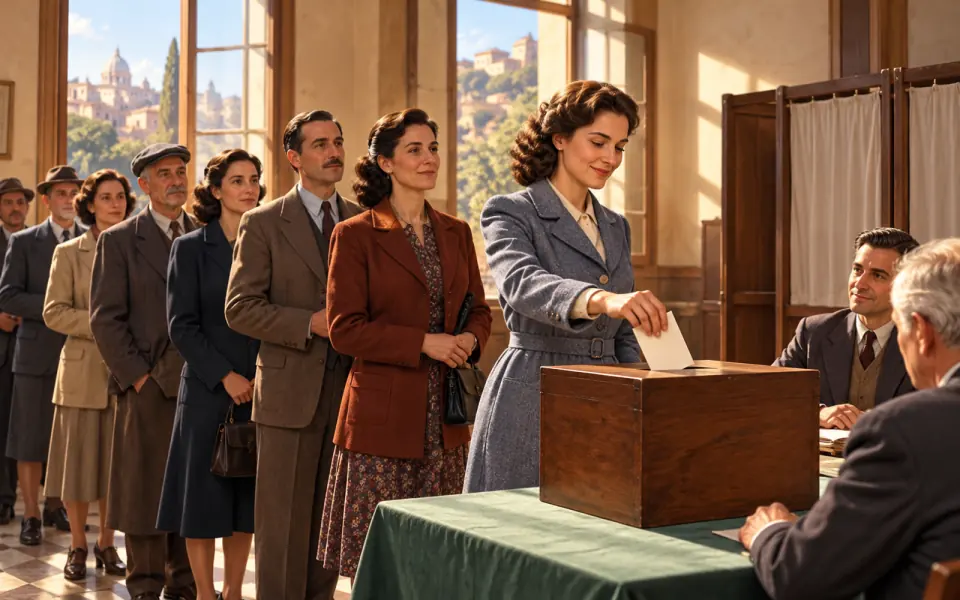
Many articles come from the memory of Fascism and war. The Constitution guarantees the freedoms that the dictatorship had suppressed: the right to assemble, to found parties and trade unions, to express one's thoughts. It forbids the re-formation of the Fascist party and lays down that nobody may be persecuted for their religion or their ideas. Women, who had just voted for the first time, have the same rights as men.
In 1955 Piero Calamandrei, one of the founding fathers, spoke to a group of students in Milan and said that the Constitution is a piece of paper that does not move on its own: it is not a machine that, once started, keeps going by itself, but needs everyone's commitment every day: “it is a testament of a hundred thousand dead”, words that many still remember.
Why it happened
The Constitution came from the desire to build a new country after twenty years of dictatorship and a devastating war. After the experience of Fascism, which had eliminated freedoms, the framers wanted a system that would safeguard citizens' rights and prevent power from being concentrated in a few hands.
It was possible because, in the Resistance and in the Constituent Assembly, the great political forces were able to work together. The great traditions, Catholic, Communist and Socialist, and the Liberal one, met and found common values.
What changed
For more than seventy-five years the Constitution has been the basis of Italian democratic life. Laws on schools, health, work and family law have been founded on it. Many achievements, such as the Workers' Statute (1970), the National Health Service (1978) and equality between men and women in the family (1975), were built on its principles.
Over time it has been amended in some parts: in 2001 the articles on the regions were changed; in 2022 the protection of the environment and of animals was added to Article 9; in 2016 a referendum rejected a broader reform. Every important change requires long debate.
For many citizens, and for schools, the Constitution is a “compass”. Even young people know its principles, studying its articles as part of civic education. For democracy to work, Calamandrei reminded us, citizens must know it and defend it.
Key people and places
People
- Umberto Terracini
- Italian politician (1895–1983): president of the Constituent Assembly.
- Enrico De Nicola
- Lawyer (1877–1959): he promulgated the Constitution on 27 December 1947.
- Alcide De Gasperi
- Politician (1881–1954): prime minister while the Constitution was being drafted.
- Piero Calamandrei
- Lawyer and writer (1889–1956): a member of the Constituent Assembly, famous for his speech to students.
- Lina Merlin
- Italian politician (1887–1979): a member of the Assembly, she wanted equality between men and women written into Article 3.
Places
- Palazzo Montecitorio, Rome
- The seat of the Constituent Assembly and today of the Chamber of Deputies.
- Quirinal Palace, Rome
- The original of the Constitution is kept here, and it is the seat of the President of the Republic.
Good to know
- The Italian Constitution has 139 articles, plus the transitional and final provisions.
- It was approved on 22 December 1947 with 453 votes in favour and 62 against.
- It came into force on 1 January 1948.
- Article 11 states that Italy “rejects war” as an instrument of aggression.
- Since 2022 Article 9 also protects the environment and animals.
Find out more
- Wikipedia, “Italian Constituent Assembly” en.wikipedia.org
- Wikipedia, “Constitution of Italy” en.wikipedia.org
- Wikipedia, “Constitutional Court of Italy” en.wikipedia.org
Related events
- The Italian Republic and votes for women1946 · Early 20th centuryThe Constituent Assembly was elected on 2 June 1946.
- The Italian Resistance1943–1945 · Early 20th centuryThe values of the Resistance entered the Constitution.
- Totalitarian regimes in Europe1922 · Early 20th centuryThe Constitution is a response to twenty years of dictatorship.
- Anne Frank writes her diary1942 · Early 20th centuryAnne Frank's diary reminds us why rights must be defended.
Before and after, in the era “Early 20th century”
Event 23 of 25
 BeforeThe first powered flight1903
 BeforeSpecial relativity1905
 BeforeMaria Montessori's Children's House1907
 BeforeAbstract artabout 1910
 BeforeMarie Curie and her two Nobel Prizes1911
 BeforeThe First World War1914–1918
 BeforeThe Russian Revolution1917
 BeforeRadio for everyoneabout 1920
 BeforeJazz spreadsabout 1920
 BeforeInsulin against diabetes1922
 BeforeTotalitarian regimes in Europe1922
 BeforeTalking pictures1927
 BeforeThe discovery of penicillin1928
 BeforeThe Great Depression1929
 BeforePicasso's Guernica1937
 BeforeThe Second World War1939–1945
 BeforeThe Shoahabout 1941–1945
 BeforeAnne Frank writes her diary1942
 BeforeFermi and the first atomic pile1942
 BeforeThe Italian Resistance1943–1945
 BeforeThe Italian Republic and votes for women1946
 BeforeThe first general-purpose electronic computer1946
- You are hereThe Italian Constitution1948
 AfterPost-war rebuildingabout 1948
 AfterTelevision spreadsabout 1950
Listen / Read next
- Music to read by: Cinematic JourneyEpic film-style music, no lyrics, by Ciro Simone IrmiciSpotifyYouTube Music
Meanwhile, elsewhere in the world
Other events of the era “Early 20th century”
- The first powered flight
- Special relativity
- Maria Montessori's Children's House
- Abstract art
- Marie Curie and her two Nobel Prizes
- The First World War
- The Russian Revolution
- Radio for everyone
- Jazz spreads
- Insulin against diabetes
- Totalitarian regimes in Europe
- Talking pictures
- The discovery of penicillin
- The Great Depression
- Picasso's Guernica
- The Second World War
- The Shoah
- Anne Frank writes her diary
- Fermi and the first atomic pile
- The Italian Resistance
- The Italian Republic and votes for women
- The first general-purpose electronic computer
- Post-war rebuilding
- Television spreads
