The Great Depression
1929 Wall Street, New York, United States (and then the whole world)
In short
In the 1920s many Americans had bought shares, small parts of companies, hoping their value would keep on rising. In October 1929 the New York Stock Exchange, on Wall Street, crashed: in a few days a huge number of people lost their savings. Banks and factories closed, and in the United States in 1933 about one worker in four had no job. The crisis spread to Europe and the rest of the world.
Why it matters It taught that countries' economies are linked and pushed governments to step in more, as President Roosevelt did with the New Deal.
Source: Encyclopaedia Britannica, “Great Depression”
Study card about 5 minutes of reading
The story
The Roaring Twenties
In the United States, the 1920s were a time of great optimism. After the First World War the country had become the world's leading economic power. Factories turned out cars, household appliances and radios without stopping, and many families bought on credit, that is, paying a little at a time. The New York Stock Exchange, where shares in companies are bought and sold, kept rising and rising: huge numbers of people, even ordinary ones, invested in shares, convinced that prices would go on rising for ever. Some borrowed money from the banks to buy even more shares.
But beneath the surface there were problems. Many farmers were deep in debt, because the price of wheat had fallen; workers' wages were not growing as fast as company profits, so many people did not have enough money to buy everything the factories produced. Shares were worth far more than the companies really produced: it was a “bubble”, like a soap bubble, ready to burst.
The October crash
At the beginning of October 1929 share prices began to fall. On Thursday 24 October, “Black Thursday”, thousands of frightened investors tried to sell everything at once: prices plunged. Some big banks stepped in to calm the market, but on 29 October, “Black Tuesday”, more than sixteen million shares were sold in a single day, a number never seen before, and prices collapsed again. In a few weeks, many people lost all their savings.
The stock market crash alone does not explain what happened next. But it was the spark: people who had lost money stopped buying, companies sold less and laid off workers; many banks, which had lent money to people who could not pay it back, failed, and the people who had deposited their savings there never saw their money again. Fear made the crisis worse: the more frightened people were, the less they spent, and the more companies closed.
The Great Depression
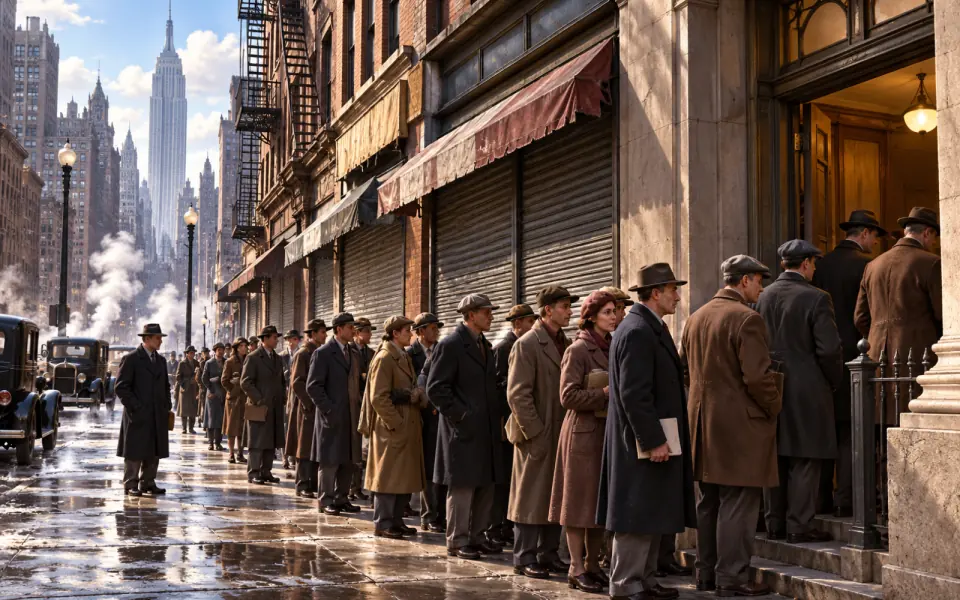
Between 1929 and 1933 American industrial production fell by almost half and unemployment reached one worker in four. The cities filled with people who had no home and no job, who lived in shacks called, ironically, “Hoovervilles” after President Herbert Hoover, and queued outside soup kitchens. On the Great Plains, a terrible drought and dust storms, the “Dust Bowl”, ruined hundreds of thousands of farmers, many of whom moved to California in search of work: their story is told by John Steinbeck in the novel The Grapes of Wrath.
The crisis spread all over the world, because economies were connected: the United States stopped buying goods abroad and called in its loans from Europe. Germany, already in difficulty because of war reparations, was hit hard, with millions out of work. Italy suffered too: the Fascist government created public institutions, such as the IRI in 1933, to rescue the banks and the big companies.
The New Deal
In 1932 the Americans elected Franklin Delano Roosevelt as president, who promised “a new deal” for the people: the New Deal. The government stepped in decisively: it closed the banks temporarily to check them and restore confidence, created insurance on deposits, paid for big public works, such as dams, roads and bridges, which gave jobs to millions of unemployed people, and introduced the first pensions and unemployment benefits. Roosevelt spoke to citizens on the radio in his “fireside chats”, calmly explaining what he was doing.
The recovery was slow, and unemployment stayed high until the Second World War, when the factories began to produce weapons and work returned.
Why it happened
The Great Depression came from a combination of causes: overproduction and too much debt, a stock market swollen by speculation, banks that were poorly supervised, an unequal distribution of wealth and a fragile system of international trade after the war. When confidence disappeared, everything collapsed.
The mistakes of governments and central banks made the crisis worse: they let many banks fail, reduced the amount of money in circulation and in 1930 raised taxes on foreign goods with a law, the Smoot-Hawley Act, which reduced world trade.
What changed
The Great Depression changed the role of the state in the economy. Before, people thought the government should step in very little; afterwards, the idea was accepted that it could and should help people who lose their jobs, supervise the banks and support the economy in difficult times. The modern “welfare state” was born, with pensions, benefits and insurance. The English economist John Maynard Keynes argued that in times of crisis the state should spend more to get the economy moving again.
It also had serious political consequences: poverty and despair helped extremist movements to rise, such as Nazism in Germany, which led to the Second World War.
After the crisis a system of rules for finance was created, to avoid further crashes: checks on banks, rules for the stock exchange. When another great crisis broke out in 2008, many people asked whether the lessons of 1929 had been forgotten, and the two events were often compared.
Key people and places
People
- Franklin Delano Roosevelt
- American president (1882–1945): he led the United States through the crisis with the New Deal.
- Herbert Hoover
- American president (1874–1964): he was in power when the crisis broke out.
- John Maynard Keynes
- English economist (1883–1946): he argued that in a crisis the state should spend to restart the economy.
- John Steinbeck
- American writer (1902–1968): in the novel The Grapes of Wrath he told the story of families ruined by the Dust Bowl; Nobel Prize in Literature in 1962.
- Dorothea Lange
- American photographer (1895–1965): with her “Migrant Mother” she showed the world the poverty of the Depression.
Places
- Wall Street, New York
- The street of the New York Stock Exchange, where panic broke out on 24 and 29 October 1929.
- Dust Bowl plains, United States
- The farming regions in the middle of the United States hit by drought and dust storms in the 1930s.
Good to know
- On 29 October 1929, “Black Tuesday”, more than sixteen million shares were sold on the stock exchange in a single day.
- In the worst years of the crisis, one worker in four in the United States was unemployed.
- The shacks of the homeless in the 1930s were called “Hoovervilles”, after the president.
- Roosevelt spoke to citizens on the radio in his “fireside chats”.
- Steinbeck's novel The Grapes of Wrath tells of the families forced to migrate from the Dust Bowl.
Find out more
- Wikipedia, “Great Depression” en.wikipedia.org
- Federal Reserve History, “The Great Depression” federalreservehistory.org
- Wikipedia, “Great Depression” en.wikipedia.org
- Wikipedia, “New Deal” en.wikipedia.org
Related events
- The First World War1914–1918 · Early 20th centuryThe war debts and reparations had weakened the European economy.
- Totalitarian regimes in Europe1922 · Early 20th centuryThe crisis helped totalitarian regimes to rise.
- The global financial crisis2008 · TodayThe 2008 crisis was often compared with that of 1929.
- The Second World War1939–1945 · Early 20th centuryThe crisis paved the way for the Second World War.
Before and after, in the era “Early 20th century”
Event 14 of 25
 BeforeThe first powered flight1903
 BeforeSpecial relativity1905
 BeforeMaria Montessori's Children's House1907
 BeforeAbstract artabout 1910
 BeforeMarie Curie and her two Nobel Prizes1911
 BeforeThe First World War1914–1918
 BeforeThe Russian Revolution1917
 BeforeRadio for everyoneabout 1920
 BeforeJazz spreadsabout 1920
 BeforeInsulin against diabetes1922
 BeforeTotalitarian regimes in Europe1922
 BeforeTalking pictures1927
 BeforeThe discovery of penicillin1928
- You are hereThe Great Depression1929
 AfterPicasso's Guernica1937
 AfterThe Second World War1939–1945
 AfterThe Shoahabout 1941–1945
 AfterAnne Frank writes her diary1942
 AfterFermi and the first atomic pile1942
 AfterThe Italian Resistance1943–1945
 AfterThe Italian Republic and votes for women1946
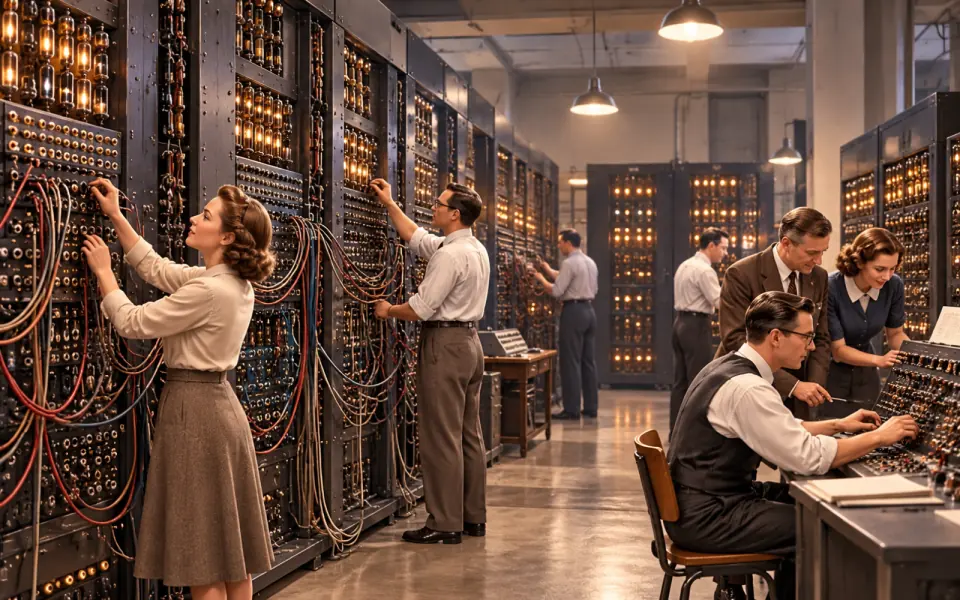 AfterThe first general-purpose electronic computer1946
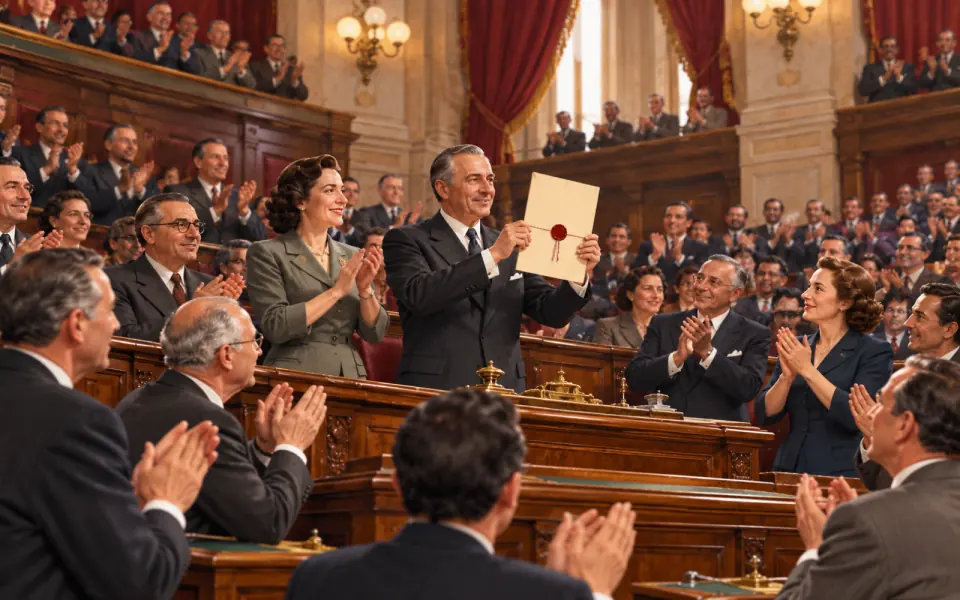 AfterThe Italian Constitution1948
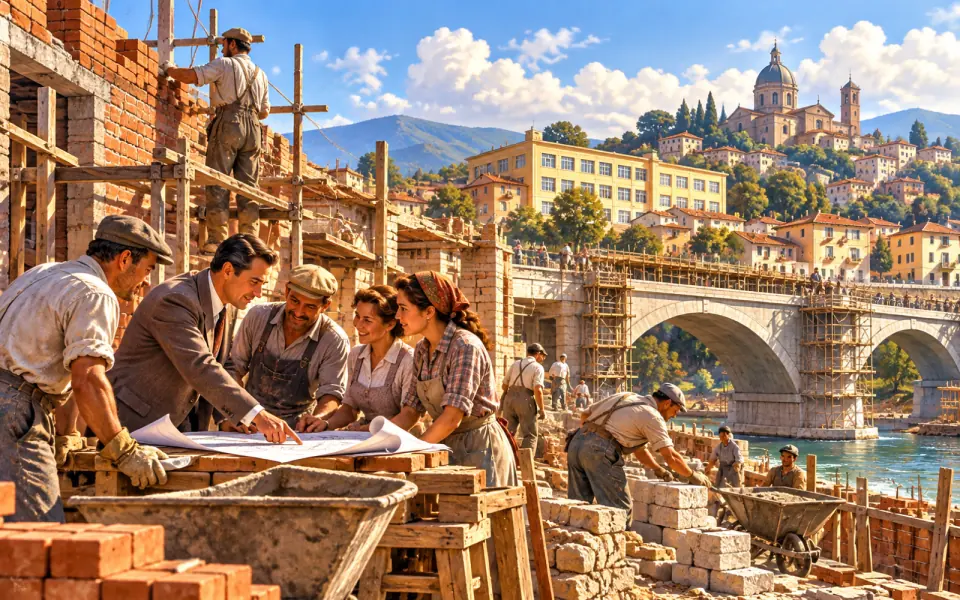 AfterPost-war rebuildingabout 1948
 AfterTelevision spreadsabout 1950
Listen / Read next
- Music to read by: Cinematic JourneyEpic film-style music, no lyrics, by Ciro Simone IrmiciSpotifyYouTube Music
Meanwhile, elsewhere in the world
Other events of the era “Early 20th century”
- The first powered flight
- Special relativity
- Maria Montessori's Children's House
- Abstract art
- Marie Curie and her two Nobel Prizes
- The First World War
- The Russian Revolution
- Radio for everyone
- Jazz spreads
- Insulin against diabetes
- Totalitarian regimes in Europe
- Talking pictures
- The discovery of penicillin
- Picasso's Guernica
- The Second World War
- The Shoah
- Anne Frank writes her diary
- Fermi and the first atomic pile
- The Italian Resistance
- The Italian Republic and votes for women
- The first general-purpose electronic computer
- The Italian Constitution
- Post-war rebuilding
- Television spreads
