A practical electric light bulb
1879 Menlo Park, New Jersey, United States
In short
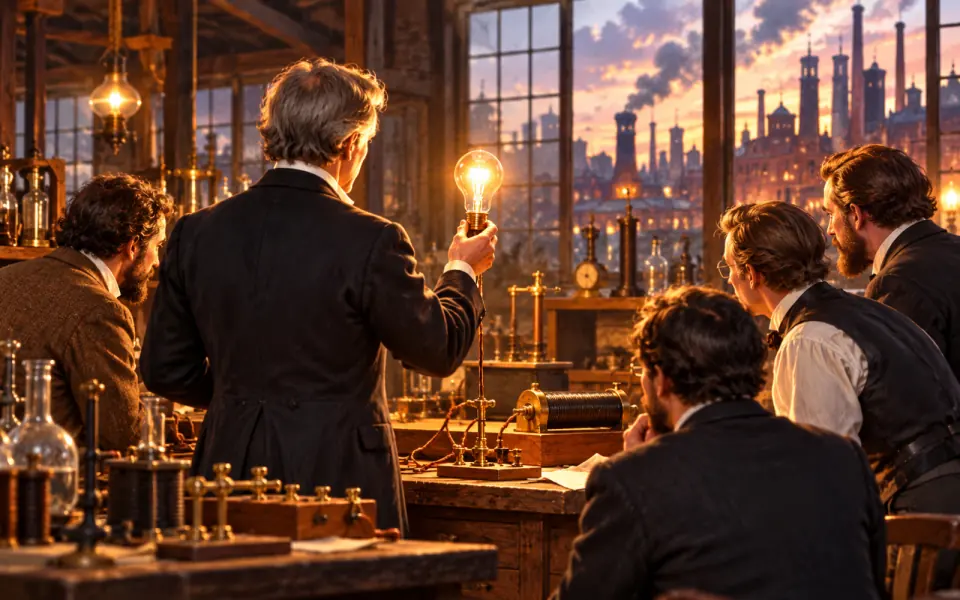
Many inventors were trying to produce light with electricity, but the filaments burnt out quickly. In the laboratory at Menlo Park, in the United States, Thomas Edison and his team tried thousands of materials. In 1879 a bulb with a thread of carbonised cotton, sealed in a glass bulb with no air, stayed alight for more than 13 hours. At around the same time the Englishman Joseph Swan had achieved a similar result.
Why it matters Edison also built the power stations and cables to bring electricity into homes, and night in the cities changed for ever.
Source: Encyclopaedia Britannica, “Thomas Edison”
Study card about 5 minutes of reading
The story
The darkness of evening
For thousands of years, when the Sun set, life slowed down. To make light people used the fire in the hearth, torches, wax or tallow candles, oil lamps. In the 19th century gas lighting spread, in streets and in the homes of the rich: there were street lamps, lit one by one every evening by a man with a long pole, but gas was expensive, dirty and dangerous, because it could cause fires and poisoning. For big squares and theatres arc lamps were also used, which produced a very powerful light, but dazzling and too strong for homes.
After Volta's battery and the discoveries about electricity, many inventors thought of a softer, safer electric light: an incandescent lamp, in which an electric current makes a very thin wire, the “filament”, glow white-hot inside a glass bulb from which the air has been removed. Between 1840 and 1870 many attempts were made. The problem was to find a material that could withstand the heat without burning up and that would last long enough.
Two inventors, one light bulb
At the end of the 1870s two men, one in England and one in America, got there almost at the same time. The Englishman Joseph Swan, a chemist from Newcastle, built a lamp with a carbon filament in 1878–79 and showed it in public. The American Thomas Edison, the famous inventor of the phonograph, had founded a big laboratory at Menlo Park, in New Jersey, a real “invention factory”, where dozens of technicians and workers worked. His aim was a cheap, long-lasting and practical light bulb, and a whole system for bringing electricity into homes.
Edison and his collaborators tried thousands of materials: platinum, filaments of every kind, even hair and plant fibres. On 22 October 1879, according to tradition, a bulb with a carbonised cotton thread stayed lit for about thirteen and a half hours; soon afterwards one with a carbonised bamboo filament lasted more than a thousand hours. This was enough for a bulb that could be sold. Between 31 December 1879 and the first days of 1880, at Menlo Park, hundreds of visitors came to see the laboratory lit by light bulbs.
A network of light
The light bulb alone was not enough: electricity was needed. So Edison also invented the generators, the cables, the meters and the power station. On 4 September 1882, in New York, in Pearl Street, in the financial district, the first big commercial power station was opened: it brought light to a few dozen customers (59 according to many sources), including banks and newspapers, with about four hundred lamps. Soon afterwards the first districts of London were lit too.
And in Italy?
Italy was among the first too. In Milan, in 1883, the engineer Giuseppe Colombo, with Edison's backing, built in the city centre, at Santa Radegonda, near the Cathedral, the first power station in continental Europe. The Teatro alla Scala, on the evening of 26 December 1883, was the first big theatre to be lit by electric lamps, to the amazement of the audience. A few years later Rome and other Italian cities also began to have electric light.
The war of the currents
In the following years there was a technical contest: Edison used direct current, suited to short distances. Another inventor, Nikola Tesla, and the businessman George Westinghouse backed alternating current, which can be transmitted over long distances with less loss. After a long “war of the currents”, alternating current won, and was used at the Niagara power station in 1896.
Why it happened
The light bulb came from the coming together of many advances: producing a vacuum in glass bulbs, carbon filaments and the generation of electric current. Edison's merit was to see the whole system together: bulb, generator, cables, meters.
Teamwork counted, as did the investments of financiers, including J. P. Morgan's bank, and the determination to turn the invention into a product for everyone. Swan and others had also contributed, and to avoid lawsuits their companies merged in 1883.
What changed
Electric light changed life. Streets became safer, homes more comfortable, factories could work at night with more shifts, and hospitals and schools had better light. The evening began to be a time that could be lived in: people went to the theatre, to the cinema, they read. Then came household appliances, from the iron to the refrigerator, and electricity became the basis of modern life.
In the 20th century light bulbs improved: from 1910 the filament was made of tungsten, which is tougher; then came fluorescent lamps (1938) and, from the 1960s, LEDs, diodes that give off light without heating a wire. For the blue LEDs, which made it possible to produce efficient white light, three scientists of Japanese origin received the Nobel Prize in Physics in 2014. Incandescent bulbs, which wasted most of their energy as heat, have been gradually banned in Europe starting in 2009.
Electric light has also brought a new problem: light pollution, which in cities hides the stars and disturbs animals and people. Today we try to use smart lights, low-energy and aimed where they are needed, to save energy and to be able to see the night sky again now and then.
Key people and places
People
- Thomas Edison
- American inventor (1847–1931): he built the practical light bulb and the first commercial electric system.
- Joseph Swan
- English physicist and chemist (1828–1914): he built a carbon-filament light bulb in 1878–79.
- Nikola Tesla
- Serbian-American inventor (1856–1943): he championed alternating current.
- George Westinghouse
- American businessman (1846–1914): he promoted the use of alternating current.
- Giuseppe Colombo
- Italian engineer and politician (1836–1921): he built the first European power station in Milan in 1883.
Places
- Menlo Park, New Jersey (United States)
- Edison's laboratory, where the light bulb was perfected.
- Santa Radegonda, Milan
- The first power station in continental Europe, opened in 1883.
Good to know
- One of Edison's first light bulbs, in October 1879, stayed lit for about thirteen and a half hours.
- The first big commercial power station, in New York, was opened on 4 September 1882.
- The Teatro alla Scala was lit with electric light on the evening of 26 December 1883.
- The tungsten filament, used from 1910, is tougher than the carbon one.
- The Nobel Prize in Physics was awarded in 2014 for the blue LEDs, which made low-energy white light possible.
Find out more
- Wikipedia, “Incandescent light bulb” en.wikipedia.org
- Wikipedia, “Thomas Edison” en.wikipedia.org
- Wikipedia, “Joseph Swan” en.wikipedia.org
- Nobel Prize in Physics 2014, official site nobelprize.org
Related events
- Volta's battery1800 · Age of revolutionsVolta's battery had opened the way to electricity.
- The first modern motor car1886 · Age of revolutionsA few years later electricity and the engine also changed transport.
- The Lumière brothers' cinema1895 · Age of revolutionsWithout electric light there would be no cinema in dark halls.
- Earth Day and the environmental movement1970 · TodayToday we are also thinking about how to reduce pollution from light and energy.
Before and after, in the era “Age of revolutions”
Event 23 of 25
 BeforeNewcomen's steam engine1712
 BeforeThe European Enlightenmentabout 1720
 BeforeDiderot's Encyclopédie1751
 BeforeWatt's steam engine1769
 BeforeThe American Revolution1776–1783
 BeforeThe first hot-air balloon flight1783
 BeforeThe French Revolution1789–1799
 BeforeThe metric system1795
 BeforeJenner's vaccine1796
 BeforeVolta's battery1800
 BeforeNapoleon becomes emperor1804
 BeforeThe Congress of Vienna1815
 BeforeThe first public steam railway1825
 BeforeNiépce's photographabout 1826
 BeforeManzoni's The Betrothed1827
 BeforeThe electric telegraph1844
 BeforeThe revolutions of 18481848
 BeforeDarwin publishes On the Origin of Species1859
 BeforeThe Expedition of the Thousand1860
 BeforeThe unification of Italy1861
 BeforeThe labour movementabout 1864
 BeforeCompulsory primary school (Coppino law)1877
- You are hereA practical electric light bulb1879
 AfterThe first modern motor car1886
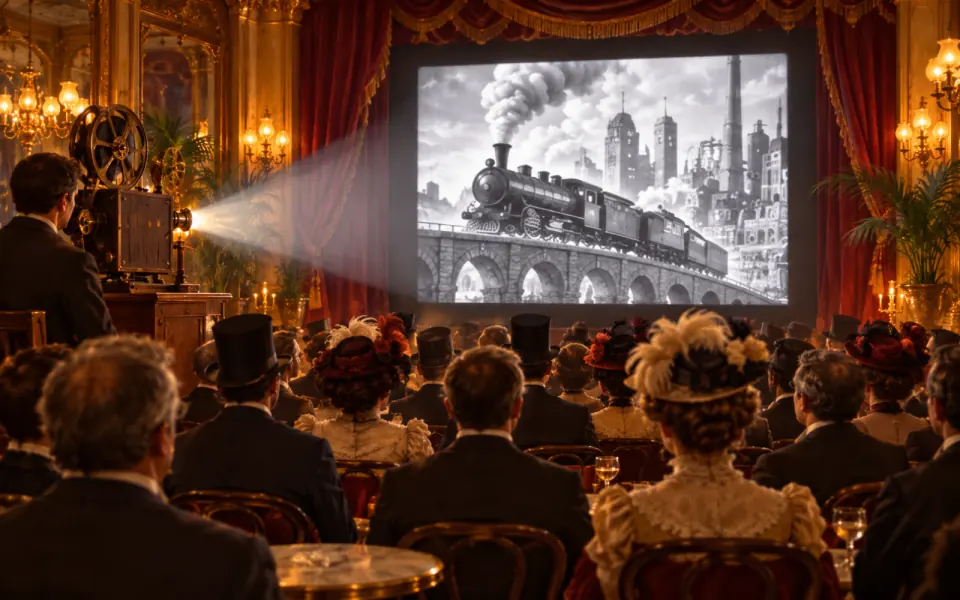 AfterThe Lumière brothers' cinema1895
Listen / Read next
- Music to read by: Cinematic JourneyEpic film-style music, no lyrics, by Ciro Simone IrmiciSpotifyYouTube Music
Meanwhile, elsewhere in the world
Other events of the era “Age of revolutions”
- Newcomen's steam engine
- The European Enlightenment
- Diderot's Encyclopédie
- Watt's steam engine
- The American Revolution
- The first hot-air balloon flight
- The French Revolution
- The metric system
- Jenner's vaccine
- Volta's battery
- Napoleon becomes emperor
- The Congress of Vienna
- The first public steam railway
- Niépce's photograph
- Manzoni's The Betrothed
- The electric telegraph
- The revolutions of 1848
- Darwin publishes On the Origin of Species
- The Expedition of the Thousand
- The unification of Italy
- The labour movement
- Compulsory primary school (Coppino law)
- The first modern motor car
- The Lumière brothers' cinema
