The modern smartphone
2007 San Francisco, United States
In short
There were already mobile phones you could read email on, but they had small keyboards and tiny screens. On 9 January 2007, in San Francisco, Steve Jobs presented the iPhone, a phone with hardly any buttons and a large screen to touch with your fingers. The following year app stores arrived, along with the first phones running Android. Within a few years the smartphone had become a camera, map, music player and pocket computer for billions of people.
Why it matters It has changed the way we communicate and find things out, and it also teaches us to be careful with screen time.
Source: Encyclopaedia Britannica, “iPhone”
Study card about 5 minutes of reading
The story
Phones with buttons
Until the early 2000s, a mobile phone was used mainly for making calls and sending text messages. In 1973 a Motorola engineer, Martin Cooper, had made the first call from a portable device, as big as a brick and weighing more than a kilo. Over time mobile phones became smaller and lighter: in the 1990s almost everyone wanted one, and brands such as Nokia and Motorola sold millions of them.
Someone had already tried to join the telephone with a small computer. In 1994 IBM had sold a device, the Simon, with a touch screen, an address book and a calendar. In the following years came Palm and BlackBerry devices, used by professionals to read email, usually with a small keyboard. They were useful, but complicated, with menus that were hard to learn, and a stylus or tiny keys for typing.
9 January 2007
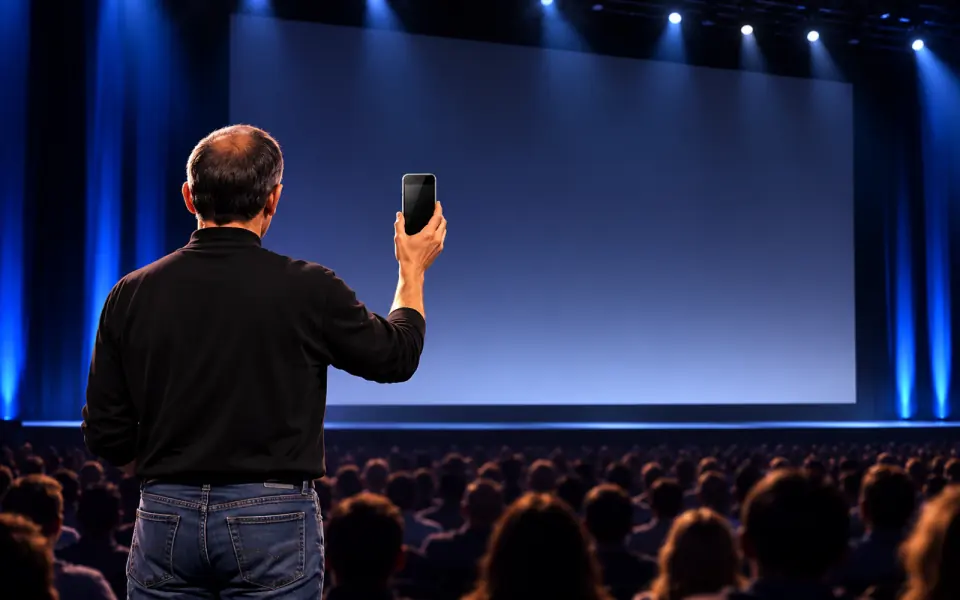
On that day, in San Francisco, Steve Jobs, the founder of Apple, stepped onto the stage at a trade show. He said he was about to present three things: an iPod with touch controls, a revolutionary phone and a device for exploring the Internet. He repeated them several times, and at some point the audience realised it was a single object: the iPhone. It had no keyboard and no stylus. It had a 3.5-inch screen that you could touch with your fingers, even two at once, to enlarge a photo or scroll a page. It was “multi-touch”.
On sale in the United States from 29 June 2007, it cost $499 at first with a phone contract, and many people queued for hours outside the shops. It contained a phone, a music player, a camera, a browser for the Web and several sensors, including the accelerometer, which works out how the device is tilted. Time magazine chose it as invention of the year.
Apps and Android
The next step was the App Store, opened on 10 July 2008 with about five hundred programs: anyone could write an app and sell it or give it away to users. Since then smartphones have shared their success among games, maps, music, messages and countless other functions. Meanwhile Google had bought a small company called Android in 2005 and turned it into a free operating system for phones, offered to many different brands. The first Android phone came out in October 2008. Today Android and the iPhone's system, iOS, dominate the market.
In the following years came social networks, messaging such as WhatsApp (2009) and Instagram (2010), digital photography always in your pocket, GPS navigation and payments by phone. The smartphone has become the camera, the satnav, the alarm clock, the wallet, the book reader and the newspaper of many people.
A world in your pocket
In a few years the smartphone took the place of a great many objects: the compact camera, the music player, the road map, the torch, the voice recorder, the calculator and the alarm clock. Sales of digital cameras, for example, fell sharply after 2010, because the best photos were now taken with the phone that everyone already had in their pocket.
The success was very fast. Within a few years the smartphone reached billions of people, including those in countries where there had never been a computer in the home: for many, it was the first way of connecting to the Internet. Today there are more than six billion smartphone subscriptions in the world.
Why it happened
The iPhone was the fruit of many technologies that had become small and cheap enough: touch screens, powerful processors that use little energy, lithium batteries, sensors and ever faster networks for calls and data. Apple put them together with a clear interface in which a finger was all you needed.
The network mattered too: with 3G and then 4G, phones could exchange data quickly. And Jobs's idea mattered: not to sell just an object, but a simple experience, with lots of programs that others could create.
What changed
The smartphone has changed the way we live. It is used to communicate, find information, study, work, find our way, pay and play. It has created new professions, such as app developers, influencers and couriers who deliver food after a digital order, and it has made many daily activities simpler.
It has also brought new problems: attention that is constantly scattered, children and teenagers spending many hours in front of a screen, fake news that spreads quickly, privacy risks, dependence on social media. Experts advise using it in moderation: turn off notifications now and then, sleep without the phone on the pillow, find time to go out and talk to each other in person.
Meanwhile technology keeps changing: today phones recognise faces, translate languages and use artificial intelligence. Nobody knows what they will be like in twenty years, but the idea of having a computer in your pocket is likely to stay.
Key people and places
People
- Steve Jobs
- American businessman (1955–2011): co-founder of Apple, he presented the iPhone in 2007.
- Martin Cooper
- American engineer (born 1928): in 1973 he made the first call from a portable mobile phone.
- Andy Rubin
- American computer scientist (born 1963): one of the creators of the Android system.
- Jonathan Ive
- English designer (born 1967): he designed many Apple products, including the iPhone.
- Tony Fadell
- American engineer (born 1969): he led the team that built the iPod and took part in developing the iPhone.
Places
- Moscone Center, San Francisco
- The convention centre where Steve Jobs presented the iPhone on 9 January 2007.
- Cupertino, California (United States)
- The city where Apple is based.
Good to know
- The first portable mobile phone, from 1973, was as big as a brick and weighed more than a kilo.
- IBM's “Simon”, from 1994, is considered the first phone with smartphone features.
- The first iPhone cost $499 with a contract and did not yet have the App Store.
- The App Store was opened on 10 July 2008 with about 500 applications.
- Today there are more than six billion smartphone subscriptions in the world.
Find out more
- Wikipedia, “IPhone” en.wikipedia.org
- Wikipedia, “Smartphone” en.wikipedia.org
- Wikipedia, “History of mobile phones” en.wikipedia.org
- Wikipedia, “Android (operating system)” en.wikipedia.org
Related events
- The World Wide Web1991 · TodayWithout the Web the smartphone would not be much use.
- The personal computer1977 · TodayThe smartphone is the descendant of the first personal computers.
- The internet's first ARPANET links1969 · TodayThe networks born with ARPANET make it possible to connect phones.
- The electric telegraph1844 · Age of revolutionsThe electric telegraph was the first great revolution in long-distance communication.
Before and after, in the era “Today”
Event 19 of 25
 BeforeThe double helix of DNA1953
 BeforeThe polio vaccine1955
 BeforeBirth of the European Community1957
 BeforeThe first artificial satellite1957
 BeforeThe first human in space1961
 BeforePop artabout 1962
 BeforeThe Beatles1963
 BeforeMartin Luther King and civil rights1963
 BeforeThe Moon landing1969
 BeforeThe internet's first ARPANET links1969
 BeforeEarth Day and the environmental movement1970
 BeforeThe personal computer1977
 BeforeThe fall of the Berlin Wall1989
 BeforeThe World Wide Web1991
 BeforeThe European Union1993
 BeforeNelson Mandela becomes president1994
 BeforeThe International Space Station1998
 BeforeEuro notes and coins arrive2002
- You are hereThe modern smartphone2007
 AfterThe global financial crisis2008
 AfterMalala wins the Nobel Peace Prize2014
 AfterThe Paris Agreement on climate2015
 AfterThe first image of a black hole2019
 AfterThe COVID-19 pandemic2020
 AfterThe Webb telescope starts observing2022
Listen / Read next
- Music to read by: Cinematic JourneyEpic film-style music, no lyrics, by Ciro Simone IrmiciSpotifyYouTube Music
Meanwhile, elsewhere in the world
Other events of the era “Today”
- The double helix of DNA
- The polio vaccine
- Birth of the European Community
- The first artificial satellite
- The first human in space
- Pop art
- The Beatles
- Martin Luther King and civil rights
- The Moon landing
- The internet's first ARPANET links
- Earth Day and the environmental movement
- The personal computer
- The fall of the Berlin Wall
- The World Wide Web
- The European Union
- Nelson Mandela becomes president
- The International Space Station
- Euro notes and coins arrive
- The global financial crisis
- Malala wins the Nobel Peace Prize
- The Paris Agreement on climate
- The first image of a black hole
- The COVID-19 pandemic
- The Webb telescope starts observing
