Leif Erikson in North America
about 1000 L'Anse aux Meadows, Newfoundland (Canada)
In short
Leif Erikson, son of Erik the Red, sailed west from Greenland. The sagas say he reached lands he called Helluland, Markland and Vinland. At L'Anse aux Meadows, in Canada, archaeologists have found the remains of a Viking village. By studying the rings in some pieces of wood, scientists discovered that those trees were cut with metal blades in 1021. The Vikings reached America almost five hundred years before Columbus, but they did not stay long.
Why it matters They were probably the first Europeans to set foot on the American continent.
Source: UNESCO, “L'Anse aux Meadows National Historic Site”
Study card about 4 minutes of reading
The story
Sailors in search of land
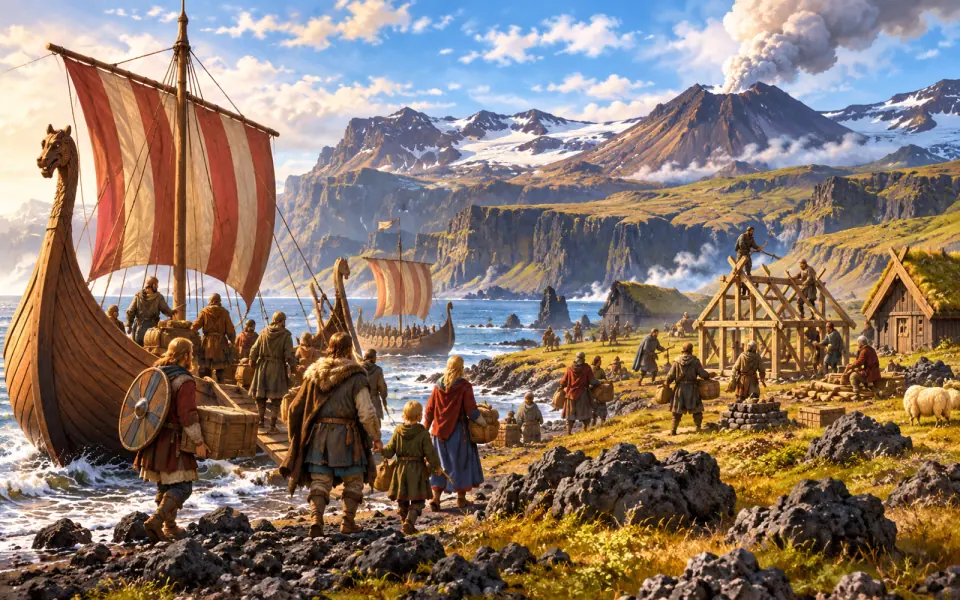
The Vikings were the people of Scandinavia, in particular Norwegians, Swedes and Danes, who from the 8th century began to leave their lands to trade, to raid and to look for new land to farm. They had long, light ships, excellent for sailing on the open sea and on rivers. Passing from island to island, they reached the Orkneys, the Faroe Islands, Iceland (around 874) and then Greenland.
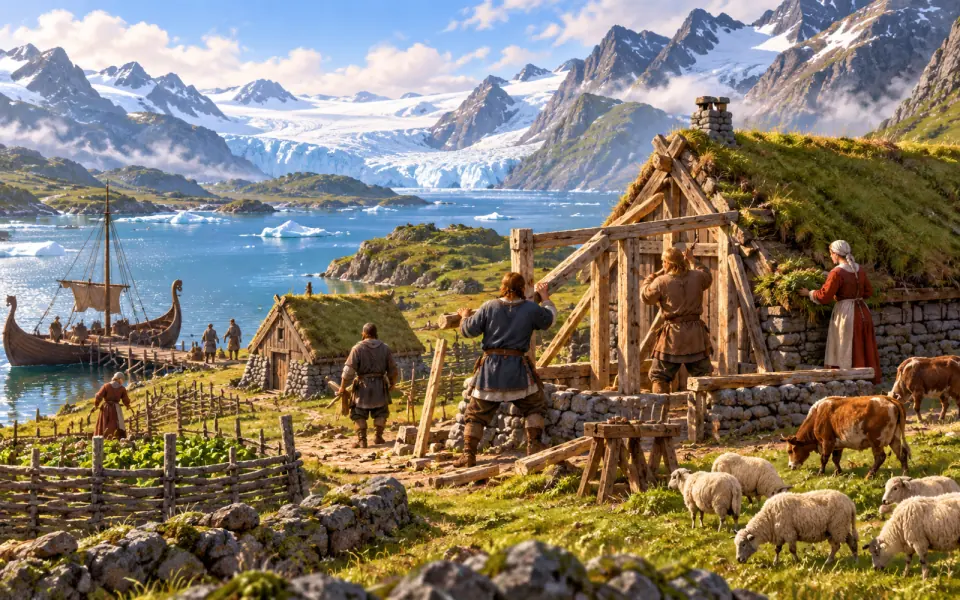
Around 985 an Icelandic chief, Erik the Red, exiled for murder, set out to the west and discovered a large land covered in ice, which he named Greenland, “green land”, to attract settlers. In the south of the island two settlements grew up, where a few hundred families lived, with farms and herds of sheep and cows.
Land sighted from afar
According to an account of the time, the “Saga of the Greenlanders”, a merchant named Bjarni Herjólfsson, while looking for Greenland, was blown off course by fog and saw in the distance wooded, hilly coasts that he did not know. He did not land, turned back and told what he had seen. A few years later, Erik the Red's son, Leif, wanted to check.
Leif Erikson bought Bjarni's ship, gathered a crew of about thirty-five men and, around the year 1000, sailed west, following the route in reverse. The sagas, which were written down two or three centuries later, tell that he found three lands. The first was full of slabs of stone, and he called it Helluland, “slab land”. The second was covered in forests, and he called it Markland, “forest land”. The third, farther south, had pastures and rivers rich in salmon, where, according to the story, wild vines or berries grew: he called it Vinland, “wine land” or perhaps “meadow land”.
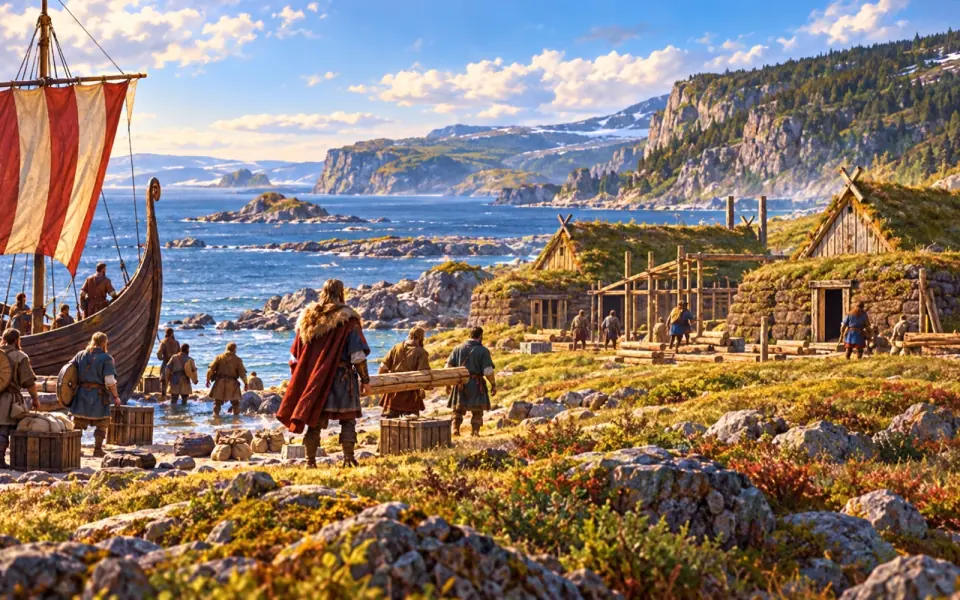
Leif and his men spent the winter in that place, in houses of wood and turf, and in spring they returned to Greenland with a cargo of timber and grapes. Other expeditions followed. One, led by Thorfinn Karlsefni, brought some families and livestock; it met some natives, whom the Norse called “skrælings”, and there were peaceful exchanges but also clashes. After a few years the settlers abandoned the settlement.
A discovery in the 20th century
For centuries many thought these stories were only legends. Then, in 1960, a Norwegian explorer, Helge Ingstad, walking along the northern coast of the island of Newfoundland, in Canada, asked a fisherman of the village of L'Anse aux Meadows whether he knew of any ancient ruins. The fisherman took him to a group of small grassy mounds. Ingstad and his wife, the archaeologist Anne Stine Ingstad, dug there for eight years.
They found the remains of eight buildings of wood and turf, in Norse style, of a forge where bog iron was worked, iron nails, a bronze pin and a spindle for spinning wool. It was proof that around the year 1000 Europeans had set foot in North America, almost five hundred years before Christopher Columbus. In 1978 L'Anse aux Meadows was among the first twelve sites placed by UNESCO on the World Heritage List.
In 2021 a group of scientists examined three pieces of wood cut with metal tools found at the site: by comparing the growth rings with those of an intense solar storm that took place in the year 993, they established that the trees were felled in exactly 1021. It remains to be understood whether L'Anse aux Meadows really is the Vinland of the sagas: butternuts, which grow farther south, were found at the site, and perhaps the true Vinland lay in a more southerly area.
Why it happened
The people of Greenland had little farmland and few trees: they needed timber to build ships and houses, and the coasts to the west, talked about among sailors, promised forests and pastures.
The Vikings had ships capable of crossing the ocean and a tradition of long voyages. Bjarni's account, since he had seen unknown lands, pushed Leif to organise a real expedition.
What changed
The Norse stay in America was short, a few years, and left no lasting traces. Contact with the native peoples was limited and had no lasting consequences. The news ended up in the Icelandic sagas, but the rest of Europe knew almost nothing.
The archaeological discovery of L'Anse aux Meadows rewrote history: Columbus was not the first European to reach the Americas. Today Leif Erikson is remembered in the United States with a holiday, on 9 October.
The episode also shows how the sagas, written long afterwards, can contain a kernel of truth, and how archaeology is useful for checking ancient stories.
Key people and places
People
- Leif Erikson
- Norse sailor (born about 970, died about 1018–1025): according to the sagas he reached Vinland.
- Erik the Red
- Explorer (about 950–1003): he colonised Greenland and was Leif's father.
- Bjarni Herjólfsson
- Norse merchant: he was the first to sight the American coast, without landing.
- Helge and Anne Stine Ingstad
- Norwegian explorer and archaeologist: they discovered the L'Anse aux Meadows site in 1960.
- Thorfinn Karlsefni
- Leader of a colonising expedition to Vinland.
Places
- L'Anse aux Meadows (Newfoundland)
- Norse archaeological site, a UNESCO World Heritage Site since 1978.
- Southern Greenland
- Where the Norse founded two settlements from 985 onwards.
- Iceland
- Island where the sagas telling of the voyages were written.
Good to know
- The Vikings reached America almost 500 years before Columbus.
- The name “Greenland” (green land) was chosen by Erik the Red to attract settlers.
- The L'Anse aux Meadows site was discovered in 1960 thanks to a fisherman.
- In 2021 tree rings dated the cutting of the wood to 1021.
- In the United States 9 October is Leif Erikson Day.
Find out more
- Wikipedia, “Leif Erikson” en.wikipedia.org
- Wikipedia, “L'Anse aux Meadows” en.wikipedia.org
- Wikipedia, “Vinland” en.wikipedia.org
- Parks Canada, L'Anse aux Meadows parks.canada.ca
Related events
- The Vikings reach Icelandabout AD 874 · Early Middle AgesBefore reaching Greenland the Vikings had reached Iceland.
- The Vikings in Greenlandabout AD 985 · Early Middle AgesErik the Red founded the Greenland settlements.
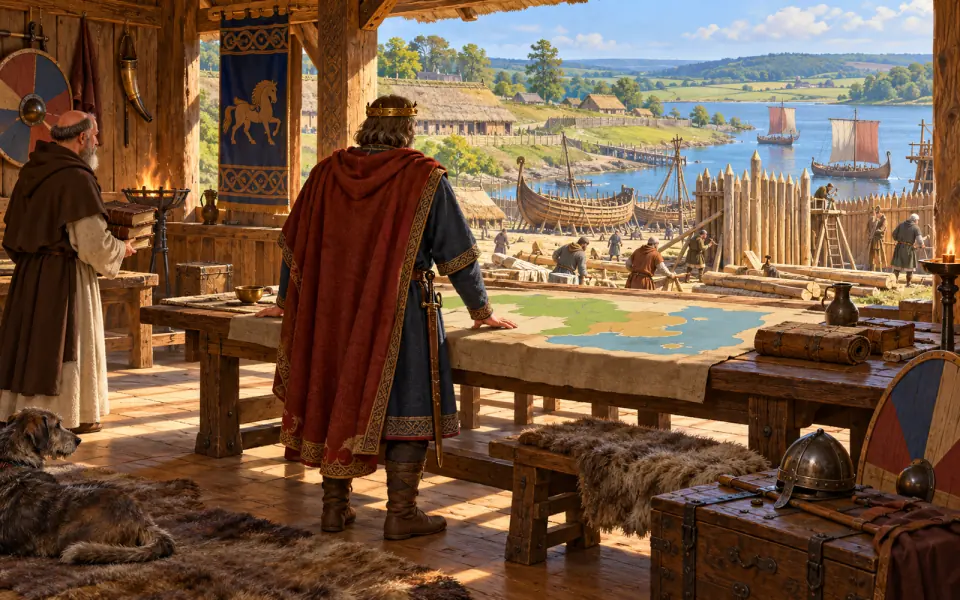
- Alfred the GreatAD 871 · Early Middle AgesThe same Vikings were attacking the England of Alfred the Great.
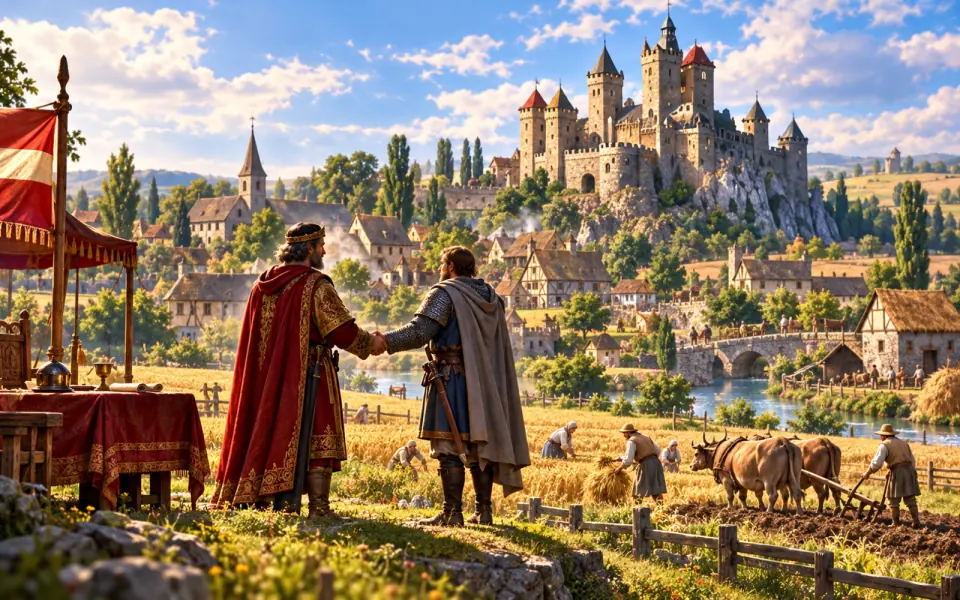
- The feudal system spreadsabout AD 900 · Early Middle AgesIn continental Europe, too, the world was changing.
Before and after, in the era “Early Middle Ages”
Event 24 of 25
 BeforeThe Romano-Germanic kingdomsabout AD 480
 BeforeEmperor JustinianAD 527
 BeforeJustinian's CodeAD 529
 BeforeBenedictine monksabout AD 529
 BeforeHagia Sophia in ConstantinopleAD 537
 BeforeThe mosaics of San Vitale in RavennaAD 547
 BeforeThe Lombards in ItalyAD 568
 BeforeMuhammad's HijraAD 622
 BeforeIsidore writes the Etymologiesabout AD 625
 BeforeThe spread of IslamAD 632–750
 BeforePaper reaches Samarkandabout AD 751
 BeforeCharlemagne, King of the FranksAD 768
 BeforeThe Carolingian Renaissanceabout AD 790
 BeforeThe Book of Kellsabout AD 800
 BeforeCharlemagne crowned emperorAD 800
 BeforeHindu-Arabic numerals head westabout AD 825
 BeforeWriting music down with neumesabout AD 850
 BeforeThe Diamond Sutra, oldest dated printed bookAD 868
 BeforeAlfred the GreatAD 871
 BeforeThe Vikings reach Icelandabout AD 874
 BeforeThe feudal system spreadsabout AD 900
 BeforeThe Medical School of Salernoabout AD 950
 BeforeThe Vikings in Greenlandabout AD 985
- You are hereLeif Erikson in North Americaabout 1000
 AfterThe heavy plough spreadsabout 1000
Listen / Read next
- Music to read by: Cinematic JourneyEpic film-style music, no lyrics, by Ciro Simone IrmiciSpotifyYouTube Music
Meanwhile, elsewhere in the world
Other events of the era “Early Middle Ages”
- The Romano-Germanic kingdoms
- Emperor Justinian
- Justinian's Code
- Benedictine monks
- Hagia Sophia in Constantinople
- The mosaics of San Vitale in Ravenna
- The Lombards in Italy
- Muhammad's Hijra
- Isidore writes the Etymologies
- The spread of Islam
- Paper reaches Samarkand
- Charlemagne, King of the Franks
- The Carolingian Renaissance
- The Book of Kells
- Charlemagne crowned emperor
- Hindu-Arabic numerals head west
- Writing music down with neumes
- The Diamond Sutra, oldest dated printed book
- Alfred the Great
- The Vikings reach Iceland
- The feudal system spreads
- The Medical School of Salerno
- The Vikings in Greenland
- The heavy plough spreads
