Justinian's Code
AD 529 Constantinople (now Istanbul, Turkey)
In short
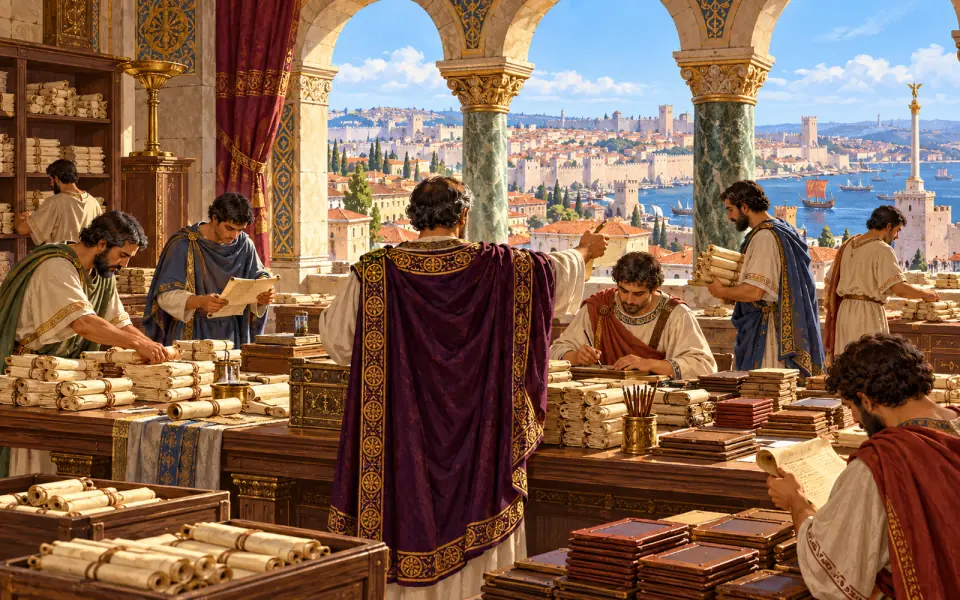
Justinian gave a group of legal experts, led by Tribonian, the task of collecting and organising the Roman laws built up over almost a thousand years. The first version of the Code came out in AD 529; it was followed by the Digest, with the opinions of the great lawyers, and the Institutes, a handbook for students. Laws that contradicted each other or were no longer used were removed. The whole collection is now called the Corpus iuris civilis.
Why it matters Rediscovered in Bologna centuries later, Justinian's law became the basis of the laws of many European countries.
Source: Treccani, entry “Corpus iuris civilis”
Study card about 6 minutes of reading
The story
A thousand years of laws, all mixed up
When Justinian became emperor, in AD 527, the laws at Constantinople were a real maze. For almost a thousand years the Romans had been producing rules: laws voted by the people and the Senate, decrees of the emperors, answers given by jurists to people who asked for an opinion. There were thousands of texts, written in different periods, often contradicting one another. A judge who had to decide a case might not know which rule was still valid, and a lawyer could quote a law that nobody remembered any more. Justinian decided to put things in order. The aim was political as well as practical: an emperor who gathers the laws of Rome shows that he is the true heir of the Romans.
Tribonian's work
The head of the undertaking was Tribonian, a jurist from Pamphylia, a region of present-day Turkey. He held a very high office, that of quaestor of the sacred palace, responsible for justice in the empire. With him worked a commission of jurists, divided into sub-commissions. For the Digest, the largest part, there were sixteen compilers: Tribonian himself, professors of law from Constantinople and from Berytus (now Beirut) and eleven lawyers.
The work went forward in several stages. With the constitution that begins with the words “Haec quae necessario” (at that time laws were referred to by their first Latin words), in 528 the emperor appointed the commission; in 529, with the constitution “Summa rei publicae”, he presented the Code, a collection of imperial constitutions, that is, of the laws issued by the emperors, from Hadrian onwards. In 530, with the constitution “Deo auctore”, the Digest was begun. On 16 December 533 the Digest was promulgated, and it came into force two weeks later, on 30 December. The same year the Institutes appeared. In 534 a second, updated edition of the Code was published, replacing the first.
The four parts
The Code, in Latin, brought together the laws of the emperors. The Digest, also called the Pandects, was a great anthology: in fifty books, divided into titles, with the subject given at the start of each, it collected passages taken from the works of the Roman jurists of the past, such as Ulpian, who is the most quoted. The compilers chose more than nine thousand passages, taken from almost two thousand books. We have to imagine an enormous task, done without computers, cutting and stitching pages of ancient authors.
The Institutes were a textbook in four books, written for law students and modelled on an older textbook by the jurist Gaius. It was the first book a young man opened at the beginning of his studies. The Digest, instead, was studied in the following years. The Novels, finally, were the new laws that Justinian issued after the Code, until his death in 565. Many were written in Greek, because by then people spoke Greek at Constantinople, and some in Latin.
An unusual ban
Justinian wanted this collection to be the only valid law. For this reason contradictory or no longer used laws were removed, and jurists were no longer allowed to interpret freely. According to what we read in the entry on the Digest, anyone who rewrote the text of the law was punished, while word-for-word translations into Greek were allowed because they did not change the meaning.
The rediscovery at Bologna
In the West, after the collapse of the empire, Justinian's Corpus was little used. In the 12th century, at Bologna, a teacher named Irnerius began to study it and explain it to his students, writing small notes in the margins of the text, called glosses. For this reason he and his pupils are called the glossators. The name “Corpus iuris civilis”, that is, “body of civil law”, spread much later, with the edition by the Frenchman Denis Godefroy, printed at Geneva in 1583.
A monument that lasts
For centuries, until the early 19th century, Justinian's Roman law was the basis of a common law for the whole of Europe: in each country local laws were applied, but judges and professors reasoned with the ideas of the Corpus. Then, with the Napoleonic Code, each country had a code of its own. But many ideas in those codes come from Roman law: property, contract, the will, the distinction between persons and things.
Tribonian did not see the end of Justinian's reign: he died in 542, perhaps because of the plague epidemic that struck Constantinople. But his work, wanted by the emperor and completed in less than ten years, is one of the great monuments of antiquity that Europe has inherited.
Why it happened
The most immediate cause was the disorder of the laws: too many, ancient, often in conflict. What is more, trials lasted a long time, because it was hard to find which rule to apply.
There was also a political reason. Justinian thought of himself as the successor of the ancient emperors and wanted to show that his government was just and orderly. Collecting the laws was a way of making the emperor's authority stronger, since he became the only source of law. He also needed well-trained judges and officials: a single text and a textbook for students were just what was needed to train them.
What changed
In the Eastern Empire the Corpus remained the basis of the laws for many centuries, even though in time it was translated and summarised in Greek. In the West, its rediscovery at Bologna in the 12th century gave rise to the legal studies of the universities and to the figure of the professional jurist.
Thanks to this, Roman law became the “common law” of Europe: for centuries the laws of different countries used the same principles and the same Latin words. Even today many courts use terms such as “will”, “contract” or “servitude”, and the civil codes of France, Italy, Spain and many other countries descend largely from that tradition.
Another consequence is that the Digest has preserved passages by ancient jurists whose works have been lost. Without the work of Justinian's compilers, today we would not have many texts of Roman legal thought.
Key people and places
People
- Justinian
- Emperor of the East from 527 to 565: he decided to collect the laws and directed the work.
- Tribonian
- Jurist born in Pamphylia, quaestor of the sacred palace: he led the commission and died in 542, perhaps of the plague.
- Ulpian
- Roman jurist who lived long before: he is the most quoted author in the Digest.
- Gaius
- Roman jurist: his textbook served as the model for Justinian's Institutes.
- Irnerius
- Teacher at Bologna in the 12th century: he began to study the Corpus and founded the school of the glossators.
Places
- Constantinople
- The capital of the Eastern Empire, where Tribonian's commission worked.
- Berytus
- Beirut today: its lawyers took part in the commission that compiled the Digest.
- Bologna
- City in Emilia where, in the 12th century, the Corpus was rediscovered and studied at its university.
Good to know
- The Digest is also called the Pandects: it is an anthology of 50 books written in Latin with a bilingual introduction, in Latin and Greek.
- Imperial constitutions were referred to by their first Latin words: the one that began the Digest, in 530, is called “Deo auctore”.
- The name “Corpus iuris civilis” is not Justinian's: it spread in 1583 thanks to an edition printed at Geneva.
- For the Digest, more than nine thousand passages taken from almost two thousand ancient books were used.
- Justinian forbade jurists to rewrite his laws, but allowed word-for-word translations into Greek.
Find out more
- Wikipedia, “Corpus Juris Civilis” en.wikipedia.org
- Wikipedia, “Digest (Roman law)” en.wikipedia.org
- Wikipedia, “Tribonian” en.wikipedia.org
- Wikipedia, “Irnerius” en.wikipedia.org
Related events
- Emperor JustinianAD 527 · Early Middle AgesJustinian and Theodora were the emperor and empress of the Corpus.
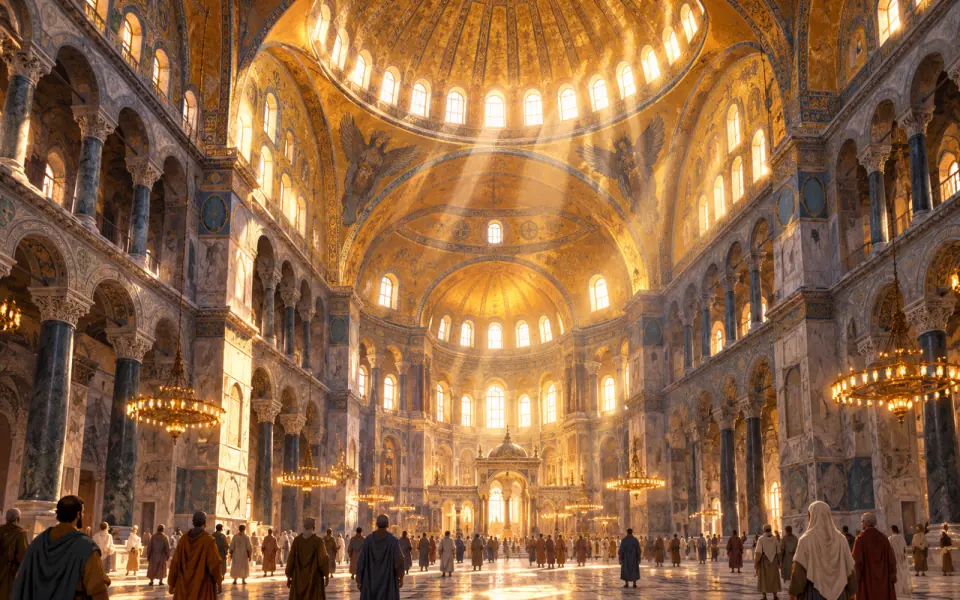
- Hagia Sophia in ConstantinopleAD 537 · Early Middle AgesIn the same years the emperor built Hagia Sophia.
- The Romano-Germanic kingdomsabout AD 480 · Early Middle AgesThe Germanic kingdoms had laws of their own, partly inspired by Roman ones.
- Charlemagne, King of the FranksAD 768 · Early Middle AgesCharlemagne too used laws as a tool of government.
Before and after, in the era “Early Middle Ages”
Event 3 of 25
 BeforeThe Romano-Germanic kingdomsabout AD 480
 BeforeEmperor JustinianAD 527
- You are hereJustinian's CodeAD 529
 AfterBenedictine monksabout AD 529
 AfterHagia Sophia in ConstantinopleAD 537
 AfterThe mosaics of San Vitale in RavennaAD 547
 AfterThe Lombards in ItalyAD 568
 AfterMuhammad's HijraAD 622
 AfterIsidore writes the Etymologiesabout AD 625
 AfterThe spread of IslamAD 632–750
 AfterPaper reaches Samarkandabout AD 751
 AfterCharlemagne, King of the FranksAD 768
 AfterThe Carolingian Renaissanceabout AD 790
 AfterThe Book of Kellsabout AD 800
 AfterCharlemagne crowned emperorAD 800
 AfterHindu-Arabic numerals head westabout AD 825
 AfterWriting music down with neumesabout AD 850
 AfterThe Diamond Sutra, oldest dated printed bookAD 868
 AfterAlfred the GreatAD 871
 AfterThe Vikings reach Icelandabout AD 874
 AfterThe feudal system spreadsabout AD 900
 AfterThe Medical School of Salernoabout AD 950
 AfterThe Vikings in Greenlandabout AD 985
 AfterLeif Erikson in North Americaabout 1000
 AfterThe heavy plough spreadsabout 1000
Listen / Read next
- Music to read by: Cinematic JourneyEpic film-style music, no lyrics, by Ciro Simone IrmiciSpotifyYouTube Music
Meanwhile, elsewhere in the world
Other events of the era “Early Middle Ages”
- The Romano-Germanic kingdoms
- Emperor Justinian
- Benedictine monks
- Hagia Sophia in Constantinople
- The mosaics of San Vitale in Ravenna
- The Lombards in Italy
- Muhammad's Hijra
- Isidore writes the Etymologies
- The spread of Islam
- Paper reaches Samarkand
- Charlemagne, King of the Franks
- The Carolingian Renaissance
- The Book of Kells
- Charlemagne crowned emperor
- Hindu-Arabic numerals head west
- Writing music down with neumes
- The Diamond Sutra, oldest dated printed book
- Alfred the Great
- The Vikings reach Iceland
- The feudal system spreads
- The Medical School of Salerno
- The Vikings in Greenland
- Leif Erikson in North America
- The heavy plough spreads
