Hindu-Arabic numerals head west
about AD 825 Baghdad (now Iraq)
In short
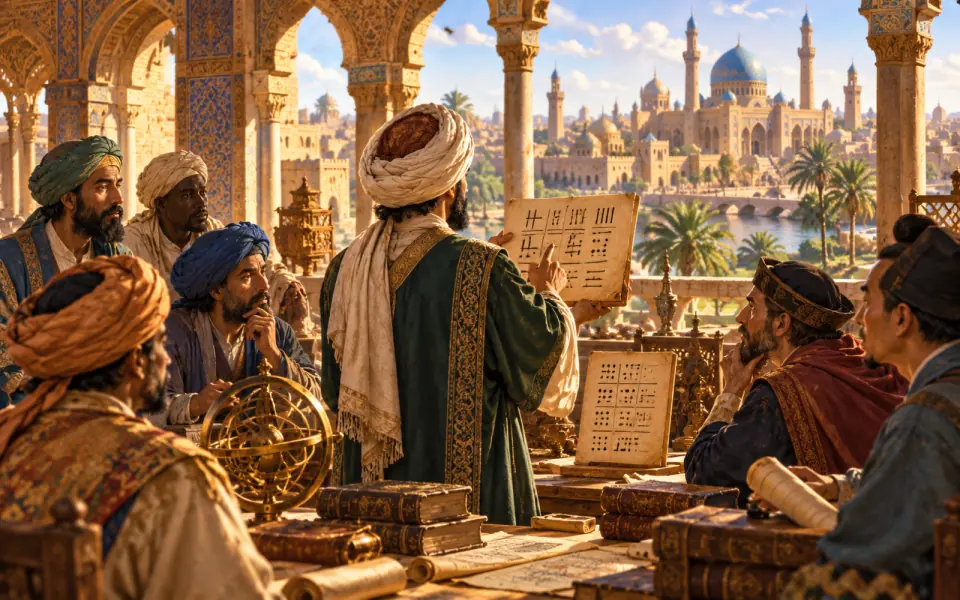
In India nine digits and a sign for zero had been used for centuries, in a system where a digit's value changes according to its position. Around AD 825 the scholar al-Khwarizmi, who worked in Baghdad in the ‘House of Wisdom’, wrote a book explaining how to calculate with these digits. His works, translated into Latin a few centuries later, made the method known in Europe too. The word ‘algorithm’ comes from his name.
Why it matters With Hindu-Arabic numerals, doing sums became much simpler than with Roman numerals.
Source: Treccani, entry “al-Khuwarizmi”
Study card about 4 minutes of reading
The story
Ten signs to write every number
Every day we write numbers with ten signs: 0, 1, 2, 3, 4, 5, 6, 7, 8, 9. With these, in endless combinations, you can write any number, huge or tiny. It seems normal to us, but it is a brilliant invention, born in India. The decisive idea is that the value of a digit depends on the place where it stands: in the number 505 the first 5 is worth five hundred and the last one five. And if in a place there is nothing, you need a sign to show “nothing”: the zero.
In India this system had been in use for a few centuries. A mathematician and astronomer, Brahmagupta, wrote down in a book in 628 the rules for calculating with zero as if it were a number in every respect: he explained what happens when you add, subtract or multiply by zero. It was an absolute novelty, which no other people had yet explained so clearly.
Words travel too. The Arabs called zero “sifr”, which means “empty”. When the word reached Italy, in the Middle Ages, it became “zefiro” and then “zero”; from the same “sifr”, with another meaning, the word “cipher” also derives. So an Arabic word reminds us that those signs came from far away.
Baghdad and the House of Wisdom
At the beginning of the 9th century the capital of the Abbasid caliphate, Baghdad, was the most learned city in the world. The caliphs, in particular al-Mansur and al-Ma'mun, had Greek, Persian and Indian books translated into Arabic. The centre of this work was the “House of Wisdom”, a library and place of study where translators and scientists worked, including Christians and Jews.
One of them was Muhammad ibn Musa al-Khwarizmi, born in Central Asia around 780. He studied Indian and Greek texts, and around 825 he wrote a book on calculating with Indian numerals, which explained how to do additions, subtractions, multiplications and divisions with those ten signs. The Arabic original has been lost, but a Latin translation of the 12th century survives, which begins with the words “Dixit Algorizmi”, that is, “Al-Khwarizmi said”. This is where the word “algorithm” comes from, which today is used for a sequence of instructions, for example in a computer program.
Al-Khwarizmi also wrote another book, “The Compendious Book on Calculation by Completion and Balancing” (about 820), which taught how to solve equations, that is, problems with an unknown number. The Arabic word for “completion”, al-jabr, gave us the word “algebra”.
The long journey to Europe
The Indian numerals spread throughout the Islamic world, from Baghdad to Spain, and changed: the shapes of the signs varied from country to country, and the ones used in the West, called “ghubar” (dust), are the ancestors of ours. In Christian Europe, for a few centuries, the new numerals were known to very few scholars. The oldest Spanish manuscript that shows them dates from 976 (without the zero). A great scholar, Gerbert of Aurillac, who had studied in Catalonia and who in 999 became pope as Sylvester II, made the numerals known, used on the abacus and without the zero.
For mass use, people had to wait. In 1202 the Pisan merchant Leonardo Fibonacci, who had learned the system in Algeria, wrote the “Liber abaci” to teach it to Europeans. Even then, calculations were still mostly done with the abacus and with Roman numerals, and the new system took hold slowly, with the help of merchants and later of printing.
That is why today we call them “Arabic numerals”, because it was the Arabs who brought them to Europe, but more precisely they are “Hindu–Arabic”.
Why it happened
After the conquests of the 7th and 8th centuries, the Arabs controlled an enormous empire that joined India, Persia and the Mediterranean. To govern it, collect taxes, divide inheritances according to Islamic law and trade, they needed to be able to do sums.
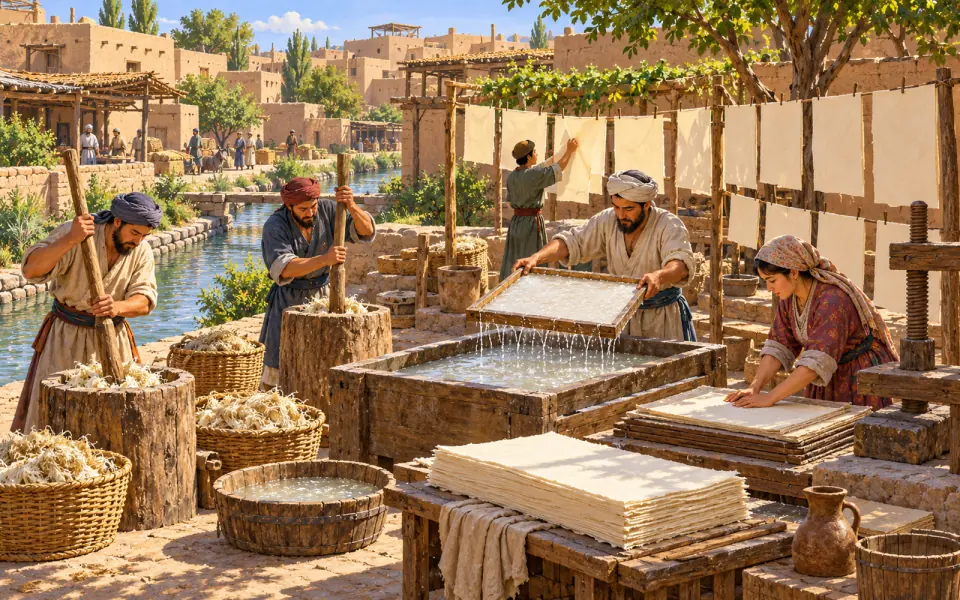
The caliphs of Baghdad supported science, paying translators and scholars, and paper, which had recently arrived from China, made it easy and cheap to multiply books.
What changed
The Hindu–Arabic number system is used all over the world today. Without it, it would have been almost impossible to develop algebra, accounting, physics and computing, and even daily life, from prices to telephones, would be different.
Al-Khwarizmi gave mathematics two basic words, algebra and algorithm. His works influenced European scholars for centuries.
Zero, in particular, is one of humanity's most important ideas: it made place-value calculation possible and, many centuries later, the binary system of computers, made only of 0 and 1.
Key people and places
People
- Muhammad ibn Musa al-Khwarizmi
- Persian mathematician and astronomer (about 780–850): he wrote books on Indian calculation and on algebra.
- Brahmagupta
- Indian mathematician (598–668): in 628 he wrote the rules for calculating with zero.
- Gerbert of Aurillac
- Scholar and later Pope Sylvester II (about 946–1003): he made Arabic numerals known in Europe.
- Al-Ma'mun
- Caliph of Baghdad from 813 to 833: he supported the House of Wisdom.
Places
- Baghdad
- Abbasid capital and cultural centre of the Islamic world.
- House of Wisdom
- Library and translation centre in Baghdad.
Good to know
- The word “algorithm” comes from al-Khwarizmi's name.
- The word “algebra” comes from al-jabr, a term in his book.
- A computer uses only two digits: 0 and 1.
- The oldest European manuscript with Arabic numerals is Spanish, from 976, and does not yet have the zero.
- Gerbert of Aurillac, Pope Sylvester II, made the new numerals known, used on the abacus and without the zero.
Find out more
- Wikipedia, “Al-Khwarizmi” en.wikipedia.org
- Wikipedia, “Eastern Arabic numerals” en.wikipedia.org
- Wikipedia, “House of Wisdom” en.wikipedia.org
- Wikipedia, “Brahmagupta” en.wikipedia.org
Related events
- The spread of IslamAD 632–750 · Early Middle AgesIslamic expansion joined different cultural worlds together.
- Paper reaches Samarkandabout AD 751 · Early Middle AgesPaper, which had arrived at Samarkand, made it easy to multiply books.
- The Medical School of Salernoabout AD 950 · Early Middle AgesThe medicine of Salerno also drew on Arab science.
- The Carolingian Renaissanceabout AD 790 · Early Middle AgesIn the same century Charlemagne was promoting learning in Europe.
Before and after, in the era “Early Middle Ages”
Event 16 of 25
 BeforeThe Romano-Germanic kingdomsabout AD 480
 BeforeEmperor JustinianAD 527
 BeforeJustinian's CodeAD 529
 BeforeBenedictine monksabout AD 529
 BeforeHagia Sophia in ConstantinopleAD 537
 BeforeThe mosaics of San Vitale in RavennaAD 547
 BeforeThe Lombards in ItalyAD 568
 BeforeMuhammad's HijraAD 622
 BeforeIsidore writes the Etymologiesabout AD 625
 BeforeThe spread of IslamAD 632–750
 BeforePaper reaches Samarkandabout AD 751
 BeforeCharlemagne, King of the FranksAD 768
 BeforeThe Carolingian Renaissanceabout AD 790
 BeforeThe Book of Kellsabout AD 800
 BeforeCharlemagne crowned emperorAD 800
- You are hereHindu-Arabic numerals head westabout AD 825
 AfterWriting music down with neumesabout AD 850
 AfterThe Diamond Sutra, oldest dated printed bookAD 868
 AfterAlfred the GreatAD 871
 AfterThe Vikings reach Icelandabout AD 874
 AfterThe feudal system spreadsabout AD 900
 AfterThe Medical School of Salernoabout AD 950
 AfterThe Vikings in Greenlandabout AD 985
 AfterLeif Erikson in North Americaabout 1000
 AfterThe heavy plough spreadsabout 1000
Listen / Read next
- Music to read by: Cinematic JourneyEpic film-style music, no lyrics, by Ciro Simone IrmiciSpotifyYouTube Music
Meanwhile, elsewhere in the world
Other events of the era “Early Middle Ages”
- The Romano-Germanic kingdoms
- Emperor Justinian
- Justinian's Code
- Benedictine monks
- Hagia Sophia in Constantinople
- The mosaics of San Vitale in Ravenna
- The Lombards in Italy
- Muhammad's Hijra
- Isidore writes the Etymologies
- The spread of Islam
- Paper reaches Samarkand
- Charlemagne, King of the Franks
- The Carolingian Renaissance
- The Book of Kells
- Charlemagne crowned emperor
- Writing music down with neumes
- The Diamond Sutra, oldest dated printed book
- Alfred the Great
- The Vikings reach Iceland
- The feudal system spreads
- The Medical School of Salerno
- The Vikings in Greenland
- Leif Erikson in North America
- The heavy plough spreads
