Benedictine monks
about AD 529 Monte Cassino, Lazio
In short
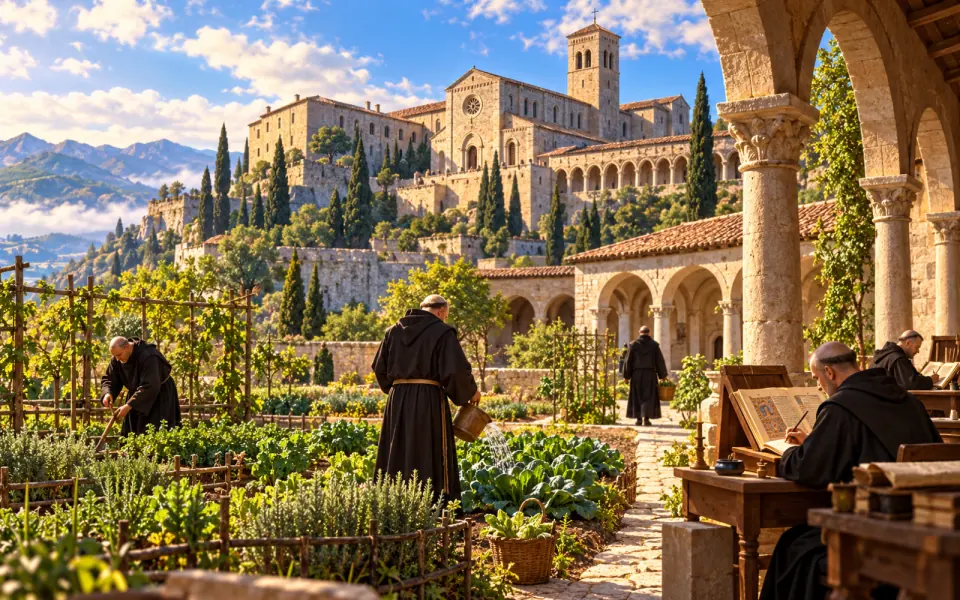
Benedict of Nursia founded a monastery on the mountain of Cassino, in southern Lazio. For his monks he wrote a Rule, a set of guidelines for living together in peace and good order. The days were divided between prayer, work in the fields and study, as the later motto ‘ora et labora’, pray and work, sums up. In Benedictine monasteries the monks also copied ancient books by hand.
Why it matters Thanks to the work of monks copying books, many Latin and Greek works have come down to us.
Source: Treccani, entry “Benedetto da Norcia, santo”
Study card about 5 minutes of reading
The story
A boy who leaves Rome
Benedict was born at Nursia, in Umbria, around 2 March 480, into a noble family. He had a twin sister, Scholastica, who also became a saint. Almost everything we know about him comes from a single source: the second book of the Dialogues of Pope Gregory the Great, written after his death. It is not a biography in the modern sense: it is the story of a saint, full of miracles and exemplary episodes. Historians use it with caution, but it is all we have.
According to Gregory, Benedict's parents sent him to study in Rome. But he did not like the life of the city, which seemed disorderly to him, and so he decided to leave it to seek God in solitude. He withdrew to a cave at Subiaco, in the mountains east of Rome, where he lived as a hermit for about three years. Little by little other men joined him and Benedict began to guide small communities of monks. Not everything went smoothly: the story recalls that at Subiaco someone tried to poison him.
The monastery on the mountain
Around AD 529 Benedict left Subiaco with some companions and climbed a hill above the town of Cassino, in southern Lazio. According to tradition he founded the monastery where a tower and an ancient temple dedicated to Apollo had stood. The date of 529 is the traditional one; some sources place the foundation between 525 and 530, so it is best to say “around 529”. That monastery is the abbey of Montecassino.
The Rule: how to live together
At Montecassino Benedict wrote his Rule, around 530-540. It was a little book of a prologue and 73 chapters, short and practical, inspired also by the rules of earlier monks such as that of Basil of Caesarea. It was not made for isolated hermits, but for communities living together under the guidance of an abbot, chosen by the monks themselves. The main ideas are three: prayer in common, personal prayer and work. To sum them up the motto “ora et labora”, that is, “pray and work”, has become popular. Be careful: this phrase is not in the Rule. It is a later summary, handy but not original.
What did the Rule say? For example, that the monks' days were marked by seven times of prayer by day and one by night, called “hours”. Manual work was compulsory and took up at least five hours a day. The monks ate two meals a day, with bread and a little wine, and could not eat the meat of four-footed animals, except the sick and the weakest. Anyone who wanted to enter first had to do a year of trial, the novitiate. A famous chapter describes twelve steps of humility. It was a hard life, but an orderly one: the Rule always looks for balance, without excess.
The heart of the system is stability: the monk promises to stay for ever in the same monastery, living with the same brothers. For an age of wars, invasions and dangerous journeys, it was a reassuring idea.
Benedict's death and Montecassino's misfortunes
Benedict died at Montecassino, according to tradition, on 21 March 547, about forty days after his sister Scholastica. The monastery, however, had a troubled history. Between about 570 and 581 the Lombards destroyed it and the monks took refuge in Rome. It was rebuilt around 718. In 883 the Saracens destroyed it again, and it was rebuilt in 949 at the wish of Pope Agapetus II. In 1349 an earthquake ruined it and it was put back on its feet in 1366. The last blow came during the Second World War: on 15 February 1944, during the battle of Cassino, Allied bombing flattened the abbey. It was rebuilt as it had been and the church was consecrated by Pope Paul VI in 1964.
After Benedict
In 1964 Pope Paul VI proclaimed Benedict patron saint of Europe.
Why it happened
In the 5th and 6th centuries Italy was an unsafe country: the Western Empire had ended, the Germanic kingdoms were at war with one another and the cities were less rich and less protected than before. Many Christians looked for a way to live their faith seriously, and some withdrew to lonely places as hermits.
What was missing was a simple rule, suited to ordinary people and to settled communities. Benedict did not invent everything from scratch: he used earlier examples, such as the rule of Basil of Caesarea, and adapted them to a Latin monastery, with a more balanced life, less extreme than that of many hermits.
What changed
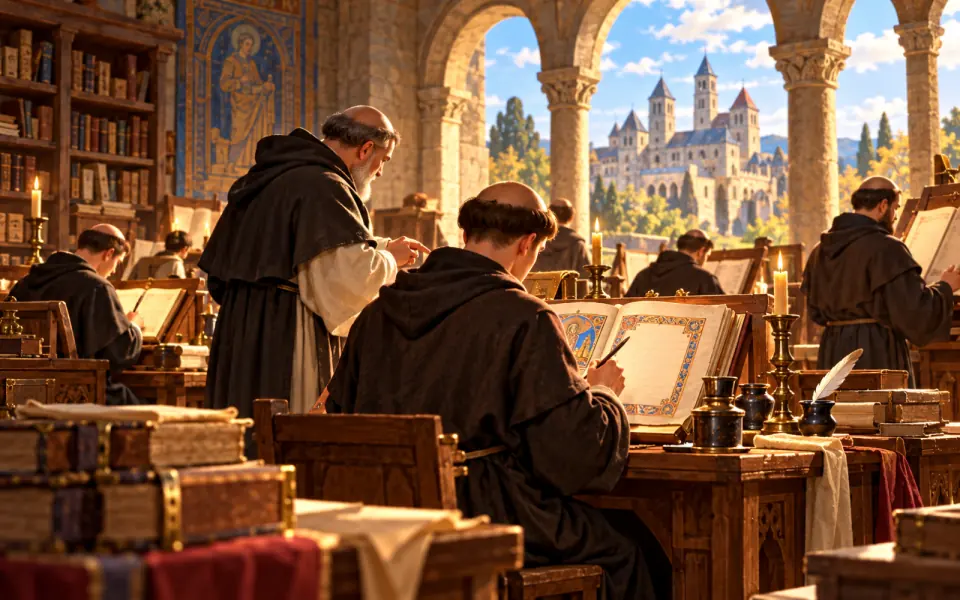
The Rule spread through most of western Europe and gave rise to a great order, the Benedictines. In Benedictine monasteries, alongside prayer and work, there was room for reading and study, and tradition says that books were kept and copied there. In a Europe with few schools, this was of enormous value.
With the Rule, manual work became a full part of the monks' lives: every day, alongside prayer and reading, there was a time for working with the hands, and this applied even to someone who had become abbot.
In 1964 Paul VI proclaimed Benedict patron saint of Europe, recalling precisely his role in the birth of European civilisation.
Key people and places
People
- Benedict of Nursia
- Born at Nursia around 480, died at Montecassino around 547: founder of Western monasticism and author of the Rule.
- Scholastica
- Benedict's twin sister, a nun: tradition remembers her as a saint; she died about forty days before him.
- Gregory the Great
- Pope Gregory I: he wrote the Dialogues, the main source on Benedict's life.
- Basil of Caesarea
- Eastern bishop and monk: his rule inspired Benedict's.
- Pope Paul VI
- In 1964 he consecrated the rebuilt church of Montecassino and proclaimed Benedict patron saint of Europe.
Places
- Nursia
- Small town in Umbria where Benedict was born around 480.
- Subiaco
- Town in the mountains east of Rome: here Benedict lived as a hermit in a cave and guided the first communities.
- Montecassino
- Monastery on the hill above Cassino, in southern Lazio: destroyed several times and always rebuilt.
Good to know
- The Rule is made up of a prologue and 73 chapters, and can be read in a few hours.
- “Ora et labora” is not found in the Rule: it is a phrase that was created later, to sum it up.
- Benedict and his sister Scholastica were twins, according to tradition.
- On 15 February 1944 the abbey of Montecassino was destroyed by a bombing raid during the Second World War.
- According to the Rule the monks had to work with their hands for at least five hours a day.
Find out more
- Wikipedia, “Benedict of Nursia” en.wikipedia.org
- Wikipedia, “Rule of Saint Benedict” en.wikipedia.org
- Wikipedia, “Abbey of Monte Cassino” en.wikipedia.org
- Wikipedia, “Subiaco, Lazio” en.wikipedia.org
Related events
- The Lombards in ItalyAD 568 · Early Middle AgesThe Lombards, who entered Italy in 568, destroyed Montecassino around 577.
- The Carolingian Renaissanceabout AD 790 · Early Middle AgesThe copyists of the monasteries were the leading figures in Charlemagne's cultural revival.
- The Romano-Germanic kingdomsabout AD 480 · Early Middle AgesBenedict lived in the time of the Romano-Germanic kingdoms, in Italy that of Theodoric.
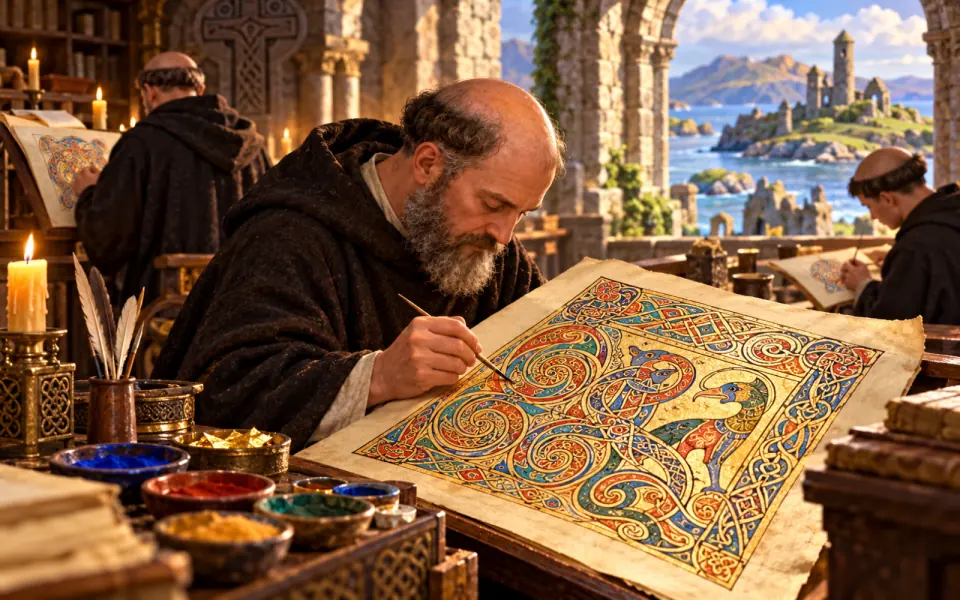
- The Book of Kellsabout AD 800 · Early Middle AgesThe Book of Kells too was born in a monastery.
Before and after, in the era “Early Middle Ages”
Event 4 of 25
 BeforeThe Romano-Germanic kingdomsabout AD 480
 BeforeEmperor JustinianAD 527
 BeforeJustinian's CodeAD 529
- You are hereBenedictine monksabout AD 529
 AfterHagia Sophia in ConstantinopleAD 537
 AfterThe mosaics of San Vitale in RavennaAD 547
 AfterThe Lombards in ItalyAD 568
 AfterMuhammad's HijraAD 622
 AfterIsidore writes the Etymologiesabout AD 625
 AfterThe spread of IslamAD 632–750
 AfterPaper reaches Samarkandabout AD 751
 AfterCharlemagne, King of the FranksAD 768
 AfterThe Carolingian Renaissanceabout AD 790
 AfterThe Book of Kellsabout AD 800
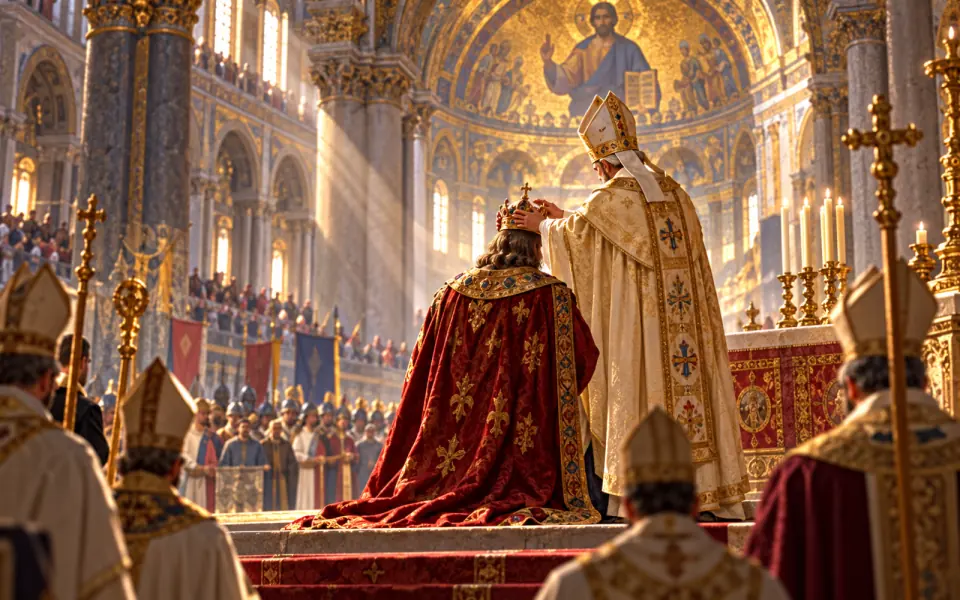 AfterCharlemagne crowned emperorAD 800
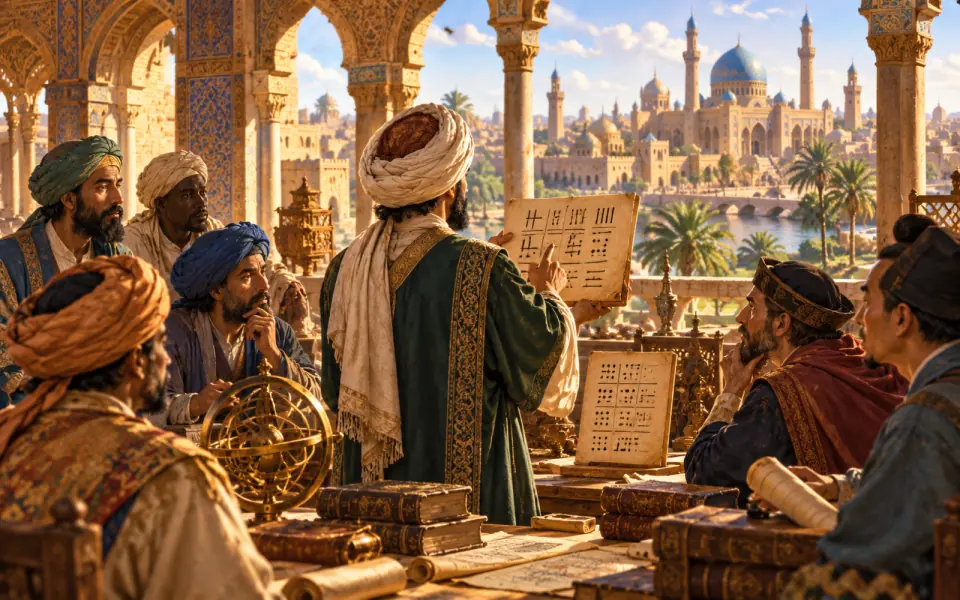 AfterHindu-Arabic numerals head westabout AD 825
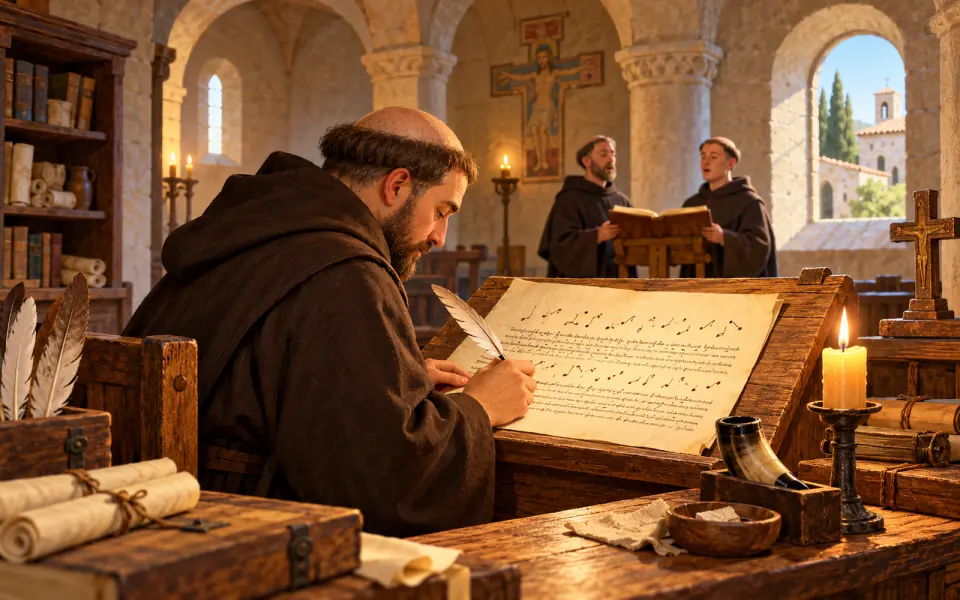 AfterWriting music down with neumesabout AD 850
 AfterThe Diamond Sutra, oldest dated printed bookAD 868
 AfterAlfred the GreatAD 871
 AfterThe Vikings reach Icelandabout AD 874
 AfterThe feudal system spreadsabout AD 900
 AfterThe Medical School of Salernoabout AD 950
 AfterThe Vikings in Greenlandabout AD 985
 AfterLeif Erikson in North Americaabout 1000
 AfterThe heavy plough spreadsabout 1000
Listen / Read next
- Music to read by: Cinematic JourneyEpic film-style music, no lyrics, by Ciro Simone IrmiciSpotifyYouTube Music
Meanwhile, elsewhere in the world
Other events of the era “Early Middle Ages”
- The Romano-Germanic kingdoms
- Emperor Justinian
- Justinian's Code
- Hagia Sophia in Constantinople
- The mosaics of San Vitale in Ravenna
- The Lombards in Italy
- Muhammad's Hijra
- Isidore writes the Etymologies
- The spread of Islam
- Paper reaches Samarkand
- Charlemagne, King of the Franks
- The Carolingian Renaissance
- The Book of Kells
- Charlemagne crowned emperor
- Hindu-Arabic numerals head west
- Writing music down with neumes
- The Diamond Sutra, oldest dated printed book
- Alfred the Great
- The Vikings reach Iceland
- The feudal system spreads
- The Medical School of Salerno
- The Vikings in Greenland
- Leif Erikson in North America
- The heavy plough spreads
