The Book of Kells
about AD 800 Iona (Scotland) and Kells (Ireland); now in Dublin
In short
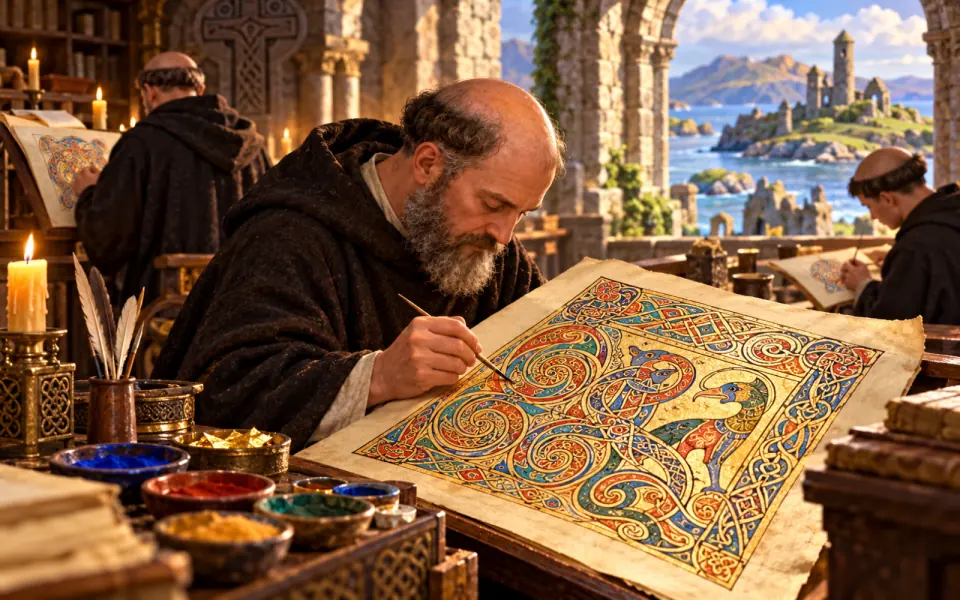
The Book of Kells contains the four Gospels in Latin and is decorated in an extraordinary way. It was made by Irish or Scottish monks, perhaps started in the monastery of Iona and finished at Kells, in Ireland. Its pages are full of knotwork, spirals, fantastic animals and opening letters so detailed that you need a magnifying glass to see everything. Today it is kept in the library of Trinity College Dublin.
Why it matters It is considered one of the masterpieces of illuminated books, decorated by hand, of the Middle Ages.
Source: Trinity College Dublin, “The Book of Kells”
Study card about 5 minutes of reading
The story
Irish monks on a Scottish island
In 563 an Irish monk, Columba (in Irish Colum Cille), landed with twelve companions on the island of Iona, a small islet of rock and meadow off the west of Scotland, and founded a monastery there. From there the monks set out to bring Christianity to the peoples of Scotland and northern England, and they made Iona one of the most important centres of culture of the age. The Irish monks were famous for their skill in copying books and for their eagerness to teach.
In the British Isles and Ireland, after the fall of the Roman Empire, a style of art all of their own had developed, called Insular: spirals, knots and interlacing lines that never end, stretched and twisted animals, stylised faces. It combined the traditions of Celtic art and of the Germanic peoples with models from Mediterranean Christianity.
A book for the altar
Around the year 800, perhaps at Iona, perhaps in another monastery, a group of monks began to copy the four Gospels, that is, the accounts of the life of Jesus, in a splendid volume. It was a book for the altar, meant not to be read every day but to stay in the church on the great feast days. The monks wrote the Latin text with an ink made from oak galls and iron sulphate, in a clear, regular script called Insular uncial.
For the parchment they used calfskin: according to scholars' calculations, the skins of about one hundred and eighty to one hundred and eighty-five calves were needed. The pages were sheets about thirty-three centimetres wide. The book today has 340 leaves, that is, 680 pages, but some of it has probably been lost.
Colour and imagination
What marks out the Book of Kells is its decoration. Almost every page has giant initial letters, interlacing, animals and human figures, brightly coloured with pigments made from minerals and plants: yellow from orpiment, green from verdigris, blue from woad or from other plant pigments. There is hardly any empty space. Some pages show portraits of the four evangelists, the Virgin Mary with the infant Jesus and the scene of the temptation of Jesus.
The most famous page is the one called “Chi-Rho”, where the first Greek letters of the name of Christ, X (chi) and P (rho), fill the whole page, with spirals, knots and hidden figures. If you look closely, you find tiny animals among the interlacing: cats, mice nibbling a communion wafer, otters with a fish, butterflies. The monks, clearly, liked a joke too.
Who made the book? Scholars recognise at least three or four different hands of scribes and decorators, who perhaps worked for years. The text is copied with some mistakes and with some lines left blank, a sign that the monks sometimes rushed or let themselves be distracted by the beauty of the decoration, which sometimes takes precedence over the text.
A book that nearly got lost
In 806 the Vikings attacked Iona and killed sixty-eight monks. The survivors took refuge in Ireland, at Kells (in Irish Ceanannas Mór), in County Meath, and probably took the book with them, or finished it there. It took its name from this place. In 1007 the book was stolen from the church at Kells: the thieves tore off the precious gold cover and left it under a heap of earth. It was found a few months later, damaged but still almost whole, according to the Irish annals.
Since 1661 it has been at Trinity College, Dublin, which received it as a gift. Today it is on show in the Old Library, and it is one of the most visited treasures of Ireland. To protect it, since 1953 it has been bound in four volumes, two of which are shown to the public, opened at different pages in rotation. An Irish animated film, “The Secret of Kells” (2009), tells a fantasy story about it.
Why it happened
In Irish monasteries copying books was considered sacred work, and the monks had time, patience and a rich artistic tradition. For the great feasts they needed a book worthy of the importance of the Gospels, rich in colour and gold.
The rich Insular style and contacts with the peoples of the continent offered the monks models and ideas to blend into something new and original.
What changed
The Book of Kells is considered the most beautiful illuminated manuscript of the early Middle Ages and a symbol of Irish identity. It shows the very high level of the art of the monasteries in a period often described as “dark”.
Artists of the time preserved its style in the following centuries, and many Celtic designs today, from jewellery to tattoos, derive from those models.
The book is also an important document for historians: it helps us understand how people worked, which materials they used and how the monks saw the world.
Key people and places
People
- Columba (Colum Cille)
- Irish monk (521–597): he founded the monastery of Iona in 563.
- The monks of Iona
- A group of monks, writers and artists who, according to scholars, began the book.
- Henry Jones
- Bishop who gave the book to Trinity College in 1661.
- The Vikings
- Scandinavian people who attacked Iona in 806 and forced the monks to flee.
Places
- Iona (Scotland)
- Island where Columba's monastery stood.
- Kells (Ireland)
- Small town in County Meath from which the book takes its name.
- Trinity College, Dublin
- The university that keeps the manuscript today.
Good to know
- The Book of Kells needed, by estimate, the skins of about 180–185 calves.
- Among the interlacing on the Chi-Rho page you can see cats, mice and otters.
- In 1007 the book was stolen and found under a heap of earth.
- Since 1661 the book has been kept at Trinity College; since 1953 it has been bound in four volumes.
- The Vikings killed 68 monks at Iona in 806.
Find out more
- Wikipedia, “Book of Kells” en.wikipedia.org
- Wikipedia, “Iona” en.wikipedia.org
- Wikipedia, “Insular art” en.wikipedia.org
- Trinity College Dublin, Old Library tcd.ie
Related events
- The Carolingian Renaissanceabout AD 790 · Early Middle AgesAt Charlemagne's court Carolingian minuscule was born.
- The Diamond Sutra, oldest dated printed bookAD 868 · Early Middle AgesIn China, a century later, the first dated printed book was produced.
- Writing music down with neumesabout AD 850 · Early Middle AgesIn the monasteries people sang and began to write down music.
- Benedictine monksabout AD 529 · Early Middle AgesMonasticism was the basis of culture in the early Middle Ages.
Before and after, in the era “Early Middle Ages”
Event 14 of 25
 BeforeThe Romano-Germanic kingdomsabout AD 480
 BeforeEmperor JustinianAD 527
 BeforeJustinian's CodeAD 529
 BeforeBenedictine monksabout AD 529
 BeforeHagia Sophia in ConstantinopleAD 537
 BeforeThe mosaics of San Vitale in RavennaAD 547
 BeforeThe Lombards in ItalyAD 568
 BeforeMuhammad's HijraAD 622
 BeforeIsidore writes the Etymologiesabout AD 625
 BeforeThe spread of IslamAD 632–750
 BeforePaper reaches Samarkandabout AD 751
 BeforeCharlemagne, King of the FranksAD 768
 BeforeThe Carolingian Renaissanceabout AD 790
- You are hereThe Book of Kellsabout AD 800
 AfterCharlemagne crowned emperorAD 800
 AfterHindu-Arabic numerals head westabout AD 825
 AfterWriting music down with neumesabout AD 850
 AfterThe Diamond Sutra, oldest dated printed bookAD 868
 AfterAlfred the GreatAD 871
 AfterThe Vikings reach Icelandabout AD 874
 AfterThe feudal system spreadsabout AD 900
 AfterThe Medical School of Salernoabout AD 950
 AfterThe Vikings in Greenlandabout AD 985
 AfterLeif Erikson in North Americaabout 1000
 AfterThe heavy plough spreadsabout 1000
Listen / Read next
- Music to read by: Cinematic JourneyEpic film-style music, no lyrics, by Ciro Simone IrmiciSpotifyYouTube Music
Meanwhile, elsewhere in the world
Other events of the era “Early Middle Ages”
- The Romano-Germanic kingdoms
- Emperor Justinian
- Justinian's Code
- Benedictine monks
- Hagia Sophia in Constantinople
- The mosaics of San Vitale in Ravenna
- The Lombards in Italy
- Muhammad's Hijra
- Isidore writes the Etymologies
- The spread of Islam
- Paper reaches Samarkand
- Charlemagne, King of the Franks
- The Carolingian Renaissance
- Charlemagne crowned emperor
- Hindu-Arabic numerals head west
- Writing music down with neumes
- The Diamond Sutra, oldest dated printed book
- Alfred the Great
- The Vikings reach Iceland
- The feudal system spreads
- The Medical School of Salerno
- The Vikings in Greenland
- Leif Erikson in North America
- The heavy plough spreads
