The mosaics of San Vitale in Ravenna
AD 547 Ravenna, Emilia-Romagna
In short
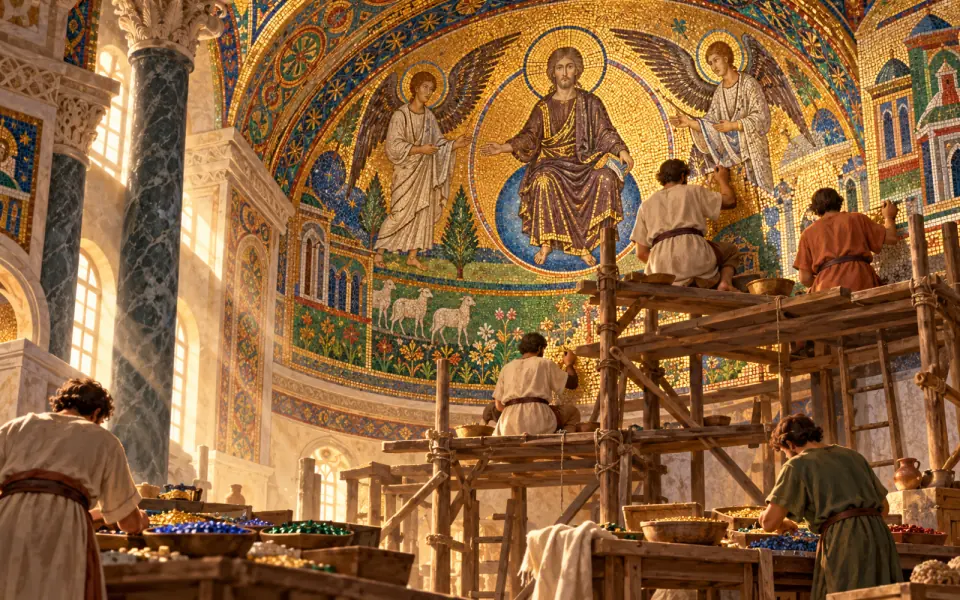
Ravenna had been won back by the Byzantines when the church of San Vitale was consecrated by Bishop Maximian. The walls of the apse are covered with mosaics made from thousands of tiny pieces of coloured and golden glass. Two large panels show Justinian and the empress Theodora with their courts, carrying gifts. Faces, fabrics and jewels are so precise that they look like portraits.
Why it matters These mosaics are among the most famous images of Byzantine art and show what an imperial court looked like.
Study card about 5 minutes of reading
The story
A church with eight sides
At Ravenna, in north-eastern Italy, there is a church that from outside looks modest: red bricks, an eight-sided body, a plain roof. But when you go inside, you find yourself in front of one of the most splendid spaces of ancient art. It is the basilica of San Vitale, dedicated to a Christian martyr. The plan is octagonal, with a taller central part and a great dome, and inside the walls are covered with marble and mosaics.
The dates are not one hundred per cent certain. Some sources say that building began in 526 or 527, under Bishop Ecclesius; the Italian Wikipedia entry instead says 532. But we know for certain that the church was consecrated on 17 May 547 by Bishop Maximian. The work was paid for by a man named Julian the Banker.
Ravenna: from one capital to another
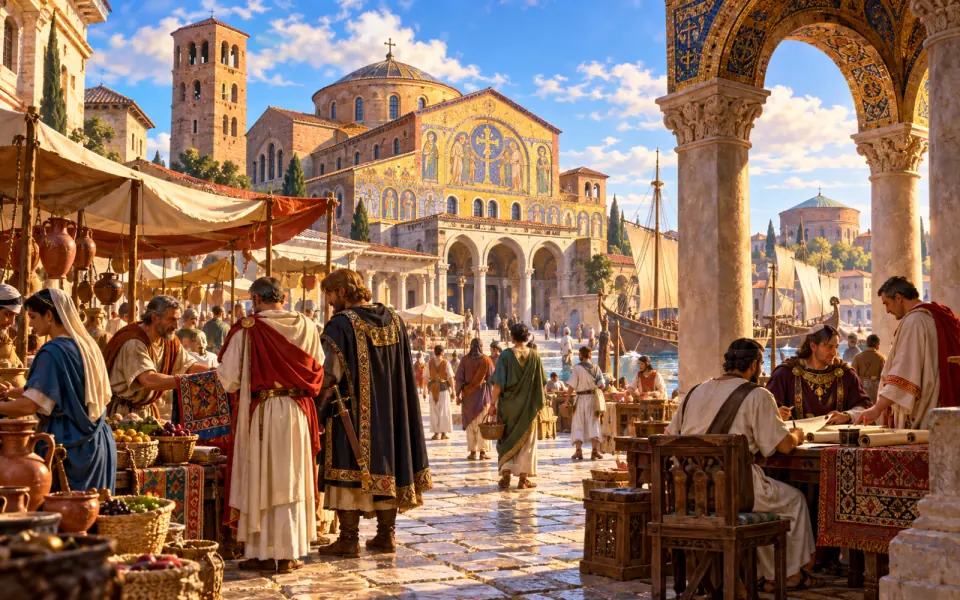
To understand the church we have to remember the history of the city. Ravenna had been the capital of Theodoric, king of the Ostrogoths. When San Vitale was built, in Italy the war was going on between the Ostrogoths and the emperor Justinian, who wanted to win back the West. In the end the city passed to the Byzantines. After the reconquest Ravenna stayed Byzantine, and it was here that the art of Constantinople arrived in all its strength.
The mosaic: a painting made of little stones
A mosaic is made of many small cubes, the tesserae, of stone, coloured glass or glass with a thin leaf of gold inside. Placed one beside another, they form an image. In the mosaics of San Vitale the golden backgrounds make the figures seem to hang in a timeless space.
In the apse, the semicircular part behind the altar, you can see Christ seated on the globe of the world between two angels, with Saint Vitalis on one side and Bishop Ecclesius on the other, holding the model of the church. Other mosaics decorate the presbytery, the area in front of the altar, where you can also see a monogram of Christ held up by two eagles and a vault with 27 stars around the Lamb.
Justinian and Theodora
The most famous panels are two, on the side walls of the apse, facing each other. In one is the emperor Justinian, in the centre, with a crown and a purple cloak, with a halo round his head, bringing as a gift a paten, the gold plate used for the bread at Mass. Beside him are his courtiers and soldiers. On his left is Bishop Maximian, the only person in the whole panel who has his name written above his head. This is how scholars know that the mosaic was made after 546, when Maximian became bishop of Ravenna.
In the other panel is the empress Theodora, she too with a halo, leading a procession of elegantly dressed ladies. She carries a golden chalice with jewels. According to some, on the hem of her cloak are embroidered the three Magi bringing gifts to Jesus: a way of saying that emperors too bring gifts to the Church.
There is a curious fact that visitors often do not know. Justinian and Theodora, it seems, never came to Ravenna: they are shown as if they were present at the consecration, but the mosaic is a solemn image, not a photograph of a real moment. It served to remind the people of Ravenna who now ruled their city.
How to read a Byzantine image
The figures face the front, motionless, with big eyes and a fixed gaze. They do not try to copy nature as Roman painters did: they want to show an order. There is no landscape, no perspective, and the characters seem to hang against a golden background that recalls the sky and the light of God. The faces, however, are individual, and the fabrics and jewels are shown with incredible care. For those who looked at it, the emperor was God's representative on Earth, and art had to make that clear.
Since 1996 San Vitale has been part of the UNESCO site of the Early Christian Monuments of Ravenna. Pope John XXIII raised it to the rank of minor basilica in October 1960.
Why it happened
The mosaics of San Vitale came from the meeting of two forces: the wealth of a citizen, Julian the Banker, who paid for the church, and the wish of the emperor at Constantinople to show himself present in the reconquered city. The bishops of Ravenna wanted a large and beautiful church that would show the importance of their city.
Ravenna, moreover, was a fitting place: the city had just been reconquered by the Byzantines and it was important for them to show themselves through images as well. The church unites Roman elements, such as the bricks, and Byzantine ones, such as the polygonal apse, and the taste for gold and for solemnity.
What changed
San Vitale is today one of the few places in the world where you can see, in an almost intact church, the portraits of a Byzantine emperor and his court. Art historians study them to understand how dignitaries dressed and how power was represented at that time.
The mosaics have greatly influenced the picture we have of Byzantine art: when we think of figures facing the front on a gold background, we also think of Ravenna. In 1996 the churches of Ravenna entered UNESCO's World Heritage List, and every year they attract visitors from all over the world.
There is also a lesson in history: an image is never just decoration. These mosaics told those who entered the church who ruled, and how he wished to be seen. For this reason, when we look at them, we must always ask who wanted them and why.
Key people and places
People
- Justinian
- Emperor of the East from 527 to 565: he is the main figure of one of the two great panels, although he probably never went to Ravenna.
- Theodora
- Empress, wife of Justinian: she leads the procession of ladies in the panel opposite.
- Maximian
- Bishop of Ravenna from 546: he consecrated the church on 17 May 547 and is the only figure in Justinian's panel with his name written.
- Julian the Banker
- Financer of the building of the basilica.
- Ecclesius
- Bishop of Ravenna at the start of the work: in the apse mosaic he holds the model of the church.
Places
- Ravenna
- City in Emilia-Romagna, once the capital of the Western Empire and of Theodoric's kingdom, then Byzantine.
- Constantinople
- Justinian's capital, from which came the power and the taste that the mosaics represent.
- The apse
- The semicircular part behind the altar, where the most important mosaics are.
Good to know
- In Justinian's panel, the only figure with his name written is Bishop Maximian.
- Justinian and Theodora, it seems, never went to Ravenna: they are present only in the image.
- A vault of the church has 27 stars surrounding the Lamb, the symbol of Christ.
- In the floor of the presbytery there is a labyrinth, a symbol of the soul's journey towards purification.
- Since 1996 San Vitale has been a World Heritage Site together with other Early Christian monuments of Ravenna.
Find out more
- Wikipedia, “Basilica of San Vitale” en.wikipedia.org
- Wikipedia, “Ravenna” en.wikipedia.org
- Wikipedia, “Theodora (wife of Justinian I)” en.wikipedia.org
- Wikipedia, “Justinian I” en.wikipedia.org
Related events
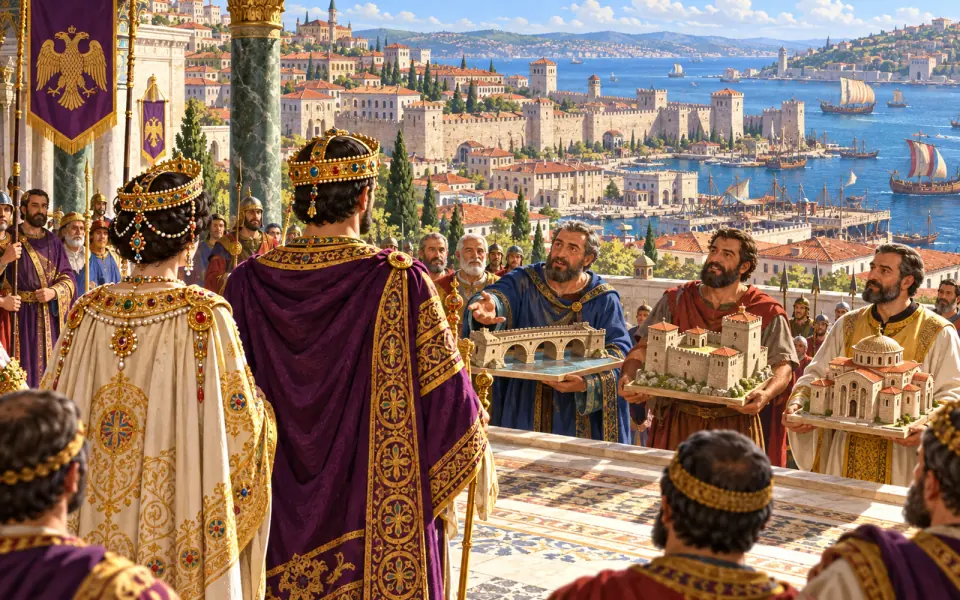
- Emperor JustinianAD 527 · Early Middle AgesJustinian and Theodora, the subjects of the mosaics, lived in the same period.
- Hagia Sophia in ConstantinopleAD 537 · Early Middle AgesIn the same years Hagia Sophia was being built at Constantinople.
- The Romano-Germanic kingdomsabout AD 480 · Early Middle AgesRavenna had been the capital of Theodoric, king of the Ostrogoths.
- The Lombards in ItalyAD 568 · Early Middle AgesIn 568 the Lombards entered Italy, where Ravenna remained in Byzantine hands.
Before and after, in the era “Early Middle Ages”
Event 6 of 25
 BeforeThe Romano-Germanic kingdomsabout AD 480
 BeforeEmperor JustinianAD 527
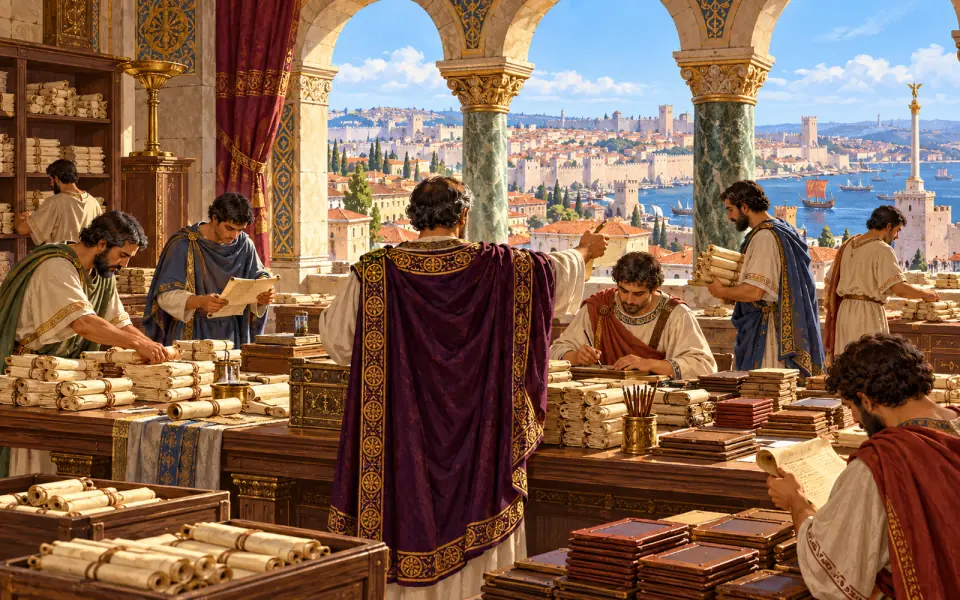 BeforeJustinian's CodeAD 529
 BeforeBenedictine monksabout AD 529
 BeforeHagia Sophia in ConstantinopleAD 537
- You are hereThe mosaics of San Vitale in RavennaAD 547
 AfterThe Lombards in ItalyAD 568
 AfterMuhammad's HijraAD 622
 AfterIsidore writes the Etymologiesabout AD 625
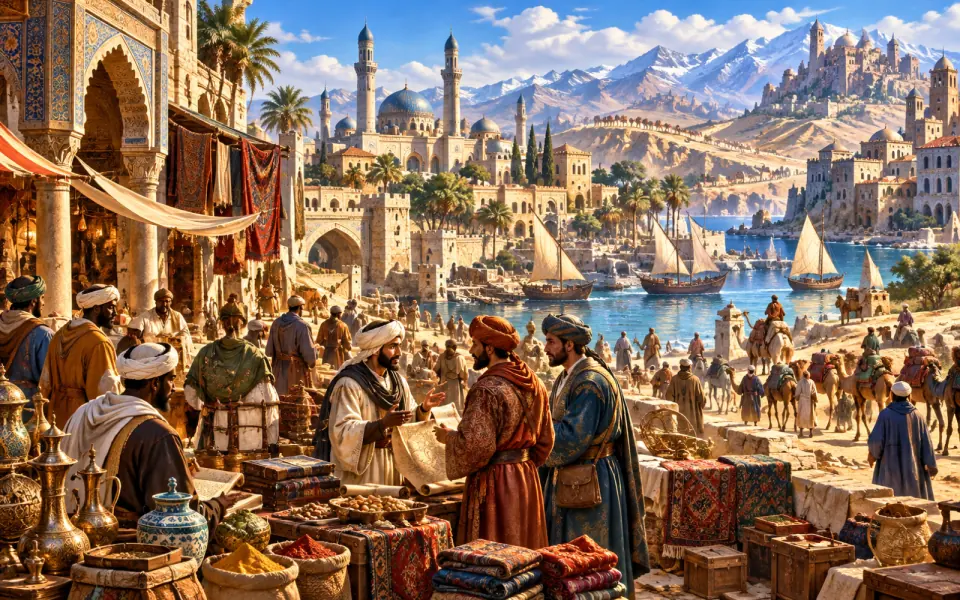 AfterThe spread of IslamAD 632–750
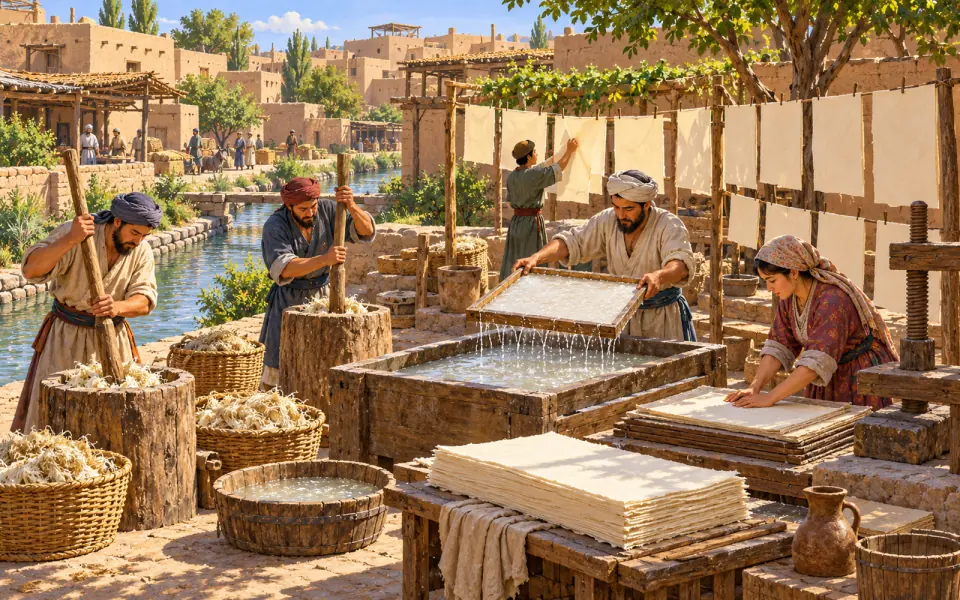 AfterPaper reaches Samarkandabout AD 751
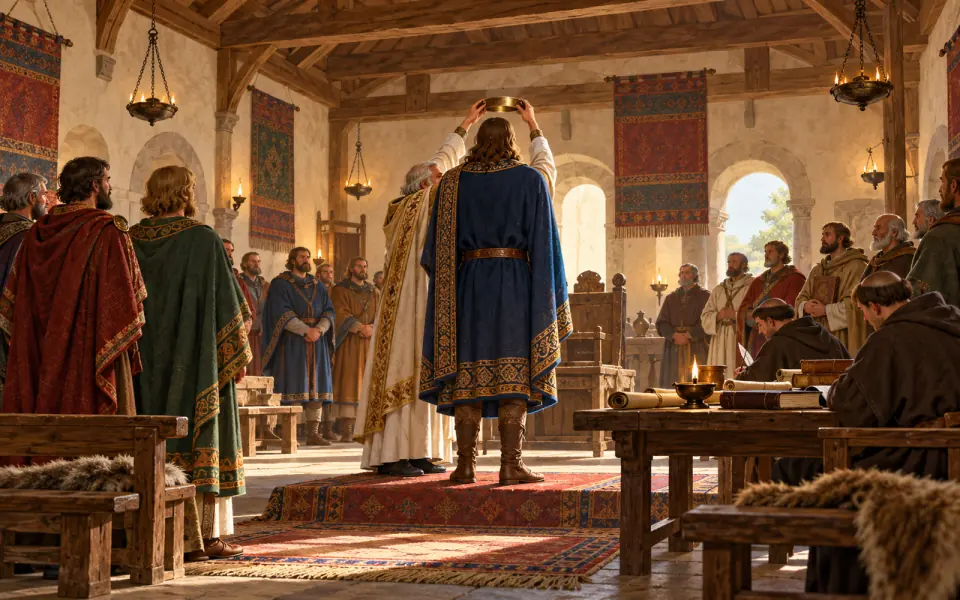 AfterCharlemagne, King of the FranksAD 768
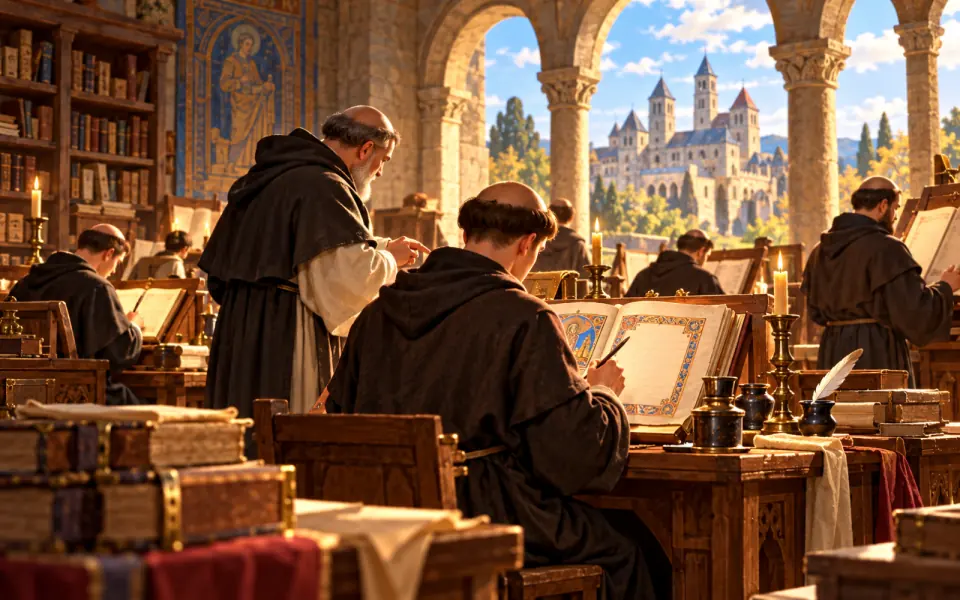 AfterThe Carolingian Renaissanceabout AD 790
 AfterThe Book of Kellsabout AD 800
 AfterCharlemagne crowned emperorAD 800
 AfterHindu-Arabic numerals head westabout AD 825
 AfterWriting music down with neumesabout AD 850
 AfterThe Diamond Sutra, oldest dated printed bookAD 868
 AfterAlfred the GreatAD 871
 AfterThe Vikings reach Icelandabout AD 874
 AfterThe feudal system spreadsabout AD 900
 AfterThe Medical School of Salernoabout AD 950
 AfterThe Vikings in Greenlandabout AD 985
 AfterLeif Erikson in North Americaabout 1000
 AfterThe heavy plough spreadsabout 1000
Listen / Read next
- Music to read by: Cinematic JourneyEpic film-style music, no lyrics, by Ciro Simone IrmiciSpotifyYouTube Music
Meanwhile, elsewhere in the world
Other events of the era “Early Middle Ages”
- The Romano-Germanic kingdoms
- Emperor Justinian
- Justinian's Code
- Benedictine monks
- Hagia Sophia in Constantinople
- The Lombards in Italy
- Muhammad's Hijra
- Isidore writes the Etymologies
- The spread of Islam
- Paper reaches Samarkand
- Charlemagne, King of the Franks
- The Carolingian Renaissance
- The Book of Kells
- Charlemagne crowned emperor
- Hindu-Arabic numerals head west
- Writing music down with neumes
- The Diamond Sutra, oldest dated printed book
- Alfred the Great
- The Vikings reach Iceland
- The feudal system spreads
- The Medical School of Salerno
- The Vikings in Greenland
- Leif Erikson in North America
- The heavy plough spreads
