The Council of Trent
1545–1563 Trento, Italy
In short
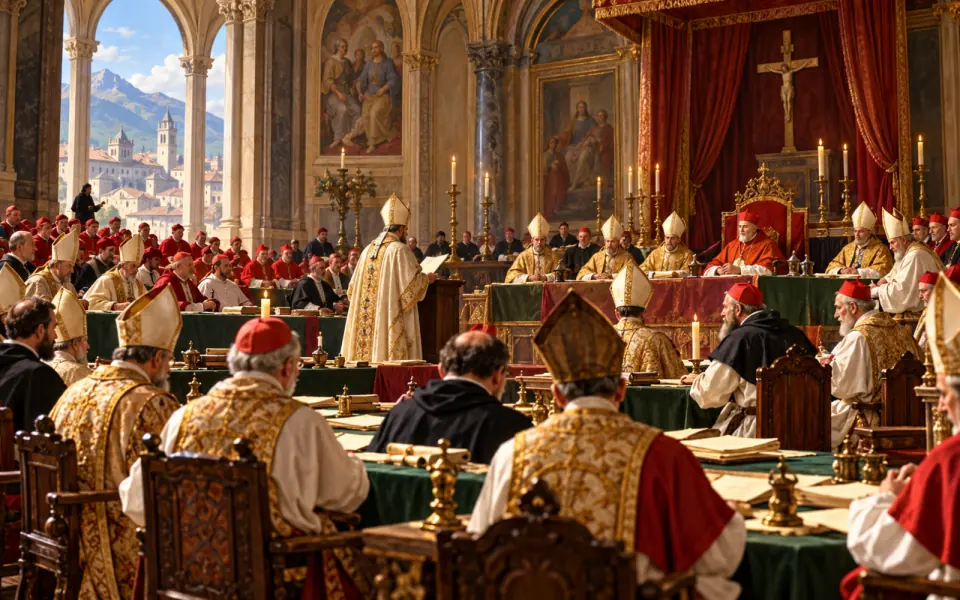
To respond to the Protestant Reformation, the Catholic Church called a great council, an assembly of bishops, in the city of Trento. The meetings went on, with long breaks, for eighteen years. The council confirmed Catholic teachings and decided on internal reforms, such as creating seminaries to train priests better. This was the start of the so-called Counter-Reformation, also known as the Catholic Reformation.
Why it matters Its decisions guided the life of the Catholic Church until the 20th century.
Source: Treccani, entry “Trento, Concilio di”
Study card about 5 minutes of reading
The story
A council to answer Luther
When Luther and the other reformers began to break away from the Church of Rome, many people, even among Catholics, thought that a great council was needed, that is, an assembly of bishops and theologians, to discuss the problems and decide what to do. Emperor Charles V pressed for one, hoping to restore the unity of Christians in Germany. The popes, on the other hand, were very cautious: they feared that a council would limit their power, and for years they put it off.
In the end Pope Paul III agreed. The place chosen was Trent, a mountain city that belonged to the Empire but was close to Italy: it was a compromise between the emperor, who wanted it held on German territory, and the pope, who wanted a city that was easy to reach and to keep an eye on. The council was opened on 13 December 1545 in the Cathedral of Saint Vigilius.
Eighteen years, three stages
The council lasted eighteen years in all, but with long breaks because of wars, epidemics, disputes between rulers and changes of pope. It took place in three periods. The first (1545–1547) was under Paul III; the second (1551–1552) under Julius III; the third (1562–1563) under Pius IV. At the start there were few participants: at the first session there were about thirty bishops. In the end, in 1563, more than two hundred signed the acts.
The Protestants, though invited, hardly came at all: a few delegates turned up in the second period, but no agreement was reached. The council was therefore an assembly of the Catholic Church alone. The discussions on individual points were long, and sometimes heated. They dealt with the Bible, the sacraments and the difference between faith and works.
What was decided
The council set out Catholic doctrine more precisely, rejecting the Protestant claims. It confirmed the seven sacraments, the real presence of Christ in the Eucharist and the value of tradition alongside the Bible, and it laid down that the Latin Bible, the Vulgate, was the official text. It also restated the authority of the pope.
It then decided on many practical reforms. Bishops had to live in their own dioceses, visit the parishes and preach. Every diocese had to have a seminary, that is, a school where future priests trained for years: before this, many priests knew little more than their congregations. The sale of Church offices was forbidden. In 1563 it was laid down that, to be valid, a marriage had to be celebrated in front of a priest and two or three witnesses, and that parishes had to keep registers of baptisms and marriages (those of deaths were added in 1614): today they are a precious source for historians and for anyone tracing their family tree.
After Trent
After the council the pope published a new catechism (1566), a new breviary (1568) and a new missal (1570), that is, the books for prayer and Mass, the same for the whole Latin Church. The Index of Forbidden Books, the list of books Catholics were not allowed to read, was strengthened. New religious orders appeared, or existing ones grew, such as the Jesuits, founded in 1540, who opened schools all over Europe.
One of the bishops who applied the decisions most energetically was Charles Borromeo, Archbishop of Milan: he visited the parishes in person, even in the most remote valleys, founded seminaries and schools for poor children, and during the plague of 1576 he cared for the sick.
This period is often called the Counter-Reformation or the Catholic Reformation. Art changed too: churches filled with images meant to move and teach people, and sacred music had to make the words easy to understand. A legend credits the composer Palestrina with having “saved” polyphony after the council's criticisms, but historians do not think it is true.
Why it happened
The Catholic Church was in crisis: the Protestant Reformation had taken away believers and territories, and it was well known that the clergy had many faults, from poor education to clinging to privileges. A clear answer was needed, both in doctrine and in practice.
Politics mattered too: the emperor wanted to restore the unity of his lands, the kings of France and Spain wanted a say in the decisions, and the pope wanted to defend his own authority.
What changed
The split between Catholics and Protestants became permanent. The decisions of Trent remained the basis of Catholic doctrine for four centuries, until the Second Vatican Council in the 1960s.
The clergy became better educated, thanks to the seminaries, and religious life became more regulated. Schools, charity and preaching also grew, mostly thanks to the new orders.
But intolerance and censorship appeared too: the Inquisition and the Index struck at anyone suspected of error. In Catholic regions this slowed down the spread of some ideas, including scientific ones, for a time.
Key people and places
People
- Paul III
- Pope from 1534 to 1549 (1468–1549): he called the council.
- Charles V
- Emperor (1500–1558): he pressed for it in order to restore unity in Germany.
- Julius III
- Pope from 1550 to 1555: he led the second period.
- Pius IV
- Pope from 1559 to 1565 (1499–1565): he brought the council to a close.
- Charles Borromeo
- Cardinal and Archbishop of Milan (1538–1584): one of the leading figures in putting the reforms into practice.
Places
- Trent
- City in Trentino, northern Italy, where the council was held; it opened in the Cathedral of Saint Vigilius.
- Cathedral of Saint Vigilius, Trent
- The church where the council was opened; later sessions were also held in Santa Maria Maggiore.
Good to know
- The council lasted eighteen years, with long pauses.
- In 1563 it was decided that every parish should keep registers of baptisms and marriages.
- Seminaries, schools for future priests, were called for by the council.
- The council's catechism was published in 1566.
- The Jesuits, founded in 1540, were very active after the council.
Find out more
- Wikipedia, “Council of Trent” en.wikipedia.org
- Wikipedia, “Counter-Reformation” en.wikipedia.org
- Wikipedia, “Index Librorum Prohibitorum” en.wikipedia.org
- Wikipedia, “Charles Borromeo” en.wikipedia.org
Related events
- Luther and the Reformation1517 · Early modern ageThe council was the Catholic answer to Luther's Reformation.
- Gutenberg prints the Bibleabout 1455 · Early modern agePrinting made it possible to spread the council's texts and the catechism.
- Copernicus puts the Sun at the centre1543 · Early modern ageIn 1543 Copernicus had published his book.
- The Gregorian calendar1582 · Early modern ageA few years later a pope reformed the calendar as well.
Before and after, in the era “Early modern age”
Event 15 of 25
 BeforeRenaissance perspectiveabout 1420
 BeforeBrunelleschi completes the dome1436
 BeforeThe fall of Constantinople1453
 BeforeGutenberg prints the Bibleabout 1455
 BeforeLorenzo de' Medici in Florence1469
 BeforeLeonardo designs machinesabout 1485
 BeforeColumbus's voyage1492
 BeforeVasco da Gama reaches India1498
 BeforeMichelangelo carves David1504
 BeforeRaphael paints the Vatican Rooms1508
 BeforeLuther and the Reformation1517
 BeforeThe conquest of Tenochtitlán1521
 BeforeThe first voyage round the world1522
 BeforeCopernicus puts the Sun at the centre1543
- You are hereThe Council of Trent1545–1563
 AfterTomatoes, maize and potatoes reach Europeabout 1550
 AfterThe Gregorian calendar1582
 AfterShakespeare's theatreabout 1590
 AfterRegular newspapers1605
 AfterGalileo turns his telescope to the sky1609
 AfterKepler describes the orbits1609
 AfterArtemisia Gentileschiabout 1612
 AfterHarvey studies the circulation of the blood1628
 AfterScientific academies1660
 AfterNewton publishes the Principia1687
Listen / Read next
- Music to read by: Cinematic JourneyEpic film-style music, no lyrics, by Ciro Simone IrmiciSpotifyYouTube Music
Meanwhile, elsewhere in the world
Other events of the era “Early modern age”
- Renaissance perspective
- Brunelleschi completes the dome
- The fall of Constantinople
- Gutenberg prints the Bible
- Lorenzo de' Medici in Florence
- Leonardo designs machines
- Columbus's voyage
- Vasco da Gama reaches India
- Michelangelo carves David
- Raphael paints the Vatican Rooms
- Luther and the Reformation
- The conquest of Tenochtitlán
- The first voyage round the world
- Copernicus puts the Sun at the centre
- Tomatoes, maize and potatoes reach Europe
- The Gregorian calendar
- Shakespeare's theatre
- Regular newspapers
- Galileo turns his telescope to the sky
- Kepler describes the orbits
- Artemisia Gentileschi
- Harvey studies the circulation of the blood
- Scientific academies
- Newton publishes the Principia
