Vasco da Gama reaches India
1498 Calicut (now Kozhikode), India
In short
The Portuguese navigator Vasco da Gama set out from Lisbon in 1497 with four ships. He sailed round Africa, passing the Cape of Good Hope, and went up the east coast of the continent. With the help of a pilot who knew the Indian Ocean well, in May 1498 he arrived at Calicut, in India. For the first time a European ship had reached India directly by sea.
Why it matters He opened a sea route for spices that made Portugal extremely rich and changed world trade.
Source: Encyclopaedia Britannica, “Vasco da Gama”
Study card about 5 minutes of reading
The story
Portugal and the sea
Portugal is a small country facing the Atlantic. In the 15th century its kings, starting with Prince Henry the Navigator, sent ships to explore a longer and longer stretch of the African coast: each expedition went a little further south and brought home gold, ivory, slaves and news. The final aim was to find a sea route to India, where the most precious spices came from, without passing through the lands of Arab and Venetian merchants.
In 1488 Bartolomeu Dias reached the southern tip of Africa, the cape now called the Cape of Good Hope, and showed that it was possible to pass from the Atlantic to the Indian Ocean. But his men were exhausted and turned back. It took nearly ten years before a new voyage was prepared, the one that was to go all the way.
The departure
The commander chosen by King Manuel I was Vasco da Gama, a nobleman aged between thirty and forty. On 8 July 1497 he set out from Lisbon with four ships: two large cargo ships, the São Gabriel and the São Rafael, a smaller caravel, the Bérrio, and a supply ship. On board were about one hundred and seventy men. To avoid the calms and the contrary currents along the African coast, Vasco da Gama made a bold choice: he moved far away from the mainland and went deep into the South Atlantic for almost three months, without ever seeing land, before curving east and approaching Africa again.
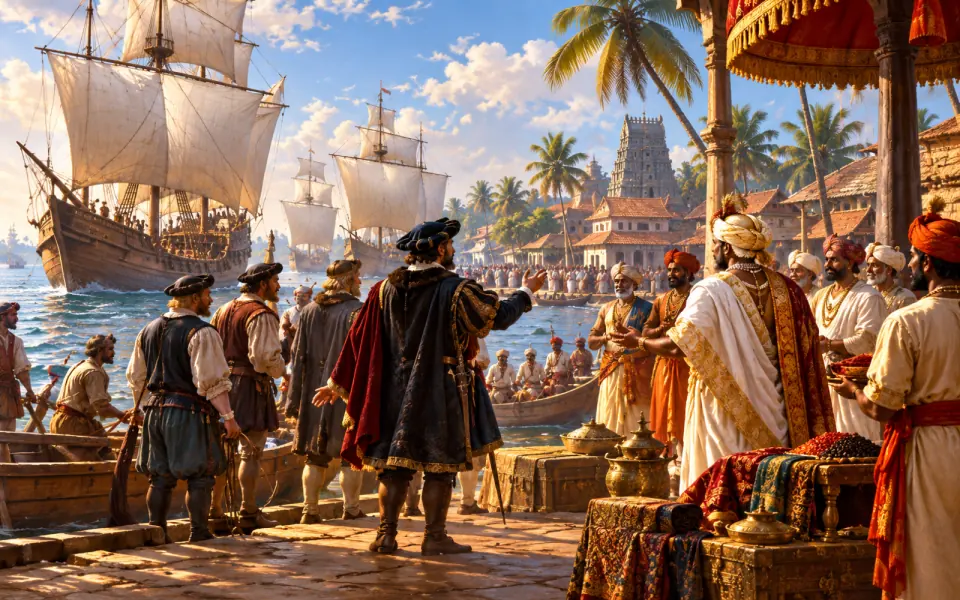
At the end of November 1497 the ships rounded the Cape of Good Hope. They then sailed up the east coast of Africa, stopping at ports such as Mozambique, Mombasa and Malindi, where they met hostility but also hospitality. At Malindi the ruler welcomed the Portuguese and provided them with a pilot, who guided them across the Indian Ocean, using the seasonal winds, the monsoons. The name of the pilot is uncertain: one tradition speaks of the Arab navigator Ahmad ibn Majid, but historians debate whether that is true.
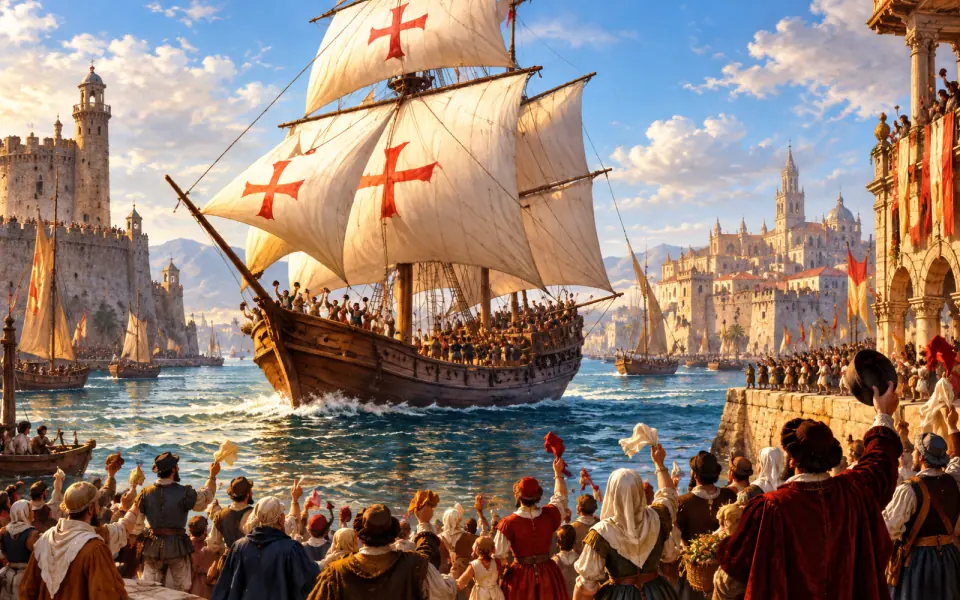
Along the way the Portuguese used to put up stone pillars with the king's coat of arms and a cross, the “padrões”, to mark that they had passed that way. On the sails of the ships was painted the red cross of the Order of Christ, the religious and military order that had paid for many explorations.
Calicut
After about twenty days of crossing, on 20 May 1498 the ships arrived off Calicut, on the south-west coast of India, after a voyage of more than ten months. Calicut was one of the great spice markets, where Arab, Indian and Chinese merchants sold pepper, cinnamon and ginger. The local ruler, the Zamorin, received the Portuguese, but the gifts they brought seemed poor, and the Muslim merchants, who feared competition, looked at them with suspicion.
Vasco da Gama managed to load spices and set off again. The return voyage was hard: crossing the Indian Ocean took three months, scurvy broke out, a disease caused by the lack of fresh fruit and vegetables, and many sailors died. After about two years of travelling, in the summer of 1499, only two ships returned to Lisbon, with fewer than half of the men. The cargo of spices, however, earned so much that the voyage was judged a great success.
After the first voyage
In 1500 the king sent a second fleet, commanded by Pedro Álvares Cabral, which touched Brazil by chance, claimed it for Portugal and then went on towards India. In 1502 Vasco da Gama returned to India with a war fleet and behaved with great harshness: he bombarded Calicut and had a ship full of pilgrims set on fire. In 1524 he went again, as viceroy, and died at Cochin, in India, a few months after he arrived.
Why it happened
Portugal wanted to break the monopoly of Arab and Venetian middlemen over the spice trade and to reach the sources directly. For this reason its kings financed explorations, schools of navigation and mapmaking for decades.
Nautical knowledge, the caravel, the compass and the astrolabe made it possible to face the open ocean. The voyages of Dias and other explorers had already shown the way.
What changed
The sea route between Europe and India was opened. Portugal built a network of bases and fortresses along the coasts of Africa and Asia, from the island of Mozambique to Goa (conquered in 1510), Malacca and Macao, and for a century controlled an important part of the spice trade.
The spice trade moved from the Mediterranean to the Atlantic. Italian cities such as Venice lost economic importance, while Lisbon and later Antwerp, Amsterdam and London became centres of world trade.
For the peoples of Asia and Africa the arrival of the Portuguese also meant violence and conquest: ports were taken by force of arms and trade was imposed by force. After the Portuguese came the Dutch, the English and the French, and an age of European domination began.
Key people and places
People
- Vasco da Gama
- Portuguese navigator (born between 1460 and 1469, died 1524): he led the first sea voyage from Europe to India.
- Bartolomeu Dias
- Portuguese navigator (about 1450–1500): in 1488 he rounded the Cape of Good Hope.
- Manuel I
- King of Portugal from 1495 to 1521: he sent Vasco da Gama to India.
- Pedro Álvares Cabral
- Portuguese navigator (about 1467–1520): in 1500 he reached Brazil.
Places
- Lisbon
- Capital of Portugal and the port the voyage set out from.
- Cape of Good Hope
- South-western tip of Africa, the passage from the Atlantic to the Indian Ocean.
- Calicut (now Kozhikode)
- Port in south-western India where the ships arrived in 1498.
Good to know
- Vasco da Gama made a crossing of almost three months in the South Atlantic without seeing land.
- The round trip lasted almost two years.
- Of the four ships that set out, only two returned to Lisbon.
- The second Portuguese expedition, led by Cabral, touched Brazil by chance.
- The poem “The Lusiads”, by Luís de Camões, sings of Vasco da Gama's voyage.
Find out more
- Wikipedia, “Vasco da Gama” en.wikipedia.org
- Wikipedia, “Bartolomeu Dias” en.wikipedia.org
- Wikipedia, “Kozhikode” en.wikipedia.org
- Wikipedia, “Pedro Álvares Cabral” en.wikipedia.org
Related events
- The fall of Constantinople1453 · Early modern ageThe fall of Constantinople pushed Europe to look for other routes.
- Columbus's voyage1492 · Early modern ageColumbus had looked for India to the west six years earlier.
- The first voyage round the world1522 · Early modern ageMagellan, soon after, sailed around the world.
- Tomatoes, maize and potatoes reach Europeabout 1550 · Early modern ageAmerican plants too arrived in Europe by sea.
Before and after, in the era “Early modern age”
Event 8 of 25
 BeforeRenaissance perspectiveabout 1420
 BeforeBrunelleschi completes the dome1436
 BeforeThe fall of Constantinople1453
 BeforeGutenberg prints the Bibleabout 1455
 BeforeLorenzo de' Medici in Florence1469
 BeforeLeonardo designs machinesabout 1485
 BeforeColumbus's voyage1492
- You are hereVasco da Gama reaches India1498
 AfterMichelangelo carves David1504
 AfterRaphael paints the Vatican Rooms1508
 AfterLuther and the Reformation1517
 AfterThe conquest of Tenochtitlán1521
 AfterThe first voyage round the world1522
 AfterCopernicus puts the Sun at the centre1543
 AfterThe Council of Trent1545–1563
 AfterTomatoes, maize and potatoes reach Europeabout 1550
 AfterThe Gregorian calendar1582
 AfterShakespeare's theatreabout 1590
 AfterRegular newspapers1605
 AfterGalileo turns his telescope to the sky1609
 AfterKepler describes the orbits1609
 AfterArtemisia Gentileschiabout 1612
 AfterHarvey studies the circulation of the blood1628
 AfterScientific academies1660
 AfterNewton publishes the Principia1687
Listen / Read next
- Music to read by: Cinematic JourneyEpic film-style music, no lyrics, by Ciro Simone IrmiciSpotifyYouTube Music
Meanwhile, elsewhere in the world
Other events of the era “Early modern age”
- Renaissance perspective
- Brunelleschi completes the dome
- The fall of Constantinople
- Gutenberg prints the Bible
- Lorenzo de' Medici in Florence
- Leonardo designs machines
- Columbus's voyage
- Michelangelo carves David
- Raphael paints the Vatican Rooms
- Luther and the Reformation
- The conquest of Tenochtitlán
- The first voyage round the world
- Copernicus puts the Sun at the centre
- The Council of Trent
- Tomatoes, maize and potatoes reach Europe
- The Gregorian calendar
- Shakespeare's theatre
- Regular newspapers
- Galileo turns his telescope to the sky
- Kepler describes the orbits
- Artemisia Gentileschi
- Harvey studies the circulation of the blood
- Scientific academies
- Newton publishes the Principia
