Brunelleschi completes the dome
1436 Florence, Italy
In short
The cathedral of Santa Maria del Fiore, in Florence, had an unsolved problem: nobody knew how to roof over a gap more than 40 metres wide. Filippo Brunelleschi won the challenge with a double dome, one inside the other, and bricks laid in a herringbone pattern that held themselves up while the work went on. He also invented machines to hoist materials to the top. In 1436 the cathedral was consecrated; the lantern on the summit came a few years later.
Why it matters It showed that with calculation and ingenuity, works that seemed impossible could be built.
Source: Treccani, entry “Brunelleschi, Filippo”
Study card about 5 minutes of reading
The story
A church without a dome
In 1296 the Florentines decided to build the biggest and most beautiful church in the city, the cathedral of Santa Maria del Fiore, to show the world the wealth and pride of Florence. The architect was Arnolfo di Cambio. Work went on for more than a century: the façade, the aisles and the bell tower designed by Giotto were built. At the centre there was meant to be an enormous dome, but nobody knew how to build it.
By the start of the 15th century the great eight-sided drum on which it was to rest had already been built: an opening about forty-five metres wide, almost the size of a town square, more than fifty metres up in the air. Nobody since the Romans had covered such a large space. Centrings, the wooden scaffolds that normally hold up a dome while it is being built, were not possible: there were not enough big trees, and the cost would have been huge. For years the great church stayed open to the sky, and the Florentines wondered whether the dome would ever be finished.
The competition of 1418
In 1418 the Opera del Duomo, the body in charge of the work, announced a competition open to everyone: whoever found a way to build the dome would win a prize and the job. Architects and engineers came from all over Italy and from other countries too, with ideas that were sometimes bizarre. One suggested filling the church with earth mixed with coins, so that people, to get the money, would carry the earth away.
Among the competitors was Filippo Brunelleschi, a goldsmith and former clockmaker, who had been to Rome to study ancient monuments such as the Pantheon and who knew geometry. The story goes, in Vasari's biographies, that when he refused to show his plan, for fear that it would be copied, the judges threw him out. Then, according to the anecdote, to explain himself, he challenged the other architects to make an egg stand upright on a slab of marble: nobody managed it; he tapped the egg on the marble, crushing its base, and left it standing. “But anyone can do it like that!” they said. “You could also have built the dome, if you had seen my model,” he replied.
A double dome with no scaffolding
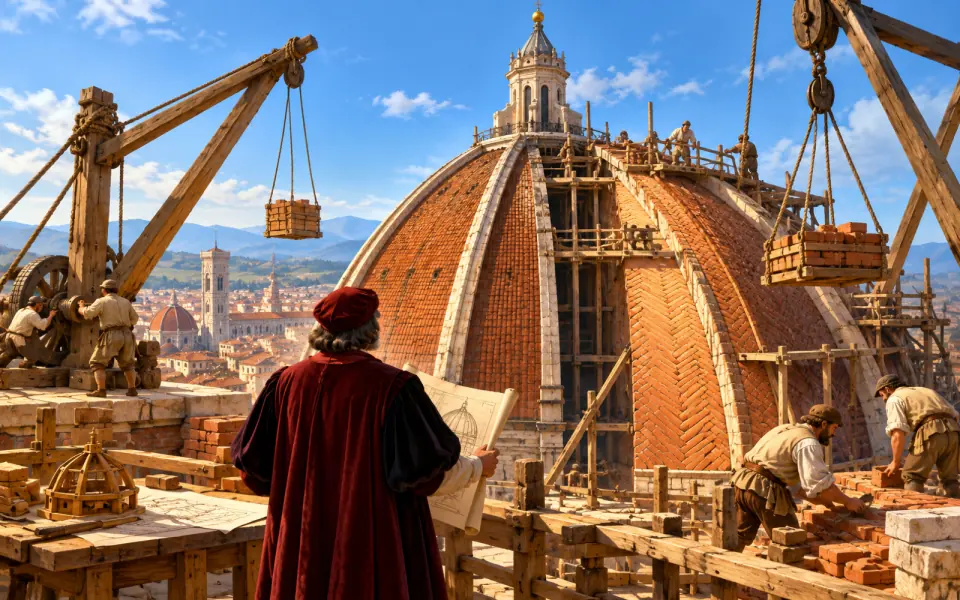
Brunelleschi's idea was brilliant: to build the dome without big centrings, making sure that each ring of bricks supported itself as it rose. To do this he designed a dome with a “double shell”: a thicker inner shell and a lighter outer shell, with an empty space in between, where you can walk on stairs and corridors. The shape was a pointed arch, more upright than a half-circle, because it pushes less outwards.
The bricks were laid in a “herringbone” pattern, that is, with a series of bricks set on edge between the horizontal courses, so as to lock the courses together and stop them slipping: this made it possible to build even without supports. Chains of stone and wood were placed around the dome to hold it together, like the hoops of a barrel. About four million bricks were used.
Machines and building site
Brunelleschi also invented machines for lifting materials: a great crane driven by oxen, with a clever system of gears to change direction, which made it possible to lift marble blocks and wooden beams high up, even a hundred metres, without having to turn the oxen round. For the bricklayers, who worked dozens of metres above the ground, fixed scaffolds were built and, so that no time was lost coming down to eat, small taverns were opened up high: the workers drank a little wine and went back to work.
The work began in 1420 and went on amid obstacles and jealousy. Ghiberti, the rival sculptor, was named co-director, even though he actually had little experience. Brunelleschi managed to get himself recognised as the only head. In 1436, on 25 March, the day the Florentine year began, the dome was finished, and Pope Eugene IV consecrated the cathedral with a solemn ceremony. The lantern, the structure at the top, was built afterwards and completed in 1461.
Why it happened
The dome came from Florence's wish to assert its own greatness, and from its citizens' desire to complete a work begun generations earlier. A republic of merchants and bankers, in competition with other cities, wanted memorable monuments.
It also needed a man able to combine different kinds of knowledge: geometry, mechanics, ancient architecture and the practical work of a building site. Brunelleschi had worked as a goldsmith and clockmaker, and had studied Roman monuments: he was ready for a challenge like this.
What changed
The dome of Santa Maria del Fiore became the symbol of Florence and of the Renaissance. It is still the largest masonry dome ever built. Michelangelo, a century later, had it in mind when he designed the dome of St Peter's in Rome: he is said to have declared that he wanted to make “a sister, bigger but not more beautiful”.
Brunelleschi showed that an architect could be an engineer and a scientist, and he changed the idea of the profession. After him, Renaissance architecture went back to classical forms: arches, columns and mathematical proportions. He died in 1446 and was buried in the cathedral, a rare honour.
Today you can climb the dome, up 463 steps, through the space between the two shells, and look at the bricks and at the frescoes of the Last Judgement (painted later, in the 16th century) from close up. At the top you can see the whole of Florence, and you can understand how much courage and intelligence it took to build it.
Key people and places
People
- Filippo Brunelleschi
- Florentine architect and engineer (1377–1446): he designed and built the dome.
- Lorenzo Ghiberti
- Florentine sculptor (1378–1455): he was for a few years co-director of the works and the maker of the Baptistery doors.
- Arnolfo di Cambio
- Tuscan architect and sculptor (about 1240–1302): he began building the cathedral in 1296.
- Giorgio Vasari
- Painter, architect and writer from Arezzo (1511–1574): he wrote the history of the great artists and told the story of the egg challenge.
- Eugene IV
- Pope from 1431 to 1447 (1383–1447): he consecrated the cathedral in 1436.
Places
- Florence Cathedral (Santa Maria del Fiore)
- The cathedral with the great dome, the symbol of the city.
- Opera del Duomo, Florence
- The body that organised the competition and the work, and that today keeps the models and documents.
Good to know
- Brunelleschi's dome was built with about four million bricks, without wooden centrings.
- It is the largest masonry dome ever built.
- According to Vasari, to win the competition Brunelleschi challenged the others to make an egg stand upright on marble.
- There are 463 steps to reach the top of the dome.
- The workers had small taverns up high, so they did not have to go down to the ground to eat.
Find out more
- Wikipedia, “Brunelleschi's Dome” en.wikipedia.org
- Wikipedia, “Filippo Brunelleschi” en.wikipedia.org
- Wikipedia, “Giotto's Campanile” en.wikipedia.org
- Wikipedia, “Florence Cathedral” en.wikipedia.org
Related events
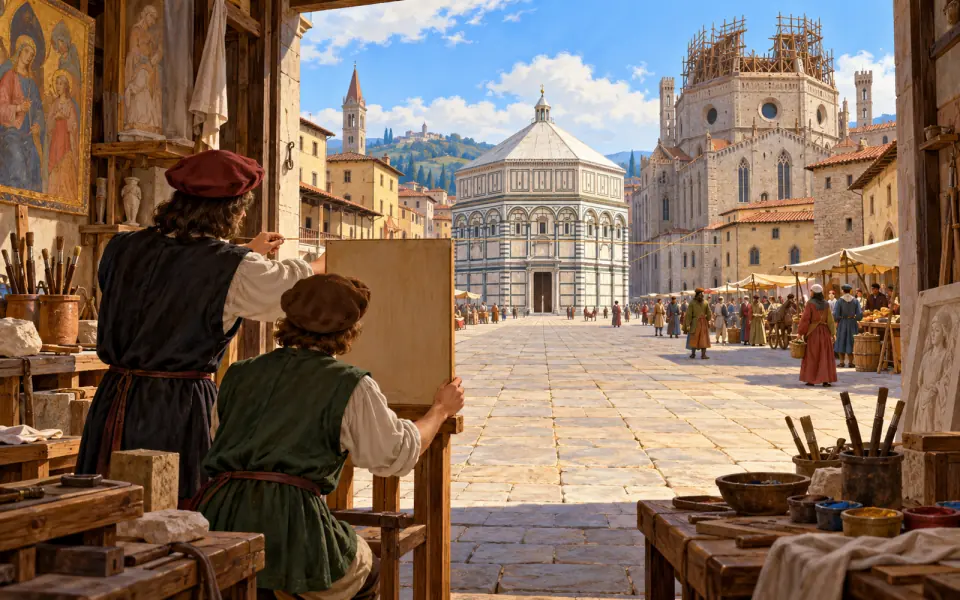
- Renaissance perspectiveabout 1420 · Early modern ageBrunelleschi is also the inventor of linear perspective.
- Michelangelo carves David1504 · Early modern ageMichelangelo, a century later, carved the David in Florence.
- Lorenzo de' Medici in Florence1469 · Early modern ageLorenzo de' Medici, patron of artists, ruled Florence in the second half of the 15th century.
- Leonardo designs machinesabout 1485 · Early modern ageLeonardo, like Brunelleschi, combined art, science and technology.
Before and after, in the era “Early modern age”
Event 2 of 25
 BeforeRenaissance perspectiveabout 1420
- You are hereBrunelleschi completes the dome1436
 AfterThe fall of Constantinople1453
 AfterGutenberg prints the Bibleabout 1455
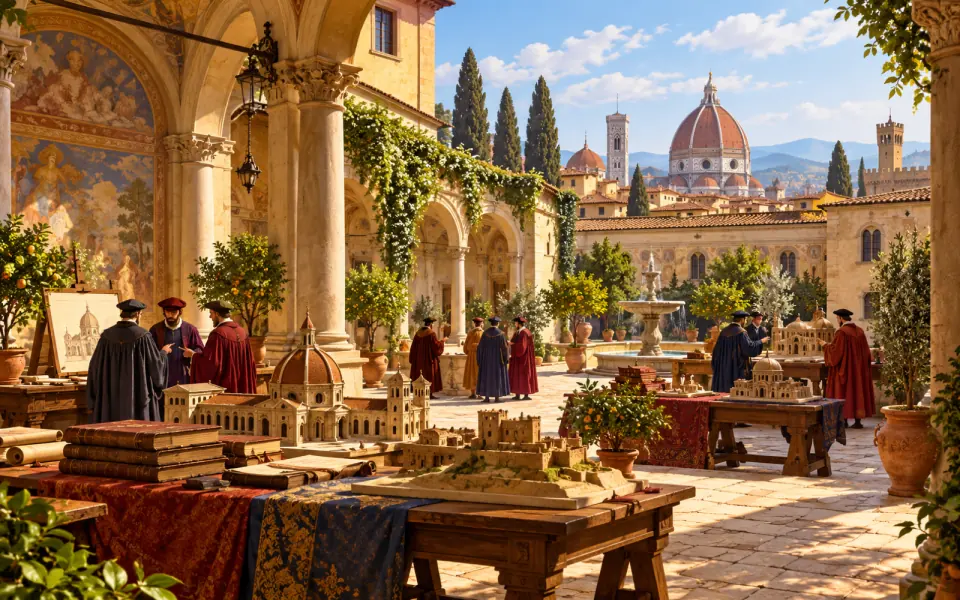 AfterLorenzo de' Medici in Florence1469
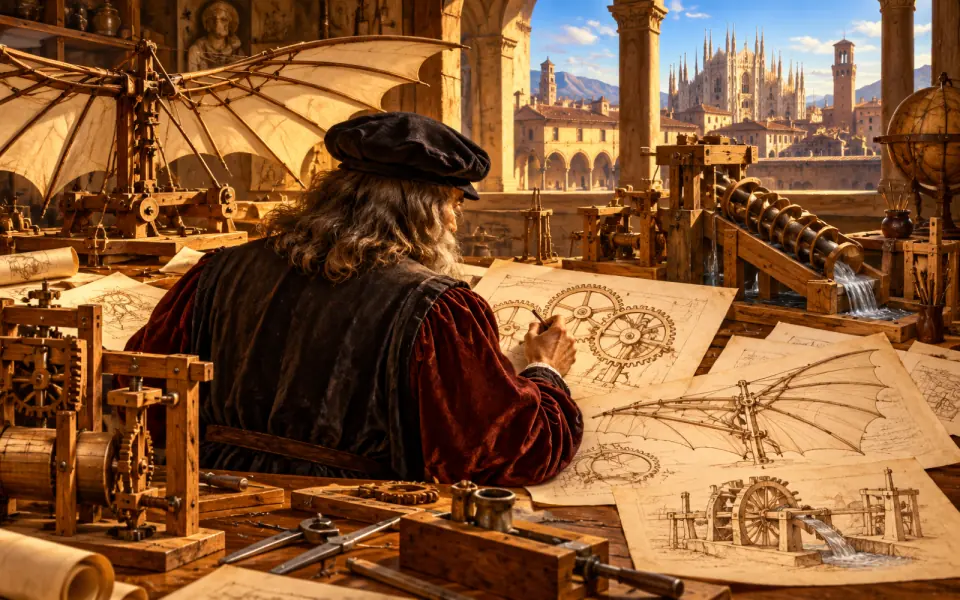 AfterLeonardo designs machinesabout 1485
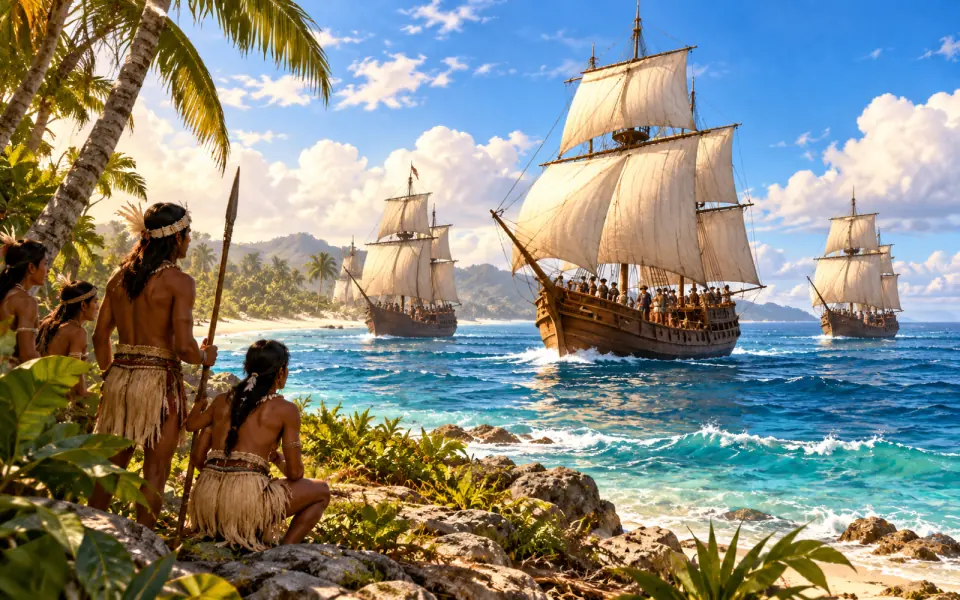 AfterColumbus's voyage1492
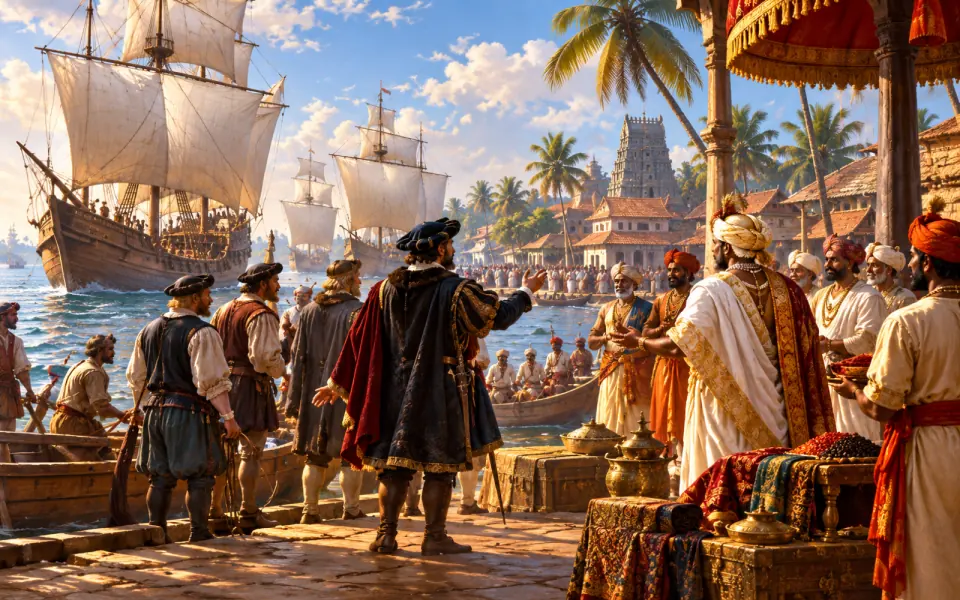 AfterVasco da Gama reaches India1498
 AfterMichelangelo carves David1504
 AfterRaphael paints the Vatican Rooms1508
 AfterLuther and the Reformation1517
 AfterThe conquest of Tenochtitlán1521
 AfterThe first voyage round the world1522
 AfterCopernicus puts the Sun at the centre1543
 AfterThe Council of Trent1545–1563
 AfterTomatoes, maize and potatoes reach Europeabout 1550
 AfterThe Gregorian calendar1582
 AfterShakespeare's theatreabout 1590
 AfterRegular newspapers1605
 AfterGalileo turns his telescope to the sky1609
 AfterKepler describes the orbits1609
 AfterArtemisia Gentileschiabout 1612
 AfterHarvey studies the circulation of the blood1628
 AfterScientific academies1660
 AfterNewton publishes the Principia1687
Listen / Read next
- Music to read by: Cinematic JourneyEpic film-style music, no lyrics, by Ciro Simone IrmiciSpotifyYouTube Music
Meanwhile, elsewhere in the world
Other events of the era “Early modern age”
- Renaissance perspective
- The fall of Constantinople
- Gutenberg prints the Bible
- Lorenzo de' Medici in Florence
- Leonardo designs machines
- Columbus's voyage
- Vasco da Gama reaches India
- Michelangelo carves David
- Raphael paints the Vatican Rooms
- Luther and the Reformation
- The conquest of Tenochtitlán
- The first voyage round the world
- Copernicus puts the Sun at the centre
- The Council of Trent
- Tomatoes, maize and potatoes reach Europe
- The Gregorian calendar
- Shakespeare's theatre
- Regular newspapers
- Galileo turns his telescope to the sky
- Kepler describes the orbits
- Artemisia Gentileschi
- Harvey studies the circulation of the blood
- Scientific academies
- Newton publishes the Principia
