Scientific academies
1660 London, England (and earlier Rome and Florence)
In short
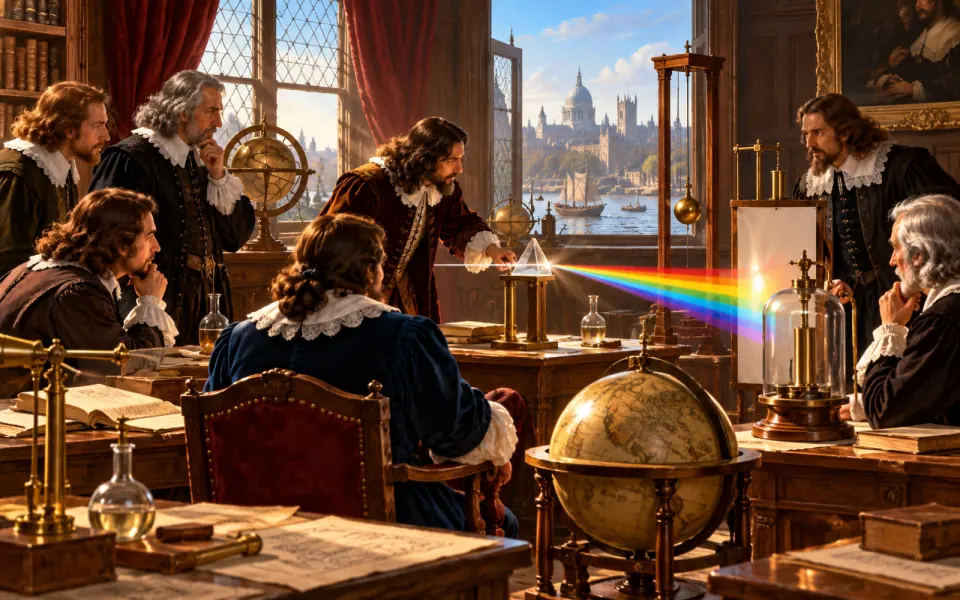
In the 17th century scientists felt the need to meet to do experiments together and discuss the results. In Rome the Accademia dei Lincei had been founded in 1603, and Galileo was a member, and in Florence in 1657 came the Accademia del Cimento, whose motto was ‘try and try again’. In 1660, in London, a group of scholars founded the Royal Society, which from 1665 published one of the first scientific journals. Even today discoveries are checked by other experts before they are accepted.
Why it matters The academies turned science into teamwork, made of repeated tests and shared results.
Study card about 4 minutes of reading
The story
Scientists who worked alone
At the start of the 17th century people who studied nature mostly worked alone, or with a few friends, and often in secret. Some feared that rivals would steal their ideas, others were afraid of being accused of heresy or magic. Discoveries also spread slowly: books were expensive and were printed years apart, letters travelled for weeks, and many errors went uncorrected.
Then came the idea of bringing curious people together, so that they could meet, discuss, repeat other people's experiments and check the results. This is how scientific academies were born, associations of scholars who met regularly.
The Lincei and the Cimento
One of the first modern scientific academies was the Accademia dei Lincei, founded in Rome in 1603 by an eighteen-year-old young nobleman, Federico Cesi. The name recalls the lynx, an animal with sharp eyesight: the academicians were to look at nature with careful eyes. In 1611 Galileo joined too, and he proudly signed himself “Lincean”. The Lincei published some of Galileo's works, but after Cesi's death, in 1630, the academy faded away.
In Florence, between 1657 and 1667, another academy existed, the Accademia del Cimento, sponsored by the Medici, in particular Prince Leopold and Grand Duke Ferdinand II. “Cimento” means “trial”, and the motto was “Provando e riprovando”, “Testing and testing again”. The academicians, who were pupils of Galileo, repeated experiments with the barometer, with the vacuum, with falling bodies and with temperature, and in 1667 they published an account of everything they had done.
The Royal Society
On 28 November 1660, in London, after a lecture by the astronomer and architect Christopher Wren at Gresham College, twelve people decided to found a society “for the promoting of experimental physico-mathematical learning”. It was a company of doctors, astronomers, chemists and educated men. In 1662 King Charles II granted it a royal charter, and the Royal Society was born, which still exists today.
Its motto, “Nullius in verba”, can be translated “on the word of no one”: it means that ideas must be proved by facts and not accepted just because an authority has said them. At meetings the fellows carried out experiments in front of everyone. Robert Boyle studied air and pressure with his vacuum pump, Robert Hooke looked at small things under the microscope and in 1665 published an illustrated book, “Micrographia”, in which he drew an enlarged flea and the “cells” of a piece of cork. Later Isaac Newton joined, and he was its president from 1703 to 1727.
The fellows met every week, on Wednesdays, paid a small fee and brought the results of their experiments. Letters from foreign scholars were also read aloud, and discussed together. It was an open way of doing science, in which nobody had to trust anybody else blindly.
The journal and the other academies
In 1665 the secretary of the Royal Society, Henry Oldenburg, founded a journal, the “Philosophical Transactions”, which still comes out regularly today: it is one of the oldest scientific journals. Before it, in the same year, the “Journal des sçavans” had already appeared in Paris. Publishing results in a journal made it possible to establish who had made a discovery first and to make it known across Europe.
In 1666 in France King Louis XIV and his minister Colbert founded the Académie des sciences, in Paris. In Germany the Leopoldina academy had been born in 1652. Others followed all over Europe, and in the 18th century the model spread to Russia, Sweden, Prussia and America.
Why it happened
In the first half of the 17th century scholars had understood that nature is studied through experiment, but they needed expensive instruments and discussion with other experts. An association could afford the vacuum pump or the telescope, and check the results.
Nobles, kings and patrons found it prestigious to support science, and printing helped news to circulate. After the wars of religion, many people wanted to discuss nature without quarrelling over religion and politics.
What changed
The academies created a new way of doing science: an international community that checks, criticises and shares results. Scientific journals and “peer review”, that is, checking by other experts before publication, come from this system.
Discoveries speeded up. The Royal Society, the Académie and the others were the place where Newton, Boyle, Hooke, Halley and others discussed and published. Observatories, botanical gardens and scientific expeditions were born.
Still today the Royal Society, the Accademia dei Lincei (revived in the 19th century) and the academies of sciences of many countries are associations that honour scholars and advise governments.
Key people and places
People
- Federico Cesi
- Roman nobleman (1585–1630): he founded the Accademia dei Lincei.
- Christopher Wren
- English astronomer and architect (1632–1723): his lecture of 1660 led to the founding of the Royal Society.
- Robert Boyle
- Irish chemist and physicist (1627–1691): he studied gases and was one of the first fellows.
- Robert Hooke
- English scientist (1635–1703): he published Micrographia in 1665.
- Henry Oldenburg
- Secretary of the Royal Society (about 1619–1677): he founded the Philosophical Transactions.
Places
- Gresham College, London
- The college where the Royal Society was born.
- Florence
- The city that was home to the Accademia del Cimento.
Good to know
- The Royal Society's motto, “Nullius in verba”, means “on the word of no one”.
- The Lincei take their name from the lynx, an animal with sharp eyesight.
- The Philosophical Transactions is one of the oldest scientific journals still published.
- Hooke drew a flea enlarged under the microscope.
- Newton was president of the Royal Society for more than twenty years.
Find out more
- Wikipedia, “Royal Society” en.wikipedia.org
- Wikipedia, “Accademia Nazionale dei Lincei” en.wikipedia.org
- Wikipedia, “Accademia del Cimento” en.wikipedia.org
- Wikipedia, “Philosophical Transactions of the Royal Society” en.wikipedia.org
Related events
- Galileo turns his telescope to the sky1609 · Early modern ageGalileo was a member of the Lincei.
- Harvey studies the circulation of the blood1628 · Early modern ageHarvey had opened the way to experimental medicine.
- Newton publishes the Principia1687 · Early modern ageNewton, president of the Royal Society, published the Principia.
- Regular newspapers1605 · Early modern ageThe first newspapers and scientific journals were born in the same period.
Before and after, in the era “Early modern age”
Event 24 of 25
 BeforeRenaissance perspectiveabout 1420
 BeforeBrunelleschi completes the dome1436
 BeforeThe fall of Constantinople1453
 BeforeGutenberg prints the Bibleabout 1455
 BeforeLorenzo de' Medici in Florence1469
 BeforeLeonardo designs machinesabout 1485
 BeforeColumbus's voyage1492
 BeforeVasco da Gama reaches India1498
 BeforeMichelangelo carves David1504
 BeforeRaphael paints the Vatican Rooms1508
 BeforeLuther and the Reformation1517
 BeforeThe conquest of Tenochtitlán1521
 BeforeThe first voyage round the world1522
 BeforeCopernicus puts the Sun at the centre1543
 BeforeThe Council of Trent1545–1563
 BeforeTomatoes, maize and potatoes reach Europeabout 1550
 BeforeThe Gregorian calendar1582
 BeforeShakespeare's theatreabout 1590
 BeforeRegular newspapers1605
 BeforeGalileo turns his telescope to the sky1609
 BeforeKepler describes the orbits1609
 BeforeArtemisia Gentileschiabout 1612
 BeforeHarvey studies the circulation of the blood1628
- You are hereScientific academies1660
 AfterNewton publishes the Principia1687
Listen / Read next
- Music to read by: Cinematic JourneyEpic film-style music, no lyrics, by Ciro Simone IrmiciSpotifyYouTube Music
Meanwhile, elsewhere in the world
Other events of the era “Early modern age”
- Renaissance perspective
- Brunelleschi completes the dome
- The fall of Constantinople
- Gutenberg prints the Bible
- Lorenzo de' Medici in Florence
- Leonardo designs machines
- Columbus's voyage
- Vasco da Gama reaches India
- Michelangelo carves David
- Raphael paints the Vatican Rooms
- Luther and the Reformation
- The conquest of Tenochtitlán
- The first voyage round the world
- Copernicus puts the Sun at the centre
- The Council of Trent
- Tomatoes, maize and potatoes reach Europe
- The Gregorian calendar
- Shakespeare's theatre
- Regular newspapers
- Galileo turns his telescope to the sky
- Kepler describes the orbits
- Artemisia Gentileschi
- Harvey studies the circulation of the blood
- Newton publishes the Principia
