The fall of Constantinople
1453 Constantinople (now Istanbul, Turkey)
In short
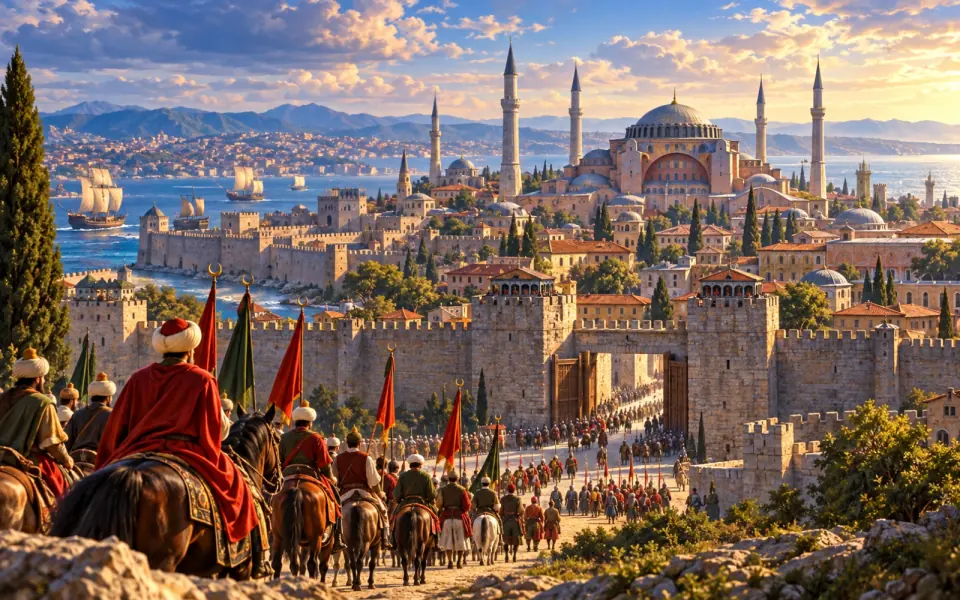
On 29 May 1453 the Ottoman sultan Mehmed II captured Constantinople after a siege of almost two months. To break through its very strong walls he used enormous cannons, some of them specially built. So ended the Byzantine Empire, heir to the Eastern Roman Empire, which had lasted more than a thousand years. The city became the Ottoman capital and is now called Istanbul.
Why it matters Many Greek scholars fled to Italy carrying ancient books, and the date is often used to mark the start of the modern age.
Source: Treccani, entry “Costantinopoli”
Study card about 5 minutes of reading
The story
A city almost alone
For more than a thousand years Constantinople had been the capital of the Eastern Roman Empire, which historians also call the Byzantine Empire. It had been founded by the emperor Constantine in 330 on the European shore of the Bosphorus, the strait that separates Europe from Asia, and for centuries it had been one of the largest and richest cities in the world. By 1453, however, very little of that empire was left: the city, with a bit of land around it, was surrounded by the lands of the Ottoman Empire, the great state of the Turks, which had spread across Asia and the Balkans.
The emperor was called Constantine XI Palaiologos. He had few soldiers: estimates speak of about seven thousand defenders, Greeks and foreigners who had come to help, especially Genoese and Venetians. On the other side was the young sultan Mehmed II, who was twenty-one and wanted to conquer the city that his predecessors had not managed to take. The exact number of his soldiers is not known: historians give tens of thousands, but with very different estimates.
The walls and the cannons
Constantinople had a formidable defence: the Theodosian Walls, built in the 5th century, were a system of three lines, with a moat, a low wall and a high wall with towers. For centuries they had driven back sieges of every kind. On the sea side, the harbour of the Golden Horn was closed by a great iron chain held up by floats, which stopped enemy ships from getting in.
Mehmed II, however, had something new: gigantic cannons. A cannon-founder of Hungarian origin, called Orban, had built for him an enormous bombard that fired very heavy stone balls. Cannons were not new, but never before had they been used with such power against such ancient walls. They began to batter the walls on 6 April 1453; at night the defenders repaired the damage with earth, wood and barrels, but the breaches kept widening.
Ships on the hill
One of the most famous feats of the siege took place on 22 April. Because the chain stopped them from entering the Golden Horn, the Turks had about seventy ships or more dragged overland, on wooden rollers greased with fat, over a hill, and lowered them into the harbour on the other side. The defenders found enemy ships in a place they believed was safe, and had to spread their few forces even thinner.
The defenders held out for more than seven weeks. An important leader was the Genoese Giovanni Giustiniani Longo, who commanded the troops at the most threatened point of the walls. When he was wounded in the final battle and left his post, many of his men were frightened.
The final assault
The decisive assault began in the early hours of 29 May 1453. The Turks attacked in successive waves: first inexperienced soldiers, then stronger troops, and finally the Janissaries, the sultan's elite soldiers. At some point the Turks managed to get into the city and the walls gave way. A legend says that a small gate, called the Kerkoporta, was left open by mistake, but historians do not know whether that is true.
Constantine XI died fighting: his body was never identified for certain, and this fed many legends, including one that an angel had saved him and turned him into marble. The city was plundered for three days, according to the custom of the time, then Mehmed II rode into the great basilica of Hagia Sophia, which was turned into a mosque. From then on the sultan was called Fatih, “the Conqueror”, and Constantinople became the capital of the Ottoman Empire. The name Istanbul, of Greek origin, was officially adopted only in the 20th century.
Why it happened
Constantinople had been weak for a long time: in 1204 it had been plundered by the Crusaders and for sixty years the empire had been divided; then it was rebuilt, but poorer and smaller. In addition, wars with the Turks and economic difficulties had reduced its strength.
Mehmed II wanted to make the city his capital and to unite the lands of his empire, which the city divided. Finally, the technical progress of cannons made it possible to beat walls that for centuries had been almost impossible to attack.
What changed
The Byzantine Empire, the last heir of ancient Rome, came to an end more than a thousand years after its foundation. For many historians the fall of Constantinople is one of the dates that separate the Middle Ages from the modern age, although the change was really gradual.
The Ottoman Empire became a great Mediterranean and European power, and stayed one for centuries. Many Greek scholars left the city and went to Italy, bringing ancient manuscripts that fed humanism. The trade routes to the East changed: Europeans tried harder to find alternative routes by sea, and the great voyages of exploration of the following decades have this reason too.
Hagia Sophia remained a mosque for five centuries; in 1934 it was turned into a museum and in 2020 it was made a place of Muslim worship again, a subject that still causes debate today.
Key people and places
People
- Mehmed II
- Ottoman sultan (1432–1481): he conquered Constantinople at the age of twenty-one.
- Constantine XI Palaiologos
- Last Byzantine emperor (1405–1453): he died defending the city.
- Giovanni Giustiniani Longo
- Genoese commander: he led the defence of the walls and was wounded during the final assault.
- Orban
- Cannon-founder of Hungarian origin: he built the great bombard for Mehmed II.
Places
- Constantinople (now Istanbul)
- Capital of the Byzantine Empire, on the Bosphorus strait, between Europe and Asia.
- Theodosian Walls
- The triple system of walls that protected the city for centuries.
- Hagia Sophia
- The great basilica built in the 6th century, later a mosque, a museum and a mosque again.
Good to know
- The Turkish ships were hauled by hand, on rollers, over a hill to get into the harbour of the Golden Horn.
- Mehmed II was only twenty-one when he conquered the city.
- The body of Constantine XI was never identified for certain.
- Hagia Sophia was a mosque from 1453 to 1934, then a museum, then a mosque again from 2020.
- Orban's great bombard fired stone balls weighing hundreds of kilos.
Find out more
- Wikipedia, “Fall of Constantinople” en.wikipedia.org
- Wikipedia, “Mehmed II” en.wikipedia.org
- Wikipedia, “Walls of Constantinople” en.wikipedia.org
- Wikipedia, “Constantine XI Palaiologos” en.wikipedia.org
Related events
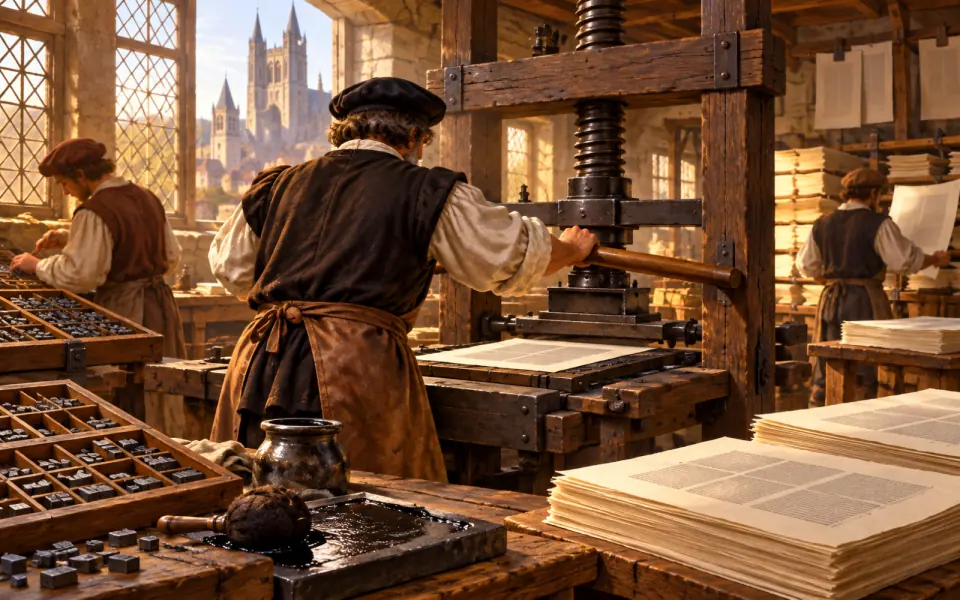
- Gutenberg prints the Bibleabout 1455 · Early modern ageA few years later, Gutenberg was printing the Bible.
- Columbus's voyage1492 · Early modern ageColumbus was looking for another route to the East.
- Vasco da Gama reaches India1498 · Early modern ageVasco da Gama found the sea route to India.
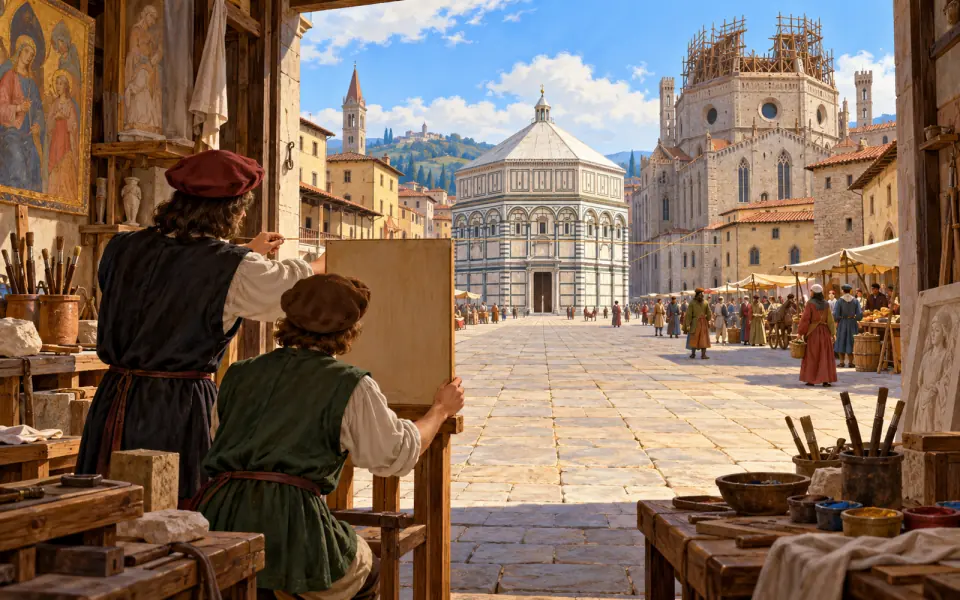
- Renaissance perspectiveabout 1420 · Early modern ageGreek scholars brought ancient texts to Italy, the basis of humanism.
Before and after, in the era “Early modern age”
Event 3 of 25
 BeforeRenaissance perspectiveabout 1420
 BeforeBrunelleschi completes the dome1436
- You are hereThe fall of Constantinople1453
 AfterGutenberg prints the Bibleabout 1455
 AfterLorenzo de' Medici in Florence1469
 AfterLeonardo designs machinesabout 1485
 AfterColumbus's voyage1492
 AfterVasco da Gama reaches India1498
 AfterMichelangelo carves David1504
 AfterRaphael paints the Vatican Rooms1508
 AfterLuther and the Reformation1517
 AfterThe conquest of Tenochtitlán1521
 AfterThe first voyage round the world1522
 AfterCopernicus puts the Sun at the centre1543
 AfterThe Council of Trent1545–1563
 AfterTomatoes, maize and potatoes reach Europeabout 1550
 AfterThe Gregorian calendar1582
 AfterShakespeare's theatreabout 1590
 AfterRegular newspapers1605
 AfterGalileo turns his telescope to the sky1609
 AfterKepler describes the orbits1609
 AfterArtemisia Gentileschiabout 1612
 AfterHarvey studies the circulation of the blood1628
 AfterScientific academies1660
 AfterNewton publishes the Principia1687
Listen / Read next
- Music to read by: Cinematic JourneyEpic film-style music, no lyrics, by Ciro Simone IrmiciSpotifyYouTube Music
Meanwhile, elsewhere in the world
Other events of the era “Early modern age”
- Renaissance perspective
- Brunelleschi completes the dome
- Gutenberg prints the Bible
- Lorenzo de' Medici in Florence
- Leonardo designs machines
- Columbus's voyage
- Vasco da Gama reaches India
- Michelangelo carves David
- Raphael paints the Vatican Rooms
- Luther and the Reformation
- The conquest of Tenochtitlán
- The first voyage round the world
- Copernicus puts the Sun at the centre
- The Council of Trent
- Tomatoes, maize and potatoes reach Europe
- The Gregorian calendar
- Shakespeare's theatre
- Regular newspapers
- Galileo turns his telescope to the sky
- Kepler describes the orbits
- Artemisia Gentileschi
- Harvey studies the circulation of the blood
- Scientific academies
- Newton publishes the Principia
