Regular newspapers
1605 Strasbourg (now France)
In short
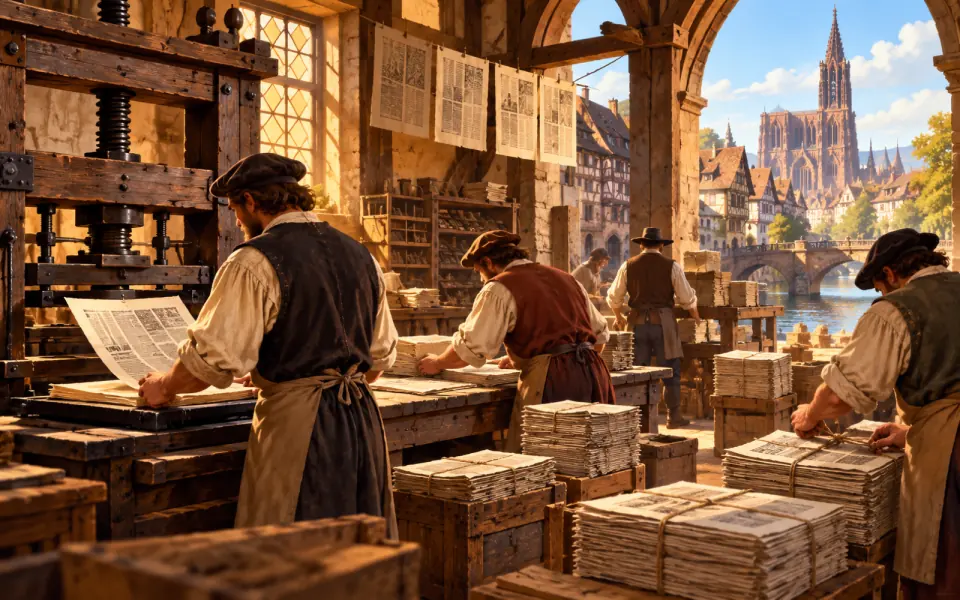
In Strasbourg, then a city of the Holy Roman Empire, the bookseller Johann Carolus copied out news by hand to sell to subscribers. After buying a printing works, in 1605 he asked the city council to protect his new sheet, printed every week and called Relation. Many consider it the first newspaper to come out regularly. Within a few decades news sheets spread to many European cities, and in 1650 the first daily paper was born in Leipzig.
Why it matters News became a regular appointment, and the habit of finding out about faraway events was born.
Source: Encyclopaedia Britannica, “newspaper”; World Association of News Publishers (WAN-IFRA)
Study card about 4 minutes of reading
The story
News before newspapers
Today news arrives in an instant, but in the 16th century it took days or weeks for a piece of news to travel from one city to another. People who needed to know what was happening, such as merchants, bankers and rulers, paid correspondents to write letters full of news: prices, wars, the arrival of ships, the deaths of kings. These letters were called “avvisi”, and in Venice, in the 16th century, they were sold for a small coin called a “gazzetta”: this is where the word “gazette” comes from.
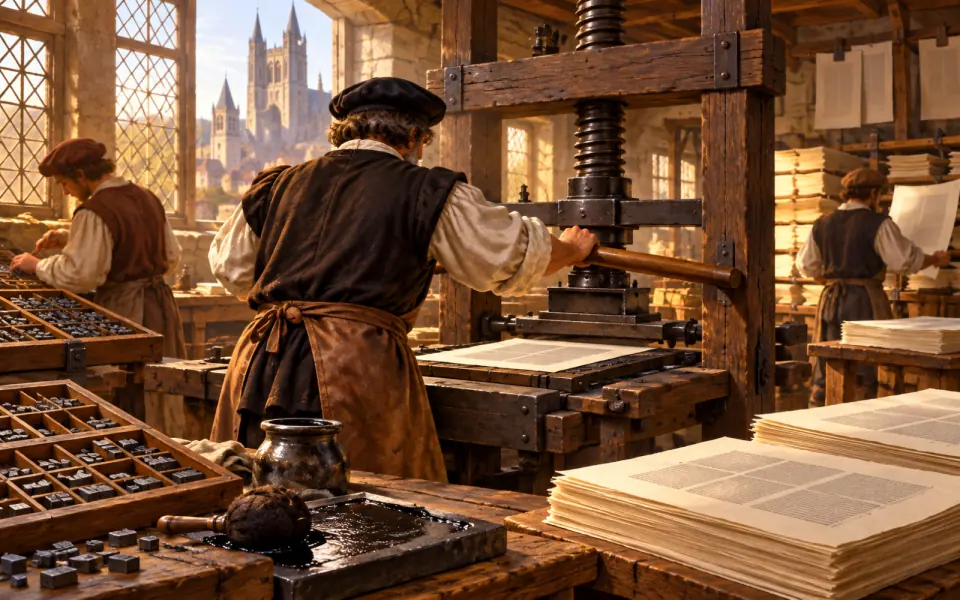
With the invention of printing, in the 15th century, news sheets appeared: single printed sheets that told of an extraordinary event, such as an earthquake, a battle or a monster born in a village. But they were printed when something remarkable happened, not at regular intervals. There was still no newspaper that came out always at the same time and in the same form.
Johann Carolus in Strasbourg
Our main character is a man named Johann Carolus, who in Strasbourg, then a free city of the German Empire, had an unusual job: every week he sold to wealthy people a handwritten sheet with the news he received from correspondents all over Europe. But copying by hand was slow and expensive, and he had few customers.
In 1604 Carolus bought a printing press. In 1605 he asked the city council for permission to print his news and he was the only one allowed to do so, a privilege that protected him from competitors. This is how the “Relation aller Fürnemmen und gedenckwürdigen Historien”, that is, “Account of All Distinguished and Memorable Stories”, was born. It came out every week, had four pages full of news, and was bought mainly by the rich, by government men and by merchants, who had the greatest need to keep informed. The copies from 1605 have been lost; the first surviving collection dates from 1609.
Carolus received the news by letter, through the post, and news travelled at the speed of horses and boats: from a faraway city it could take several weeks. For this reason each piece of news was printed with the name of the city it had come from and with the date, so the reader knew where it came from and how fresh it was. The newspaper did not explain or comment: it only reported, like a long list.
Other sheets, other countries
The idea spread. In 1609 a periodical came out in Wolfenbüttel, in Germany. In 1618 in Amsterdam the “Courante uyt Italien, Duytslandt, &c.” was born, one of the first newspapers in Dutch. In France, in 1631, a doctor, Théophraste Renaudot, founded the “Gazette”, with the support of Cardinal Richelieu and with the king's privilege. In London the “Oxford Gazette”, later the “London Gazette”, came out from 1665 and is still published today.
These first newspapers were very different from ours. They had no big headlines and no photographs. The news items, with dates and places, were put one after another, in order of arrival, without comment. Above all, newspapers had to pass government checks: rulers and cities granted permission to print, and anyone who wrote too much had to be careful.
Why 1605?
For many years nobody knew which was the first newspaper in history, because some scholars pointed to other sheets. A German scholar, Martin Welke, together with Jean-Pierre Kintz, found in Strasbourg the request that Carolus had written in 1605. In 2005 the World Association of Newspapers (WAN) accepted the evidence that the Relation was being printed as early as 1605 and recognised it as the first printed newspaper. The fact remains that the definition of “newspaper” is a matter of choices, and that other earlier sheets might have been missed.
Why it happened
Trade, banks and wars in the 16th century made the demand for fast and reliable news grow and grow. Regular postal services, organised by emperors and great families, made it possible to receive letters every week.
Movable-type printing made it possible to produce many copies cheaply. In Strasbourg there were printers, and there was an audience of merchants and officials who were ready to read what they printed.
What changed
Newspapers became a new way of getting informed, and later of forming opinions. In the 18th and 19th centuries daily papers appeared, and with the telegraph and the rotary press newspapers became fast and cheap, for everyone.
Periodical printing helped to create public opinion, that is, a group of people who read the same news and discuss it. This played an important part in revolutions, from the English revolutions to the French one.
Governments and authorities soon understood the power of this tool and tried to control it with licences and censorship. The relationship between freedom of the press and power is still an open question today.
Key people and places
People
- Johann Carolus
- Strasbourg printer (1575–1634): he published the first weekly newspaper.
- Théophraste Renaudot
- French doctor and journalist (1586–1653): he founded the “Gazette” in 1631.
- Martin Welke
- German scholar of newspaper history: he found Carolus's documents.
- Cardinal Richelieu
- Chief minister of the King of France (1585–1642): he supported the Gazette.
Places
- Strasbourg
- City in present-day France, then a free imperial city, where the “Relation” came out.
- Venice
- The city where paid “avvisi” were sold for a gazzetta.
Good to know
- The word “gazette” comes from a small Venetian coin.
- Carolus's newspaper came out every week and had four pages.
- The London Gazette has been published since 1665 and is still going.
- In 2005 the World Association of Newspapers recognised the Relation of 1605 as the first newspaper.
- The copies from 1605 have been lost: the first surviving collection dates from 1609.
Find out more
- Wikipedia, “Newspaper” en.wikipedia.org
- Wikipedia, “Gazette” en.wikipedia.org
- Wikipedia, “Johann Carolus” en.wikipedia.org
- Wikipedia, “Théophraste Renaudot” en.wikipedia.org
Related events
- Gutenberg prints the Bibleabout 1455 · Early modern ageMovable-type printing made the newspaper possible.
- Shakespeare's theatreabout 1590 · Early modern ageIn the same years in London Shakespeare was writing for the theatre.
- Scientific academies1660 · Early modern ageScientific academies also spread their discoveries through periodicals.
- Luther and the Reformation1517 · Early modern ageLuther's ideas had spread through printed news sheets.
Before and after, in the era “Early modern age”
Event 19 of 25
 BeforeRenaissance perspectiveabout 1420
 BeforeBrunelleschi completes the dome1436
 BeforeThe fall of Constantinople1453
 BeforeGutenberg prints the Bibleabout 1455
 BeforeLorenzo de' Medici in Florence1469
 BeforeLeonardo designs machinesabout 1485
 BeforeColumbus's voyage1492
 BeforeVasco da Gama reaches India1498
 BeforeMichelangelo carves David1504
 BeforeRaphael paints the Vatican Rooms1508
 BeforeLuther and the Reformation1517
 BeforeThe conquest of Tenochtitlán1521
 BeforeThe first voyage round the world1522
 BeforeCopernicus puts the Sun at the centre1543
 BeforeThe Council of Trent1545–1563
 BeforeTomatoes, maize and potatoes reach Europeabout 1550
 BeforeThe Gregorian calendar1582
 BeforeShakespeare's theatreabout 1590
- You are hereRegular newspapers1605
 AfterGalileo turns his telescope to the sky1609
 AfterKepler describes the orbits1609
 AfterArtemisia Gentileschiabout 1612
 AfterHarvey studies the circulation of the blood1628
 AfterScientific academies1660
 AfterNewton publishes the Principia1687
Listen / Read next
- Music to read by: Cinematic JourneyEpic film-style music, no lyrics, by Ciro Simone IrmiciSpotifyYouTube Music
Meanwhile, elsewhere in the world
Other events of the era “Early modern age”
- Renaissance perspective
- Brunelleschi completes the dome
- The fall of Constantinople
- Gutenberg prints the Bible
- Lorenzo de' Medici in Florence
- Leonardo designs machines
- Columbus's voyage
- Vasco da Gama reaches India
- Michelangelo carves David
- Raphael paints the Vatican Rooms
- Luther and the Reformation
- The conquest of Tenochtitlán
- The first voyage round the world
- Copernicus puts the Sun at the centre
- The Council of Trent
- Tomatoes, maize and potatoes reach Europe
- The Gregorian calendar
- Shakespeare's theatre
- Galileo turns his telescope to the sky
- Kepler describes the orbits
- Artemisia Gentileschi
- Harvey studies the circulation of the blood
- Scientific academies
- Newton publishes the Principia
