Writing on oracle bones
about 1250 BC Anyang, China
In short
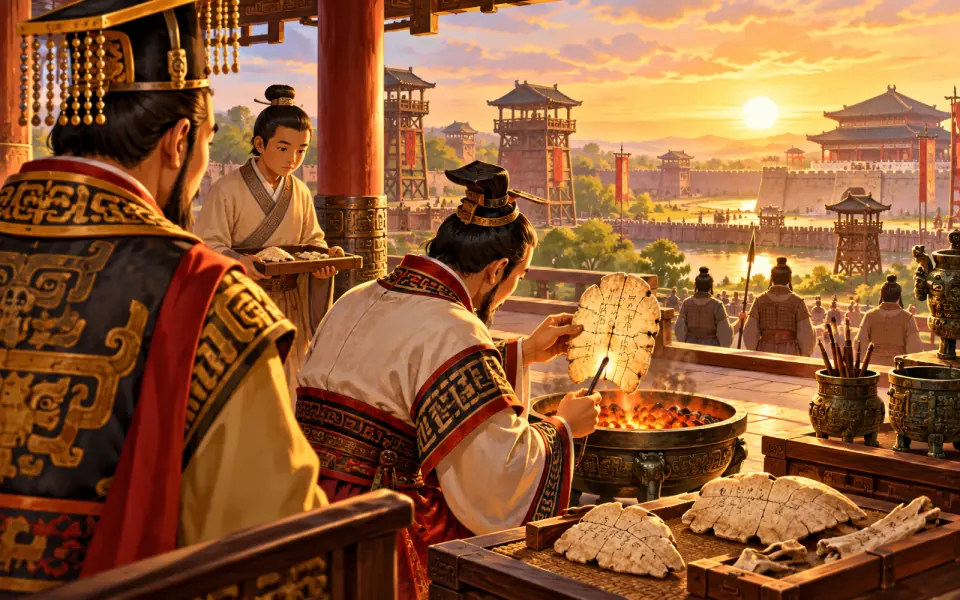
The Shang kings wanted to know the future: whether the hunt would go well, whether it would rain, whether a battle would be won. Fortune-tellers wrote the question on turtle shells or ox bones, then heated them until cracks appeared that could be read. Many of these bones are carved with the oldest known Chinese characters. They were recognised in 1899, when they were being sold in chemists' shops as ‘dragon bones’.
Why it matters From those signs comes the Chinese writing still used today by more than a billion people.
Source: Encyclopaedia Britannica, “Oracle bone”
Study card about 6 minutes of reading
The story
The “dragon bones” from the pharmacy
In 1899, in Beijing, a high official and scholar of antiquities, Wang Yirong, was ill with malaria. According to the best-known story, his doctor prescribed a medicine made from “dragon bones”, pieces of fossil bone that pharmacies sold by weight and that patients ground into powder to cure themselves. As he looked at the pieces that had been brought to him, Wang noticed marks carved on the surface: they were not scratches, they were very ancient characters. He asked for every piece the pharmacist had and bought them all. It was the beginning of the discovery of the oracle bones.
Historians doubt some details of this story (for example, whether Wang was really ill), but all agree on the general lines: the discovery came from the trade in “dragon bones” and from an attentive collector. Where did those bones come from? For some years the sellers kept it secret. In 1908 the scholar Luo Zhenyu found out that they came from a village near Anyang, in Henan, where farmers, ploughing their fields, brought up fragments of bones and shells. There stood the ancient Shang capital, Yin. Those farmers had for years been selling the oldest history of China for a few coins.
How the future was “questioned”
The Shang kings always wanted to know the opinion of their ancestors and spirits before any important decision. This is how it was done. The diviners prepared a turtle shell (the lower part, the plastron) or an ox shoulder blade, cleaning and smoothing it. On the back they hollowed out small pits. Then the king or the diviner put the question to the ancestors, aloud, and a heated rod of bronze or wood was brought up to the pit. The heat made the shell crackle and split, forming T-shaped cracks, like the Chinese character bu, which means “to divine”. The diviner read the cracks and gave the answer: favourable or unfavourable.
Afterwards, the scribes carved on the shell, with a pointed tool, the question, sometimes the answer and sometimes, a few days later, the outcome too: whether the prediction had come true. The shells were then piled up in special pits, like an archive. It is a wonderful way of preserving something, and that is why the bones have reached us.
What they asked
The questions open a window on life three thousand years ago. “Will it rain tomorrow?” “Will the harvest be good?” “Should I fight a battle against the enemies in the west?” “Will the king recover from his toothache?” “Will Lady Hao have a baby? Will it be a good day?” “Which ancestor sent this illness?” They also asked about hunts, journeys, dreams, sacrifices and eclipses. Some texts concern an eclipse of the Moon that astronomers are able to date, and that helps fix the chronology of that time. The king did nothing without asking.
More than one hundred and fifty thousand fragments have been found: the oldest go back to the reign of Wu Ding, around 1250 BC (the traditional date), and run up to the fall of the dynasty, in 1046 BC. In a single pit at Anyang, discovered in 1936, archaeologists found about seventeen thousand carved turtle shells, still in order.
The first Chinese writing
The characters carved on the bones are the oldest form of Chinese writing to have reached us. About four thousand different ones have been counted, but only between a third and a half can be read with certainty. Some are still recognisable: the character for “sun” is a circle with a dot, the one for “moon” a crescent, the one for “man” a figure with arms, the one for “horse” an animal with a mane. Others join one element that gives the meaning to one that gives the sound, as still happens today in most Chinese characters.
The fact that the writing is already so complete makes scholars think it began much earlier. The first stages have been lost, probably because they were written on perishable materials such as bamboo and silk, which do not survive. The Shang bronze vessels also carry short clan inscriptions. But from the bones one can even read the grammar: the language, indeed, is an ancestor of Chinese.
A doubt: writing and invention
As with hieroglyphs and cuneiform, people have asked whether Chinese writing was invented on its own or inspired by others. The answer, for now, is that it seems an independent invention: there are no signs of links with Mesopotamia or Egypt, and the system is different. But we cannot be sure.
Why it happened
The oracle bones were born from the religion of the Shang. The king could decide nothing without asking his ancestors, who were considered powerful spirits. Divination was the means of speaking with them. Writing down the questions and answers served to keep a record of the responses and to check whether they came true.
The organisation of the state counted too. The Shang king had around him diviners and specialised scribes, who recorded everything. A power based on contact with the spirits needs rituals and documents, and this pushed writing to improve.
Finally there was the abundance of materials. Turtle shells and ox shoulder blades were easy to get, because oxen were sacrificed and eaten and turtles came from the south as tribute. A hard, smooth material, suited to carving, kept the marks for millennia.
What changed
From the writing of the bones descends, in an unbroken line, today's Chinese writing: bronze, seals, regular script. No other writing so ancient is still in use in a recognisable form. Today more than a billion people use it, and students of Chinese still recognise in modern characters the shape of the ancient ones.
The oracle bones changed Chinese history: they confirmed that the Shang dynasty had really existed, with the kings listed by later historians. They have given information on the religion, politics, medicine, climate and astronomy of the time. The scholars who read them are still at work, and even today they propose new readings of some characters.
Their study also opened the way to scientific archaeology in China. From the excavations at Anyang, begun in 1928, came a school of Chinese archaeologists who applied modern methods and took care of protecting sites. Anyang became a symbolic place for China, because the beginning of the country's written history is recognised there.
Key people and places
People
- Wang Yirong
- Chinese official and scholar (1845–1900), considered the first to recognise, in 1899, the ancient characters carved on “dragon bones”.
- Luo Zhenyu
- Chinese scholar (1866–1940) who in 1908 discovered where the bones came from, near Anyang.
- Wang Guowei
- Chinese scholar (1877–1927) who in 1917 linked the names of kings on the bones to Sima Qian's list.
- Wu Ding
- Shang king (about 1250–1192 BC) under whom the oldest known oracle bones were carved.
Places
- Anyang (Henan, China)
- A Chinese city near which Yin stood, the Shang capital. Almost all the oracle bones come from here.
- Xiaotun
- A village near Anyang, in China, where the area of the Shang palaces is and where thousands of shells were found.
- Beijing
- The capital of China, where in 1899 the “dragon bones” were sold by pharmacies and recognised as ancient.
Good to know
- In China, for years, powder of oracle bones was sold in pharmacies as medicine: thousands of precious ancient characters were ground up.
- The Chinese character bu, “to divine”, is drawn as a T-shaped crack, just like the one that formed on the heated shell.
- In 1936, in a single pit at Anyang, about 17,000 carved turtle shells were found.
- One of the carved questions concerns the birth of a child of Lady Fu Hao: the king wanted to know whether the day would be favourable.
- About 4,000 characters are known on the bones, but only between a third and a half have been deciphered with certainty.
Find out more
- Wikipedia, “Oracle bone” en.wikipedia.org
- Wikipedia, “Chinese characters” en.wikipedia.org
- Wikipedia, “Yinxu” en.wikipedia.org
- Wikipedia, “Shang dynasty” en.wikipedia.org
Related events
- The Shang dynastyabout 1600–1046 BC · River civilisationsThe bones come from the capital of the Shang dynasty.
- Cuneiform writingabout 3200 BC · River civilisationsCuneiform was the first writing, but Chinese writing arose independently.
- Egyptian hieroglyphsabout 3200 BC · River civilisationsHieroglyphs too were born for temples and kings.
- The Phoenician alphabetabout 1050 BC · Sea civilisationsWhile in China thousands of characters were used, the Phoenicians were inventing the alphabet with few signs.
- The Diamond Sutra, oldest dated printed bookAD 868 · Early Middle AgesThe Diamond Sutra, the oldest printed book, uses the descendants of those characters.
Before and after, in the era “River civilisations”
Event 24 of 25
 BeforeThe first Sumerian citiesabout 4000 BC
 BeforeCuneiform writingabout 3200 BC
 BeforeEgyptian hieroglyphsabout 3200 BC
 BeforeThe unification of Egyptabout 3100 BC
 BeforeUruk, the great cityabout 3000 BC
 BeforeThe Egyptian calendarabout 2800 BC
 BeforeThe Step Pyramid of Djoserabout 2650 BC
 BeforeThe Standard of Urabout 2600 BC
 BeforeEgyptian mummificationabout 2600 BC
 BeforeThe Great Pyramid of Gizaabout 2560 BC
 BeforeThe cities of the Indus Valleyabout 2500 BC
 BeforeThe drains and baths of Mohenjo-daroabout 2450 BC
 BeforeSargon and the Akkadian Empireabout 2334 BC
 BeforeTrade between the Indus and Mesopotamiaabout 2300 BC
 BeforeThe Epic of Gilgameshabout 2100 BC
 BeforeThe Ziggurat of Urabout 2100 BC
 BeforeBabylonian mathematicsabout 1800 BC
 BeforeThe Code of Hammurabiabout 1754 BC
 BeforeWar chariotsabout 1700 BC
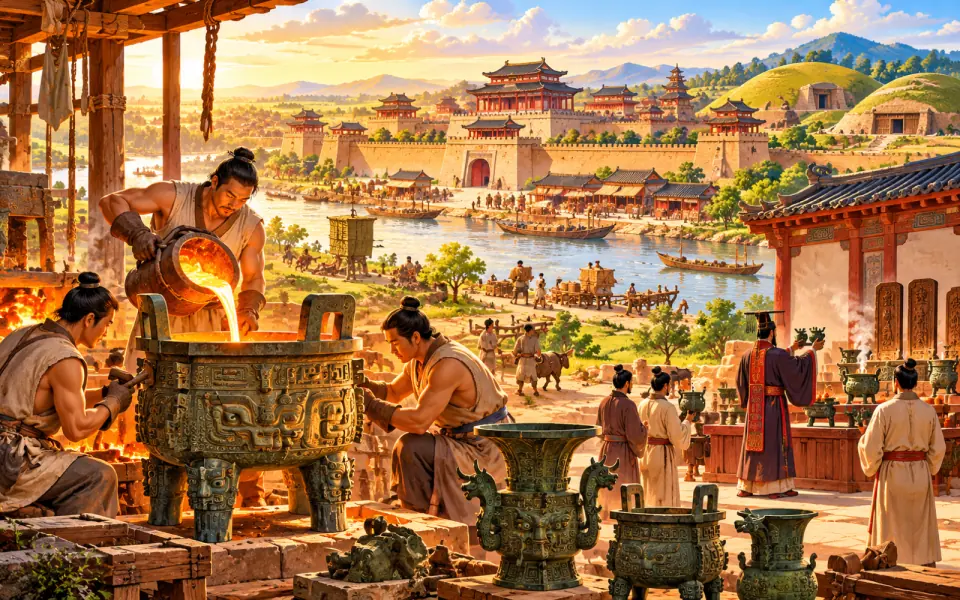 BeforeThe Shang dynastyabout 1600–1046 BC
 BeforeHatshepsut, the woman pharaohabout 1479–1458 BC
 BeforeThe reign of Akhenatenabout 1353–1336 BC
 BeforeThe reign of Ramesses IIabout 1279–1213 BC
- You are hereWriting on oracle bonesabout 1250 BC
 AfterThe Bronze Age collapseabout 1200 BC
Listen / Read next
- Music to read by: Cinematic JourneyEpic film-style music, no lyrics, by Ciro Simone IrmiciSpotifyYouTube Music
Meanwhile, elsewhere in the world
Other events of the era “River civilisations”
- The first Sumerian cities
- Cuneiform writing
- Egyptian hieroglyphs
- The unification of Egypt
- Uruk, the great city
- The Egyptian calendar
- The Step Pyramid of Djoser
- The Standard of Ur
- Egyptian mummification
- The Great Pyramid of Giza
- The cities of the Indus Valley
- The drains and baths of Mohenjo-daro
- Sargon and the Akkadian Empire
- Trade between the Indus and Mesopotamia
- The Epic of Gilgamesh
- The Ziggurat of Ur
- Babylonian mathematics
- The Code of Hammurabi
- War chariots
- The Shang dynasty
- Hatshepsut, the woman pharaoh
- The reign of Akhenaten
- The reign of Ramesses II
- The Bronze Age collapse
