The drains and baths of Mohenjo-daro
about 2450 BC Mohenjo-daro, Indus Valley (now Pakistan)
In short
In Mohenjo-daro many houses had a well, a bathroom and a toilet connected to brick channels. Dirty water flowed into covered drains that ran under the streets, with openings for cleaning them. The city also had the ‘Great Bath’, a pool lined with bricks and made watertight with bitumen. In Europe such a well-ordered system arrived only many centuries later.
Why it matters It shows that people were already thinking about keeping a whole city clean 4500 years ago.
Study card about 6 minutes of reading
The story
The home bathroom, 4,500 years ago
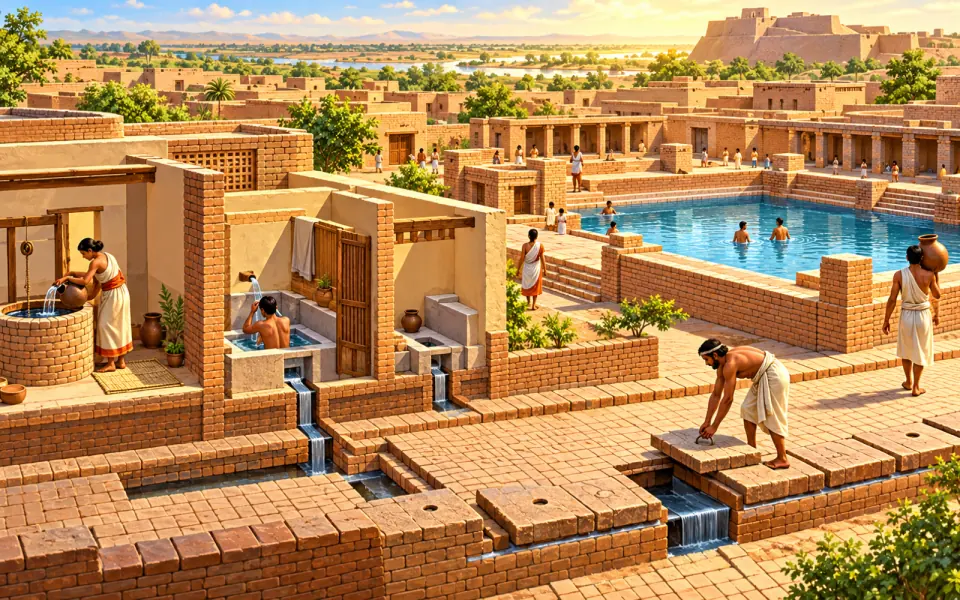
Step in your imagination into a house in Mohenjo-daro around 2500 BC. From the narrow lane you go through a door into a central courtyard, around which the rooms open. In one corner there is a well lined with fired bricks, from which water is drawn. Nearby, a small room has a brick floor sloping slightly: this is the bathroom. You wash by pouring water from a jug, and the water slips away through a hole in the wall and ends up in a clay pipe or a small channel. The channel leads into a drain that runs under the street. In some buildings there is even a toilet, with a seat and a duct that carries the waste into the sewer.
This is not an imaginary scene. Archaeologists have found hundreds of houses with these fittings. At Mohenjo-daro about seven hundred wells have been counted, one for every three or four houses. No other city of that time had so widespread a system of clean water and dirty water.
Under the streets
The heart of the system was the sewers. Along the main streets ran channels of fired brick, covered with slabs of brick or stone that could be lifted for cleaning. At regular intervals there were inspection pits, which served to hold back debris and let the water through. The drains of the houses flowed into those of the street, those of the street into larger channels, and finally the used water left through the walls, towards the fields or the river. To build them, the bricks were joined with a mortar of mud or gypsum and, where needed, with bitumen, a waterproof black substance.
This system demanded an overall plan: houses had to face inwards, with blank walls on the street, and the slopes of the channels had to be carefully calculated so that the water would flow. Someone in the city had to decide and enforce the rules and then pay the teams who cleaned the drains. It is one of the reasons why scholars think the Indus cities were governed with great care, even though we do not know who governed.
The Great Bath
At the highest point of Mohenjo-daro, the citadel, there is a unique building: the Great Bath. It is a rectangular pool about twelve metres long, seven wide and two and a half deep, lined with fired bricks joined with gypsum. Between two layers of bricks the craftsmen put a layer of bitumen, to stop the water seeping into the ground: after 4,500 years, the seal is still good. You went down by two flights of steps, one to the north and one to the south, and around it ran a colonnade with rooms. The water came from a nearby well and was drained through a channel with a corbelled vault, high enough to let a person crawl in.
What it was for, nobody knows for certain. Most scholars think of ritual purification baths, like those that still exist today in the religions of India, but this is a hypothesis: we have no texts that say so, and we do not know what the inhabitants believed. It is not even certain whether it was a public pool or a place reserved for priests.
Nothing like it elsewhere? Not quite
It is often read that Europe had sewers like these only many centuries later, and that is true in general. But we must be precise: ancient drainage systems are found elsewhere too. At Skara Brae, in the Scottish Orkney Islands, houses about 5,000 years old had a kind of channel for waste. The palace of Knossos, in Crete, had pipes and bathrooms around 1700 BC. The difference is that at Mohenjo-daro the system served almost a whole city of tens of thousands of inhabitants, not just a palace or a village.
Sewers, afterwards, had a strange history. The Cloaca Maxima of Rome, built in the 6th century BC, is the most famous of antiquity. But after the fall of the Roman Empire, in many European cities the systems were lost. To see orderly and widespread systems again we have to wait for the nineteenth century: in London, after the “Great Stink” of 1858, the engineer Joseph Bazalgette built more than 1,800 kilometres of sewers. That is, over 4,000 years after Mohenjo-daro.
A city to protect
Today Mohenjo-daro is in danger. After 4,500 years the bricks are crumbling from the salt rising from the ground and from rain and floods. The site was added to the World Heritage list in 1980 and is the subject of conservation work. Only a part has been excavated, and archaeologists have decided to leave the rest underground, because it is safer: an excellent way of keeping something for future generations.
Why it happened
The first cause was water. On a plain subject to floods and intense heat, wells were indispensable and standing water could bring disease. Those who lived in cities of tens of thousands of inhabitants had to send away the dirty water before it infected the well.
A second cause was organisation. The Indus cities were planned: streets at right angles, bricks of standard sizes, districts on platforms to escape the floods. In so rational a setting, sewers were a natural step, and they were designed together with the streets.
A third cause may have been culture: many people believe that habits of cleanliness and purification were important in Indus religious life. The Great Bath and the bathrooms in the houses suggest that water had a special value, not just a practical one.
What changed
The sewers of Mohenjo-daro are one of the best proofs that 4,500 years ago ideas such as public health and the shared responsibility of the city already existed. Archaeologists cite them to show that an ancient civilisation could be very advanced even without great palaces.
They also teach us something about progress. Innovations do not always grow in a straight line: the sewers of the Indus, of Crete and of Rome were very advanced, then in many places they were lost and rebuilt almost from scratch. Our modern bathroom is the result of many discoveries and forgettings.
Today modern cities face the same problems: how to collect and treat wastewater. In the world, even now, more than three billion people do not have safely managed sanitation, according to World Health Organization estimates. Mohenjo-daro reminds us that clean water and sewers are an achievement that depends on the choices of the community.
Key people and places
People
- Rakhaldas Banerji
- Indian archaeologist who in 1922 began the excavation of Mohenjo-daro and brought to light the first streets and houses.
- Mortimer Wheeler
- British archaeologist who in the mid-twentieth century excavated the citadel and studied the Great Bath.
- Joseph Bazalgette
- English engineer (1819–1891) who built London's modern sewers after 1858: an example of how modern cities rediscovered a system already known at Mohenjo-daro.
Places
- Mohenjo-daro (Sindh, Pakistan)
- The largest city of the Indus, with straight streets, houses with a well and bathroom, and a system of covered sewers.
- The Great Bath
- A brick pool in the citadel of Mohenjo-daro, made waterproof with bitumen, probably used for rituals.
- Skara Brae (Orkney, Scotland)
- A stone village about 5,000 years old, with drainage channels: it shows that ancient drains were known in Europe too.
Good to know
- About 700 wells have been counted at Mohenjo-daro: on average one for every few houses.
- The Great Bath is 12 metres long and 2.5 deep; its floor was made waterproof with a layer of bitumen.
- The sewers were covered with bricks that could be lifted for cleaning: the idea of manholes is 4,500 years old.
- People washed in the houses with jugs of water: there were no taps, but the floors sloped towards a drain.
- Mohenjo-daro was added to the World Heritage list in 1980; only a part of the city has been excavated.
Find out more
- Wikipedia, “Mohenjo-daro” en.wikipedia.org
- Wikipedia, “Great Bath” en.wikipedia.org
- World History Encyclopedia, “Indus Valley Civilization” worldhistory.org
- Wikipedia, “Indus Valley Civilisation” en.wikipedia.org
Related events
- The cities of the Indus Valleyabout 2500 BC · River civilisationsMohenjo-daro is one of the great cities of the Indus civilisation.
- The Aqua Marcia aqueduct144–140 BC · Ancient RomeThe Aqua Marcia aqueduct and the Roman sewers continue the tradition of water in the city.
- The Ziggurat of Urabout 2100 BC · River civilisationsThe ziggurat of Ur also had drainage holes to protect the bricks from rain.
- The walls of Jerichoabout 10,300 years ago · PrehistoryFortified Jericho was one of the first cities with common works such as walls and a tower.
- The growth of medieval townsabout 1050 · Late Middle AgesMedieval cities had to rediscover the problem of waste and water.
Before and after, in the era “River civilisations”
Event 12 of 25
 BeforeThe first Sumerian citiesabout 4000 BC
 BeforeCuneiform writingabout 3200 BC
 BeforeEgyptian hieroglyphsabout 3200 BC
 BeforeThe unification of Egyptabout 3100 BC
 BeforeUruk, the great cityabout 3000 BC
 BeforeThe Egyptian calendarabout 2800 BC
 BeforeThe Step Pyramid of Djoserabout 2650 BC
 BeforeThe Standard of Urabout 2600 BC
 BeforeEgyptian mummificationabout 2600 BC
 BeforeThe Great Pyramid of Gizaabout 2560 BC
 BeforeThe cities of the Indus Valleyabout 2500 BC
- You are hereThe drains and baths of Mohenjo-daroabout 2450 BC
 AfterSargon and the Akkadian Empireabout 2334 BC
 AfterTrade between the Indus and Mesopotamiaabout 2300 BC
 AfterThe Epic of Gilgameshabout 2100 BC
 AfterThe Ziggurat of Urabout 2100 BC
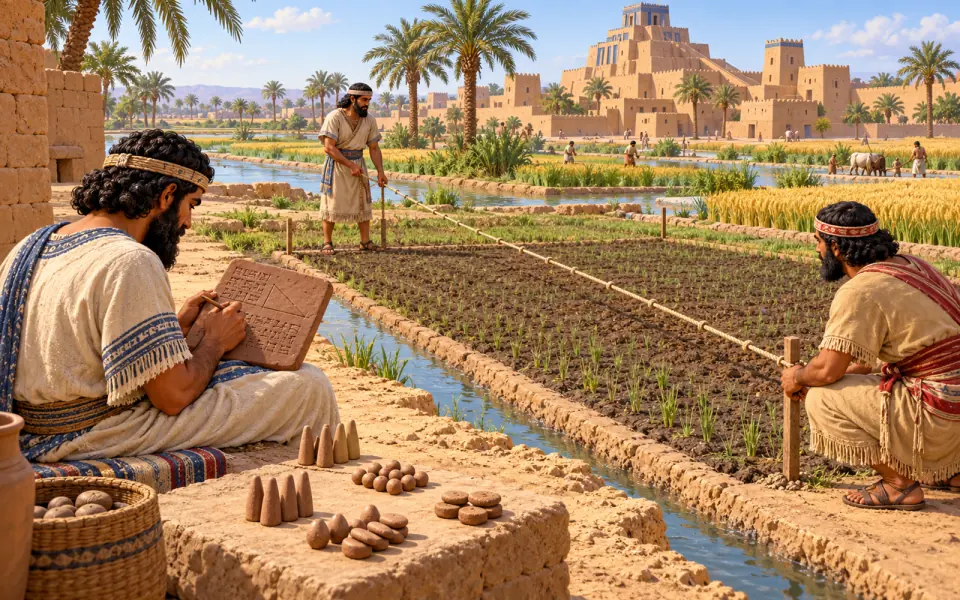 AfterBabylonian mathematicsabout 1800 BC
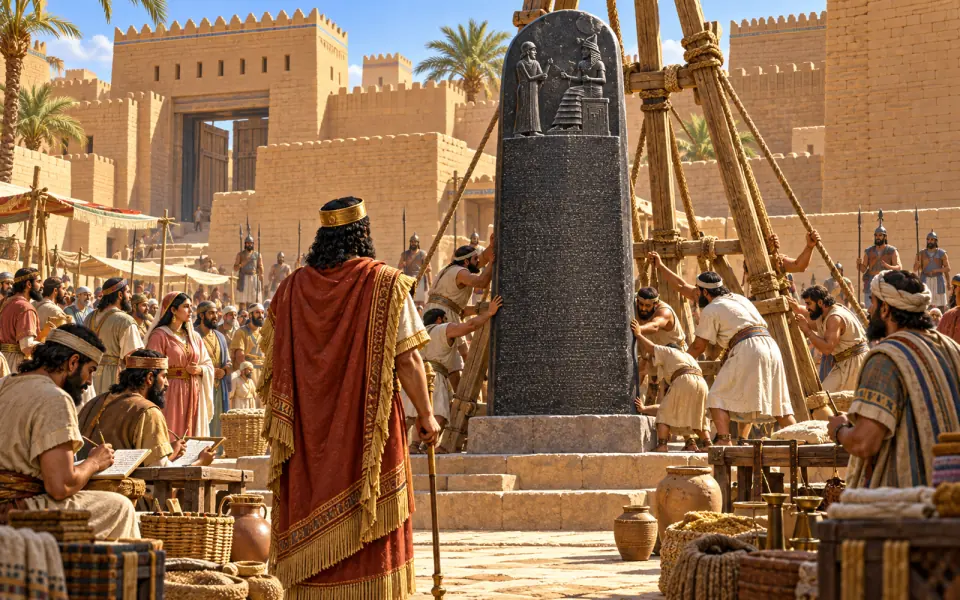 AfterThe Code of Hammurabiabout 1754 BC
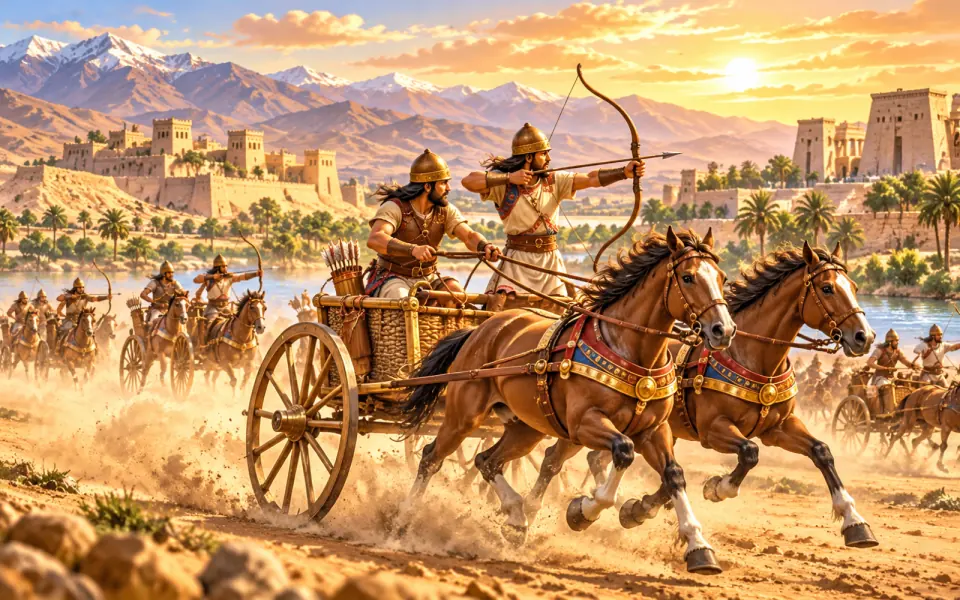 AfterWar chariotsabout 1700 BC
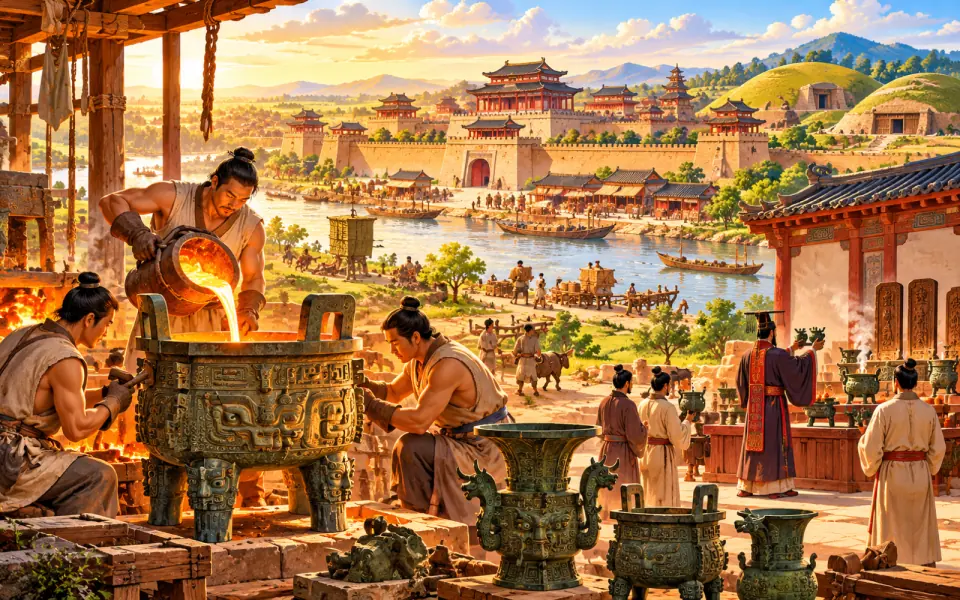 AfterThe Shang dynastyabout 1600–1046 BC
 AfterHatshepsut, the woman pharaohabout 1479–1458 BC
 AfterThe reign of Akhenatenabout 1353–1336 BC
 AfterThe reign of Ramesses IIabout 1279–1213 BC
 AfterWriting on oracle bonesabout 1250 BC
 AfterThe Bronze Age collapseabout 1200 BC
Listen / Read next
- Music to read by: Cinematic JourneyEpic film-style music, no lyrics, by Ciro Simone IrmiciSpotifyYouTube Music
Meanwhile, elsewhere in the world
Other events of the era “River civilisations”
- The first Sumerian cities
- Cuneiform writing
- Egyptian hieroglyphs
- The unification of Egypt
- Uruk, the great city
- The Egyptian calendar
- The Step Pyramid of Djoser
- The Standard of Ur
- Egyptian mummification
- The Great Pyramid of Giza
- The cities of the Indus Valley
- Sargon and the Akkadian Empire
- Trade between the Indus and Mesopotamia
- The Epic of Gilgamesh
- The Ziggurat of Ur
- Babylonian mathematics
- The Code of Hammurabi
- War chariots
- The Shang dynasty
- Hatshepsut, the woman pharaoh
- The reign of Akhenaten
- The reign of Ramesses II
- Writing on oracle bones
- The Bronze Age collapse
