The Egyptian calendar
about 2800 BC Memphis, Egypt
In short
The Egyptians divided the year into 365 days: 12 months of 30 days plus 5 feast days at the end. The year also had three seasons linked to the Nile: the flood, the growing of the crops and the harvest. Astronomers noticed that the river's flood came more or less when the star Sirius became visible again at dawn. But there was no extra day for leap years, so the calendar slowly drifted out of step with the seasons.
Why it matters Julius Caesar drew on this calendar, and the one we use today comes from his.
Source: Encyclopaedia Britannica, “Egyptian calendar”
Study card about 6 minutes of reading
The story
The river decides the year
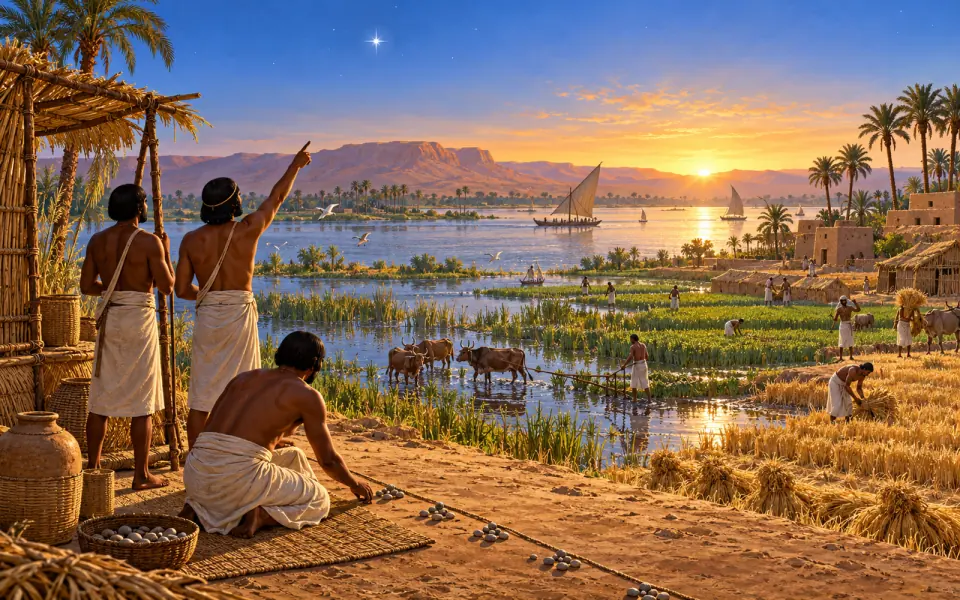
For the Egyptians the year did not begin with winter, but with the Nile. Every summer, because of the rains that fell on the mountains of Ethiopia, the river swelled and left its bed. The water covered the fields for weeks and, when it withdrew, it left a layer of black, fertile silt. The Egyptians called this moment akhet, “the flood”, and considered it the start of the year. Then, when the land re-emerged, came the season of sowing and growth, peret; finally the last, shemu, was the season of harvest, when the river was at its lowest. Three seasons of four months each, then, and not four like ours.
There were twelve months, of thirty days, and each month was divided into three weeks of ten days. That made 360 days. The Egyptians knew perfectly well that the year is a little longer, so they added five days at the end, outside the months. These were the days “upon the year”, considered the birthday feast of some gods, including Osiris, Isis and Seth. The total came to 365 days. This is the Egyptian civil calendar, and everything suggests it was already in use in the Old Kingdom, but the date of its invention is uncertain: some place it shortly after 3000 BC, others around 2800 or 2700 BC.
The star that announces the flood
The Egyptians watched the sky carefully. They noticed that there was a very bright star, our Sirius, which disappeared for about seventy days and then came back into view, for a brief moment, at dawn, just before the Sun. This event is called the heliacal rising of Sirius. Since it fell, more or less, in the days when the Nile began to rise, the star, which the Egyptians called Sopdet and identified with the goddess Isis, was seen as the announcement of the flood. For this reason a year based on Sirius could serve as a guide for farmers.
A calendar that slips
There was, however, a problem. The true year lasts 365 days and about six hours (a quarter of a day more). The Egyptian calendar had no day added every four years, like our leap years. Each year it fell six hours behind the sun and the seasons. After four years a day was missing, after one hundred and twenty years a whole month. After 1,461 years the calendar had gone all the way round and again matched the seasons. Scholars call this period the Sothic cycle, from Sothis, the Greek name for Sirius.
Since the difference built up slowly, it did not change much for a farmer. For scribes and priests, however, the New Year festival could fall in the middle of winter. To know when the flood was really about to arrive, they went on watching the sky and measuring the level of the river with nilometers, stepped wells with a graduated scale dug along the bank.
In 238 BC a decree of Canopus, issued by the priests under King Ptolemy III, proposed adding one day every four years. The reform was not applied. It was only in 26–23 BC, under the emperor Augustus, that a year with the extra day was adopted at Alexandria.
The priests' clock
The day, too, was divided by an original system. At night the Egyptians watched the passage of thirty-six groups of stars, called decans, each of which rose at regular intervals. Twelve of them were used for the night, and from this came the idea of dividing the night into twelve hours. The day was also divided into twelve hours, making twenty-four in all. These were unequal hours, because they changed in length with the seasons. To measure them people needed sundials and water clocks, the oldest of which to have reached us comes from the temple of Karnak, from about 1400 BC.
From Egypt to Rome and to us
The other peoples of the time, such as the Mesopotamians and later the Greeks, used calendars based on the Moon, with months of 29 or 30 days that did not match the year and had to be corrected often. The Egyptian calendar, with its simple rule, was much more convenient, and the Greek astronomers of Alexandria used it for their calculations. When Julius Caesar, in 46 BC, wanted to reform the muddled Roman calendar, he had the help of an astronomer from Alexandria, Sosigenes, and took from Egypt the solar year of 365 days with one extra day every four years. This is the Julian calendar (see the card on Caesar). In 1582 Pope Gregory XIII corrected it slightly, and it is the calendar we use today.
The Egyptian calendar still lives, in a modern form, in the Coptic Church of Egypt and in Ethiopia, where the year still has twelve months of thirty days and a thirteenth month of five or six days.
Why it happened
The Egyptians lived by farming, and farming depended on one precise event, the flood of the Nile. Knowing when it would arrive, when to sow and when to harvest was a matter of survival. Hence the need for a calendar tied to the river and the seasons.
A united state (see the card on the unification) also needed a calendar that was valid for everyone. Those who collected taxes, organised work shifts and ran the temple festivals had to count the days in the same way all over the country. A simple count, with months all the same, served that purpose better than one based on the phases of the Moon.
Finally there was the observation of the sky, carried out by priests whose task was to fix the right time for ceremonies. From the observation of Sirius and the decans came knowledge of the cycle of time and a division of the day that is still used today.
What changed
The Egyptian civil calendar was the first solar calendar of 365 days to have a regular structure. It was used by astronomers for centuries, because months that were all the same made calculations easier. Even Copernicus, in the sixteenth century, used tables based on the Egyptian year for his calculations.
From the Julian reform to the Gregorian calendar, our measure of the year descends in a direct line from the Egyptian one, with the addition of the leap day. The division of the day into twenty-four hours also has its roots in the decans and in the hours of the Egyptian priests.
The idea that time can be measured in a regular way, the same for everyone, had wide consequences: it made it possible to date events, keep archives and plan works and festivals. Egyptian scribes counted the years from the coronation of each king, a system that today helps us reconstruct the chronology of antiquity.
Key people and places
People
- Sosigenes of Alexandria
- Greek astronomer who advised Julius Caesar on the reform of the calendar in 46 BC, using the Egyptian solar year.
- Ptolemy III Euergetes
- King of Egypt in the 3rd century BC. The Decree of Canopus of 238 BC proposed adding one day every four years, but the rule was not applied.
- The Egyptian priest-astronomers
- Temple priests who observed the stars and Sirius to fix the festivals and the start of the year. Their names have usually not come down to us.
Places
- Memphis (Egypt)
- The first capital of united Egypt, near the point where the Nile opens into the delta. The calendar for the whole country was organised here.
- Karnak (Luxor, Egypt)
- The great temple of Amun, where one of the oldest known water clocks was found, from about 1400 BC.
- Elephantine (Aswan, Egypt)
- An island on the Nile in the south with a famous nilometer, a stepped well that measured the level of the flood.
Good to know
- The Egyptian year had three seasons and not four: flood, growth and harvest.
- The five days added at the end of the year were feast days: according to the myth they matched the birthdays of Osiris, Isis, Seth, Horus the Elder and Nephthys.
- After 1,461 years the Egyptian calendar matched the seasons again: scholars call it the Sothic cycle.
- In Ethiopia a calendar of twelve months of thirty days plus a thirteenth month of five or six days is still used. So there, when it is 2026 for us, the year may be 2018 or 2019.
- The Egyptians divided the week into ten days, not seven. The seven-day week came later from Mesopotamia and from Jewish tradition.
Find out more
- Wikipedia, “Ancient Egyptian calendar” en.wikipedia.org
- Wikipedia, “Sirius” en.wikipedia.org
- World History Encyclopedia, “Ancient Egypt” worldhistory.org
- Museo Egizio, Turin (in English) museoegizio.it
Related events
- The unification of Egyptabout 3100 BC · River civilisationsThe united state needed a calendar valid for the whole country.
- The Julian calendar46 BC · Ancient RomeCaesar's Julian calendar comes from the Egyptian solar year.
- The Gregorian calendar1582 · Early modern ageThe Gregorian calendar corrects the last error of the Julian year.
- Public mechanical clocksabout 1350 · Late Middle AgesPublic mechanical clocks continue the tradition of dividing the day into hours.
- Babylonian mathematicsabout 1800 BC · River civilisationsThe Babylonians too watched the sky and divided time using the base-60 system.
Before and after, in the era “River civilisations”
Event 6 of 25
 BeforeThe first Sumerian citiesabout 4000 BC
 BeforeCuneiform writingabout 3200 BC
 BeforeEgyptian hieroglyphsabout 3200 BC
 BeforeThe unification of Egyptabout 3100 BC
 BeforeUruk, the great cityabout 3000 BC
- You are hereThe Egyptian calendarabout 2800 BC
 AfterThe Step Pyramid of Djoserabout 2650 BC
 AfterThe Standard of Urabout 2600 BC
 AfterEgyptian mummificationabout 2600 BC
 AfterThe Great Pyramid of Gizaabout 2560 BC
 AfterThe cities of the Indus Valleyabout 2500 BC
 AfterThe drains and baths of Mohenjo-daroabout 2450 BC
 AfterSargon and the Akkadian Empireabout 2334 BC
 AfterTrade between the Indus and Mesopotamiaabout 2300 BC
 AfterThe Epic of Gilgameshabout 2100 BC
 AfterThe Ziggurat of Urabout 2100 BC
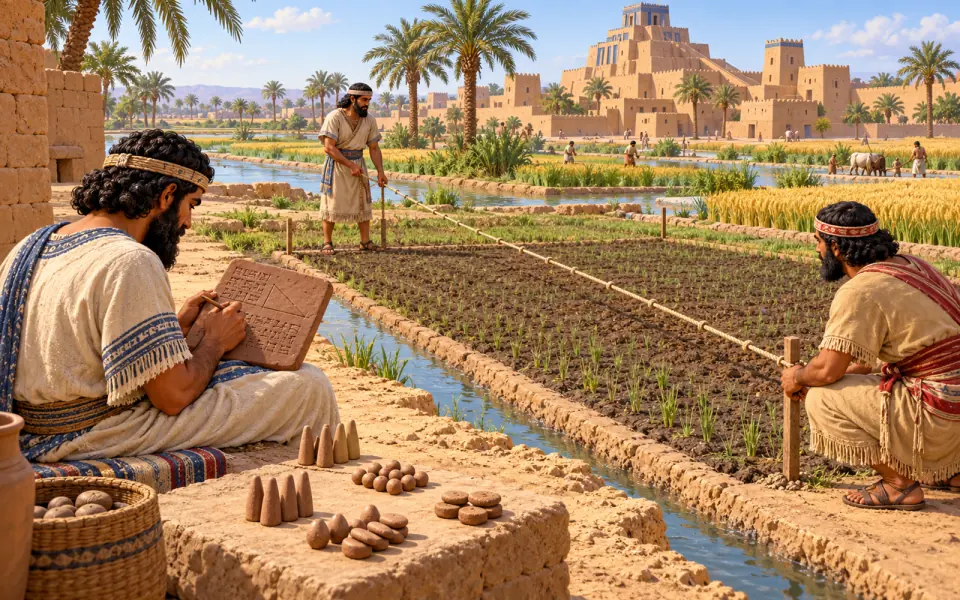 AfterBabylonian mathematicsabout 1800 BC
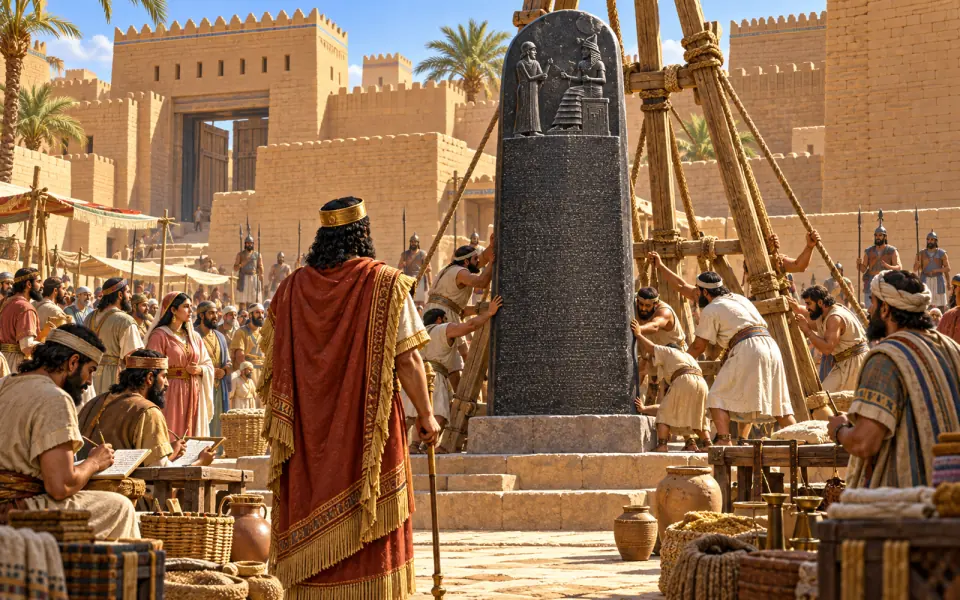 AfterThe Code of Hammurabiabout 1754 BC
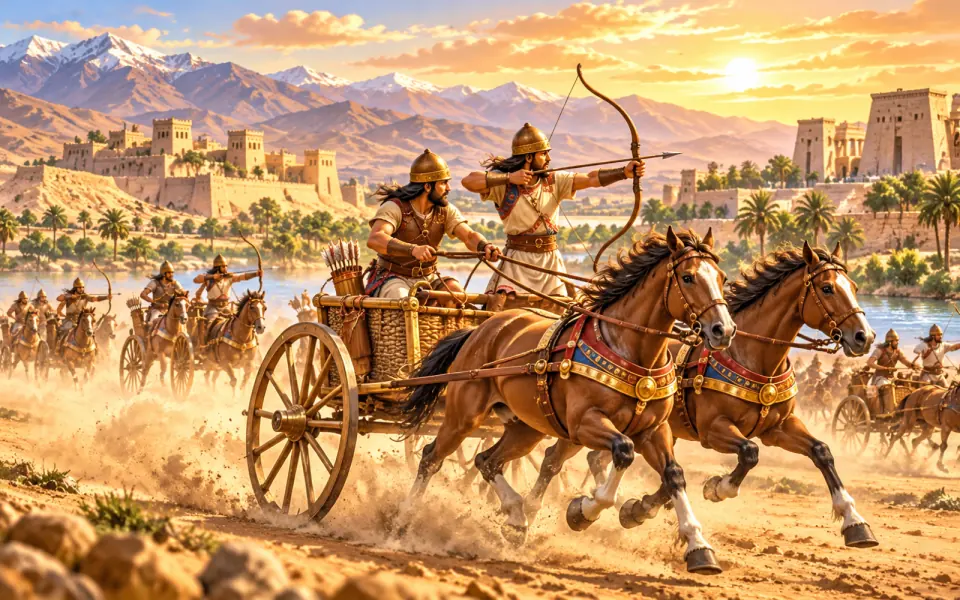 AfterWar chariotsabout 1700 BC
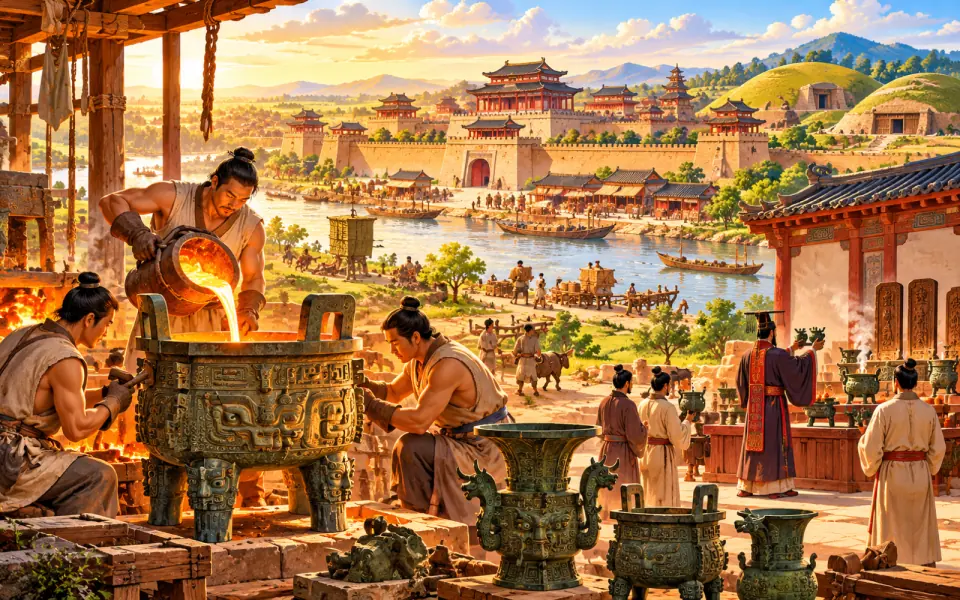 AfterThe Shang dynastyabout 1600–1046 BC
 AfterHatshepsut, the woman pharaohabout 1479–1458 BC
 AfterThe reign of Akhenatenabout 1353–1336 BC
 AfterThe reign of Ramesses IIabout 1279–1213 BC
 AfterWriting on oracle bonesabout 1250 BC
 AfterThe Bronze Age collapseabout 1200 BC
Listen / Read next
- Music to read by: Cinematic JourneyEpic film-style music, no lyrics, by Ciro Simone IrmiciSpotifyYouTube Music
Other events of the era “River civilisations”
- The first Sumerian cities
- Cuneiform writing
- Egyptian hieroglyphs
- The unification of Egypt
- Uruk, the great city
- The Step Pyramid of Djoser
- The Standard of Ur
- Egyptian mummification
- The Great Pyramid of Giza
- The cities of the Indus Valley
- The drains and baths of Mohenjo-daro
- Sargon and the Akkadian Empire
- Trade between the Indus and Mesopotamia
- The Epic of Gilgamesh
- The Ziggurat of Ur
- Babylonian mathematics
- The Code of Hammurabi
- War chariots
- The Shang dynasty
- Hatshepsut, the woman pharaoh
- The reign of Akhenaten
- The reign of Ramesses II
- Writing on oracle bones
- The Bronze Age collapse
