The Phoenician alphabet
about 1050 BC Byblos (now Lebanon)
In short
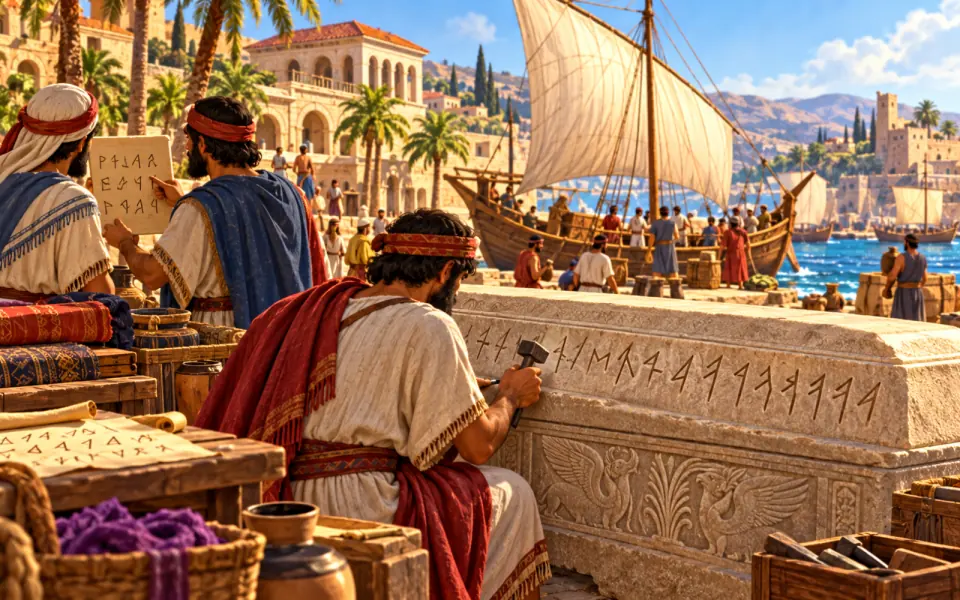
The Phoenicians used an alphabet of 22 letters, all consonants, written from right to left. One of the oldest inscriptions is carved on the coffin of Ahiram, King of Byblos. Being good merchants, they carried this way of writing to every port they visited. From it came the Greek alphabet, then the Latin one and finally the one we use.
Why it matters The letters you are reading this sentence with have a Phoenician ancestor.
Source: Encyclopaedia Britannica, “Phoenician alphabet”
Study card about 5 minutes of reading
The story
Twenty-two signs to write everything
Try writing a sentence without using the vowels: “ll th lttrs”. A trained reader might perhaps understand it all the same. The Phoenicians wrote exactly like this. Their alphabet had twenty-two signs, and all of them stood for consonants. The vowels were not written: the reader guessed them from the sense, as we do with certain abbreviations. Later, to make some words clearer, people began to use a few consonants to indicate a vowel too.
It was written from right to left, the opposite of the way we do it. Scholars note that it was one of the first writing systems with a fixed direction. With only twenty-two signs, learning to write was much easier than with hieroglyphs or cuneiform.
The names of the letters
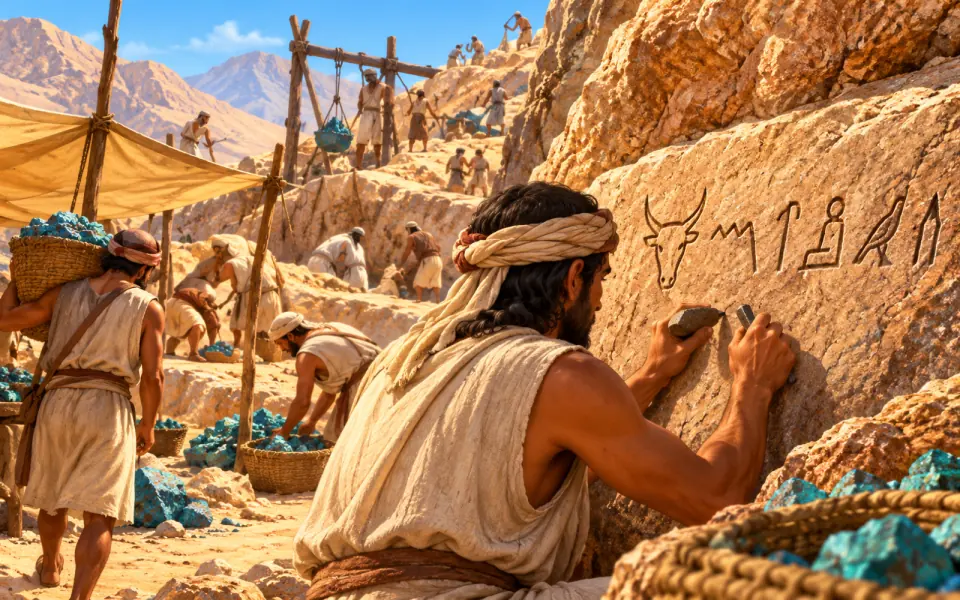
Each letter had a name that recalled an object, and this is the thread that links us to the past. The first was called aleph, meaning “ox”; the second bet, “house”; the third gimel, which means “throwing stick” or, according to other interpretations, “camel”. The oldest signs came from drawings, like those of the Sinai inscriptions, and over time they were simplified until they became letters. If you look at our A, in fact, with a little imagination you can see an ox's head turned upside down.
The first inscriptions
What is the oldest Phoenician inscription? It depends on how things are dated. One of the most celebrated is carved on the sarcophagus of Ahiram, which was discovered in 1923 at Byblos, in present-day Lebanon, by the French archaeologist Pierre Montet. After a landslide some royal tombs had been revealed, and in tomb number five the sarcophagus was found. On its rim there is an inscription of thirty-eight words: it is a warning. It says that anyone, king or governor, who opens the tomb or erases the inscription will be struck by a curse. The sarcophagus is decorated with reliefs showing a king seated on a throne with sphinxes and a priestess offering him a lotus flower. Today it is in the National Museum of Beirut.
The date of the sarcophagus is debated. It is generally thought to be around 1000 BC, but some scholars place it around 850 BC, and another scholar, Edith Porada, even later, between the middle of the 9th and the 8th century BC. This is why the conventional date for the beginning of the Phoenician alphabet, about 1050 BC, is more a choice made by historians than a sure point. The oldest securely dated inscriptions are from the 10th century BC. Among the other important witnesses are the Kilamuwa stele, of the 9th century BC, and the Nora stele, in Sardinia, of about 800 BC, which we discuss in another card.
Travelling with the merchants
The Phoenicians, merchants and sailors, carried their writing wherever they went. From the 9th century BC the peoples who met it adapted it to their own language. The Greeks made the most important change: they added the vowels. It was a brilliant idea, which made the alphabet much more precise.
From a variant of Greek, the one from Cumae, in Campania, the alphabets of ancient Italy were born, including Latin, and Etruscan descends from it too. By another route, Aramaic derived from Phoenician, and from that Hebrew, Syriac and Arabic. This is why the letters you are reading are relatives of those of an eastern language: there is a single family, which starts here.
The myth of Cadmus
The Greeks had an explanation all their own, which the historian Herodotus told in the 5th century BC. According to him, a Phoenician prince named Cadmus had come to Greece and brought letters with him. Herodotus placed Cadmus about sixteen hundred years before his own time, but the true story seems more recent: the Greeks' adoption of the alphabet took place about three hundred and fifty years before him. The myth nevertheless says one true thing: the Greeks knew they owed their letters to the Phoenicians.
Why it happened
The Phoenicians were merchants. They had to keep accounts, write letters, contracts, labels for goods, and do it quickly, in different ports and with people who spoke different languages. A script with hundreds of signs, like the Egyptian one, or with complicated syllable systems, was inconvenient. A short alphabet was perfect for people who travelled.
Besides, the idea of one sign for each sound was not born at Byblos: it had already spread in the previous centuries, starting from the inscriptions of Sinai and Canaan. The Phoenicians took it, arranged it into twenty-two letters and made it a standard that could be taught and copied anywhere.
What changed
The Phoenician alphabet is the ancestor of almost all the alphabets of the Western world and of many others. Greek, Latin, Cyrillic, Hebrew, Arabic and other systems descend from it, by different routes.
With a short alphabet many more people could learn to write. This helped change the way people governed, traded and passed on ideas: laws could be written and read by many, books could circulate, Greek literature could be put into writing. The Homeric poems, for example, have reached us thanks to the alphabet.
When you write a word today, you repeat a gesture that comes from a choice made by merchants and scribes long before Rome and Athens.
Key people and places
People
- Ahiram
- A man of Byblos, probably a ruler, whose sarcophagus bears one of the oldest Phoenician inscriptions; the text does not call him king.
- Pierre Montet
- French archaeologist who in 1923 discovered at Byblos the tomb with the sarcophagus of Ahiram.
- Cadmus
- Phoenician prince of Greek myth: according to Herodotus he brought letters to Greece.
- Herodotus
- Greek historian of the 5th century BC who reported the story of Cadmus.
Places
- Byblos
- A Phoenician city on the coast of Lebanon where the sarcophagus of Ahiram was found.
- National Museum of Beirut
- The museum in Lebanon where the sarcophagus of Ahiram is kept.
- Cumae
- An ancient Greek colony in Campania: its variant of the Greek alphabet was the origin of the Italic alphabets, including Latin.
Good to know
- The Phoenician alphabet had 22 letters, all consonants, and was written from right to left.
- Aleph meant “ox” and bet “house”: alpha and beta come from these names.
- On the sarcophagus of Ahiram an inscription of 38 words warns that whoever opens it will be struck by a curse.
- The Greeks added to the Phoenician alphabet the vowels, which were not written there.
- Herodotus told that letters had been brought to Greece by the Phoenician prince Cadmus.
Find out more
- Wikipedia, “Ahiram sarcophagus” en.wikipedia.org
- World History Encyclopedia, “Byblos” worldhistory.org
- Wikipedia, “History of the alphabet” en.wikipedia.org
- Wikipedia, “Phoenician alphabet” en.wikipedia.org
Related events
- The Proto-Sinaitic alphabetabout 1800 BC · Sea civilisationsThe Sinai inscriptions were the first step towards the alphabet.
- The Greek alphabetabout 750 BC · Ancient GreeceThe Greeks adapted the Phoenician alphabet by adding the vowels.
- The Nora Stoneabout 800 BC · Sea civilisationsThe Nora stele, in Sardinia, is written in Phoenician letters.
- Homer's poems are written downabout 750 BC · Sea civilisationsThe Homeric poems were put into writing thanks to the alphabet.
- Greek colonies in the Westabout 750 BC · Sea civilisationsFrom the Greek colony of Cumae the alphabet passed to Italy.
Before and after, in the era “Sea civilisations”
Event 12 of 25
 BeforeMinoan civilisation on Creteabout 2000 BC
 BeforeThe palace of Knossosabout 1900 BC
 BeforeThe Proto-Sinaitic alphabetabout 1800 BC
 BeforeThe eruption of Theraabout 1600 BC
 BeforeThe nuraghi of Sardiniaabout 1600 BC
 BeforeThe gold mask of Mycenaeabout 1550 BC
 BeforeLinear Babout 1450 BC
 BeforeThe Lion Gate at Mycenaeabout 1250 BC
 BeforeThe Iron Age beginsabout 1200 BC
 BeforeThe Phoenicians spread outabout 1200 BC
 BeforePhoenician purpleabout 1100 BC
- You are hereThe Phoenician alphabetabout 1050 BC
 AfterThe Kingdom of Israelabout 1000 BC
 AfterPhoenician seafaringabout 1000 BC
 AfterThe Villanovan culture in Italyabout 900 BC
 AfterTraditional founding of Carthageabout 814 BC
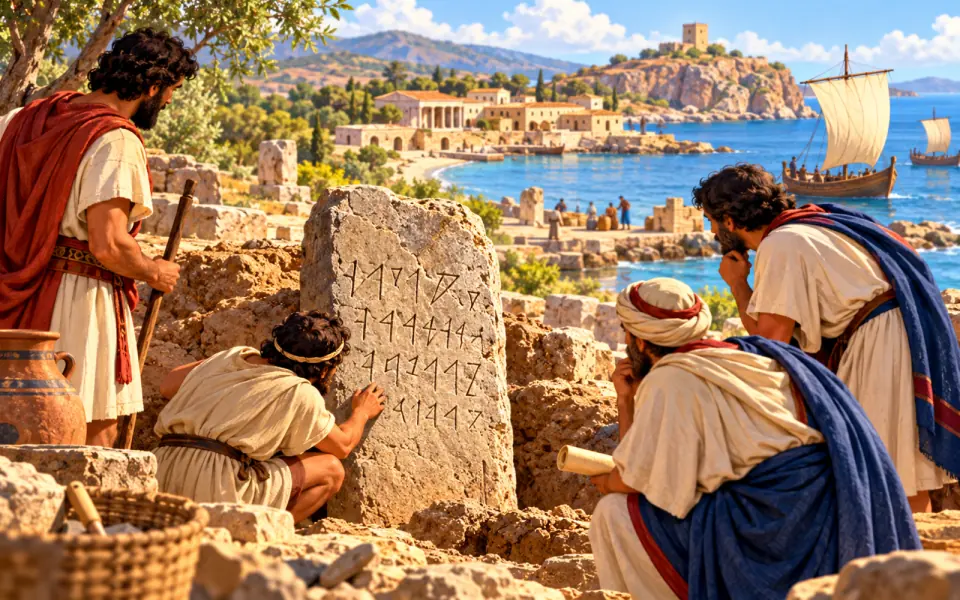 AfterThe Nora Stoneabout 800 BC
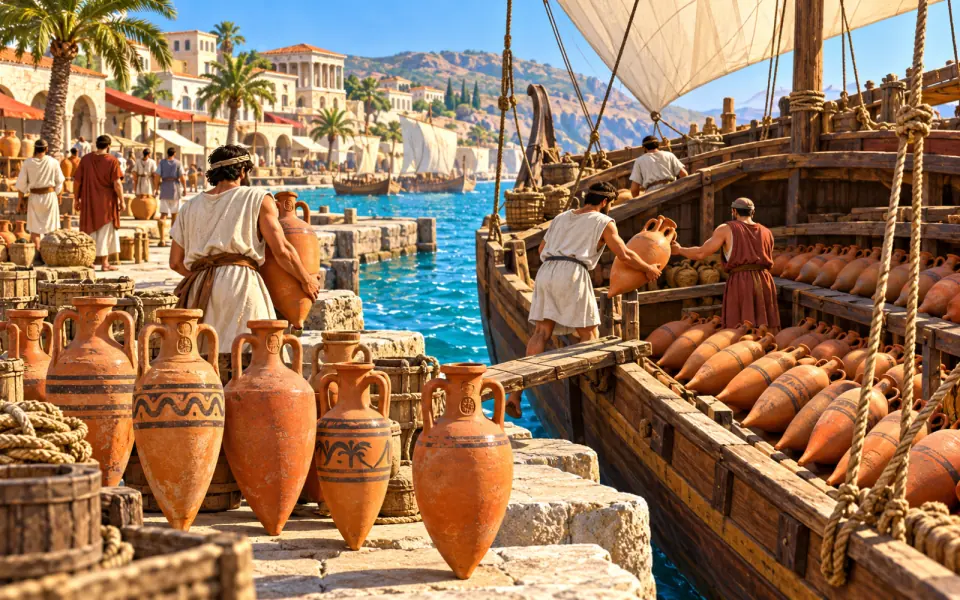 AfterAmphorae for oil and wineabout 800 BC
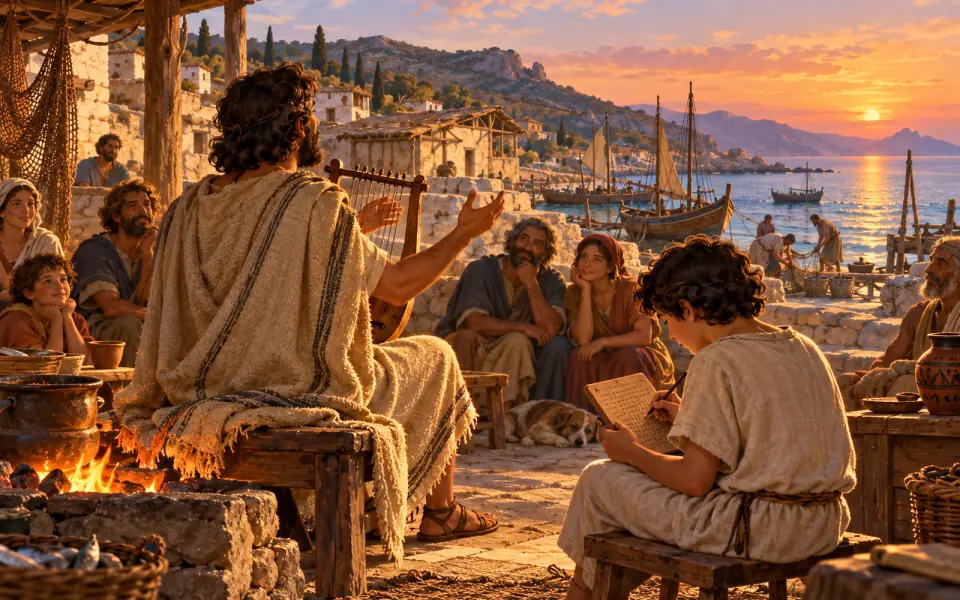 AfterHomer's poems are written downabout 750 BC
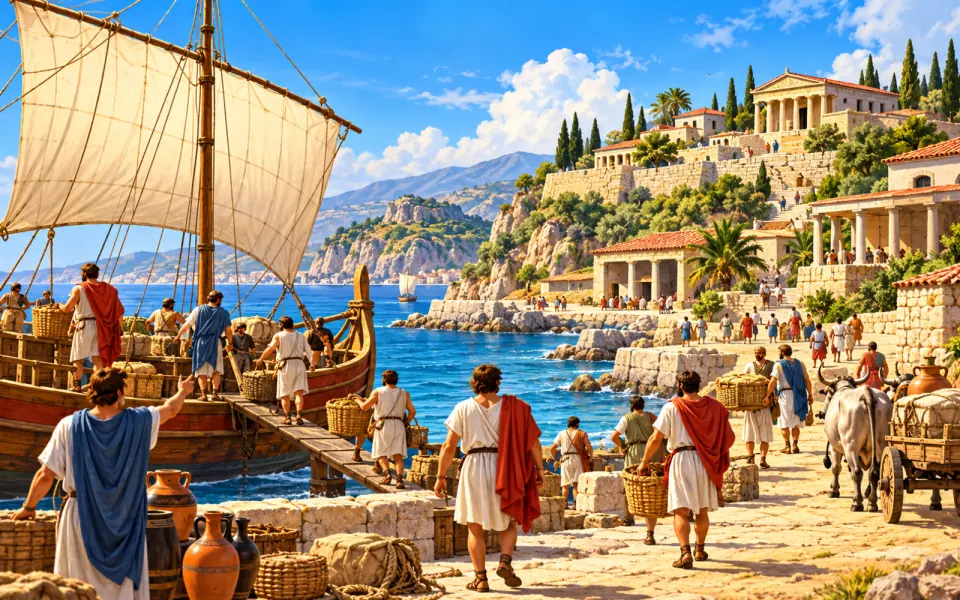 AfterGreek colonies in the Westabout 750 BC
 AfterThe Etruscans, lords of the Tyrrhenian Seaabout 700 BC
 AfterPhoenician glass spreadsabout 600 BC
 AfterCoins in the Mediterraneanabout 600 BC
 AfterThe Babylonian Exileabout 586 BC
 AfterSailing beyond Gibraltarabout 500 BC
Listen / Read next
- Music to read by: Cinematic JourneyEpic film-style music, no lyrics, by Ciro Simone IrmiciSpotifyYouTube Music
Meanwhile, elsewhere in the world
Other events of the era “Sea civilisations”
- Minoan civilisation on Crete
- The palace of Knossos
- The Proto-Sinaitic alphabet
- The eruption of Thera
- The nuraghi of Sardinia
- The gold mask of Mycenae
- Linear B
- The Lion Gate at Mycenae
- The Iron Age begins
- The Phoenicians spread out
- Phoenician purple
- The Kingdom of Israel
- Phoenician seafaring
- The Villanovan culture in Italy
- Traditional founding of Carthage
- The Nora Stone
- Amphorae for oil and wine
- Homer's poems are written down
- Greek colonies in the West
- The Etruscans, lords of the Tyrrhenian Sea
- Phoenician glass spreads
- Coins in the Mediterranean
- The Babylonian Exile
- Sailing beyond Gibraltar
