The invention of the wheel
about 5,500 years ago Mesopotamia and Europe (Ljubljana wheel, Slovenia)
In short
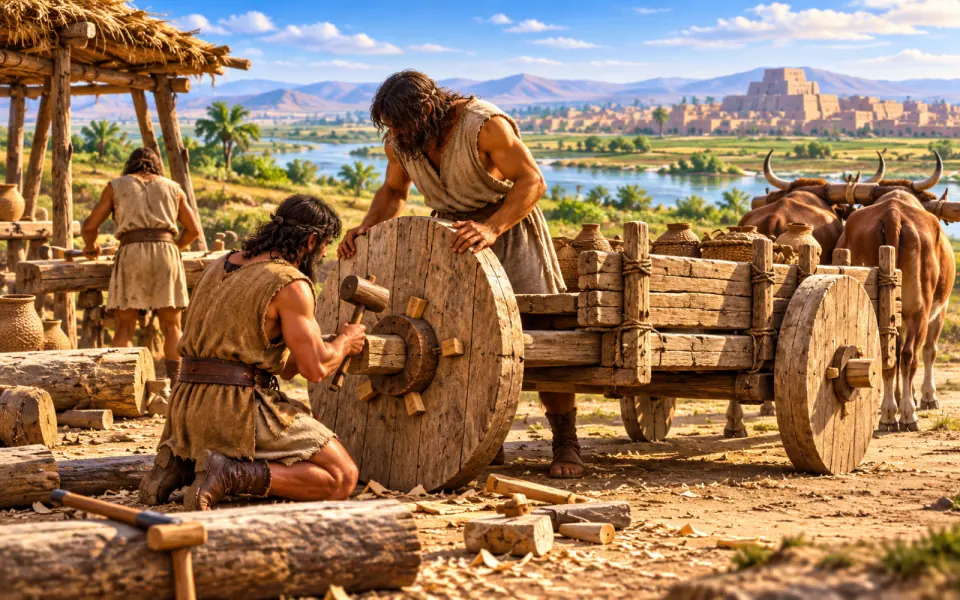
The first wheels for carts appeared about 5500 years ago, at almost the same time in the Near East and in Europe. They were solid wooden discs; lighter spoked wheels came much later. One of the oldest wooden wheels in the world, about 5200 years old and still with its axle, was found in Slovenia, near Ljubljana.
Why it matters Moving heavy loads became much easier.
Source: City Museum of Ljubljana (MGML), “The Wheel – 5,200 Years”
Study card about 5 minutes of reading
The story
A discovery in the peat
In 2002, on the outskirts of Ljubljana, the capital of Slovenia, some archaeologists were exploring a vast wetland called the Ljubljansko Barje, the “Ljubljana Marsh”. Until not long before it had been a lake; then the rivers had filled it with mud and peat. Long ago, among the reeds, groups of farmers lived and built villages on stilts. Digging in the peat, more than two metres down, someone touched something wooden, curved and smooth with a spade. It was a wheel. And beside it, still in its hole, was its axle.
That wheel, washed and studied, proved to be a treasure. It is about 5,150 to 5,200 years old (the researchers used radiocarbon and dendrochronology, that is, the reading of tree rings). It is made of two ash planks, joined by two crosspieces, and has a diameter of about seventy centimetres. The axle, of oak, is more than a metre long. It is the oldest wooden wheel with its axle ever found, and it is on show in the City Museum of Ljubljana.
The peat worked the miracle. In wet ground, with no oxygen, wood does not rot: it stays intact for thousands of years. Almost everywhere in the world ancient wooden wheels have vanished, because wood wears away. That is why they are so rare.
A late and difficult invention
It might seem that the wheel is a natural idea, but in fact it came very late. Human beings had already invented the bow, the boat, cloth and pottery before thinking of a cart. The reason is that a round disc is not enough. You have to make the wheel turn around an axle without it stopping or jamming. The wheel and the axle have to be precise, with well-smoothed surfaces and a little space to move. You need a road to travel on and an animal to pull. First you needed the herding of oxen, which happened about 10,000 years ago, and then you had to learn to make them work, which happened thousands of years later.
For this reason the wheel is not the invention of a lone genius. It seems to have appeared little by little, perhaps from an idea like the rollers made of logs that were put under heavy objects to drag them.
Where and when
The oldest evidence comes from places very far from one another, all between about 3500 and 3000 BC. On a pot found at Bronocice in Poland, about 5,500 years old, there is a drawing that looks like a four-wheeled cart. In northern Germany, at Flintbek, traces of ruts left by carts in the ground have been found, dating from more or less the same period. In Mesopotamia, in the city of Uruk, drawings of sledges and carts appear on the clay tablets, around 3200 BC. We do not know where the wheel was invented: perhaps in several places, perhaps in just one, from which it spread very quickly. Scholars argue about it.
Perhaps the first use was the potter's wheel, a disc that turns and makes it possible to make regular pots. For others the wheel arose in mines, to carry the ore. This too is a matter of hypotheses.
From disc to spoke
The first wheels were solid discs, made of one or more wooden planks. They were heavy and slow. Only much later, around 2000 BC, did spoked wheels appear, lighter and faster, in the steppes between Russia and Kazakhstan, where the first light war chariots, pulled by horses, were built. With the spoked wheel came war chariots, which changed the armies of antiquity.
There is a curious fact: the wheel was not invented everywhere. In the American civilisations before Columbus the wheel, as far as we know, appears only in toys, such as little terracotta animals with wheels found in Mexico. They had no large draught animals, such as oxen and horses, and without them the wheel was of little use. The great American cities were therefore built without carts.
Why it happened
The wheel arose from the need to carry heavy loads: grain, wood, stone, ore. With agriculture and herding, villages had more things to move, and oxen were available to pull.
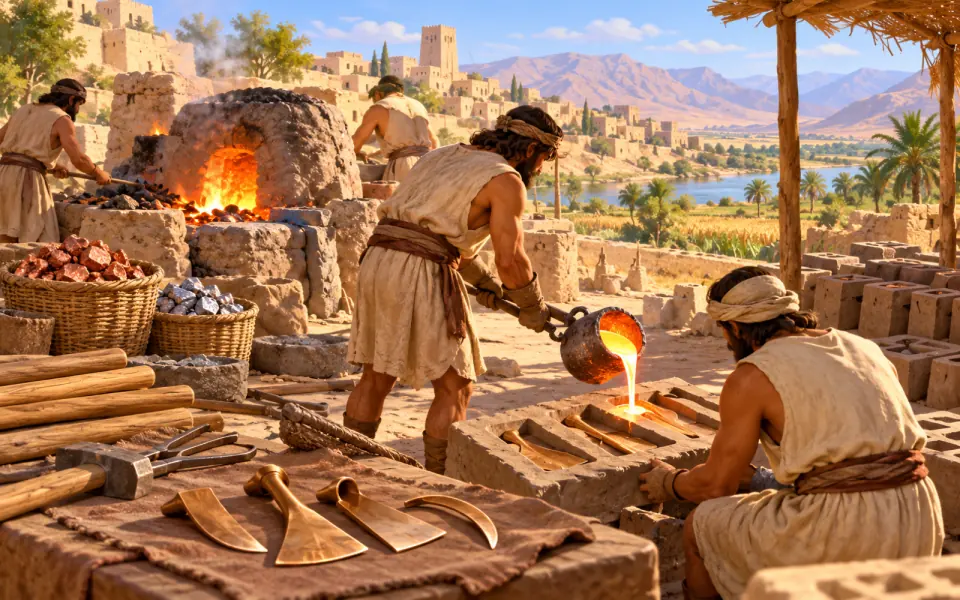
It was also made possible by wood technology. To make an axle that turned and a suitable hole you needed good metal tools, such as copper axes and chisels, and to be able to work wood precisely. It is no accident that the wheel appears together with the Copper Age.
Another cause was probably the circulation of ideas. It seems that the wheeled cart spread in Europe and Asia within a few centuries, a very short time, and this suggests that news travelled quickly along the trade routes.
What changed
The wheel changed transport and trade. A cart with an ox can carry a much heavier load than a person could. Farther fields could be farmed, and harvests, stones and metals carried over greater distances. Roads, little by little, began to become important.
Many other inventions came from the wheel: the lathe, the water mill, gears, clocks, pulleys. The wheel is at the base of almost every machine. Without cogwheels, for example, there would be no Antikythera mechanism and no clock.
Today the wheel is everywhere: in cars, bikes, suitcases, trains, turbines. Even the rovers exploring Mars have six wheels. The design of the wheel has stayed the same, but now wheels are made of rubber, with air inside, and of metal.
Key people and places
People
- Anton Velušček
- Slovenian archaeologist at the Slovenian Academy of Sciences and Arts in Ljubljana. He has studied for years the stilt villages of the Ljubljana Marsh, where the wheel was found.
- David Anthony
- American archaeologist. In the book “The Horse, the Wheel, and Language” (2007) he told the story of the origin of the wheel and of wagons on the steppes.
Places
- Ljubljana Marsh (Slovenia)
- A wetland south of the Slovenian capital, with stilt villages more than 5,000 years old. It is part of the Prehistoric Pile Dwellings around the Alps, a World Heritage Site.
- Bronocice (Poland)
- A prehistoric village where a pot with the image of a cart about 5,500 years old was found.
- Uruk (Iraq)
- An ancient Sumerian city where the first drawings of carts appear on clay tablets.
Good to know
- The Ljubljana wheel is made of two planks of ash, a wood that stands up to knocks, and is only a few centimetres thick.
- The ancient Egyptians built the pyramids without wheels: they dragged the blocks on sledges, pouring water on the sand in front to make them slide better.
- In Mesopotamia four-wheeled carts and sledges appear in the first images of battles and processions, as in the Standard of Ur.
- The toys with wheels found in Mexico, in ancient tombs, show that the principle of the wheel was known, but not used for carts.
- The Latin word for wheel was rota, and from it come English words such as “rotate”, “rotation” and “rotund”.
Find out more
- City Museum of Ljubljana, “The Wheel – 5,200 Years” (in English) mgml.si
- Wikipedia, “Wheel” en.wikipedia.org
- Wikipedia, “Chalcolithic” en.wikipedia.org
- Wikipedia, “Domestication” en.wikipedia.org
Related events
- War chariotsabout 1700 BC · River civilisationsWar chariots, with spoked wheels, changed armies.
- Pottery spreadsabout 9,000 years ago · PrehistoryThe potter's wheel and the wheel arose almost together.
- Taming the sheepabout 11,000 years ago · PrehistoryDraught animals, such as oxen, made the wheel useful.
- The Standard of Urabout 2600 BC · River civilisationsThe Standard of Ur shows carts with wheels in a war scene.
- The Antikythera mechanismabout 100 BC · Ancient GreeceThe Antikythera mechanism is made of dozens of cogwheels.
Before and after, in the era “Prehistory”
Event 24 of 25
 BeforeThe first homininsabout 7 million years ago
 BeforeLucy the australopithecineabout 3.2 million years ago
 BeforeThe first stone toolsabout 2.6 million years ago
 BeforeHomo habilisabout 2.4 million years ago
 BeforeHomo erectusabout 1.9 million years ago
 BeforeTaming fireabout 790,000 years ago
 BeforeHomo heidelbergensisabout 600,000 years ago
 BeforeNeanderthalsabout 400,000 years ago
 BeforeThe arrival of Homo sapiensabout 300,000 years ago
 BeforeThe first deliberate burialsabout 100,000 years ago
 BeforeHomo sapiens leaves Africaabout 60,000 years ago
 BeforeThe needle with an eyeabout 48,000 years ago
 BeforeThe first people in Australiaabout 48,000 years ago
 BeforeThe cave art of Sulawesiabout 44,000 years ago
 BeforeThe Venus of Willendorfabout 28,000 years ago
 BeforeThe Lascaux caveabout 19,000 years ago
 BeforeThe first permanent villagesabout 14,000 years ago
 BeforeThe Neolithic Revolutionabout 12,000 years ago
 BeforeTaming the sheepabout 11,000 years ago
 BeforeThe walls of Jerichoabout 10,300 years ago
 BeforePottery spreadsabout 9,000 years ago
 BeforeÇatalhöyükabout 9,000 years ago
 BeforeWorking with copperabout 7,000 years ago
- You are hereThe invention of the wheelabout 5,500 years ago
 AfterThe Bronze Ageabout 5,300 years ago
Listen / Read next
- Music to read by: Cinematic JourneyEpic film-style music, no lyrics, by Ciro Simone IrmiciSpotifyYouTube Music
Meanwhile, elsewhere in the world

Other events of the era “Prehistory”
- The first hominins
- Lucy the australopithecine
- The first stone tools
- Homo habilis
- Homo erectus
- Taming fire
- Homo heidelbergensis
- Neanderthals
- The arrival of Homo sapiens
- The first deliberate burials
- Homo sapiens leaves Africa
- The needle with an eye
- The first people in Australia
- The cave art of Sulawesi
- The Venus of Willendorf
- The Lascaux cave
- The first permanent villages
- The Neolithic Revolution
- Taming the sheep
- The walls of Jericho
- Pottery spreads
- Çatalhöyük
- Working with copper
- The Bronze Age
