The cave art of Sulawesi
about 44,000 years ago Leang Tedongnge Cave, Sulawesi (Indonesia)
In short
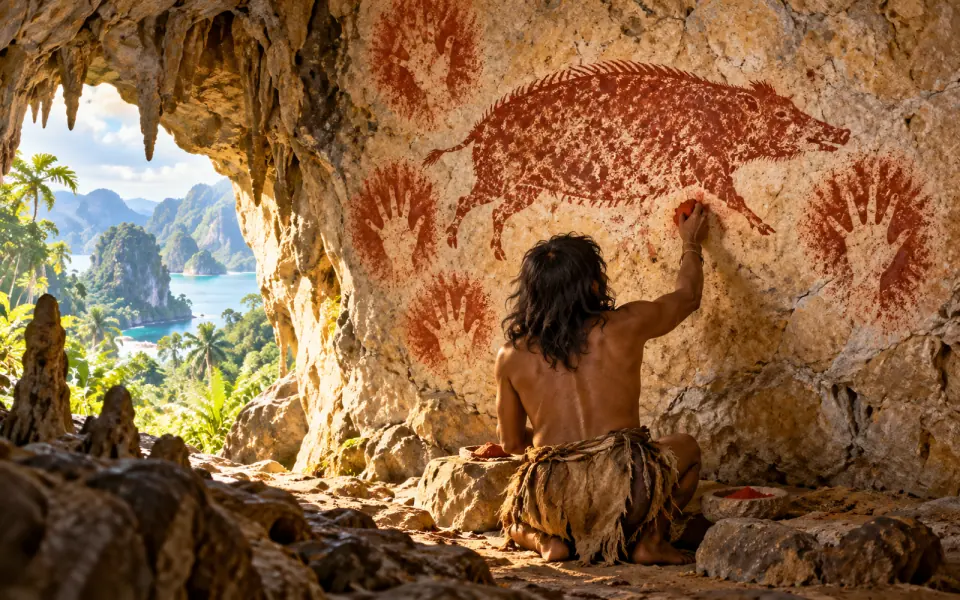
On the island of Sulawesi, in Indonesia, there is one of the oldest paintings in the world: a wild pig painted in a cave at least 45,500 years ago. The artists used a dark red pigment, and next to the pig are the outlines of two hands. Discoveries like this show that art was born in different places, not just in Europe.
Why it matters It tells us that the need to draw and tell stories is extremely old and belongs to everyone.
Source: Science Advances, 2021, “Oldest cave art found in Sulawesi”
Study card about 5 minutes of reading
The story
A red pig on a rock wall
The island of Sulawesi, in Indonesia, is shaped like a crooked K. In its southern part, near the city of Makassar, there is a region of limestone hills full of caves, called Maros-Pangkep. For decades archaeologists have known that its walls are covered with images of hands and animals. In December 2017, during an exploration, an Indonesian archaeologist, Basran Burhan, entered a cave called Leang Tedongnge, at the end of a valley enclosed between very steep walls, and saw on one wall a red figure, almost completely hidden by time: a pig. It was over a metre and thirty centimetres long and more than fifty centimetres high.
The pig shown is a Sulawesi warty pig, an animal that still lives on the island today, recognisable by the warty lumps on its muzzle. The drawing is made with a dark red pigment, a colour obtained from ochre. Behind the body there are the outlines of two hands, made by placing the hand on the rock and blowing the colour around it. They are the “stamp” of whoever painted, or of someone who wanted to leave a mark.
How to measure the age of a painting
A drawing on rock cannot be dated with radiocarbon, because the red of ochre contains no carbon of organic origin. The researchers used another method, based on uranium. In caves, water dripping down the walls slowly deposits a crust of calcite, which sometimes also covers paintings. Calcite contains traces of uranium, which over time turns into another element, thorium, at a known rate. By measuring the amount of uranium and thorium, you can tell how long ago the crust formed. If the crust lies on top of the drawing, the drawing is older than the crust.
So in 2021 the team led by the Australian archaeologist Adam Brumm, of Griffith University, with his colleague Maxime Aubert and the Indonesian Adhi Agus Oktaviana, established that the pig of Leang Tedongnge is at least 45,500 years old. “At least” because the crust is younger than the drawing: the pig may be much older, and nobody knows by how much. The result was published in the journal Science Advances.
A story told
In 2024 the same team dated another scene, in a cave called Leang Karampuang. It shows three figures with a somewhat human look standing near a pig. The calcite crust that covers it indicates an age of at least 51,200 years. For scholars it is the oldest known narrative scene: not a single figure, but a group of characters who seem to be doing something together. It is hard to say what story it was, because the painting is in bad condition and can be interpreted in different ways. But it seems to want to tell of an event.
Other images in the region are more recent, but still very ancient: a painted hand in Leang Timpuseng cave is about 40,000 years old; on the walls there are also many figures of small wild cattle, the anoa. These places are still little explored and could hold more surprises.
Art was not born in Europe
For more than a century it was thought that art had begun in Europe. The reason is simple: the first painted cave discovered, Altamira in Spain, in 1879, and French caves such as Lascaux and Chauvet attracted scholars, and digging in Europe has gone on for longer. But the oldest datings come more and more often from other parts of the world. In Spain, some red discs and hands have been dated with the same method to more than 40,000 years, while in South Africa, in Blombos Cave, a piece of ochre with crossed lines engraved on it is about 73,000 years old. On a wall in Borneo, in Lubang Jeriji Saléh cave, there is a figure of a bovine about 40,000 years old.
The picture that emerges is of an ability that belongs to our species and that appeared in several places, perhaps very early, perhaps already in Africa before the great migration. We know that the first paintings are not necessarily the simplest: the pig of Sulawesi is realistic and detailed.
Why paint a pig? We do not know. It may have been a sign of belonging, hunting magic, a story for children, a tribute to an important animal. The silence of the paintings reminds us that not everything ancient can be explained.
Why it happened
There is no certain cause for the birth of art, but scholars put forward some ideas. The most widespread is that the sapiens brain had developed the ability to think with symbols, that is, to make one thing stand for another: an image in place of an animal.
Social life probably played a part too. Shared images help to create a common identity, to hand down stories, to mark important places. A painted wall may have been a meeting place or a place for ceremonies.
Finally there were practical conditions: pigments such as ochre were widespread and already used to colour the body and objects, and caves offered walls protected from the weather.
What changed
The paintings of Sulawesi tell us that the need to represent the world is very ancient and universal. It was not born in one place, but in many, and perhaps it is part of the very nature of our species.
Today many of these paintings are in danger. Damp, salts and changes in climate flake off the rock and erase the colour: in Sulawesi some images are disappearing faster than they can be studied. For this reason archaeologists work with local communities to protect them.
From the point of view of science, uranium dating has opened a new chapter: in a few years it has changed the dates of rock art in Europe, Asia and Africa, and it will go on doing so.
Key people and places
People
- Adam Brumm
- Australian archaeologist at Griffith University. He leads research on the rock art of Sulawesi with Indonesian colleagues.
- Maxime Aubert
- Archaeologist and geochemist at Griffith University, an expert in uranium dating of calcite crusts on paintings.
- Basran Burhan
- Indonesian archaeologist who in 2017 discovered the pig of Leang Tedongnge.
- Adhi Agus Oktaviana
- Indonesian archaeologist at the national research agency (BRIN), one of the authors of the studies on the paintings of Sulawesi.
Places
- Leang Tedongnge, Sulawesi (Indonesia)
- A cave in a valley enclosed by limestone walls, in the Maros-Pangkep region. The pig at least 45,500 years old is here.
- Leang Karampuang, Sulawesi (Indonesia)
- A cave with the scene of three figures and a pig, at least 51,200 years old.
- Altamira (Spain)
- A cave in Cantabria, discovered in 1879, with the famous painted bison. It was the first decorated prehistoric cave to be recognised.
- Blombos (South Africa)
- A cave on the coast of the Indian Ocean where engraved ochre and perforated shells about 75,000 years old were found.
Good to know
- The hills of Maros-Pangkep form steep limestone towers that stick up among the rice fields like huge teeth: it is one of the most spectacular rock landscapes in the world.
- The pig of Leang Tedongnge lost its record for age when the scene at Leang Karampuang was dated: the race for records changes quickly and must always be read with caution. In 2026 a hand stencil in Liang Metanduno cave, on the island of Muna, south-east of Sulawesi, was dated to at least 67,800 years: it is now the oldest securely dated rock art, while the Karampuang scene remains the oldest known narrative one.
- The red ochre used for painting is obtained from the iron in the soil and has been used by human beings for tens of thousands of years, also to colour the skin.
- “Negative” hands, made by blowing colour around a hand placed on the rock, are found in caves in Europe, Asia, Africa and the Americas.
- In Sulawesi there still lives a small wild bovine, the anoa, which is one of the very animals painted in the caves and is in danger of extinction today.
Find out more
- Wikipedia, “Sulawesi warty pig” en.wikipedia.org
- Wikipedia, “Sulawesi” en.wikipedia.org
- Wikipedia, “Prehistoric art” en.wikipedia.org
- Wikipedia, “Lascaux” en.wikipedia.org
Related events
- The Lascaux caveabout 19,000 years ago · PrehistoryThe caves of Lascaux, in France, are much more recent and much more famous.
- The Venus of Willendorfabout 28,000 years ago · PrehistoryThe Venus of Willendorf is another work of art from the Palaeolithic.
- The first people in Australiaabout 48,000 years ago · PrehistoryThe people of Sulawesi were close to the first sailors heading for Australia.
- The first deliberate burialsabout 100,000 years ago · PrehistoryBurials are another proof of symbolic thought.
- Cuneiform writingabout 3200 BC · River civilisationsWriting is the latest heir of this need to leave marks.
Before and after, in the era “Prehistory”
Event 14 of 25
 BeforeThe first homininsabout 7 million years ago
 BeforeLucy the australopithecineabout 3.2 million years ago
 BeforeThe first stone toolsabout 2.6 million years ago
 BeforeHomo habilisabout 2.4 million years ago
 BeforeHomo erectusabout 1.9 million years ago
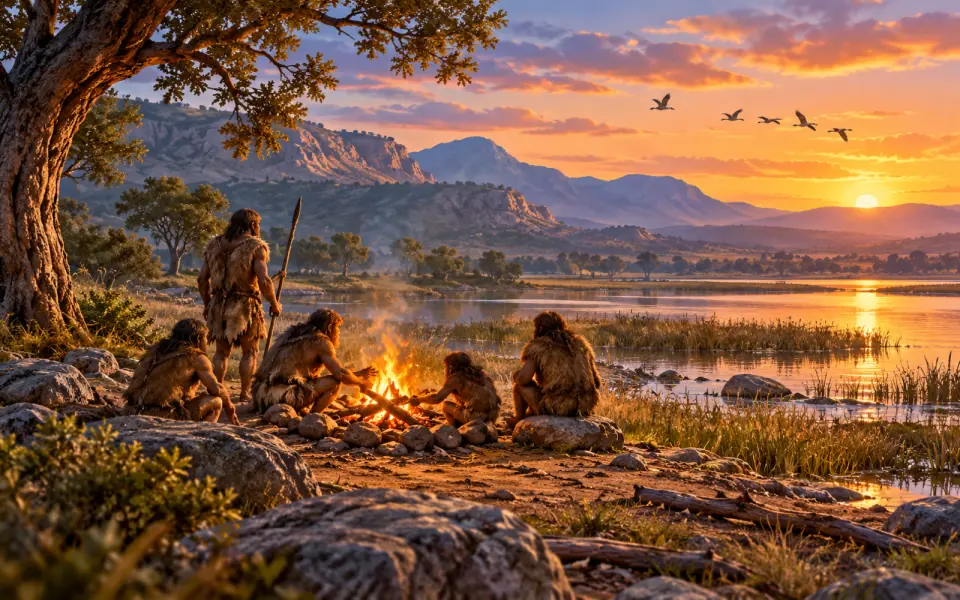 BeforeTaming fireabout 790,000 years ago
 BeforeHomo heidelbergensisabout 600,000 years ago
 BeforeNeanderthalsabout 400,000 years ago
 BeforeThe arrival of Homo sapiensabout 300,000 years ago
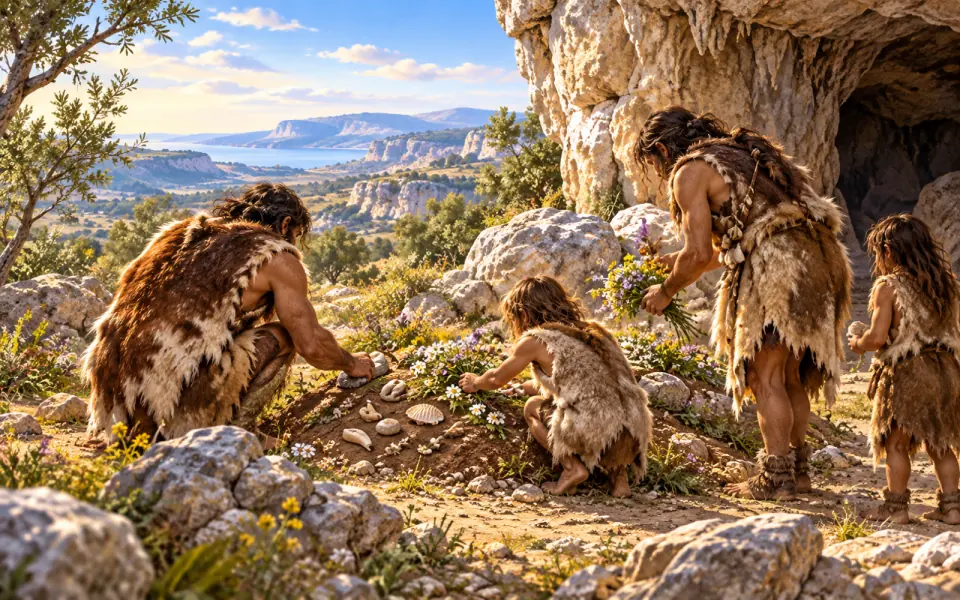 BeforeThe first deliberate burialsabout 100,000 years ago
 BeforeHomo sapiens leaves Africaabout 60,000 years ago
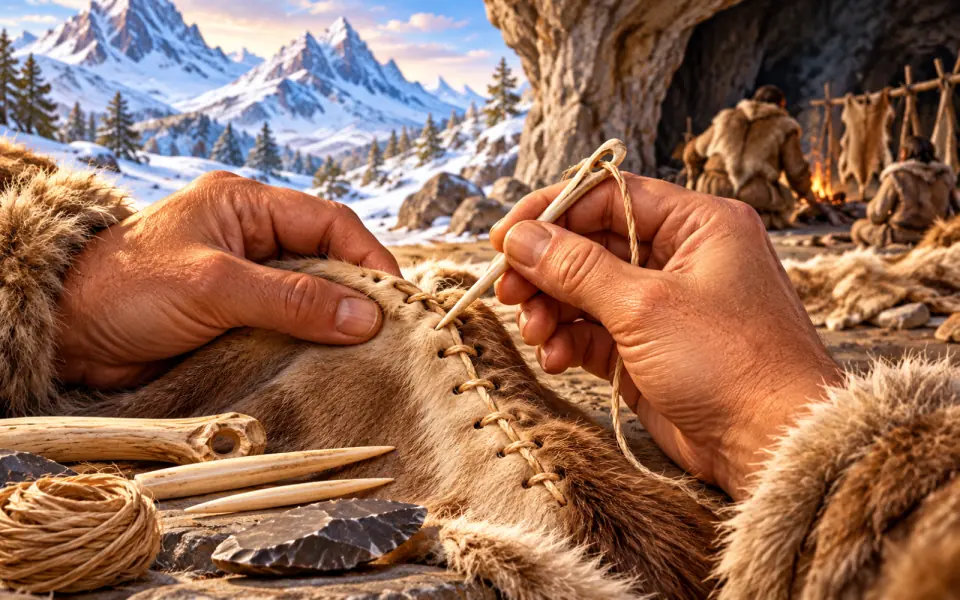 BeforeThe needle with an eyeabout 48,000 years ago
 BeforeThe first people in Australiaabout 48,000 years ago
- You are hereThe cave art of Sulawesiabout 44,000 years ago
 AfterThe Venus of Willendorfabout 28,000 years ago
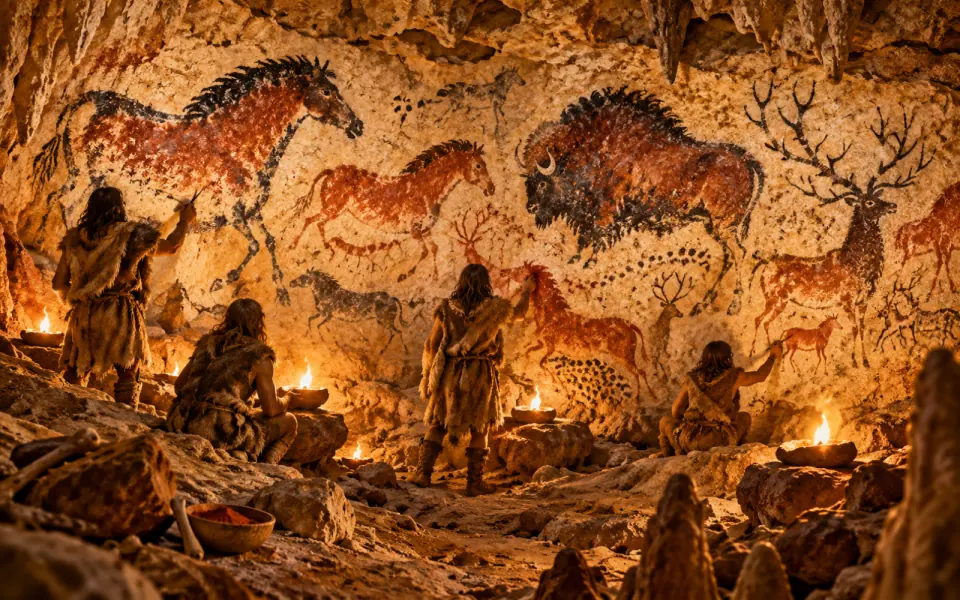 AfterThe Lascaux caveabout 19,000 years ago
 AfterThe first permanent villagesabout 14,000 years ago
 AfterThe Neolithic Revolutionabout 12,000 years ago
 AfterTaming the sheepabout 11,000 years ago
 AfterThe walls of Jerichoabout 10,300 years ago
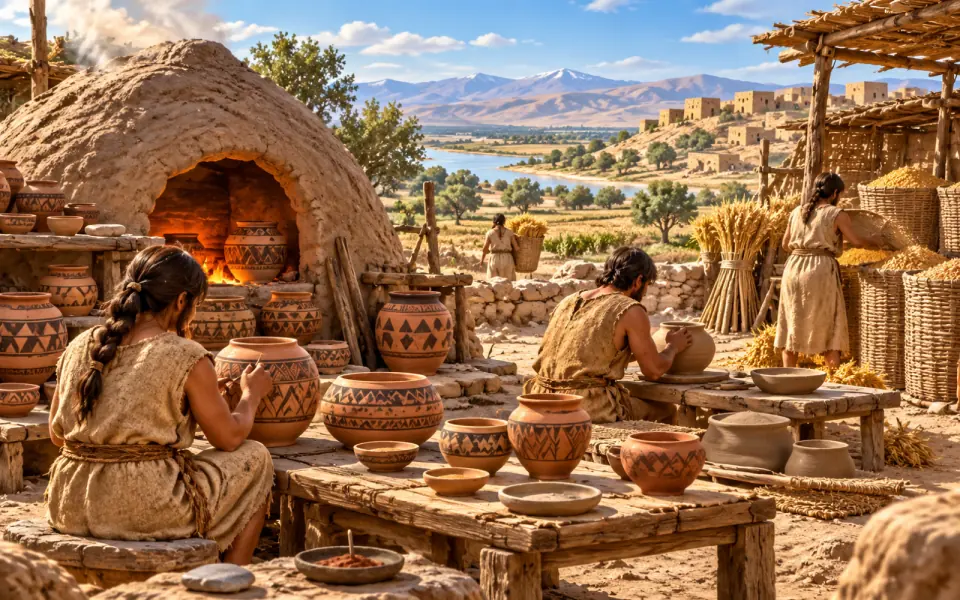 AfterPottery spreadsabout 9,000 years ago
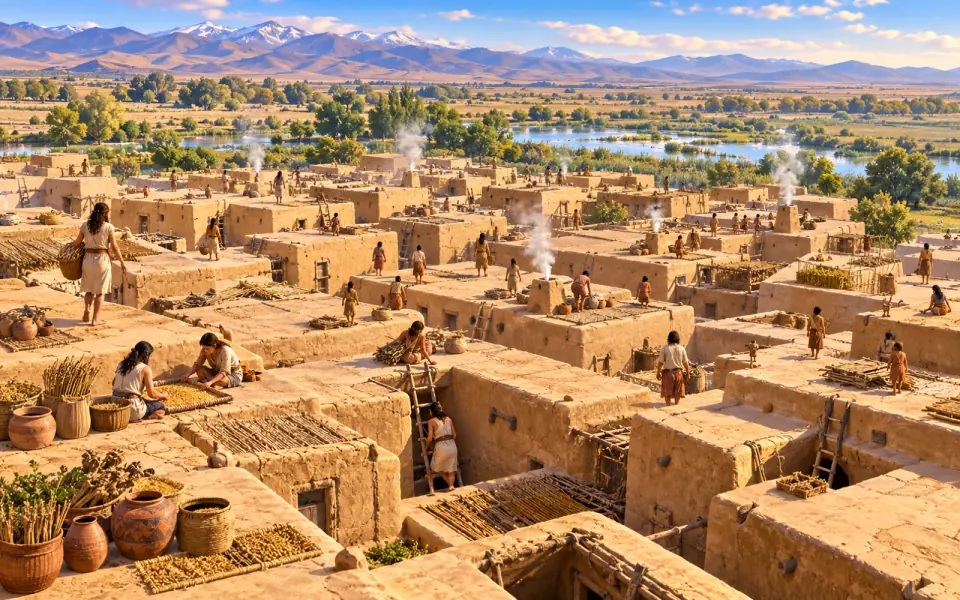 AfterÇatalhöyükabout 9,000 years ago
 AfterWorking with copperabout 7,000 years ago
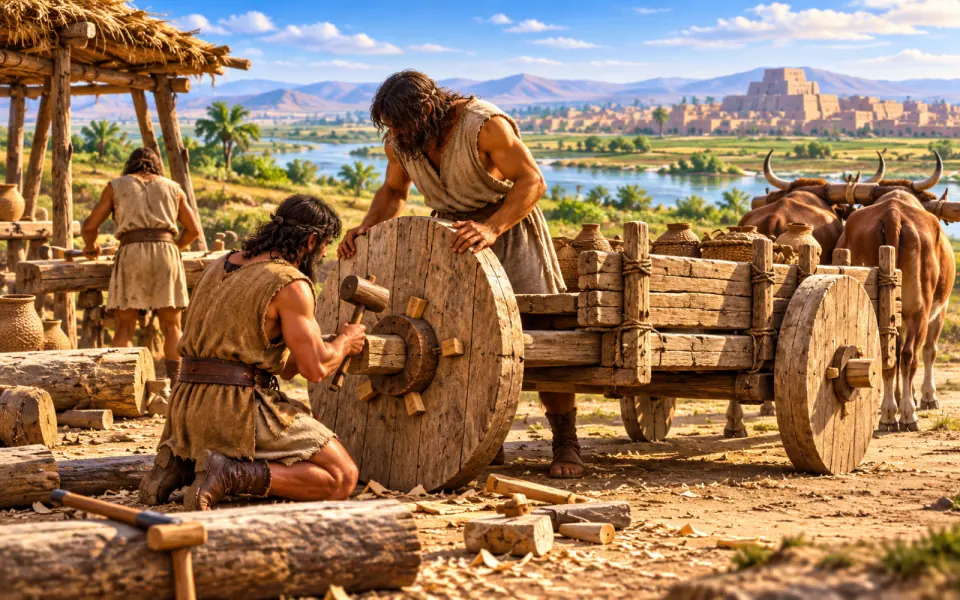 AfterThe invention of the wheelabout 5,500 years ago
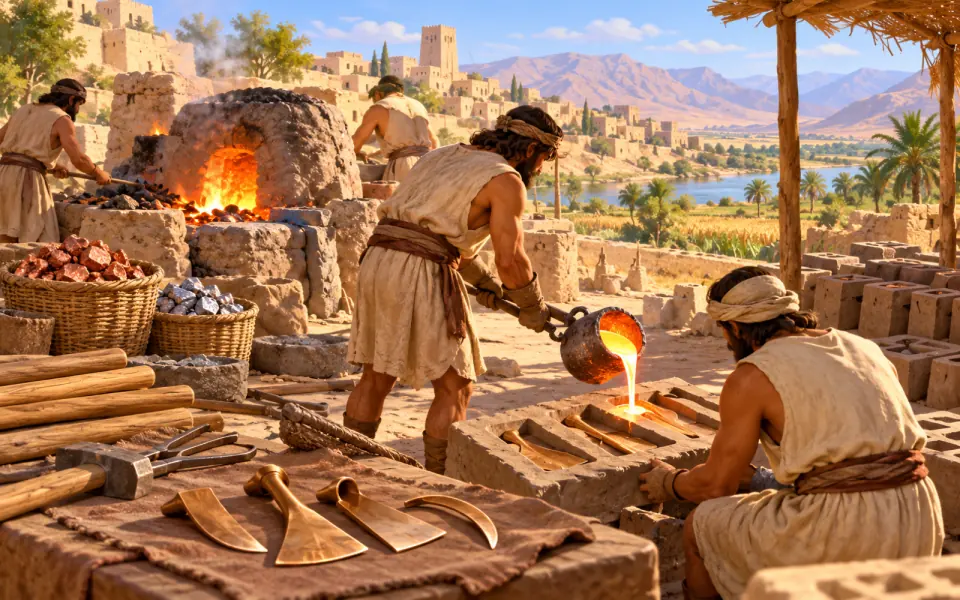 AfterThe Bronze Ageabout 5,300 years ago
Listen / Read next
- Music to read by: Cinematic JourneyEpic film-style music, no lyrics, by Ciro Simone IrmiciSpotifyYouTube Music
Meanwhile, elsewhere in the world
Other events of the era “Prehistory”
- The first hominins
- Lucy the australopithecine
- The first stone tools
- Homo habilis
- Homo erectus
- Taming fire
- Homo heidelbergensis
- Neanderthals
- The arrival of Homo sapiens
- The first deliberate burials
- Homo sapiens leaves Africa
- The needle with an eye
- The first people in Australia
- The Venus of Willendorf
- The Lascaux cave
- The first permanent villages
- The Neolithic Revolution
- Taming the sheep
- The walls of Jericho
- Pottery spreads
- Çatalhöyük
- Working with copper
- The invention of the wheel
- The Bronze Age
