The Antikythera mechanism
about 100 BC Island of Antikythera (Greece)
In short
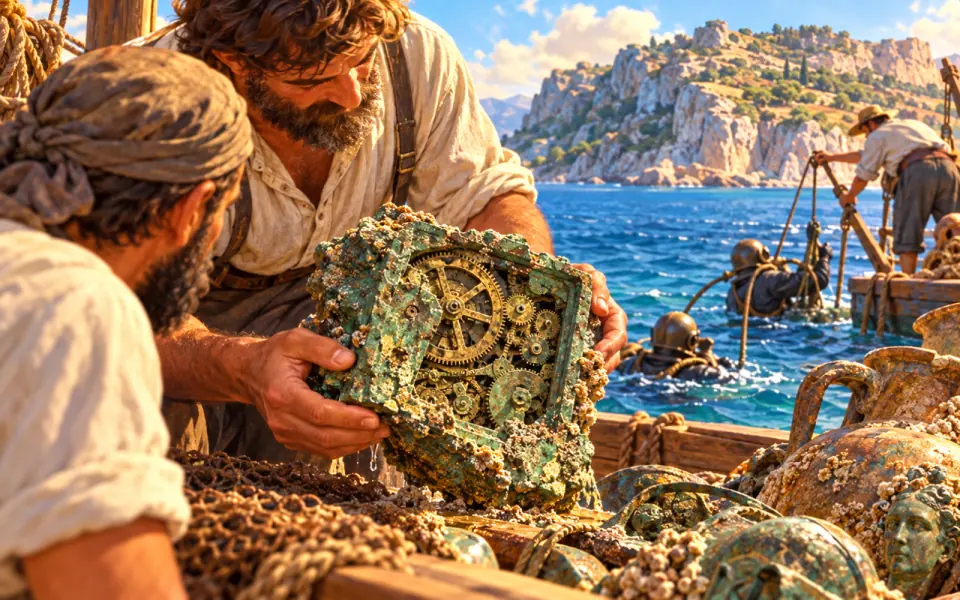
In the early 1900s some sponge divers found the wreck of a ship that had sunk near the Greek island of Antikythera, and among the objects brought up was a lump of corroded bronze. Inside were dozens of gearwheels, as fine as those in a clock. It was a kind of calculator: when a handle was turned, it showed the positions of the Sun and Moon, the phases of the Moon and coming eclipses. No mechanism this complex is known for more than a thousand years afterwards.
Why it matters It shows that Greek scientists could build precision machines that no one would have imagined.
Study card about 5 minutes of reading
The story
A storm and a wreck
In 1900 a group of sponge divers was caught by a storm and took shelter on the island of Antikythera, a small rock between Crete and the Peloponnese. When the sea calmed, the divers went down and at a depth of about 43 metres found something unexpected: the wreck of a large Roman merchant ship, loaded with treasures. There were bronze and marble statues, vases, jewels, luxury objects. The ship, according to archaeologists, had sunk in the second quarter of the 1st century BC.
The recovery took a long time. Among the objects brought to the surface were also corroded pieces of bronze, which seemed less interesting than the statues. They were set aside in the museum in Athens, among many other finds. On 17 May 1902 an archaeologist, Spyridon Stais, noticed that a gear seemed to be stuck in a block of material. It was the first proof that the object was a mechanism.
What was it?
For more than half a century nobody managed to understand it. Then, in 1951, an English scholar, Derek de Solla Price, began to study it and, after about twenty years of research, discovered its basic workings. Over time, new techniques have made it possible to look inside the fragments without damaging them: X-rays, tomography and digital images, used by the international research group that has been working on the mechanism for more than twenty years. In 2016 high-resolution X-ray scans made it possible to read new parts of the inner inscriptions.
The result is surprising. The machine was about 30 by 15 centimetres, as thick as a book, originally mounted inside a wooden frame. It was made of bronze, with more than thirty gear wheels, and covered with inscriptions: thousands of characters, largely legible thanks to the scans. They are like the instructions for use.
What it was for
By turning a crank, the mechanism made the gear wheels move and showed on dials the movement of the Sun and the Moon, the phases of the Moon, the equinoxes, the months and the days of the week. According to reconstructions, it also showed the positions of the five planets visible to the naked eye (none of the planet wheels survives) and predicted eclipses. One dial showed, according to one study, the dates of the Olympic Games and other great festivals. It also described the relation between the motions of the Moon and the Sun: 254 revolutions of the Moon relative to the stars every 19 solar years. It is like an astronomical calendar made of gears: it gives the results of complex calculations without the need to do them in your head.
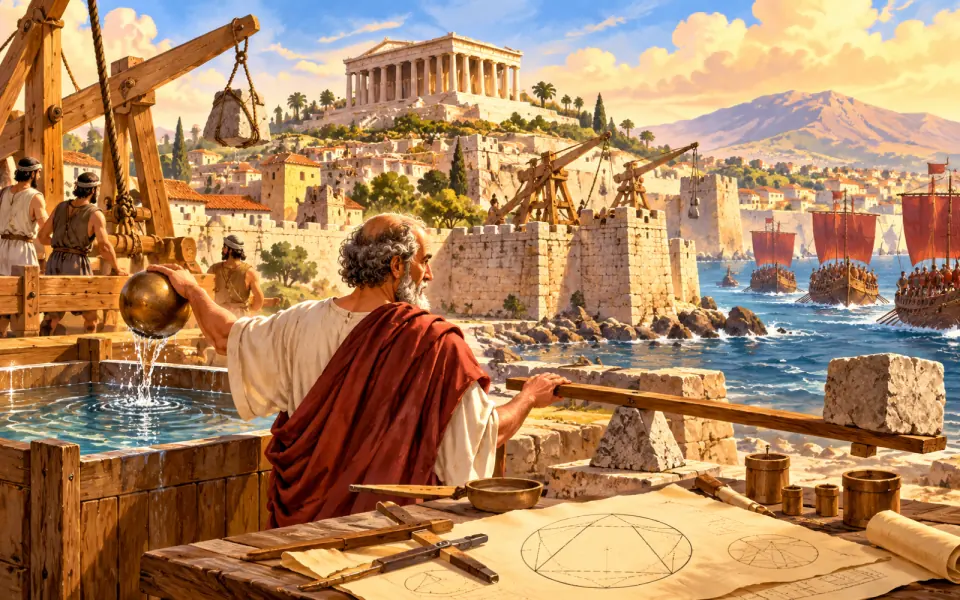
No Greek source clearly describes a similar machine. The Roman philosopher Cicero, however, recalls that at Syracuse Archimedes had built a circular machine to show the motions of the heavenly bodies, and that another philosopher, Posidonius of Rhodes, had made a similar one. This has led people to think that this type of instrument existed, even though we do not know who built the one from Antikythera.
When and by whom?
The date is debated. Our site gives “about 100 BC”, but some research suggests the mechanism may be older. According to scholars' reconstructions, it was built between 150 and 100 BC. A 2022 study identifies 23 December 178 BC as the starting calibration date, while others proposed 28 April 205 BC. The shipwreck, on the other hand, dates from the second quarter of the 1st century BC, so the mechanism was already old when the ship sank.
About the builder there are only hypotheses. The astronomer Tony Freeth, one of the scholars of the project, has thought that it could have been assembled at Syracuse, in a school linked to the memory of Archimedes. It remains a contested hypothesis (a 2017 study weakens it).
Where it is
Today the mechanism is kept in the National Archaeological Museum in Athens, together with a modern reconstruction. The research group calls it the most sophisticated scientific instrument known from the ancient world.
Why it happened
The Antikythera mechanism was born from centuries of studying the sky. The Babylonians had recorded the movements of the heavenly bodies for generations, and the Greeks had linked those data to geometry. The idea that the cycles of the Sun, Moon and planets followed mathematical rules was widespread by the 2nd century BC, and as a result it was possible to turn it into a mechanical object.
A very high technical skill was also needed. Making thin, precise gear wheels with well-cut teeth required expert craftsmen and accurate tools. In cities such as Rhodes, Syracuse or Alexandria mathematicians and craftsmen worked in close contact, and the Hellenistic world produced many ingenious devices.
What changed
The discovery has changed the idea we had of ancient technology. Antikythera shows that the Greeks knew how to build precision machines, and that science and craftsmanship could work together.
Since then an international group of historians, archaeologists, astronomers, physicists and engineers has been studying every detail, and has made digital reconstructions. Every new discovery, such as the identification of new parts of the inscription or of new gears, changes a little our idea of what the Greeks knew.
For the public, the Antikythera mechanism has become a symbol of how much history still lies hidden under the sea. It reminds us that many centuries after it was built nobody knew any more how it worked, and that knowledge, if it is not passed on, can be lost even when it is highly refined.
Key people and places
People
- Derek de Solla Price
- English historian of science who from 1951 studied the mechanism and discovered how it worked.
- Spyridon Stais
- The archaeologist who on 17 May 1902 noticed a gear in the block of bronze.
- Tony Freeth
- Scholar who has taken part in the modern research and put forward the Syracuse hypothesis.
- Archimedes and Posidonius
- The scientists whom Cicero recalls as builders of machines imitating the motion of the heavenly bodies.
Places
- Antikythera
- Small Greek island between Crete and the Peloponnese, near which the wreck was found.
- National Archaeological Museum, Athens
- The museum where the mechanism is kept.
- Syracuse
- City of Sicily where, according to one hypothesis, it may have been built.
Good to know
- The mechanism was found in 1900 by sponge divers sheltering from a storm and was recognised as a machine only in 1902.
- On the machine there are thousands of characters of inscriptions, largely read thanks to scans.
- Among the things it showed were the dates of the Olympic Games.
- The ratio between Moon and Sun that it calculated is 254 lunar revolutions (relative to the stars) in 19 years.
- The date of construction is debated: between 150 and 100 BC, but a recent study proposes an earlier starting date, 178 BC.
Find out more
- Wikipedia, “Antikythera mechanism” en.wikipedia.org
- Antikythera Mechanism Research Project antikythera-mechanism.gr
- National Archaeological Museum, Athens (in English) namuseum.gr
Related events
- Archimedes of Syracuseabout 250 BC · Ancient GreeceArchimedes is linked by tradition to devices that imitate the sky.
- Euclid writes the Elementsabout 300 BC · Ancient GreeceEuclid and Greek mathematics lie at the base of these calculations.
- The Egyptian calendarabout 2800 BC · River civilisationsThe Egyptian calendar, too, was born from observing the sky.
- Public mechanical clocksabout 1350 · Late Middle AgesMedieval mechanical clocks take up the idea of gears.
- Thales studies natureabout 585 BC · Ancient GreeceThales, about five centuries earlier, was already studying the sky looking for natural rules.
Before and after, in the era “Ancient Greece”
Event 25 of 25
 BeforeThe first Greek city-statesabout 800 BC
 BeforeThe ancient Olympic Gamesabout 776 BC
 BeforeThe Greek alphabetabout 750 BC
 BeforeLife in Spartaabout 700 BC
 BeforeSappho, the poet of Lesbosabout 600 BC
 BeforeThe reforms of Solonabout 594 BC
 BeforeThales studies natureabout 585 BC
 BeforePythagoras at Crotonabout 530 BC
 BeforeCleisthenes and democracyabout 508 BC
 BeforeThe Battle of Marathon490 BC
 BeforeThe Battle of Thermopylae480 BC
 BeforeThe theatre of Aeschylus472 BC
 BeforeThe Age of Pericles461–429 BC
 BeforeThe Parthenon447–432 BC
 BeforeThe Peloponnesian War431–404 BC
 BeforeHerodotus writes the Historiesabout 430 BC
 BeforeHippocrates and medicineabout 400 BC
 BeforeSocrates is condemned399 BC
 BeforePlato's Academyabout 387 BC
 BeforeAristotle founds the Lyceumabout 335 BC
 BeforeThe conquests of Alexander334–323 BC
 BeforeEuclid writes the Elementsabout 300 BC
 BeforeThe Library of Alexandriaabout 295 BC
 BeforeArchimedes of Syracuseabout 250 BC
- You are hereThe Antikythera mechanismabout 100 BC
Listen / Read next
- Music to read by: Cinematic JourneyEpic film-style music, no lyrics, by Ciro Simone IrmiciSpotifyYouTube Music
Meanwhile, elsewhere in the world
Other events of the era “Ancient Greece”
- The first Greek city-states
- The ancient Olympic Games
- The Greek alphabet
- Life in Sparta
- Sappho, the poet of Lesbos
- The reforms of Solon
- Thales studies nature
- Pythagoras at Croton
- Cleisthenes and democracy
- The Battle of Marathon
- The Battle of Thermopylae
- The theatre of Aeschylus
- The Age of Pericles
- The Parthenon
- The Peloponnesian War
- Herodotus writes the Histories
- Hippocrates and medicine
- Socrates is condemned
- Plato's Academy
- Aristotle founds the Lyceum
- The conquests of Alexander
- Euclid writes the Elements
- The Library of Alexandria
- Archimedes of Syracuse
