The Venus of Willendorf
about 28,000 years ago Willendorf, Austria
In short
It is a limestone figurine about 11 centimetres tall, found in 1908 at Willendorf, in Austria. It shows a woman with a full, rounded figure and is about 29,500 years old. The stone probably comes from northern Italy, near Lake Garda, so it made a long journey across the Alps. We do not know what it was for: perhaps it was a good-luck charm, or a symbol of plenty.
Why it matters It is one of the most famous works of art of the Palaeolithic.

Study card about 5 minutes of reading
The story
A small woman made of stone
If you hold a hand clenched in a fist, you have in front of you roughly her size: eleven centimetres. The Venus of Willendorf is a statuette of pale limestone, with the round, full body of a woman. She has no face: where it should be, there is a tilted head covered with horizontal rows of small shapes, which may be plaits, curls or a kind of headdress. The thin arms rest on the chest; the legs end quickly, with almost invisible feet. Traces of red colour, ochre, remain on the surface, and it is thought that originally she was painted all over.
She was carved about 29,500 years ago, in a period that archaeologists call the Gravettian, when the climate in Europe was cold and hunters chased herds of mammoths, horses and reindeer. For a long time the last ice age was thought of as an age of hard living and few thoughts; the statuette tells us that the human beings of the time could think, create and give an object a meaning.
The discovery
In 1908 in the village of Willendorf in Austria, on the Danube, in the valley called the Wachau, work was in full swing on a new railway line. The workers, digging in the loess soil, a yellowish dust carried by the wind, found traces of ancient camps. Archaeologists from the Natural History Museum in Vienna, among them Josef Szombathy, Hugo Obermaier and Josef Bayer, dug on the spot. On 7 August 1908 a statuette came to light from a layer of the ground. Who found it first? According to accounts it was a worker; but the credit for understanding its value belongs to the archaeologists who directed the digging.
Scholars called her a “Venus”, after the Roman goddess of love and beauty. It was perhaps a bit of a joke: a figure so different from the classical ideal looked almost like a “Venus” in reverse. Today many people think the name is misleading, because we do not know whether the statuette represented a goddess, a real woman, a mother or a symbol, and some scholars prefer to call her simply the “Woman of Willendorf”.
A journey of hundreds of kilometres
The most recent surprise concerns the stone. It is an oolitic limestone, that is, made of countless tiny spheres, like fish eggs (hence the name, from the Greek òon, “egg”). In the Willendorf area this stone does not exist. A study published in 2022 by the University of Vienna and the Natural History Museum used tomography, a kind of X-ray scan, to see inside the statuette and compare the grains with rocks from many countries. The result is that the most similar oolite is found in northern Italy, in the area of the Lessini Mountains and north of Lake Garda.
This means that the stone, or the statuette already finished, travelled hundreds of kilometres, crossing the Alps or going round them, in an age with no roads or wheels. Perhaps hunters carried it during their seasonal movements, perhaps it was exchanged between groups. In any case, the statuette was so important to its owners that someone made it travel far from home.
What was it for?
Nobody knows. There are many ideas: a symbol of fertility, of abundance, a good-luck charm, an object to hold in the hand during a ritual, a model of beauty, a portrait, a toy, a self-portrait of the person who carved her. There are no texts or stories to explain. Even the idea that she was a “mother goddess” is a modern interpretation, not proof.
She is not alone. In Europe more than a hundred Palaeolithic statuettes called “Venuses” are known, found from France to Russia. One, found in 2008 at Hohle Fels in Germany, is made of mammoth ivory and is about 40,000 years old: it is considered the oldest known “Venus”. In Italy there are a few, such as the Venus of Savignano, in Emilia, and the statuettes of the Balzi Rossi, in Liguria. The Venus of Willendorf is kept today in the Natural History Museum in Vienna, where she draws a great many visitors every year.
Why it happened
In the Gravettian, human groups lived in a cold Europe, with large herds and long winters. They needed to cooperate and to keep up relations with other groups far away, to exchange food, good stones and, perhaps, wives and husbands. Symbolic objects helped to create bonds.
Carving took time, and time came from the food stored up during the summer: a society able to keep supplies had free days in winter to make things and think.
Besides, sapiens, for some tens of thousands of years, had developed a strong skill in the use of symbols. Carving a human body, even a stylised one, was a natural step for this ability.
What changed
The Venus of Willendorf has become one of the most famous images of prehistory. She appears in school books, in museums, in the works of modern artists. She is also an image that is debated: about the way the female body is represented, and about how we should not take for granted that we know what our ancestors thought.
The studies of the stone have opened up a new method. Analysing the composition of an object makes it possible to understand where the material comes from and to reconstruct the networks of exchange between prehistoric groups, information that cannot be read from the shape.
Finally the statuette reminds us of a simple thing: art is not a luxury that arose after civilisation. Groups of hunter-gatherers in an icy Europe found the time and the wish to create something beautiful.
Key people and places
People
- Josef Szombathy
- Austrian archaeologist (1853–1943) at the Natural History Museum in Vienna. He directed the Willendorf excavations in 1908.
- Hugo Obermaier
- German prehistorian (1877–1946). He took part in the Willendorf excavations in 1908 and was later a professor in Madrid.
- Gerhard Weber
- Anthropologist at the University of Vienna. He led the 2022 study that traced the stone of the Venus back to northern Italy.
Places
- Willendorf in der Wachau (Austria)
- A village on the Danube, about 80 kilometres west of Vienna, where the statuette was found in 1908.
- Lake Garda and the Lessini Mountains (Italy)
- An area of northern Italy from which, according to a 2022 study, the stone of the Venus comes.
- Hohle Fels (Germany)
- A cave in the Swabian Jura where in 2008 an ivory Venus about 40,000 years old was found.
- Balzi Rossi, Ventimiglia (Liguria)
- Caves by the sea, on the border with France, with prehistoric statuettes called Venuses.
Good to know
- The Venus of Willendorf is 11.1 centimetres tall: smaller than a mobile phone, she fits comfortably in the palm of a hand.
- On the head there are rows of small shapes, arranged around it like a hat: scholars are not sure whether they are hair, a plait or a headdress.
- The word “oolite” comes from the Greek òon, “egg”, because the stone looks as if it were made of petrified fish eggs.
- The Wachau valley, where the statuette was found, is today famous for its vineyards and its apricots.
- The Venus of Willendorf is kept in a special display case in the Natural History Museum in Vienna, with controlled light and temperature.
Find out more
- Wikipedia, “Venus of Willendorf” en.wikipedia.org
- Wikipedia, “Venus figurine” en.wikipedia.org
- Wikipedia, “Venus of Savignano” en.wikipedia.org
- Wikipedia, “Gravettian” en.wikipedia.org
- Natural History Museum Vienna, press release on the stone of the Venus (in English) idw-online.de
Related events
- The Lascaux caveabout 19,000 years ago · PrehistoryThe paintings of Lascaux are another masterpiece of European prehistoric art.
- The cave art of Sulawesiabout 44,000 years ago · PrehistoryThe pig of Sulawesi shows that art arose in many places, not only in Europe.
- The needle with an eyeabout 48,000 years ago · PrehistoryThe same Gravettian people sewed clothes rich in beads.
- Egyptian hieroglyphsabout 3200 BC · River civilisationsThousands of years later, the Egyptians carved and wrote their images.
- The first permanent villagesabout 14,000 years ago · PrehistoryTowards the end of the Palaeolithic hunters began to settle in villages.
Before and after, in the era “Prehistory”
Event 15 of 25
 BeforeThe first homininsabout 7 million years ago
 BeforeLucy the australopithecineabout 3.2 million years ago
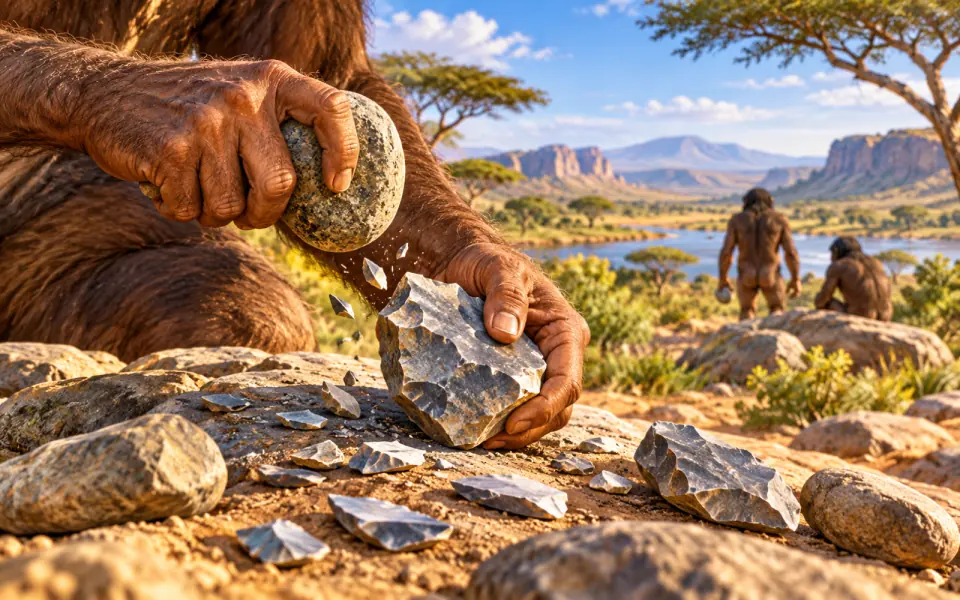 BeforeThe first stone toolsabout 2.6 million years ago
 BeforeHomo habilisabout 2.4 million years ago
 BeforeHomo erectusabout 1.9 million years ago
 BeforeTaming fireabout 790,000 years ago
 BeforeHomo heidelbergensisabout 600,000 years ago
 BeforeNeanderthalsabout 400,000 years ago
 BeforeThe arrival of Homo sapiensabout 300,000 years ago
 BeforeThe first deliberate burialsabout 100,000 years ago
 BeforeHomo sapiens leaves Africaabout 60,000 years ago
 BeforeThe needle with an eyeabout 48,000 years ago
 BeforeThe first people in Australiaabout 48,000 years ago
 BeforeThe cave art of Sulawesiabout 44,000 years ago
- You are hereThe Venus of Willendorfabout 28,000 years ago
 AfterThe Lascaux caveabout 19,000 years ago
 AfterThe first permanent villagesabout 14,000 years ago
 AfterThe Neolithic Revolutionabout 12,000 years ago
 AfterTaming the sheepabout 11,000 years ago
 AfterThe walls of Jerichoabout 10,300 years ago
 AfterPottery spreadsabout 9,000 years ago
 AfterÇatalhöyükabout 9,000 years ago
 AfterWorking with copperabout 7,000 years ago
 AfterThe invention of the wheelabout 5,500 years ago
 AfterThe Bronze Ageabout 5,300 years ago
Listen / Read next
- Music to read by: Cinematic JourneyEpic film-style music, no lyrics, by Ciro Simone IrmiciSpotifyYouTube Music
Meanwhile, elsewhere in the world
Other events of the era “Prehistory”
- The first hominins
- Lucy the australopithecine
- The first stone tools
- Homo habilis
- Homo erectus
- Taming fire
- Homo heidelbergensis
- Neanderthals
- The arrival of Homo sapiens
- The first deliberate burials
- Homo sapiens leaves Africa
- The needle with an eye
- The first people in Australia
- The cave art of Sulawesi
- The Lascaux cave
- The first permanent villages
- The Neolithic Revolution
- Taming the sheep
- The walls of Jericho
- Pottery spreads
- Çatalhöyük
- Working with copper
- The invention of the wheel
- The Bronze Age
