The first people in Australia
about 48,000 years ago Northern Australia
In short
Humans reached Australia about 50,000 years ago, perhaps even earlier, crossing stretches of sea in boats. They were the ancestors of the Aboriginal peoples, whose cultures are among the oldest still alive. Getting there took courage and seafaring skill.
Why it matters It is one of the first great sea voyages in human history.
Source: University of Western Australia, “People voyaged to Australia by boat more than 50,000 years ago”
Study card about 6 minutes of reading
The story
A continent cut off by the sea
Australia is, and always was, an enormous island. There has never been a land route to it from Asia. Even in the coldest periods of the last ice age, when so much water was locked up in the ice and the sea level fell by about a hundred metres, there was always sea between south-east Asia and Australia. At those times Australia, New Guinea and Tasmania were joined into a single big continent, which scientists call Sahul. On the Asian side there was another emerged continent, Sunda, which included Malaysia, Sumatra, Java and Borneo. Between the two there was a zone of islands, called Wallacea, with deep waters and strong currents.
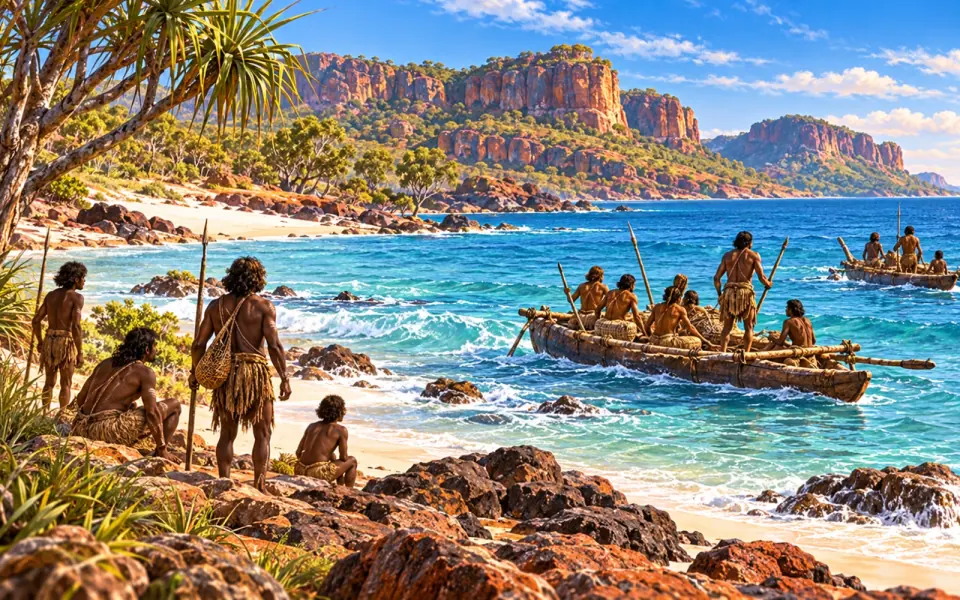
Anyone who wanted to reach Sahul therefore had to sail, in several stages. Some of the stretches to be crossed were tens of kilometres long, up to about a hundred, and the land they were heading for was often out of sight. An international group of researchers tried to simulate on a computer, in studies of 2018 and 2019, the possible routes, with the winds, currents and sea levels of that time. The conclusion: it is not plausible that these journeys were accidental, dragged along by the waves. They must have been planned, with craft able to stand up to the sea.
When they arrived
The date is disputed. A site in the north of the continent, called Madjedbebe, on Mirarr land, near Kakadu National Park, has yielded stone tools, ochre and fragments of ground-edge axes. In 2017 the archaeologists led by Chris Clarkson announced that the first signs of human presence there go back to about 65,000 years ago. Other scholars think that some of the tools moved downwards in the ground and that the safest date is about 50,000 years. The date of 50,000 years is today accepted by almost everyone.
Another piece of evidence comes from a very different region, Lake Mungo, in the south-east, where a series of lakes, dry today, are surrounded by dunes. In the late 1960s the scientist Jim Bowler found there the remains of a woman, the so-called “Mungo Lady”, who had been cremated: it is among the oldest known cremations. In 1974 he also found the skeleton of a man, “Mungo Man”, laid carefully to rest and sprinkled with ochre. The two people were about 40,000 years old. In 2017 the remains were returned to the local Aboriginal communities.
If in 10,000 years people went from Africa to Australia, the pace is impressive. But remember that they were small groups, moving little by little along the coasts, where they found shellfish, fish and fruit.
A land of giant animals
The Australia they met was different from today's. There lived Diprotodon, a marsupial as big as a rhinoceros, Genyornis, a big flightless bird about two metres tall, and Thylacoleo, the “marsupial lion”. Almost all the big animals disappeared in a period that scholars place between 45,000 and 40,000 years ago. People have argued for decades about why: the climate, hunting, fires lit by humans, or a combination of causes. There is no single answer accepted by everyone.
Cultures that continue
Aboriginal peoples and Torres Strait Islanders descend from these first inhabitants. DNA studies show that Aboriginal populations are among the oldest in the world outside Africa, separated from those of Eurasia for a very long time. When the Europeans arrived, in the eighteenth century, about 250 different languages were spoken, on a continent as big as Europe, with ways of life suited to deserts, forests, coasts and mountains. Many languages disappeared after colonisation, but others are still alive, and studying and defending them is very important today.
Aboriginal communities keep stories that tell of places and events from the most distant past. Some speak of territories drowned by the sea at the end of the last ice age, about 10,000 years ago, an event that scientists have reconstructed from geological data. They are stories passed on by word of mouth for generations. Other stories linked to the “Dreaming” explain how the mountains, rivers and animals were created, and connect people to the place where they live in a very deep way.
At a site called Budj Bim, in the south-east, the Gunditjmara community built, at least 6,600 years ago, stone channels and ponds to farm eels: one of the oldest aquaculture systems in the world. It shows that Australian hunter-gatherers were not “simple” at all: they knew how to manage the land with refined engineering.
Why it happened
The causes of the great crossing were probably various. The low sea level made south-east Asia a vast plain with coasts rich in food. As populations grew, groups moved in search of new territories.
From the easternmost coasts of Sunda, perhaps, on clear days the nearby islands could be seen, and a good observer could notice other signs: smoke from distant fires, flocks of birds flying in one direction. Curiosity and the wish to discover may have done the rest.
We do not know the type of boat. Perhaps bamboo rafts, the plant that grows abundantly in those regions, or canoes hollowed out of tree trunks. The material rots away and nothing is left: it is evidence that we can only imagine.
What changed
The settling of Australia was the first great sea voyage in human history and the first arrival of humans on a continent where no other primates lived and almost no large placental mammals. It changed the landscape: Aboriginal people used fire to manage vegetation and favour the animals they fed on, and this has shaped Australian nature for thousands of years.
For tens of thousands of years Australian societies developed independently, with no contact with the rest of the world except with the nearest islands. This is one of the reasons why their languages, arts and knowledge are so unique and precious.
Today Australia increasingly recognises the value of these cultures. Sites such as Madjedbebe, Mungo and Budj Bim are protected, communities take part in the excavations and decide how to treat the remains of their ancestors, and many universities work with Aboriginal elders.
Key people and places
People
- Chris Clarkson
- Australian archaeologist at the University of Queensland. In 2017 he led the Madjedbebe excavations that suggested a human presence of 65,000 years.
- Jim Bowler
- Australian geologist (born 1930). In the late 1960s he discovered the Mungo Lady and in 1974 Mungo Man, at Lake Mungo.
- Michael Bird
- Scientist at James Cook University in Australia, lead author of the 2018 study on sea voyages to Australia.
Places
- Madjedbebe (Northern Territory, Australia)
- A rock shelter on Mirarr land, near Kakadu National Park, with traces of human presence 50,000 years old or more.
- Lake Mungo (New South Wales, Australia)
- An ancient dry lake with sand dunes, where burials about 40,000 years old were found.
- Wallacea (Indonesia)
- A zone of deep-water islands separated by sea between Asia and Australia, which the first sailors had to cross.
- Budj Bim (Victoria, Australia)
- A volcanic landscape where the Gunditjmara built ponds for eels more than 6,600 years ago.
Good to know
- During the last ice age New Guinea and Australia were joined by a land bridge, which was flooded about 8,000 years ago, forming the Torres Strait.
- Diprotodon weighed about three tonnes and was the largest marsupial that ever lived.
- The ochre found at Madjedbebe, together with grindstones to reduce it to powder, shows that those first Australians used colours very early.
- The Mungo Lady is among the oldest known cremations: her bones had been burnt and then crushed and laid in a small pit.
- Australia's wild dogs, the dingoes, arrived much later, about 4,000 years ago, probably brought by Asian sailors.
Find out more
- University of Western Australia, “People voyaged to Australia by boat more than 50,000 years ago” (in English) news.uwa.edu.au
- Wikipedia, “Aboriginal Australians” en.wikipedia.org
- Wikipedia, “Lake Mungo” en.wikipedia.org
- Wikipedia, “History of Australia” en.wikipedia.org
Related events
- Homo sapiens leaves Africaabout 60,000 years ago · PrehistoryThe journey to Australia is part of the great migration of sapiens out of Africa.
- The cave art of Sulawesiabout 44,000 years ago · PrehistoryThe paintings of Sulawesi, in eastern Indonesia, are from the same period.
- The first deliberate burialsabout 100,000 years ago · PrehistoryThe burials at Mungo show rituals for the dead in Australia.
- Sailing beyond Gibraltarabout 500 BC · Sea civilisationsThousands of years later, Phoenician sailors were venturing beyond Gibraltar: the story of sea voyages goes on.
- The first voyage round the world1522 · Early modern ageThe first voyage around the world by sea came much later than the arrival of the first sailors in Australia.
Before and after, in the era “Prehistory”
Event 13 of 25
 BeforeThe first homininsabout 7 million years ago
 BeforeLucy the australopithecineabout 3.2 million years ago
 BeforeThe first stone toolsabout 2.6 million years ago
 BeforeHomo habilisabout 2.4 million years ago
 BeforeHomo erectusabout 1.9 million years ago
 BeforeTaming fireabout 790,000 years ago
 BeforeHomo heidelbergensisabout 600,000 years ago
 BeforeNeanderthalsabout 400,000 years ago
 BeforeThe arrival of Homo sapiensabout 300,000 years ago
 BeforeThe first deliberate burialsabout 100,000 years ago
 BeforeHomo sapiens leaves Africaabout 60,000 years ago
 BeforeThe needle with an eyeabout 48,000 years ago
- You are hereThe first people in Australiaabout 48,000 years ago
 AfterThe cave art of Sulawesiabout 44,000 years ago
 AfterThe Venus of Willendorfabout 28,000 years ago
 AfterThe Lascaux caveabout 19,000 years ago
 AfterThe first permanent villagesabout 14,000 years ago
 AfterThe Neolithic Revolutionabout 12,000 years ago
 AfterTaming the sheepabout 11,000 years ago
 AfterThe walls of Jerichoabout 10,300 years ago
 AfterPottery spreadsabout 9,000 years ago
 AfterÇatalhöyükabout 9,000 years ago
 AfterWorking with copperabout 7,000 years ago
 AfterThe invention of the wheelabout 5,500 years ago
 AfterThe Bronze Ageabout 5,300 years ago
Listen / Read next
- Music to read by: Cinematic JourneyEpic film-style music, no lyrics, by Ciro Simone IrmiciSpotifyYouTube Music
Meanwhile, elsewhere in the world
Other events of the era “Prehistory”
- The first hominins
- Lucy the australopithecine
- The first stone tools
- Homo habilis
- Homo erectus
- Taming fire
- Homo heidelbergensis
- Neanderthals
- The arrival of Homo sapiens
- The first deliberate burials
- Homo sapiens leaves Africa
- The needle with an eye
- The cave art of Sulawesi
- The Venus of Willendorf
- The Lascaux cave
- The first permanent villages
- The Neolithic Revolution
- Taming the sheep
- The walls of Jericho
- Pottery spreads
- Çatalhöyük
- Working with copper
- The invention of the wheel
- The Bronze Age
