Pottery spreads
about 9,000 years ago Near East, China and Japan
In short
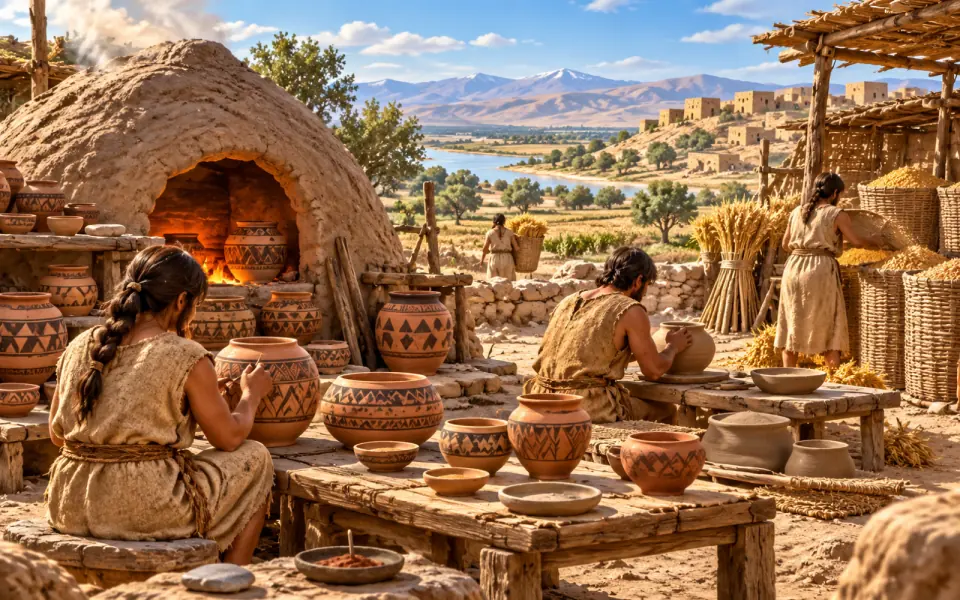
Clay pots were used to store food and to cook it over the fire. In China, in Xianrendong Cave, fragments about 20,000 years old have been found, made by hunter-gatherers. In the Near East pots became common much later, in farming villages, about 9000 years ago. The decorations on pots help archaeologists to tell different peoples apart.
Why it matters For archaeologists, broken bits of pottery are like an identity card of the people who made them.
Study card about 6 minutes of reading
The story
Clay, water and fire
Clay is a very fine earth that, when wet, becomes soft and can be modelled like play dough. Just leave it to dry in the sun and it hardens, but at the first storm it turns back into mud. One day someone discovered that if you put it in the fire and heat it for a long time at high temperatures, something changes for ever: the clay becomes hard as stone and no longer dissolves in water. Pottery had been invented, that is, terracotta. It was an irreversible chemical change, one of the first that humanity learned to bring about.
When you think about it, it is a surprising discovery. Human beings worked stone, bone and wood by changing only the shape. Pottery transformed the matter itself. And it is an almost indestructible material: a pot breaks, but the sherds remain for thousands of years, even in soils where everything else rots.
The oldest sherds in the world
For a long time it was thought that pottery had arisen with farmers, after the invention of villages. Then came surprises. In Xianrendong Cave, in the Chinese province of Jiangxi, a team of archaeologists from Peking University and Harvard found fragments of pots that, according to radiocarbon dating, are about 20,000 years old, that is, from the last ice age. The study, published in 2012 in the journal Science and led by Xiaohong Wu, showed that the sherds are blackened with smoke on the outside: this means that the pots stood on the fire to cook food. The people who used them were not farmers, but hunters and gatherers.
In Japan too pottery appeared very early. The hunter-gatherers of the Jōmon culture, a name that means “cord-marked” because they decorated their pots by pressing twisted cords into them, were making pots as early as about 16,000 years ago. Chemical analyses of the residues in their pots, made in 2013, showed that they were used to cook fish, both sea and river fish. The areas where pottery appeared so early were rich in fish and shellfish, and this perhaps explains the need for cooking pots.
In Africa, in the Sahel region, decorated pots appeared about 11,000 years ago, and in South America, in Amazonia, more than 7,000 years ago. The same thing happened in many places, then, and probably independently.
In the Near East and in Italy
In the Near East the story is different. The first farming villages, such as Jericho, did without pots for a long time: they used containers of stone, plaster, and baskets lined with bitumen and clay. Terracotta pots became common only about 9,000 years ago, when agriculture was already fully widespread, in places such as the sites of northern Syria. This was the period that archaeologists call the Pottery Neolithic.
With the spread of farmers into Europe, pottery arrived in Italy too, about 8,000 years ago. It was decorated with shell impressions or fingertip marks: this is why people speak of “impressed ware” or “Cardial ware”, from the name of the mollusc Cardium. Those who followed the coasts of the Mediterranean carried pots and seeds with them.
What pots were for
A pot changes many things. It lets you store cereals safe from mice and damp, hold water, cook soups and porridge. Cooking in water makes hard foods such as pulses and cereals digestible, and makes it possible to feed children and old people who cannot chew. Analyses of the food residues left in the walls, of fat, milk and meat, tell us what was cooked in those pots, almost like reading a recipe.
An identity card made of sherds
For archaeologists pottery is a precious tool. Every people and every age had its way of making pots: in shape, clay and decoration. They changed as fashions change. By studying sherds you can tell what age a layer of the dig belongs to and whether two distant places were in contact. As early as the end of the nineteenth century the English archaeologist Flinders Petrie put hundreds of Egyptian tombs in order just from the way the shape of the pots changed. Today a sherd of terracotta with a particular decoration is for the archaeologist what an identity document is for the police.
Why it happened
People who live on the move prefer objects that are light and do not break, such as baskets and skins. A clay pot is heavy and fragile: it makes sense only if you stay put. This is why many scholars think pottery is linked to the habit of staying longer in the same place.
But there is another cause: the wish to cook. In places with many fish, shellfish or tough plants, a container that could stand the fire made it possible to make better use of food. In the case of Japan and China, it really seems that pottery arose for this.
The invention probably came after many accidental attempts: clay softened by water dripping near a fire, a basket lined with mud that hardened in the flames. Someone observed, remembered and tried again.
What changed
Pottery transformed cooking. Cooking in water made new recipes and safer food possible; storing grain and oil, later, made long-distance trade in foodstuffs possible, with amphorae and jars.
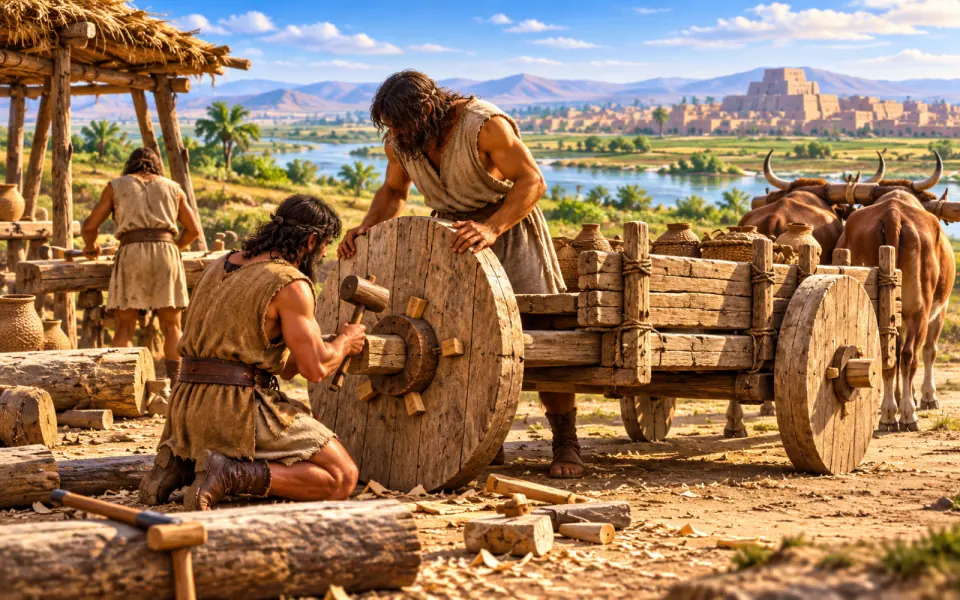
A trade was born: the potter. In Mesopotamia, between about 6,500 and 5,500 years ago, the potter's wheel was developed, a flat wheel that turns and makes it possible to produce pots more and more alike and more quickly. It is almost contemporary with the wheel of carts, and some scholars think the wheel arose precisely for the potter.
Pottery is also the great source of information about antiquity: sherds are the most numerous material in almost every dig. And ceramic material is an invention that is still very much alive today: plates, cups, bricks, roof tiles, sanitary ware, tiles and even the tiles of space rockets descend from the same idea.
Key people and places
People
- Xiaohong Wu
- Chinese archaeologist at Peking University. She led the study on the sherds of Xianrendong, the oldest in the world.
- Oliver Craig
- British archaeologist at the University of York. In 2013 he showed that Japanese pots 15,000 years old were used to cook fish.
- Flinders Petrie
- English archaeologist (1853–1942). He used the shapes of pots to put Egyptian tombs in order in time and was a pioneer of relative dating.
Places
- Xianrendong Cave (China)
- A cave in Jiangxi province, in eastern China, with sherds about 20,000 years old.
- Jōmon region (Japan)
- The Japanese islands where hunter-gatherers were making cord-decorated pots as early as 16,000 years ago.
- Mesopotamia
- The land between the Tigris and the Euphrates where, between about 6,500 and 5,500 years ago, the potter's wheel was developed.
Good to know
- Some Jōmon pots are decorated with such elaborate relief that they look like flames: they are among the most spectacular of prehistory.
- A single jar can tell what it contained: inside the porous walls traces of milk, wine, oil or honey remain for thousands of years.
- The word “ceramic” comes from the Greek keramos, “clay”, and from the name of a district of Athens, the Kerameikos, where the potters worked.
- In modern kilns clay is fired at temperatures of over a thousand degrees, while the first pots were fired in an open fire, at lower temperatures.
- Some fired clay figurines, such as the Venus of Dolní Věstonice in Moravia, in the Czech Republic, are about 29,000 to 25,000 years old: they were made long before pots, but show that firing was already known.
Find out more
- Science News Explores, “World's oldest pots” (in English) snexplores.org
- Wikipedia, “Ceramic” en.wikipedia.org
- Wikipedia, “Jōmon period” en.wikipedia.org
- Wikipedia, “Neolithic” en.wikipedia.org
Related events
- Taming fireabout 790,000 years ago · PrehistoryWithout the control of fire there would be no terracotta.
- The Neolithic Revolutionabout 12,000 years ago · PrehistoryPots were used to store the farmers' harvests.
- The invention of the wheelabout 5,500 years ago · PrehistoryThe potter's wheel and the wheel of carts arose more or less together.
- Amphorae for oil and wineabout 800 BC · Sea civilisationsAmphorae for oil and wine carried pottery all around the Mediterranean.
- Cuneiform writingabout 3200 BC · River civilisationsThe Sumerians wrote on clay tablets, which were also fired.
Before and after, in the era “Prehistory”
Event 21 of 25
 BeforeThe first homininsabout 7 million years ago
 BeforeLucy the australopithecineabout 3.2 million years ago
 BeforeThe first stone toolsabout 2.6 million years ago
 BeforeHomo habilisabout 2.4 million years ago
 BeforeHomo erectusabout 1.9 million years ago
 BeforeTaming fireabout 790,000 years ago
 BeforeHomo heidelbergensisabout 600,000 years ago
 BeforeNeanderthalsabout 400,000 years ago
 BeforeThe arrival of Homo sapiensabout 300,000 years ago
 BeforeThe first deliberate burialsabout 100,000 years ago
 BeforeHomo sapiens leaves Africaabout 60,000 years ago
 BeforeThe needle with an eyeabout 48,000 years ago
 BeforeThe first people in Australiaabout 48,000 years ago
 BeforeThe cave art of Sulawesiabout 44,000 years ago
 BeforeThe Venus of Willendorfabout 28,000 years ago
 BeforeThe Lascaux caveabout 19,000 years ago
 BeforeThe first permanent villagesabout 14,000 years ago
 BeforeThe Neolithic Revolutionabout 12,000 years ago
 BeforeTaming the sheepabout 11,000 years ago
 BeforeThe walls of Jerichoabout 10,300 years ago
- You are herePottery spreadsabout 9,000 years ago
 AfterÇatalhöyükabout 9,000 years ago
 AfterWorking with copperabout 7,000 years ago
 AfterThe invention of the wheelabout 5,500 years ago
 AfterThe Bronze Ageabout 5,300 years ago
Listen / Read next
- Music to read by: Cinematic JourneyEpic film-style music, no lyrics, by Ciro Simone IrmiciSpotifyYouTube Music
Other events of the era “Prehistory”
- The first hominins
- Lucy the australopithecine
- The first stone tools
- Homo habilis
- Homo erectus
- Taming fire
- Homo heidelbergensis
- Neanderthals
- The arrival of Homo sapiens
- The first deliberate burials
- Homo sapiens leaves Africa
- The needle with an eye
- The first people in Australia
- The cave art of Sulawesi
- The Venus of Willendorf
- The Lascaux cave
- The first permanent villages
- The Neolithic Revolution
- Taming the sheep
- The walls of Jericho
- Çatalhöyük
- Working with copper
- The invention of the wheel
- The Bronze Age
