The first permanent villages
about 14,000 years ago Near East (Natufian villages)
In short
About 14,000 years ago, in the Near East, the Natufians began living all year round in villages of round houses, partly dug into the ground. They were still hunter-gatherers, but they collected wild cereals in large amounts. Settling in one place paved the way for farming.
Why it matters For the first time people stopped moving around with the seasons.
Source: Treccani, entry “Natufiano”
Study card about 5 minutes of reading
The story
Staying in one place
For almost all their history, human beings were nomads. They followed the herds, gathered fruit in the right seasons and changed camp when the food nearby ran out. A hut was a temporary shelter, something to leave without regret. Then, in one corner of the world, someone decided to stay. It was not a sudden choice and it did not involve everyone, but it marked a turning point: it is the moment when human history begins to put down roots.
That place is the Near East, in particular the region that today includes Israel, Lebanon, Jordan and western Syria. The people we are talking about are called Natufians by archaeologists, after a valley, the Wadi en-Natuf, in the West Bank, where the British archaeologist Dorothy Garrod found in 1928 a cave with traces of their culture. The Natufians lived between about 15,000 and 11,500 years ago, at the end of the last ice age, when the climate was becoming warmer and wetter.
The round houses of Ain Mallaha
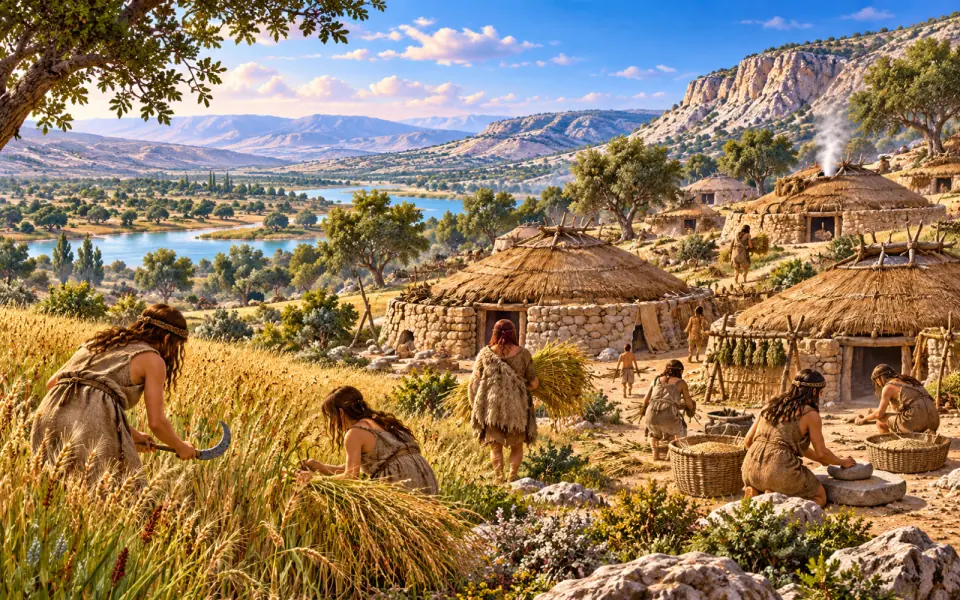
The most studied site is called Ain Mallaha (in Hebrew Eynan), near an ancient lake in northern Israel. Here, about 12,000 to 14,000 years ago, archaeologists found the remains of dozens of round houses, six to nine metres across, with stone walls and a floor dug a little below ground level. Above there was probably a roof of branches and reeds. Inside there are hearths, pits for storing food, stone grinders. Between the houses there are burials: the dead were laid close to where people lived, sometimes under the floor.
Living like this all year round needs a few things: food available in every season, water nearby, the chance to store supplies. The Near East of the time offered all of this. There were oak woods, with acorns and almonds; meadows of wild cereals such as barley and wheat; lakes with fish; gazelles to hunt. Not all Natufian sites were occupied all year round, and scholars argue about how settled they really were. But at least in some places a settled life was probably already normal.
What they ate and how they worked
The Natufians did not yet farm, but they gathered wild cereals in large quantities. We know this from their tools: bone sickles with little flint blades set into them, which show a special shine, left by the cut blades of grass; stone mortars and pestles for grinding the seeds. At a site in Jordan called Shubayqa 1, in 2018, charred remains of a kind of flatbread were found, made with ground wild cereals and roots, about 14,400 years old: the oldest bread known. In a cave on Mount Carmel, Raqefet, archaeologists have found traces of an alcoholic drink like beer, made from fermented cereals, about 13,000 years old. It may have been served at feasts and rites after a funeral.
They also made beautiful objects: necklaces of shells and animal teeth, stone figurines, polished bowls. At Hilazon Tachtit, in Galilee, a grave about 12,000 years old was found with an elderly woman surrounded by dozens of tortoise shells (fifty according to the first publication) and the bones of various animals, including a leopard's pelvis: perhaps a person of great standing in the community. In another grave at Ain Mallaha an elderly person was buried with a puppy, held close to her: one of the first signs of affection between humans and dogs.
Towards farming
Towards the end of the period the climate changed again. Around 12,900 years ago a dry cold returned, which lasted more than a thousand years and which scientists call the Younger Dryas. Many wild cereals became rare. The inhabitants, by now rooted in villages, were forced to find solutions: to move, to look for other resources, or to help plants grow by sowing and tending fields. For some groups this was the road to agriculture. It is not certain that it happened this way, because the data are still few, and some researchers think that cultivation began earlier or in other ways. But the link between villages and fields is clear: the first farmers already lived in settled communities, descendants of peoples like the Natufians.
Why it happened
Climate was the first factor. At the end of the last ice age, about 15,000 years ago, the Near East became warmer and rainier. Woods and grasslands with wild cereals grew back, and the amount of food increased.
When an area offers enough food near home, moving is no longer necessary: those who stay can build, store, care for the sick. According to some scholars, staying put also made it possible to have more children: a mother who does not have to walk every day with a small child in her arms can have one after another more quickly.
Technology mattered too: grinding stones, sickles, storage pits. The more people gathered and put aside, the more worthwhile it was to stay near the stores.
What changed
The village changed the way of living. Those who do not change home every season can have heavy and fragile objects, such as grinding stones and pots, and build solid structures. With time, property, roles and rules also develop: those who have the stores have more power, and agreements are needed to share.
Settled life also brought new problems. Where many people live close together, with rubbish, animals and stored food, infectious diseases spread more easily. Mice and parasites move into the houses. The village had advantages, but it meant learning to manage these risks.
Above all, villages opened the way to farming and then to cities. Everything that came afterwards in the rest of the world, from walls to temples, from writing to governments, grew on this base. The round houses of the Natufians are, in a way, the beginning of architecture.
Key people and places
People
- Dorothy Garrod
- British archaeologist (1892–1968). In 1928 she discovered the Natufian culture in the Wadi en-Natuf and gave it its name.
- Ofer Bar-Yosef
- Israeli archaeologist (1937–2020) at Harvard University. He studied the Natufians and the move to farming for a long time.
- Leore Grosman
- Israeli archaeologist at the Hebrew University of Jerusalem. She has studied the grave of the woman of Hilazon Tachtit.
Places
- Ain Mallaha / Eynan (Israel)
- A Natufian village near the ancient Lake Hula, in northern Israel, with round houses about 12,000 to 14,000 years old.
- Shubayqa 1 (Jordan)
- A site in the desert of north-eastern Jordan, where the oldest known bread, about 14,400 years old, was found.
- Raqefet Cave (Mount Carmel, Israel)
- A cave used as a cemetery, where traces of a fermented drink about 13,000 years old were discovered.
- Wadi en-Natuf (West Bank)
- The valley that gave its name to the Natufian culture.
Good to know
- The bread of Shubayqa 1 was not leavened: it was a kind of flat bread, baked on the fire 4,000 years before the birth of agriculture.
- The puppy buried at Ain Mallaha beside an elderly person is about 12,000 years old and is one of the first proofs of an affectionate bond with a dog.
- The Natufians' necklaces were also made with sea shells, such as tusk shells, which came from distant coasts: a sign of exchange between groups.
- The shine that the sickles show under the microscope is called “sickle gloss”: it forms when flint cuts thousands of stems rich in silica.
- In a Natufian village not all the houses were used at the same time: some were abandoned and others built on top.
Find out more
- Wikipedia, “Ain Mallaha” en.wikipedia.org
- Wikipedia, “Natufian culture” en.wikipedia.org
- Wikipedia, “Neolithic” en.wikipedia.org
- Wikipedia, “Fertile Crescent” en.wikipedia.org
Related events
- The Neolithic Revolutionabout 12,000 years ago · PrehistoryThe Natufian villages prepared the birth of agriculture.
- The walls of Jerichoabout 10,300 years ago · PrehistoryJericho, a few thousand years later, was a fortified village in the same region.
- Çatalhöyükabout 9,000 years ago · PrehistoryÇatalhöyük is a big village of farmers born from this tradition.
- Taming the sheepabout 11,000 years ago · PrehistoryAlongside the fields came herding: sheep and goats.
- The first Sumerian citiesabout 4000 BC · River civilisationsFrom settled communities, thousands of years later, came the first Sumerian cities.
Before and after, in the era “Prehistory”
Event 17 of 25
 BeforeThe first homininsabout 7 million years ago
 BeforeLucy the australopithecineabout 3.2 million years ago
 BeforeThe first stone toolsabout 2.6 million years ago
 BeforeHomo habilisabout 2.4 million years ago
 BeforeHomo erectusabout 1.9 million years ago
 BeforeTaming fireabout 790,000 years ago
 BeforeHomo heidelbergensisabout 600,000 years ago
 BeforeNeanderthalsabout 400,000 years ago
 BeforeThe arrival of Homo sapiensabout 300,000 years ago
 BeforeThe first deliberate burialsabout 100,000 years ago
 BeforeHomo sapiens leaves Africaabout 60,000 years ago
 BeforeThe needle with an eyeabout 48,000 years ago
 BeforeThe first people in Australiaabout 48,000 years ago
 BeforeThe cave art of Sulawesiabout 44,000 years ago
 BeforeThe Venus of Willendorfabout 28,000 years ago
 BeforeThe Lascaux caveabout 19,000 years ago
- You are hereThe first permanent villagesabout 14,000 years ago
 AfterThe Neolithic Revolutionabout 12,000 years ago
 AfterTaming the sheepabout 11,000 years ago
 AfterThe walls of Jerichoabout 10,300 years ago
 AfterPottery spreadsabout 9,000 years ago
 AfterÇatalhöyükabout 9,000 years ago
 AfterWorking with copperabout 7,000 years ago
 AfterThe invention of the wheelabout 5,500 years ago
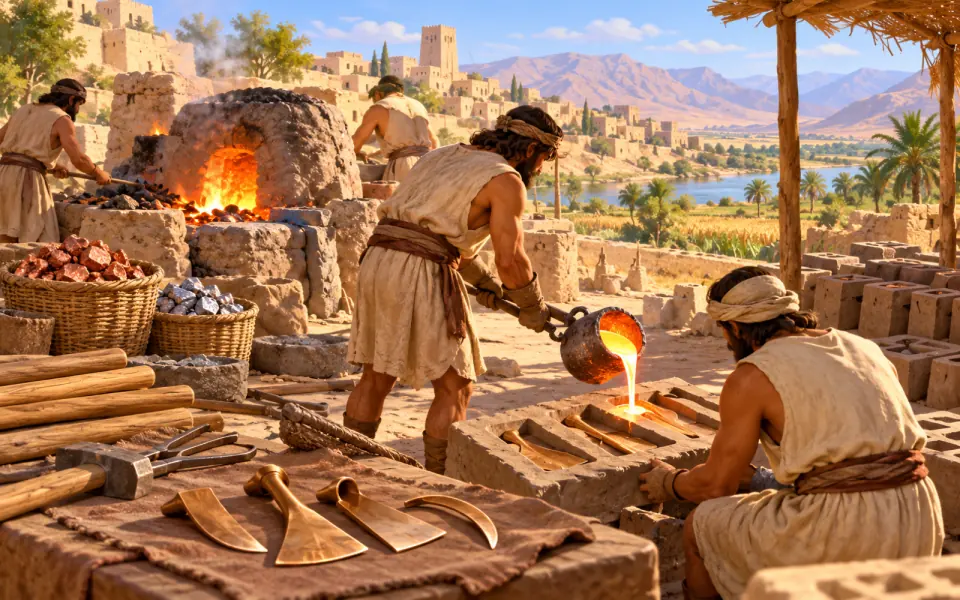 AfterThe Bronze Ageabout 5,300 years ago
Listen / Read next
- Music to read by: Cinematic JourneyEpic film-style music, no lyrics, by Ciro Simone IrmiciSpotifyYouTube Music
Meanwhile, elsewhere in the world
Other events of the era “Prehistory”
- The first hominins
- Lucy the australopithecine
- The first stone tools
- Homo habilis
- Homo erectus
- Taming fire
- Homo heidelbergensis
- Neanderthals
- The arrival of Homo sapiens
- The first deliberate burials
- Homo sapiens leaves Africa
- The needle with an eye
- The first people in Australia
- The cave art of Sulawesi
- The Venus of Willendorf
- The Lascaux cave
- The Neolithic Revolution
- Taming the sheep
- The walls of Jericho
- Pottery spreads
- Çatalhöyük
- Working with copper
- The invention of the wheel
- The Bronze Age
