Working with copper
about 7,000 years ago Europe (Ötzi, Similaun glacier)
In short
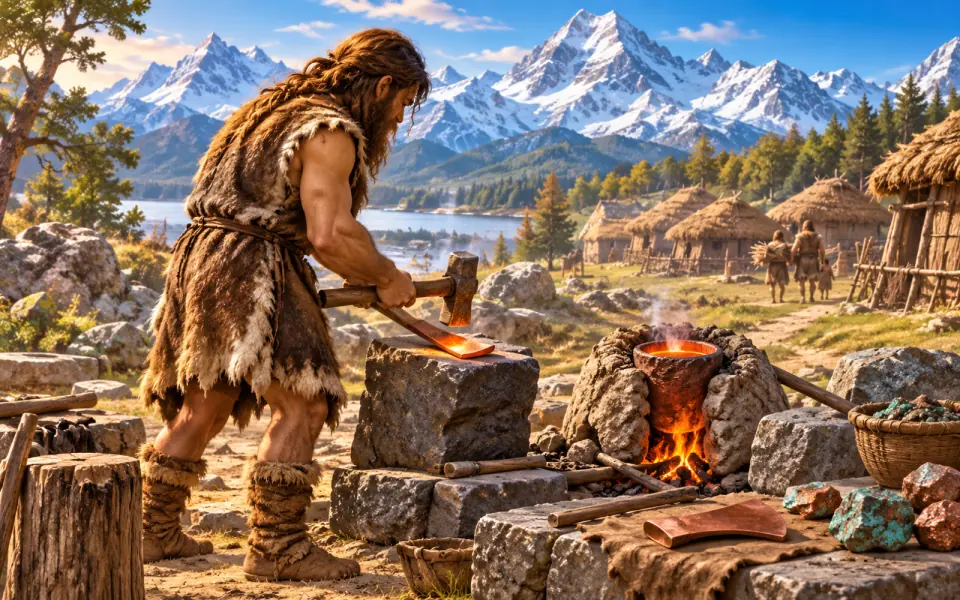
Copper was the first metal to be worked: at first it was hammered cold, then people learnt to melt it in fire. The oldest traces of smelted copper, from about 7000 years ago, come from Belovode, in Serbia. In Europe this period is called the Copper Age, or Chalcolithic. Ötzi, the man found in 1991 on the Similaun glacier, between Italy and Austria, was carrying a copper axe.
Why it matters Metals brought a new way of making tools and of trading.
Source: Science News, “Serbian site may have hosted first copper makers”
Study card about 6 minutes of reading
The story
A man on the glacier
On 19 September 1991 two German hikers from Nuremberg, Helmut and Erika Simon, were walking in the Alps, at over 3,200 metres, near the Tisenjoch pass, between Italy and Austria. That summer had been very hot and the snow had melted more than usual. In a hollow of ice they saw something sticking out: a dark back, a head, brown skin, like that of a mountaineer who had died recently. They told the mountain huts. The first people to arrive, police and rescuers, tried to free the body from the ice with pickaxes and even a pneumatic drill, damaging it a little. Only afterwards, when archaeologists looked at the objects found beside the body, was it understood that this man had not died a few years earlier, but thousands of years ago.
He was named Ötzi, after the Ötztal valleys, and today he is the most studied natural mummy in the world. He is kept in Bolzano, in South Tyrol, in the Archaeological Museum, in a cold, damp cell that imitates the ice. Official surveys showed that the body lay in Italian territory, about ninety metres from the border with Austria.
A man of the Copper Age
Ötzi lived about 5,300 years ago, around 3300 BC. He was about forty-five years old, 1.6 metres tall and weighed around fifty kilos. He wore clothes of goat, sheep and deer skin, a cloak of plaited grass, shoes stuffed with hay and a bearskin cap. With him he had a bow not yet finished, a quiver with arrows, a flint dagger, a birch-bark container for carrying embers and a small kit for repairing objects. On his body he had sixty-one tattoos, lines and crosses at points where he perhaps felt pain in his joints. In his shoulder there was an arrowhead, which probably caused his death: it was discovered in 2001 with an X-ray.
But the object that interests us is another: an axe. The handle was of yew wood, about sixty centimetres long, and at the top, set in place, tied with strips of leather and fixed with birch pitch, was a copper blade a little under ten centimetres long. The copper is over 99 per cent pure. That axe was a valuable object, a kind of symbol of prestige, as well as a tool for felling trees. Ötzi was a man who belonged to a world in which metals had by then entered life.
Copper: the first metal
Copper is one of the few metals found in nature even in pure form, in greenish and reddish nuggets. The first people who noticed it treated it like a stone, and for thousands of years they hammered it with a rock to make pins, beads and small jewellery. This is called cold working, and it is attested as early as about 9,000 years ago in Anatolia. A second step, much more important, was to discover that the metal could be extracted from ores with fire and melted. Copper melts at about 1,085 degrees: it takes a very hot fire, fed by charcoal and by the blowing of reeds or bellows.
The first secure evidence for copper smelting comes from the Balkans. At Belovode, in Serbia, a team of archaeologists led by Miljana Radivojević found slag and small drops of copper, dating to about 7,000 years ago, that is, to about 5000 BC. It was the Vinča culture, whose villages had big houses, decorated pots and figurines. Other places, such as Anatolia and Iran, may have known smelting at the same time or even earlier, and scholars argue about it.
The period in which copper was used in an important way is called the Copper Age, or Eneolithic (“stone and copper”), or Chalcolithic. It begins at different times in each region: in the Balkans around 5000 BC; in Italy, especially in the north, in the 4th and 3rd millennia BC, with cultures such as Remedello, in Lombardy.
Ötzi's copper
In 2017 a group of researchers at the University of Padua, led by the mineralogist Gilberto Artioli, analysed the blade of Ötzi's axe, measuring the composition of tiny amounts of lead contained in the metal. The conclusion is surprising: the copper comes from southern Tuscany, hundreds of kilometres to the south, beyond the Apennines and the Po Plain. So in 3300 BC metal was already travelling over great distances, and this tells us that there were networks of exchange between distant peoples. It may be that the blade was melted and hammered closer to home, but the basic ingredient came from the south.
Why it happened
Copper was probably discovered by chance and then out of curiosity. People who already worked with fire, to bake terracotta or keep warm, knew high temperatures well. Pieces of green ore, such as malachite, used as a pigment, that fell into a pottery kiln could give drops of copper.
Then came the wish for better objects. Molten copper could be poured into a mould to get a wanted shape, more and better than stone. A copper blade can be sharpened again when it goes blunt, or melted down again when it breaks.
The presence of copper ores near the surface in many regions also mattered, from the Balkans to the Alps, from Tuscany to Cyprus. The island of Cyprus was so famous for this metal that in Latin copper took the name aes Cyprium, “metal of Cyprus”, from which come the word “cuprum” and the chemical symbol Cu.
What changed
With copper the era of metals began. A new profession, the smelter, needed secret knowledge of ores, furnaces and firing times. Specialised people and long-distance exchanges appeared, to carry the ore where it was needed.
Copper is soft and not very strong; so people tried to improve it. By adding a little arsenic or, above all, tin, they got bronze, which is harder. It is the next step, which the card on the Bronze Age tells about.
Today copper is everywhere: in electric wires, in pipes, in phones, in coins. Almost all the electricity we use passes through copper wires, and its use in computers and electric cars grows from year to year.
Key people and places
People
- Helmut and Erika Simon
- A German couple from Nuremberg. On 19 September 1991 they discovered Ötzi while walking in the mountains.
- Konrad Spindler
- Austrian archaeologist (1940–2005) at the University of Innsbruck. He was the first to study Ötzi and to understand that he was a man of the Copper Age.
- Gilberto Artioli
- Mineralogist at the University of Padua. In 2017 he led the study that showed that the copper of Ötzi's axe came from Tuscany.
- Miljana Radivojević
- Serbian archaeologist who studied the slag of smelted copper at Belovode, in Serbia, about 7,000 years old.
Places
- Tisenjoch, Ötztal Alps (South Tyrol)
- A pass at about 3,200 metres, near the border with Austria, where Ötzi was found.
- South Tyrol Museum of Archaeology (Bolzano)
- The museum that keeps Ötzi and his objects, including the copper axe.
- Belovode (Serbia)
- A site of the Vinča culture, with the oldest secure traces of smelted copper, about 7,000 years old.
- Southern Tuscany
- The area where, according to the 2017 analysis, the ore used for Ötzi's axe was mined.
Good to know
- Ötzi has 61 tattoos, made with charcoal rubbed into thin cuts: they are among the oldest tattoos known.
- His last meal was ibex and deer meat with cereals, eaten a few hours before he died.
- The handle of Ötzi's axe is of yew, a hard and springy wood, used since prehistory also for bows.
- Copper, in contact with air, is covered with a green patina: it is the same colour as old domes and the Statue of Liberty.
- The symbol for copper, Cu, comes from the Latin cuprum, and the name comes from the island of Cyprus, a great producer of copper in antiquity.
Find out more
- Science News, “Serbian site may have hosted first copper makers” (in English) sciencenews.org
- South Tyrol Museum of Archaeology, Ötzi the Iceman (in English) iceman.it
- Wikipedia, “Ötzi” en.wikipedia.org
- Wikipedia, “Chalcolithic” en.wikipedia.org
Related events
- The Bronze Ageabout 5,300 years ago · PrehistoryBy mixing copper and tin, bronze was obtained.
- Taming fireabout 790,000 years ago · PrehistoryFire, controlled hundreds of thousands of years earlier, made it possible to melt metal.
- Pottery spreadsabout 9,000 years ago · PrehistoryThe kilns for terracotta were perhaps the place of the first smelting.
- The Iron Age beginsabout 1200 BC · Sea civilisationsThe Iron Age followed the Bronze Age.
- The first Sumerian citiesabout 4000 BC · River civilisationsThe first Sumerian cities depended on the trade in metals and stones.
Before and after, in the era “Prehistory”
Event 23 of 25
 BeforeThe first homininsabout 7 million years ago
 BeforeLucy the australopithecineabout 3.2 million years ago
 BeforeThe first stone toolsabout 2.6 million years ago
 BeforeHomo habilisabout 2.4 million years ago
 BeforeHomo erectusabout 1.9 million years ago
 BeforeTaming fireabout 790,000 years ago
 BeforeHomo heidelbergensisabout 600,000 years ago
 BeforeNeanderthalsabout 400,000 years ago
 BeforeThe arrival of Homo sapiensabout 300,000 years ago
 BeforeThe first deliberate burialsabout 100,000 years ago
 BeforeHomo sapiens leaves Africaabout 60,000 years ago
 BeforeThe needle with an eyeabout 48,000 years ago
 BeforeThe first people in Australiaabout 48,000 years ago
 BeforeThe cave art of Sulawesiabout 44,000 years ago
 BeforeThe Venus of Willendorfabout 28,000 years ago
 BeforeThe Lascaux caveabout 19,000 years ago
 BeforeThe first permanent villagesabout 14,000 years ago
 BeforeThe Neolithic Revolutionabout 12,000 years ago
 BeforeTaming the sheepabout 11,000 years ago
 BeforeThe walls of Jerichoabout 10,300 years ago
 BeforePottery spreadsabout 9,000 years ago
 BeforeÇatalhöyükabout 9,000 years ago
- You are hereWorking with copperabout 7,000 years ago
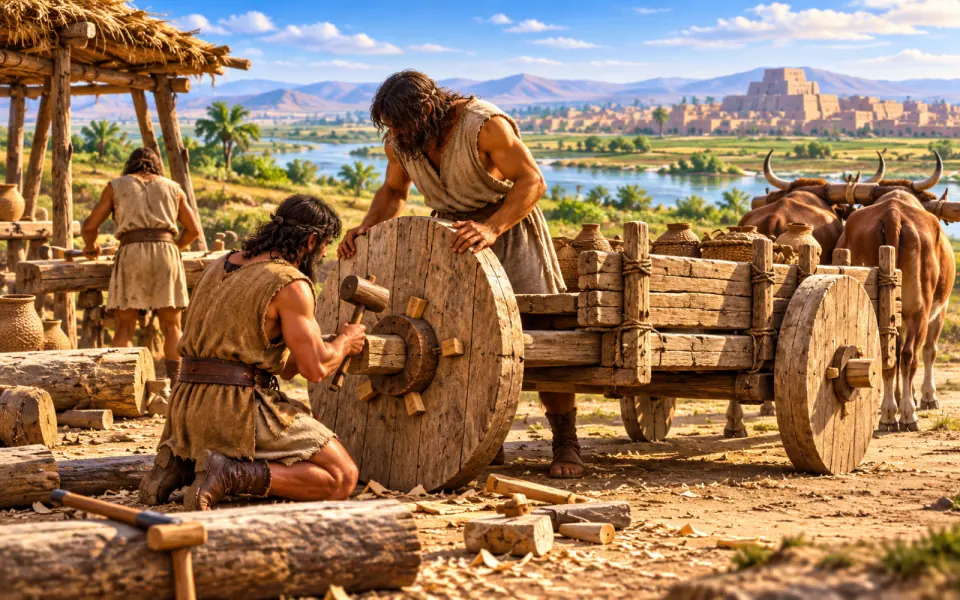 AfterThe invention of the wheelabout 5,500 years ago
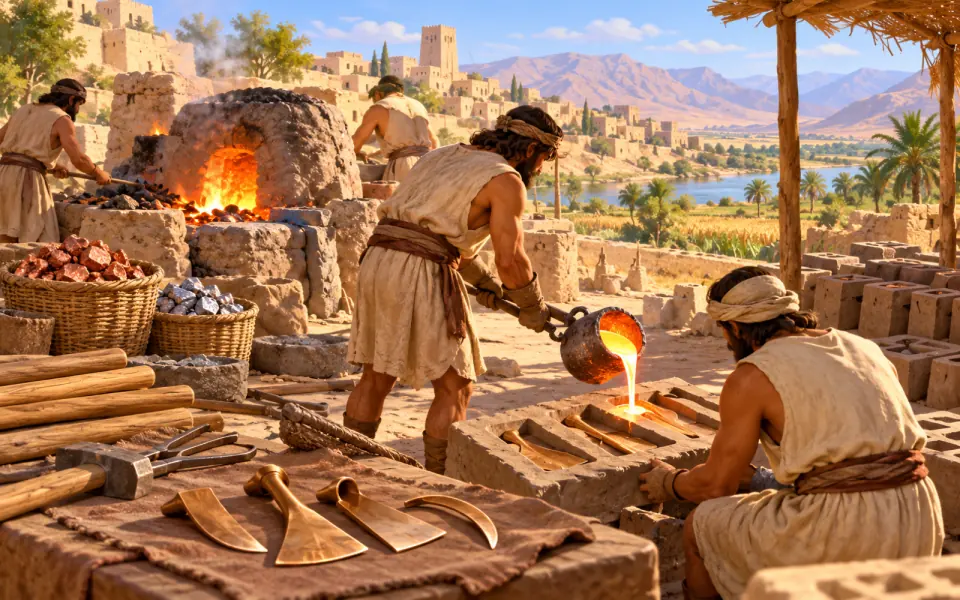 AfterThe Bronze Ageabout 5,300 years ago
Listen / Read next
- Music to read by: Cinematic JourneyEpic film-style music, no lyrics, by Ciro Simone IrmiciSpotifyYouTube Music
Other events of the era “Prehistory”
- The first hominins
- Lucy the australopithecine
- The first stone tools
- Homo habilis
- Homo erectus
- Taming fire
- Homo heidelbergensis
- Neanderthals
- The arrival of Homo sapiens
- The first deliberate burials
- Homo sapiens leaves Africa
- The needle with an eye
- The first people in Australia
- The cave art of Sulawesi
- The Venus of Willendorf
- The Lascaux cave
- The first permanent villages
- The Neolithic Revolution
- Taming the sheep
- The walls of Jericho
- Pottery spreads
- Çatalhöyük
- The invention of the wheel
- The Bronze Age
