The Julian calendar
46 BC Rome
In short
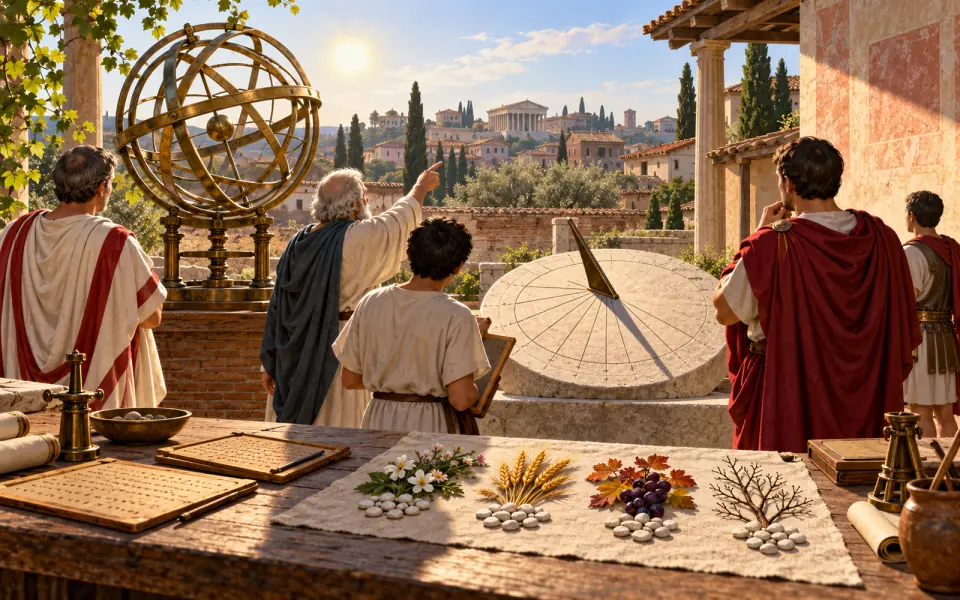
The old Roman calendar was several weeks out of step with the seasons. Julius Caesar asked the astronomer Sosigenes of Alexandria for help and created a year of 365 days, with an extra day every four years. To put things right, 46 BC lasted no fewer than 445 days and was called ‘the year of confusion’. The new calendar came into force on 1 January of the following year.
Why it matters The calendar we use today is a correction of the Julian one, decided in 1582.
Source: Encyclopaedia Britannica, “Julian calendar”
Study card about 6 minutes of reading
The story
A calendar that did not add up
Imagine your birthday fell one year in spring and the next in autumn: you would no longer know when to celebrate. Something like this happened to the Romans before the reform of Julius Caesar. Their calendar was such a muddle that the dates no longer matched the seasons. The harvest festival could fall when the fields were still green.
The problem came from the fact that the solar year, that is, the time the Earth takes to go round the Sun, lasts about 365 and a quarter days, while the old Roman calendar had shorter years. To put things right, every so often an extra month was added, called Mercedonius, after February: it lasted 27 or 28 days. But there was a complication: it was the pontiffs, the priests in charge of the calendar, who decided when to insert it. They did not always do it accurately. So the calendar drifted further and further from the seasons.
The astronomer of Alexandria
Julius Caesar, who was also pontifex maximus, that is, the head of the priests, wanted to put an end to the disorder. He asked for help from a Greek astronomer, Sosigenes of Alexandria, a city in Egypt famous for its scholars. The reform was worked out by him and promulgated by Caesar in 46 BC.
The idea was simple and brilliant. It was decided that the year would last 365 days, and that every four years one more would be added, to make up the quarter of a day that was missing. This extra day was inserted after 24 February, which for the Romans was the “sixth day before the Kalends of March”. In the year with the extra day they said bis sexto die, that is, “the sixth day twice”: from this comes the word “bissextile”, which is the old name for a leap year.
The year of confusion
Before starting the new system the dates had to be put back in order. For this reason 46 BC was an exceptional year. Two months were added between November and December and the year lasted as many as 445 days. The Romans called it annus confusionis, “the year of confusion”. The new calendar came into force on 1 January 45 BC. Since 153 BC the consuls had taken office on 1 January and the civil year had begun in January; the names from September to December, instead, recall the very ancient Roman year, which began in March.
The months change their names
The Julian calendar gave their names to some months that we still use. The seventh month, which was called Quintilis, was dedicated to Caesar in 44 BC and became Julius, our July. The eighth month, Sextilis, was dedicated to Augustus in 8 BC and became Augustus, that is, August. The other names stayed those of the ancient Roman year that began in March: that is why September, October, November and December, which mean “seventh”, “eighth”, “ninth” and “tenth” month, are today the ninth, the tenth, the eleventh and the twelfth.
Mistakes and corrections
Not even Caesar's reform was perfect straight away. After his death, in 44 BC, the priests in charge made mistakes and inserted the extra day too often, perhaps a leap year every three years instead of every four, according to one possible explanation. Augustus, in 8 BC, sorted the matter out by suspending leap years for a certain period, until the calendar was set right.
Another reform, sixteen centuries later
The Julian year lasted about 11 minutes and 14 seconds longer than the real year of the seasons. It seems very little, but year after year this difference built up: about one day every 128 years. By the 16th century the lag had become about ten days compared with the seasons. For this reason Pope Gregory XIII, with a papal bull of 24 February 1582, introduced the calendar we use, called the Gregorian. To make up the lag, 10 days were skipped in one go. Not all countries adopted it straight away: the changeover happened at different times, between the 18th and 20th centuries.
Some Orthodox Churches still use the Julian calendar today for religious festivals. This is why Christmas falls on 25 December for some Churches and on 7 January for others. In 1923 the Serbian scientist Milutin Milanković proposed a corrected version, used by several Churches, but not by all.
Why it happened
The earlier Roman calendar was too short compared with the solar year and had to be corrected by adding a month now and then. But it was the pontiffs who decided when to do it, and they did not always manage it well. With time the gap between the dates and the seasons had become obvious, with serious consequences for a people of farmers.
Caesar wanted to put the system in order once and for all, and after his victories he had the power to do it. He called in an expert, Sosigenes, and chose a simple method, based on a regular year of 365 days and one extra day every four years. It was an easy solution to remember, which did not depend on the will of the priests.
What changed
The Julian calendar remained in force for over sixteen hundred years in much of Europe. It gave peoples a common way to count time, and even today we use its months, with the names Julius and Augustus, and the rule of a leap year every four years.
The Gregorian calendar of 1582 did not cancel it, but corrected it: the rule for leap years was refined to reduce the error. The Julian one is still used for festivals by some Orthodox Churches, which explains why in some countries Christmas is celebrated in January.
The story also shows how measuring time has always been a collective undertaking, which needs astronomers, governments and religions. And it reminds us why the names of the months have a Roman origin: every time we write “July” or “August” we are talking about Caesar and Augustus.
Key people and places
People
- Julius Caesar
- Roman general and politician who in 46 BC reformed the calendar in his role as pontifex maximus.
- Sosigenes of Alexandria
- Greek astronomer who worked out the calendar reform at Caesar's request.
- Pope Gregory XIII
- Introduced the Gregorian calendar in 1582, which corrected the lag built up by the Julian one.
- Milutin Milanković
- Serbian scientist who in 1923 proposed the “revised Julian calendar”, adopted by some Orthodox Churches.
Places
- Rome
- Where Caesar promulgated the reform in 46 BC and where the pontiffs managed the calendar.
- Alexandria in Egypt
- City where Sosigenes worked, famous in antiquity for its science.
Good to know
- The year 46 BC lasted 445 days and is considered the longest year in history: the Romans called it the “year of confusion”.
- The word “bissextile” comes from the Latin bis sexto, “the sixth day twice” before the Kalends of March.
- The very ancient Roman year began on 1 March (from 153 BC the civil year already began in January): this is why September means “seventh month”, even though it is now the ninth.
- The Julian calendar is longer than the solar year by about 11 minutes and 14 seconds: built up over the centuries they became days.
- In 1582, to switch to the Gregorian calendar, 10 days were skipped.
Find out more
- Wikipedia, “Roman calendar” en.wikipedia.org
- Wikipedia, “Julian calendar” en.wikipedia.org
- Wikipedia, “Gregorian calendar” en.wikipedia.org
- Wikipedia, “Leap year” en.wikipedia.org
Related events
- The Gregorian calendar1582 · Early modern ageIn 1582 the Gregorian calendar corrected the Julian one.
- Caesar crosses the Rubicon49 BC · Ancient RomeCaesar reformed the calendar shortly after winning the civil war that began at the Rubicon.
- Augustus, the first emperor27 BC · Ancient RomeAugustus too left his name to a month and corrected the calendar's mistakes.
- The Egyptian calendarabout 2800 BC · River civilisationsThe Egyptians, long before, also had a calendar of 365 days.
- The murder of Julius Caesar44 BC · Ancient RomeCaesar died just over a year after the calendar came into force.
Before and after, in the era “Ancient Rome”
Event 12 of 25
 BeforeTraditional founding of Romeabout 753 BC
 BeforeBirth of the Roman Republicabout 509 BC
 BeforeThe Laws of the Twelve Tablesabout 450 BC
 BeforeThe Appian Way312 BC
 BeforeThe First Punic War264–241 BC
 BeforeHannibal crosses the Alps218 BC
 BeforePlautus and comedyabout 200 BC
 BeforeRoman concreteabout 150 BC
 BeforeThe Aqua Marcia aqueduct144–140 BC
 BeforeSpartacus leads the revolt73–71 BC
 BeforeCaesar crosses the Rubicon49 BC
- You are hereThe Julian calendar46 BC
 AfterThe murder of Julius Caesar44 BC
 AfterAugustus, the first emperor27 BC
 AfterThe Pax Romana27 BC – AD 180
 AfterVirgil and the Aeneid19 BC
 AfterPompeii buried by VesuviusAD 79
 AfterThe Colosseum opensAD 80
 AfterTrajan's ColumnAD 113
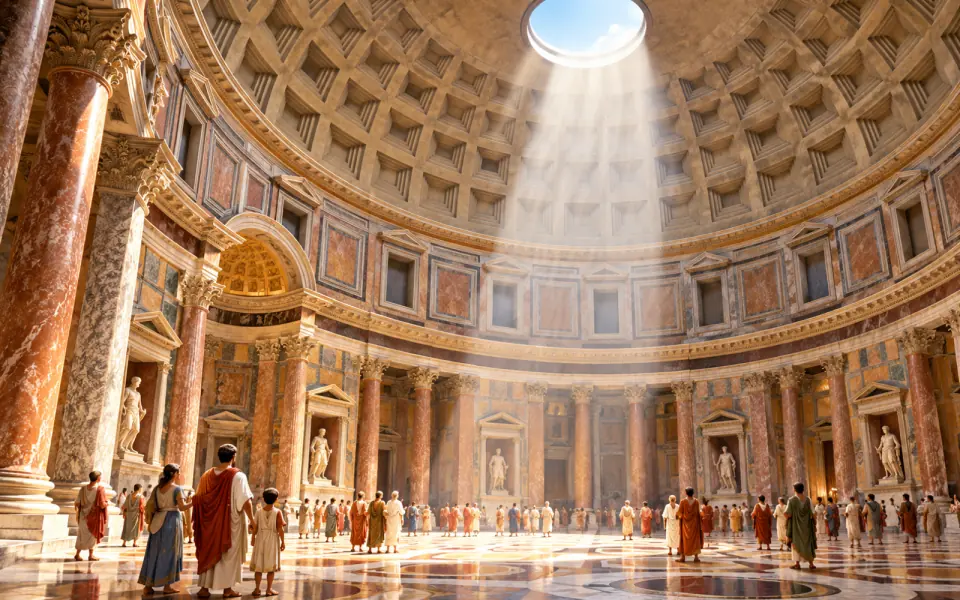 AfterThe Pantheonabout AD 125
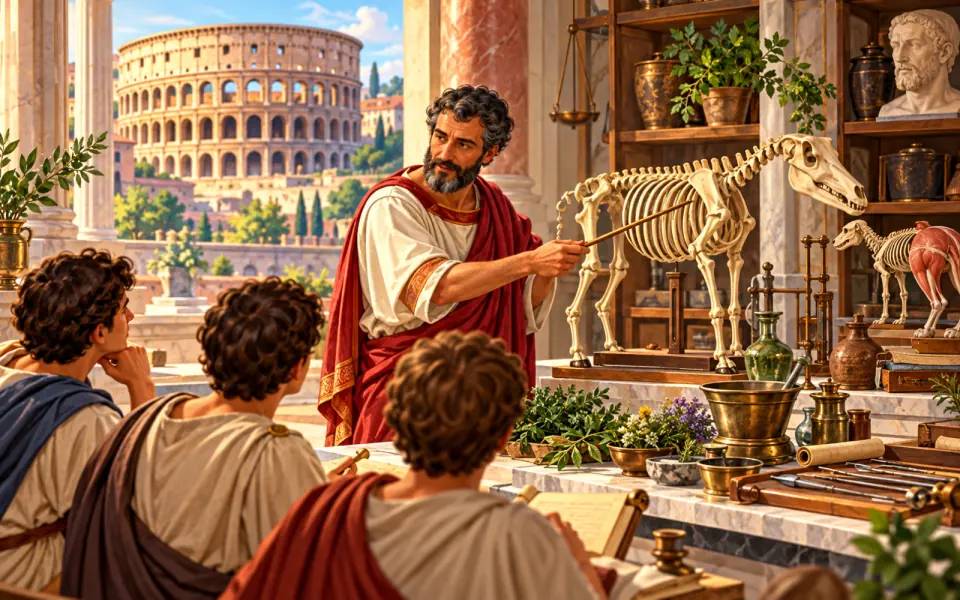 AfterGalen, a doctor in Romeabout AD 162
 AfterThe Baths of CaracallaAD 216
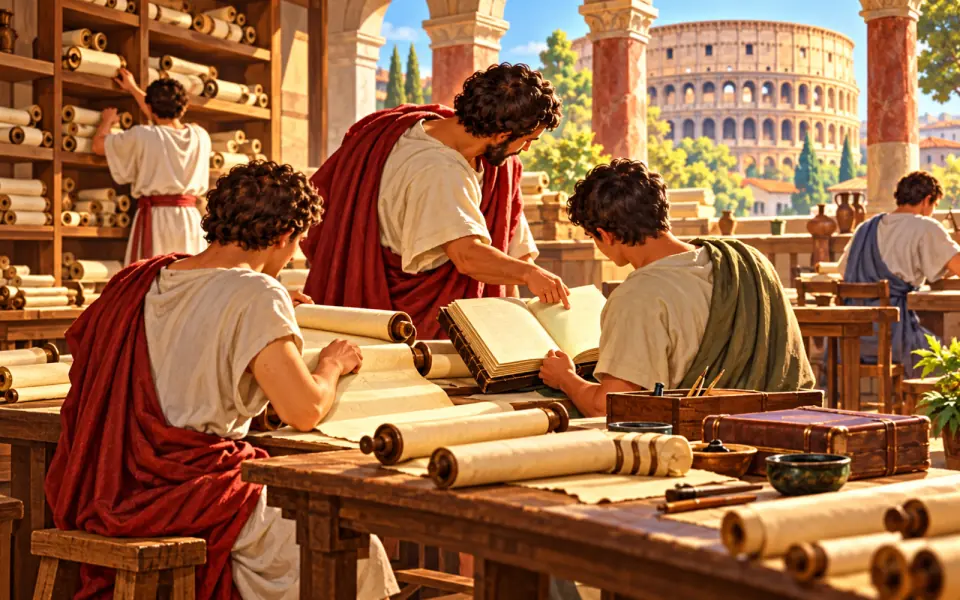 AfterThe book with pages (the codex)about AD 300
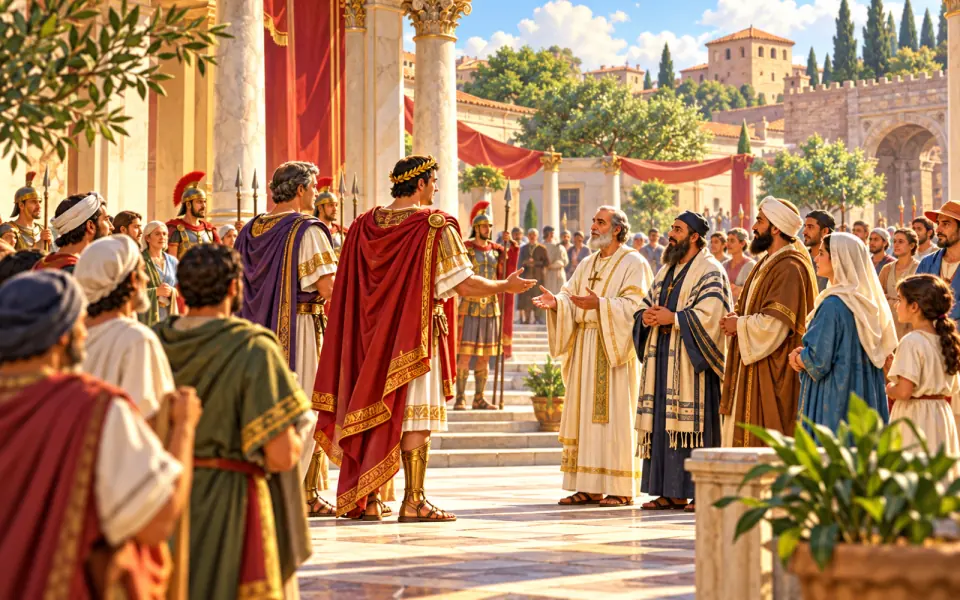 AfterThe Edict of MilanAD 313
 AfterFall of the Western Roman EmpireAD 476
Listen / Read next
- Music to read by: Cinematic JourneyEpic film-style music, no lyrics, by Ciro Simone IrmiciSpotifyYouTube Music
Meanwhile, elsewhere in the world

Other events of the era “Ancient Rome”
- Traditional founding of Rome
- Birth of the Roman Republic
- The Laws of the Twelve Tables
- The Appian Way
- The First Punic War
- Hannibal crosses the Alps
- Plautus and comedy
- Roman concrete
- The Aqua Marcia aqueduct
- Spartacus leads the revolt
- Caesar crosses the Rubicon
- The murder of Julius Caesar
- Augustus, the first emperor
- The Pax Romana
- Virgil and the Aeneid
- Pompeii buried by Vesuvius
- The Colosseum opens
- Trajan's Column
- The Pantheon
- Galen, a doctor in Rome
- The Baths of Caracalla
- The book with pages (the codex)
- The Edict of Milan
- Fall of the Western Roman Empire
