Aristotle founds the Lyceum
about 335 BC Athens (Greece)
In short
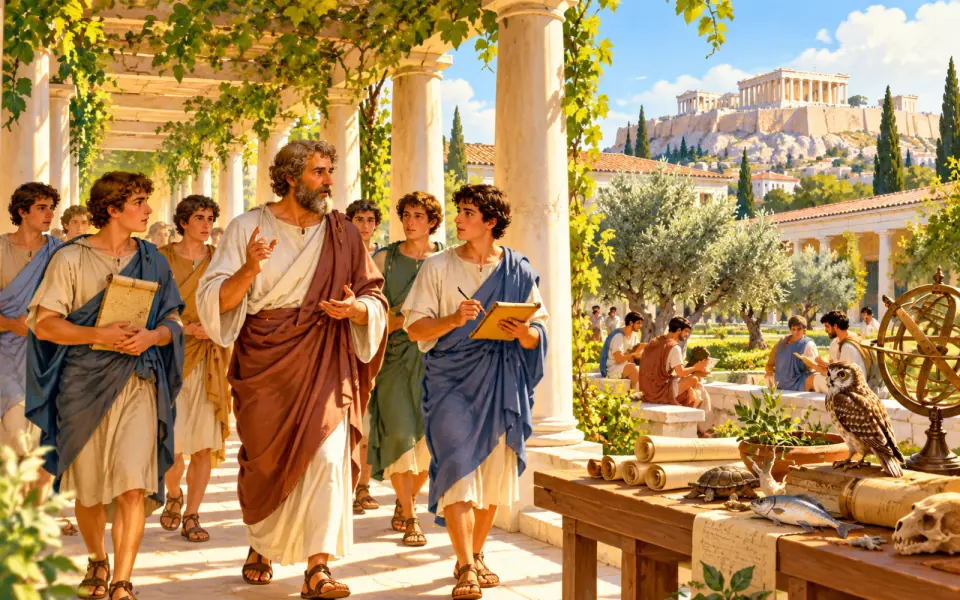
Aristotle, Plato's student for twenty years and later the teacher of the young Alexander the Great, returned to Athens and opened his own school at the Lyceum, a sports ground outside the walls. It was said that he taught while walking up and down a covered walkway, so his students were called Peripatetics, meaning ‘those who walk about’. Aristotle studied almost everything: logic, politics, poetry, the stars and above all animals, describing hundreds of species. He also collected a huge number of books, in one of the first great libraries.
Why it matters For almost two thousand years his books were the basis for studying nature in Europe and in the Islamic world.
Source: Encyclopaedia Britannica, “Aristotle”
Study card about 5 minutes of reading
The story
From the doctor's son to the Academy
Aristotle was born in 384 or 383 BC at Stagira, a small Greek town on the Chalcidice peninsula, in northern Greece. His father, Nicomachus, was the doctor of the king of Macedon, Amyntas III. It is said that as a boy he helped his father and from him took his interest in living things and in direct observation. Orphaned, he was entrusted to a guardian, who sent him to Athens when he was about seventeen or eighteen.
In Athens he entered Plato's Academy. He stayed there about twenty years, until his teacher's death, in 347 BC. He was never an Athenian citizen but a metic, that is a resident foreigner. After Plato's death he left Athens and moved to Asia Minor, to Assos, to the ruler of the place, Hermias, and then to Mytilene, on the island of Lesbos.
Alexander's teacher
Around 343–342 BC the king of Macedon Philip II called him to his Macedonian court (at Mieza) to act as tutor to his son Alexander, who was about thirteen. The task lasted about three years. The young prince, who would become Alexander the Great, had the greatest thinker of the time as his teacher.
The Lyceum
Around 335–334 BC Aristotle returned to Athens and opened a school of his own, in a gymnasium near a precinct sacred to Apollo Lyceus (hence the name “Lyceum”). The school was also called the “Peripatos”, from the Greek “peripatos”, that is “walk”: according to tradition the teachers and pupils discussed while walking under a colonnade. His followers were called Peripatetics.
The Lyceum was different from the Academy. Aristotle gave great importance to the observation of facts. In the school they studied nature, politics and poetry, and Aristotle also gathered a library. Most of the works of Aristotle that have come down to us were intended for the school and not for the public.
An encyclopedic mind
Aristotle wrote about almost everything. The group of works devoted to logic, that is, the correct way of reasoning, is called the “Organon” (“instrument”). Then there are the “Physics”, devoted to nature and movement, the “Metaphysics”, which tries to understand what “being” means, the moral works such as the “Nicomachean Ethics”, the “Politics”, the “Rhetoric” and the “Poetics”, on the art of writing poetry and tragedies.
He was very interested in animals. His “History of Animals” is in ten books, and other works deal with their parts and how they reproduce. According to the Treccani encyclopedia entry, among his observations is that of the stomach of ruminants, and he understood that dolphins breathe and give birth like mammals, not like fish. He also tried to arrange living things on a scale, from inanimate beings up to man.
The last years and the fate of the books
In 323 BC Alexander died. Aristotle was accused of impiety, as Socrates had been. He then left the city and took refuge at Chalcis, on the island of Euboea, where he died in 322 BC.
The leadership of the Lyceum passed to his pupil Theophrastus, who also inherited the library. At Theophrastus' death the collection passed to another heir, Neleus, who took it to Scepsis, in Asia Minor. According to an ancient story, the manuscripts were hidden in a cellar, to keep them from the kings who wanted to buy them for their libraries, and were then sold to a rich collector, Apellicon of Teos, who brought them back to Athens. The Roman general Sulla took them to Rome after the capture of Athens. There the philosopher Andronicus of Rhodes put them in order and published them. The edition that resulted is still the reference one today, although scholars think Andronicus intervened in the texts, correcting them or moving things around.
Why it happened
Aristotle founded a school of his own for a very practical reason. After Plato's death, Speusippus had been chosen to head the Academy, and Aristotle did not agree with certain ideas of the group. Back in Athens after years spent away, and with the reputation of having educated Alexander, he could open a Lyceum of his own.
As for ideas, Aristotle held that knowledge arose from the observation of concrete things and not only from reflection on perfect Forms, as Plato thought. That is why the Lyceum concerned itself a great deal with natural history and the observation of phenomena.
What changed
Aristotle's works became the foundation of knowledge for a very long time. According to the Treccani encyclopedia, his “encyclopedia of knowledge” dominated Western culture until the 17th century. His texts were studied for logic, physics, politics and ethics; for centuries his works were read and commented on in the schools of Europe.
His influence on science was also enormous, for better and for worse. Aristotle had introduced the method of classification and observation, but some of his ideas on physics, such as those on the motion of bodies, proved wrong and were corrected only by the scientists of the modern age. His prestige meant that certain errors lasted a long time.
Many words we use every day come from him or are linked to his work: “logic”, “metaphysics”, “poetics”, “peripatetic”. And our idea of organising knowledge into disciplines, such as physics, biology, politics, ethics and poetry, descends largely from his way of dividing knowledge.
Key people and places
People
- Aristotle
- Philosopher and scientist from Stagira (384/383–322 BC), a pupil of Plato, teacher of Alexander and founder of the Lyceum.
- Nicomachus
- Aristotle's father, doctor of the king of Macedon Amyntas III.
- Theophrastus
- Pupil of Aristotle: he led the Lyceum after him and inherited its library.
- Alexander the Great
- The young prince whom Aristotle tutored at the Macedonian court.
- Andronicus of Rhodes
- Philosopher who in the 1st century BC put Aristotle's writings in order and published them.
Places
- Stagira
- Greek colony on the Chalcidice peninsula where Aristotle was born.
- Pella
- Capital of the kingdom of Macedon, where Aristotle was Alexander's tutor.
- Lyceum of Athens
- The gymnasium by a precinct of Apollo Lyceus, outside the walls of Athens, where Aristotle opened his school.
- Chalcis
- City on the island of Euboea, where Aristotle retired and died in 322 BC.
Good to know
- The word “peripatetic” comes from the Greek “peripatos”, meaning “walk”: the philosophers of the Lyceum discussed as they walked.
- Aristotle was never a citizen of Athens: he was a metic, a resident foreigner.
- According to Treccani, among his observations was that dolphins are not fish: they breathe and give birth like mammals.
- His manuscripts, according to the ancient story, were hidden in a cellar and then found and sold to a collector.
- His “History of Animals” is divided into ten books.
Find out more
- Wikipedia, “Aristotle” en.wikipedia.org
- Wikipedia, “Lyceum (classical)” en.wikipedia.org
- Wikipedia, “Peripatetic school” en.wikipedia.org
- Wikipedia, “Alexander the Great” en.wikipedia.org
Related events
- Plato's Academyabout 387 BC · Ancient GreeceAristotle was formed in Plato's Academy.
- The conquests of Alexander334–323 BC · Ancient GreeceHis most famous pupil was Alexander the Great.
- The Library of Alexandriaabout 295 BC · Ancient GreeceThe Lyceum and the Library of Alexandria shared the idea of gathering knowledge in books.
- Copernicus puts the Sun at the centre1543 · Early modern ageCopernicus challenged the Aristotelian physics that had dominated for centuries.
- Galileo turns his telescope to the sky1609 · Early modern ageGalileo corrected many of Aristotle's ideas about motion.
Before and after, in the era “Ancient Greece”
Event 20 of 25
 BeforeThe first Greek city-statesabout 800 BC
 BeforeThe ancient Olympic Gamesabout 776 BC
 BeforeThe Greek alphabetabout 750 BC
 BeforeLife in Spartaabout 700 BC
 BeforeSappho, the poet of Lesbosabout 600 BC
 BeforeThe reforms of Solonabout 594 BC
 BeforeThales studies natureabout 585 BC
 BeforePythagoras at Crotonabout 530 BC
 BeforeCleisthenes and democracyabout 508 BC
 BeforeThe Battle of Marathon490 BC
 BeforeThe Battle of Thermopylae480 BC
 BeforeThe theatre of Aeschylus472 BC
 BeforeThe Age of Pericles461–429 BC
 BeforeThe Parthenon447–432 BC
 BeforeThe Peloponnesian War431–404 BC
 BeforeHerodotus writes the Historiesabout 430 BC
 BeforeHippocrates and medicineabout 400 BC
 BeforeSocrates is condemned399 BC
 BeforePlato's Academyabout 387 BC
- You are hereAristotle founds the Lyceumabout 335 BC
 AfterThe conquests of Alexander334–323 BC
 AfterEuclid writes the Elementsabout 300 BC
 AfterThe Library of Alexandriaabout 295 BC
 AfterArchimedes of Syracuseabout 250 BC
 AfterThe Antikythera mechanismabout 100 BC
Listen / Read next
- Music to read by: Cinematic JourneyEpic film-style music, no lyrics, by Ciro Simone IrmiciSpotifyYouTube Music
Meanwhile, elsewhere in the world
Other events of the era “Ancient Greece”
- The first Greek city-states
- The ancient Olympic Games
- The Greek alphabet
- Life in Sparta
- Sappho, the poet of Lesbos
- The reforms of Solon
- Thales studies nature
- Pythagoras at Croton
- Cleisthenes and democracy
- The Battle of Marathon
- The Battle of Thermopylae
- The theatre of Aeschylus
- The Age of Pericles
- The Parthenon
- The Peloponnesian War
- Herodotus writes the Histories
- Hippocrates and medicine
- Socrates is condemned
- Plato's Academy
- The conquests of Alexander
- Euclid writes the Elements
- The Library of Alexandria
- Archimedes of Syracuse
- The Antikythera mechanism
