Pythagoras at Croton
about 530 BC Croton (Crotone), Calabria (Italy)
In short
Pythagoras was born on the island of Samos and around 530 BC moved to Croton, in Calabria, where he founded a community of followers. The Pythagoreans believed that numbers were the key to understanding the whole universe, music included. They discovered, for example, that pleasant-sounding notes depend on simple ratios between the lengths of strings. The famous theorem named after him, though, was already known in other forms to the Babylonians.
Why it matters His school made mathematics a science to be studied, not just a tool for counting.
Source: Treccani, entry “Pitagora”
Study card about 6 minutes of reading
The story
A man between history and legend
Pythagoras is one of the most famous figures of antiquity, and yet we know very little about him for certain. He left no writings, and news of his life has reached us from authors who lived centuries later, who often mix fact and legend. According to tradition he was born on the island of Samos, in the eastern Aegean, at a time placed between about 580 and 570 BC. His father was called Mnesarchus. He is said to have been a pupil of various teachers, among them the philosopher Anaximander, of the school of Miletus.
The ancients told that he had travelled to Egypt and Babylon to learn the knowledge of the priests and mathematicians. Scholars today regard these journeys as traditional but unproven. Fantastic stories also circulated, such as that he was the son of the god Apollo or had miraculous gifts: they are legends, not history.
Arriving at Croton
Around 530 BC Pythagoras left Samos and moved to Italy, to Croton, a Greek city in Calabria, on the Ionian coast. Why did he leave? Some scholars, among them the philosopher Bertrand Russell, think he did so for political reasons: in Samos the tyrant Polycrates ruled, and Pythagoras did not approve of his government. At Croton, in any case, he found a suitable setting.
Here Pythagoras founded a school, which was also a community living together. The pupils committed to following rules of “purity”: they had food bans, kept silence and lived as a group. According to tradition, for a long time pupils could not even contradict the master: the formula “ipse dixit”, that is “he himself said it”, was repeated to end every discussion. Some late authors divide the followers into “akousmatikoi” and “mathematikoi”, but modern scholars are not sure this distinction is true. The school spread to the cities of Magna Graecia and remained influential until about 450 BC.
Everything is number
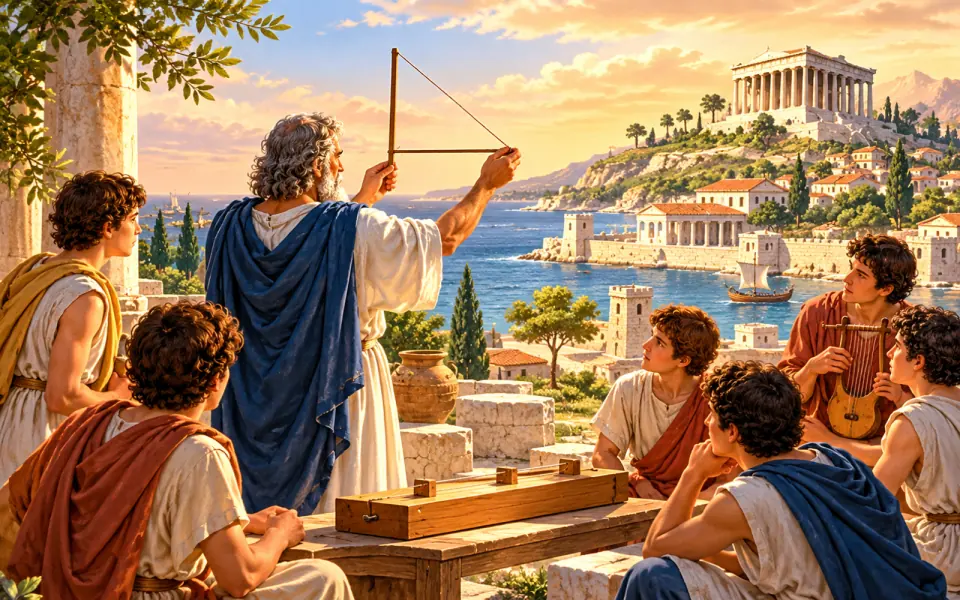
The central idea of the Pythagoreans, at least in tradition, was that reality was built on numbers. They thought that behind things there was a harmony, that is, an order made of numerical ratios. An example that was remembered is that of music. The story goes that Pythagoras, with a one-string instrument called a monochord, discovered that the musical intervals that sound good together correspond to simple ratios between the lengths of the strings. If you halve the string, the sound rises by an octave (ratio 1 to 2); with two thirds you get the fifth, with three quarters the fourth. Tradition, with its “is said to have”, does not let us say whether the discovery was Pythagoras' own or his followers'. But the idea is important: a phenomenon you hear with your ears can be described with mathematics.
For the Pythagoreans the universe itself was harmonious, almost musical, and this belief had a lasting influence on ancient thought.
The Pythagorean theorem
The theorem that bears his name says that in a right-angled triangle the square built on the hypotenuse (the longest side) equals the sum of the squares built on the other two sides, the legs. It is studied in middle school. Surprisingly, though, it is not clear that he discovered it: the property was already known to the Babylonians, who used it in their calculations long before. The tradition that attributes the theorem to Pythagoras appears only centuries after him, with Cicero and Plutarch and then with the philosopher Proclus. Perhaps it was the Pythagoreans who proved it with reasoning valid for any right-angled triangle, but this is not certain either.
The end of the community
The school of Croton, like other aristocratic communities in Magna Graecia, also attracted enmity. The sources tell different versions of the end of Pythagoras. According to one, a group of political opponents, the democrats, attacked the Pythagoreans and set fire to the house where they were gathered; Pythagoras is said to have taken refuge at Metapontum. According to another, he fled first to Locri and Taranto and then to Metapontum, where he died around 495 BC; according to a local tradition, near the temple of Hera (the “Tavole Palatine” are the remains of that temple). Even his death, in short, is told in ways that do not agree.
Legends have kept on growing. It was said, for example, that he had a wife, Theano, also a philosopher, and that women were found in his school too. These are traditions that over the centuries have made the figure of Pythagoras even more mysterious and fascinating.
Why it happened
In 6th-century BC Greece there was a great desire to understand the world with reason. At Miletus, close to Samos, philosophers such as Thales and Anaximander had begun to look for natural explanations. Pythagoras was formed in this setting and added a new idea: that the secret of nature lay in numbers and in the relations between things.
Then there was the attraction of the West. The Greek colonies in Italy were rich and young, and their elites were open to new ideas and new forms of shared life. Croton offered Pythagoras an audience and a safe place to found his community, far from the tyranny that, according to some, had led him to leave Samos.
What changed
The Pythagorean school made mathematics a subject of study in its own right, not just a tool for measuring fields or doing sums. People began to reason about numbers and figures in an abstract way and to look for proofs. This way of doing mathematics reached Plato, who visited Magna Graecia and met the Pythagoreans, and then Euclid.
The link between numbers and music survives today. Notes are described by frequencies, that is, by numerical ratios. The idea that nature obeys mathematical laws is at the base of modern physics.
The theorem that bears his name remains one of the best known in all of mathematics, and the name of Pythagoras has been associated for centuries with an idea of wisdom that joins science, music and an ordered life.
Key people and places
People
- Pythagoras
- Philosopher and teacher born on Samos (about 580–570 BC), founder of the school of Croton, died around 495 BC at Metapontum.
- Polycrates
- Tyrant of Samos, whose government Pythagoras disliked according to some scholars.
- Theano
- A figure of tradition, presented as Pythagoras' wife or pupil; her story is partly legend.
- Proclus
- Late ancient philosopher, one of the latest witnesses to the tradition that credits Pythagoras with the theorem about the right-angled triangle.
Places
- Samos
- Island in the eastern Aegean, close to Asia Minor, where tradition says Pythagoras was born.
- Croton
- Greek city in Calabria where around 530 BC Pythagoras founded his school.
- Metapontum
- Greek city in Basilicata where, according to the sources, Pythagoras died.
- Magna Graecia
- The group of Greek cities of southern Italy, where the Pythagorean school was very influential.
Good to know
- The theorem called “Pythagoras'” was already used by the Babylonians, long before him.
- According to tradition, Pythagoras discovered that halving a string raises the note by an octave, that is, it sounds the same note but higher.
- In the Pythagorean school pupils had to keep silence and follow very precise rules of life.
- The ancients told that Pythagoras was the son of the god Apollo, but historians regard this story as a legend.
- The “Tavole Palatine”, near Metapontum, are the remains of a temple dedicated to the goddess Hera, next to which according to one version Pythagoras died.
Find out more
- Wikipedia, “Pythagoras” en.wikipedia.org
- Wikipedia, “Crotone” en.wikipedia.org
- Wikipedia, “Magna Graecia” en.wikipedia.org
Related events
- Thales studies natureabout 585 BC · Ancient GreeceThales opened the way to the search for rational explanations.
- Euclid writes the Elementsabout 300 BC · Ancient GreeceEuclid put geometry in order by developing the idea of proof.
- Plato's Academyabout 387 BC · Ancient GreecePlato met the Pythagoreans and valued mathematics in his Academy.
- Babylonian mathematicsabout 1800 BC · River civilisationsThe Babylonians already knew properties of the right-angled triangle.
- Greek colonies in the Westabout 750 BC · Sea civilisationsCroton is one of the Greek colonies of Italy born from colonisation.
Before and after, in the era “Ancient Greece”
Event 8 of 25
 BeforeThe first Greek city-statesabout 800 BC
 BeforeThe ancient Olympic Gamesabout 776 BC
 BeforeThe Greek alphabetabout 750 BC
 BeforeLife in Spartaabout 700 BC
 BeforeSappho, the poet of Lesbosabout 600 BC
 BeforeThe reforms of Solonabout 594 BC
 BeforeThales studies natureabout 585 BC
- You are herePythagoras at Crotonabout 530 BC
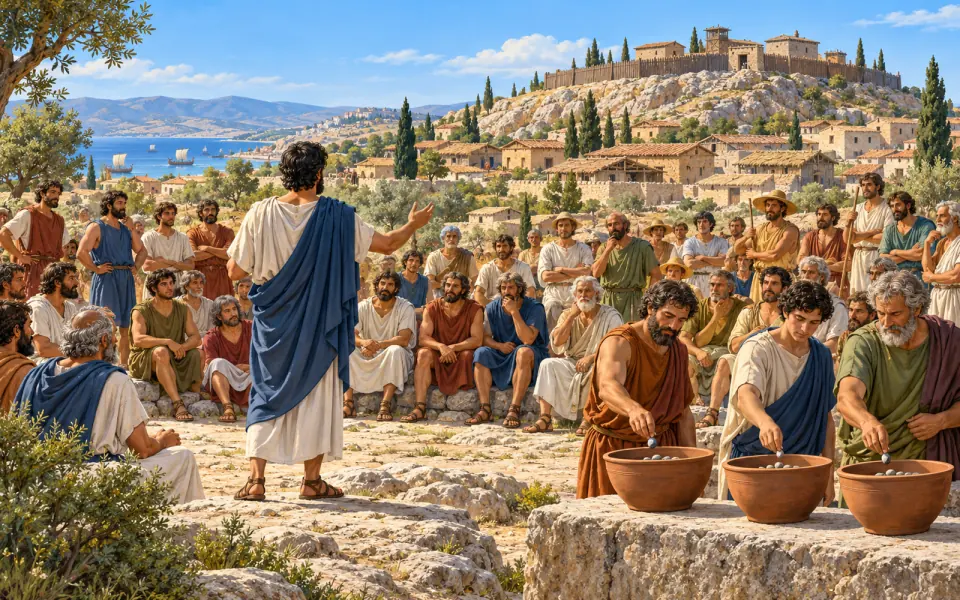 AfterCleisthenes and democracyabout 508 BC
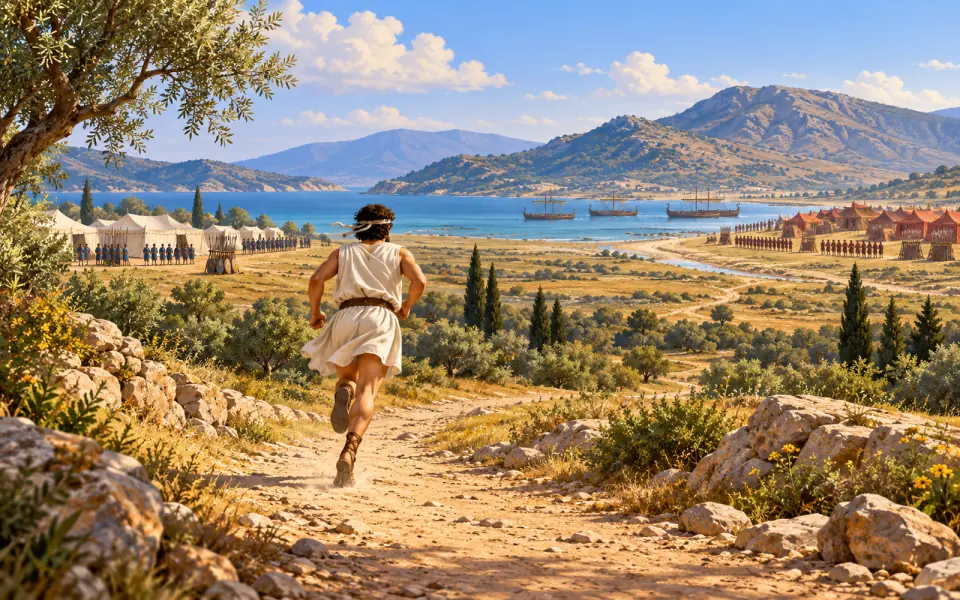 AfterThe Battle of Marathon490 BC
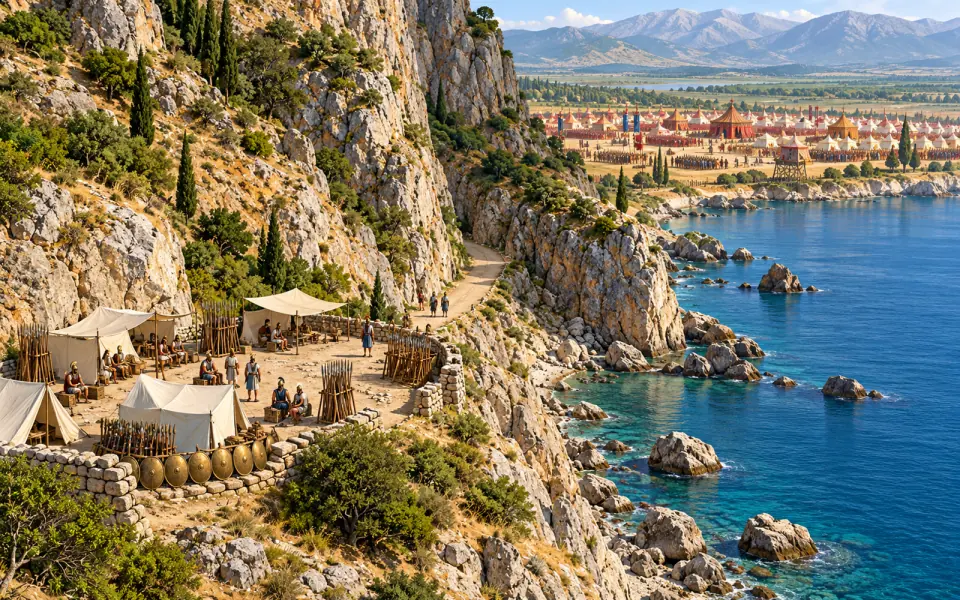 AfterThe Battle of Thermopylae480 BC
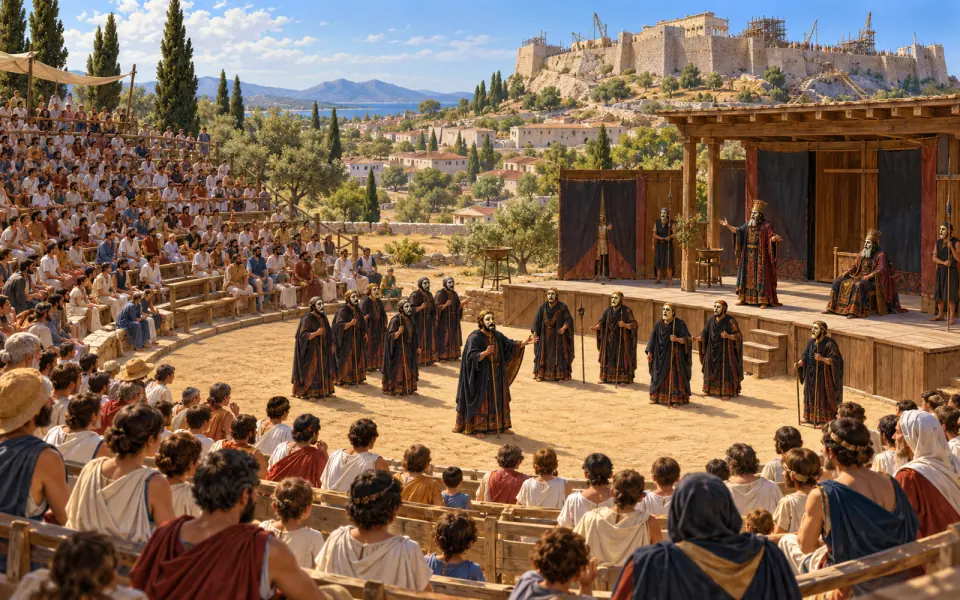 AfterThe theatre of Aeschylus472 BC
 AfterThe Age of Pericles461–429 BC
 AfterThe Parthenon447–432 BC
 AfterThe Peloponnesian War431–404 BC
 AfterHerodotus writes the Historiesabout 430 BC
 AfterHippocrates and medicineabout 400 BC
 AfterSocrates is condemned399 BC
 AfterPlato's Academyabout 387 BC
 AfterAristotle founds the Lyceumabout 335 BC
 AfterThe conquests of Alexander334–323 BC
 AfterEuclid writes the Elementsabout 300 BC
 AfterThe Library of Alexandriaabout 295 BC
 AfterArchimedes of Syracuseabout 250 BC
 AfterThe Antikythera mechanismabout 100 BC
Listen / Read next
- Music to read by: Cinematic JourneyEpic film-style music, no lyrics, by Ciro Simone IrmiciSpotifyYouTube Music
Meanwhile, elsewhere in the world
Other events of the era “Ancient Greece”
- The first Greek city-states
- The ancient Olympic Games
- The Greek alphabet
- Life in Sparta
- Sappho, the poet of Lesbos
- The reforms of Solon
- Thales studies nature
- Cleisthenes and democracy
- The Battle of Marathon
- The Battle of Thermopylae
- The theatre of Aeschylus
- The Age of Pericles
- The Parthenon
- The Peloponnesian War
- Herodotus writes the Histories
- Hippocrates and medicine
- Socrates is condemned
- Plato's Academy
- Aristotle founds the Lyceum
- The conquests of Alexander
- Euclid writes the Elements
- The Library of Alexandria
- Archimedes of Syracuse
- The Antikythera mechanism
