Euclid writes the Elements
about 300 BC Alexandria, Egypt
In short
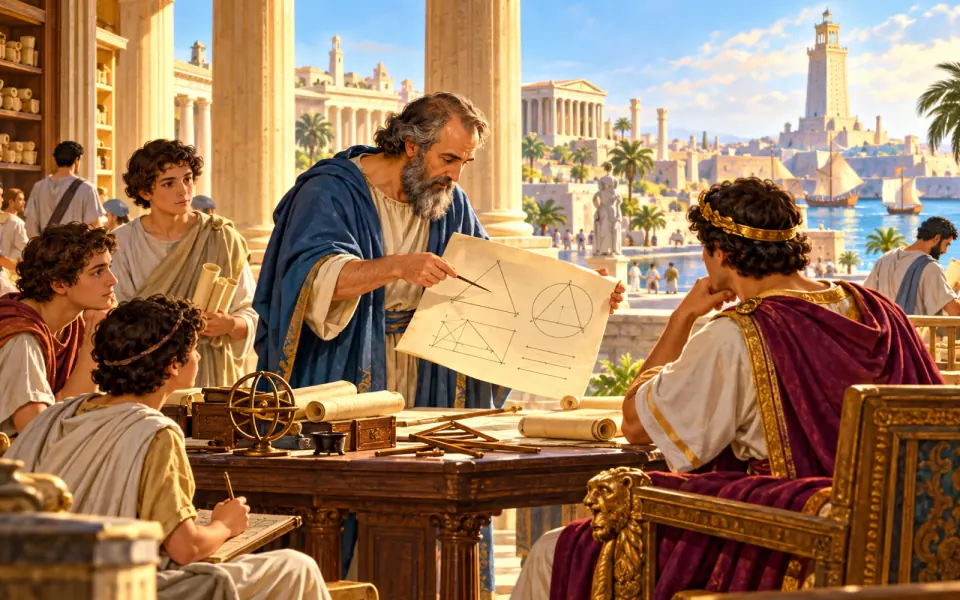
Euclid taught mathematics in Alexandria, in Egypt, the new city founded by Alexander. In his “Elements”, divided into thirteen books, he gathered and put in order what was known about geometry and numbers. He started from a few simple rules, called postulates, and from there proved hundreds of propositions step by step. It is said that when King Ptolemy asked for an easier way, Euclid replied that there is no royal shortcut to geometry.
Why it matters The “Elements” were used as a school textbook for more than two thousand years.
Source: Treccani, entry “Euclide”
Study card about 5 minutes of reading
The story
An author without a biography
Euclid is one of the most widely read authors in history, but we know almost nothing about him. We do not know his date of birth, or his birthplace, or his appearance, or his family. Scholars place him between the end of the 4th and the beginning of the 3rd century BC. The philosopher Proclus, who wrote many centuries later, tells that he was younger than Plato's disciples and older than Eratosthenes and Archimedes, and that he lived in the time of Ptolemy I, the king of Egypt. He probably taught at the Mouseion of Alexandria (this is a reconstruction, not a certain fact), the great centre of study set up by the Ptolemies. That is why our site marks the date as “about 300 BC”: it is an estimate, not a precise year.
We also know an anecdote, which may be a legend. King Ptolemy is said to have asked him whether there was a shorter way to learn geometry. Euclid is said to have answered that there is no “royal road” to geometry. As if to say: study is the same for everyone, even the powerful.
The book that put mathematics in order
The work that made him famous is called the “Elements”. It is divided into 13 books, which gather and put in order what Greek mathematicians knew in his time. Books one to six deal with plane geometry: triangles, quadrilaterals, circles, proportions. Seven to nine treat numbers and their properties. The tenth studies magnitudes that cannot be measured with whole numbers or fractions, called incommensurable. The last three books, the eleventh to the thirteenth, concern geometry in space, that is, solids.
The “Elements” are not a collection of random results. Euclid's merit is the method. Each book opens with definitions, that is, the explanation of what a point, a line, a circle is. Then come the postulates and the common notions, the few simple statements that are accepted without proof: for example, that a straight line can be drawn between two points. From these foundations Euclid proves, step by step, hundreds of propositions and theorems: each result rests on the previous ones, with no jumps. It is a building made of bricks, in which every brick is checked.
The fifth postulate
Among the postulates there is one, the fifth, that has always seemed different from the others. It concerns parallel lines, and in its simplest formulation, that of the scholar Playfair in 1795, it says that, given a line and a point outside it, only one line can be drawn parallel to the given one. If you deny this postulate you do not fall into contradiction, but you obtain other geometries: the elliptic one, in which no parallel passes through a point outside the line, and the hyperbolic one, in which at least two pass. These are the “non-Euclidean geometries”.
A book that has lasted two thousand years
The “Elements” were copied by hand for centuries and translated many times. One of the Latin versions, that of Campanus of Novara, revised starting from the translation of Adelard of Bath, was printed in Venice in 1482. For more than twenty centuries it was regarded as the model of how to write a scientific text, clear and rigorous, and until the early 20th century it was one of the main texts for teaching geometry in schools. According to a scholar cited by Wikipedia, the number of its editions has been exceeded only by that of the Bible.
Euclid also wrote other works. The “Elements” is the most famous, but among those that have come down to us, some attributed to him, are the “Optics” and the “Catoptrics”, on light and mirrors, the “Phenomena”, on astronomy, the “Data”, the “Division of the Canon”, on music, and “On Divisions of Figures”. Others, like the “Surface Loci” and the “Conics”, have been lost.
Why it happened
Euclid wrote the “Elements” because Greek mathematics had grown a great deal in the previous two centuries, but in a disorderly way. Pythagoreans, Platonists and other scholars had discovered many results, often in different schools and with different methods. Someone was needed to gather everything into a single coherent account.
The setting counted for a lot too: Alexandria. Here the Ptolemaic kings funded the Mouseion and the Library to bring together scholars from all over the Greek world. A mathematician could work with time and books at his disposal, discuss with other scientists and teach motivated pupils. The conditions were ideal for a work of synthesis like Euclid's.
What changed
The “Elements” taught people to reason. Even those who are not mathematicians have learned from that book the idea of proof: starting from a few clear principles and arriving at certain conclusions with steps that anyone can check. This way of reasoning is the basis of mathematics and, in part, of physics and philosophy.
For more than twenty centuries, the “Elements” were an exemplary text for clarity and rigour. We still speak of “Euclidean geometry” to mean the plane geometry we learn in middle school. The story of the fifth postulate, which led to the birth of non-Euclidean geometries, is a fine example of how even a very ancient book can give rise to completely new ideas.
Euclid's name lives on in the words we use at school: “Euclidean geometry”, “postulate”, “theorem”.
Key people and places
People
- Euclid
- Greek mathematician active at Alexandria around 300 BC; we know almost nothing about his life.
- Ptolemy I
- The king of Egypt in whose time Euclid lived; according to the anecdote Euclid was asked by him for an easy road to geometry.
- Proclus
- Late ancient philosopher who has left us the few facts about Euclid.
- Campanus of Novara
- Medieval scholar whose version of the “Elements” was printed in Venice in 1482.
Places
- Alexandria, Egypt
- The city founded by Alexander the Great where Euclid taught.
- Mouseion of Alexandria
- The centre of study set up by Ptolemy I, where the scholars of the time worked.
- Venice
- Here in 1482 one of the first printed versions of the “Elements” was produced.
Good to know
- The “Elements” has 13 books and contains hundreds of propositions, all proved starting from a few principles.
- According to the anecdote, to a king who wanted a shortcut Euclid replied that in geometry there are no roads reserved for kings.
- The fifth postulate, on parallel lines, has been debated by mathematicians for centuries and led to the discovery of new geometries.
- According to one scholar, no book has had more editions than the “Elements”, with the exception of the Bible.
- The book was first printed in Venice in 1482, in a version derived from medieval translations.
Find out more
- Wikipedia, “Euclid” en.wikipedia.org
- Wikipedia, “Euclid's Elements” en.wikipedia.org
- Wikipedia, “Mouseion” en.wikipedia.org
Related events
- The Library of Alexandriaabout 295 BC · Ancient GreeceThe Mouseion and the Library of Alexandria were Euclid's home.
- Pythagoras at Crotonabout 530 BC · Ancient GreecePythagoras had made mathematics a science to be studied.
- Archimedes of Syracuseabout 250 BC · Ancient GreeceArchimedes, younger, was one of the great continuers of Greek mathematics.
- The conquests of Alexander334–323 BC · Ancient GreeceAlexandria was founded by Alexander the Great.
- Babylonian mathematicsabout 1800 BC · River civilisationsThe Babylonians had already solved complex mathematical problems, without the method of proof.
Before and after, in the era “Ancient Greece”
Event 22 of 25
 BeforeThe first Greek city-statesabout 800 BC
 BeforeThe ancient Olympic Gamesabout 776 BC
 BeforeThe Greek alphabetabout 750 BC
 BeforeLife in Spartaabout 700 BC
 BeforeSappho, the poet of Lesbosabout 600 BC
 BeforeThe reforms of Solonabout 594 BC
 BeforeThales studies natureabout 585 BC
 BeforePythagoras at Crotonabout 530 BC
 BeforeCleisthenes and democracyabout 508 BC
 BeforeThe Battle of Marathon490 BC
 BeforeThe Battle of Thermopylae480 BC
 BeforeThe theatre of Aeschylus472 BC
 BeforeThe Age of Pericles461–429 BC
 BeforeThe Parthenon447–432 BC
 BeforeThe Peloponnesian War431–404 BC
 BeforeHerodotus writes the Historiesabout 430 BC
 BeforeHippocrates and medicineabout 400 BC
 BeforeSocrates is condemned399 BC
 BeforePlato's Academyabout 387 BC
 BeforeAristotle founds the Lyceumabout 335 BC
 BeforeThe conquests of Alexander334–323 BC
- You are hereEuclid writes the Elementsabout 300 BC
 AfterThe Library of Alexandriaabout 295 BC
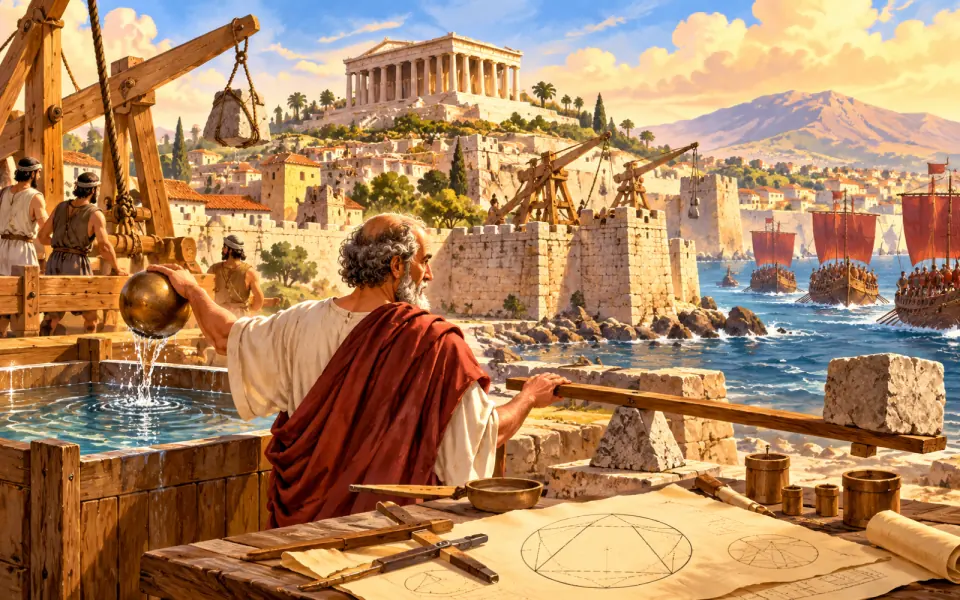 AfterArchimedes of Syracuseabout 250 BC
 AfterThe Antikythera mechanismabout 100 BC
Listen / Read next
- Music to read by: Cinematic JourneyEpic film-style music, no lyrics, by Ciro Simone IrmiciSpotifyYouTube Music
Meanwhile, elsewhere in the world
Other events of the era “Ancient Greece”
- The first Greek city-states
- The ancient Olympic Games
- The Greek alphabet
- Life in Sparta
- Sappho, the poet of Lesbos
- The reforms of Solon
- Thales studies nature
- Pythagoras at Croton
- Cleisthenes and democracy
- The Battle of Marathon
- The Battle of Thermopylae
- The theatre of Aeschylus
- The Age of Pericles
- The Parthenon
- The Peloponnesian War
- Herodotus writes the Histories
- Hippocrates and medicine
- Socrates is condemned
- Plato's Academy
- Aristotle founds the Lyceum
- The conquests of Alexander
- The Library of Alexandria
- Archimedes of Syracuse
- The Antikythera mechanism
