The Library of Alexandria
about 295 BC Alexandria, Egypt
In short
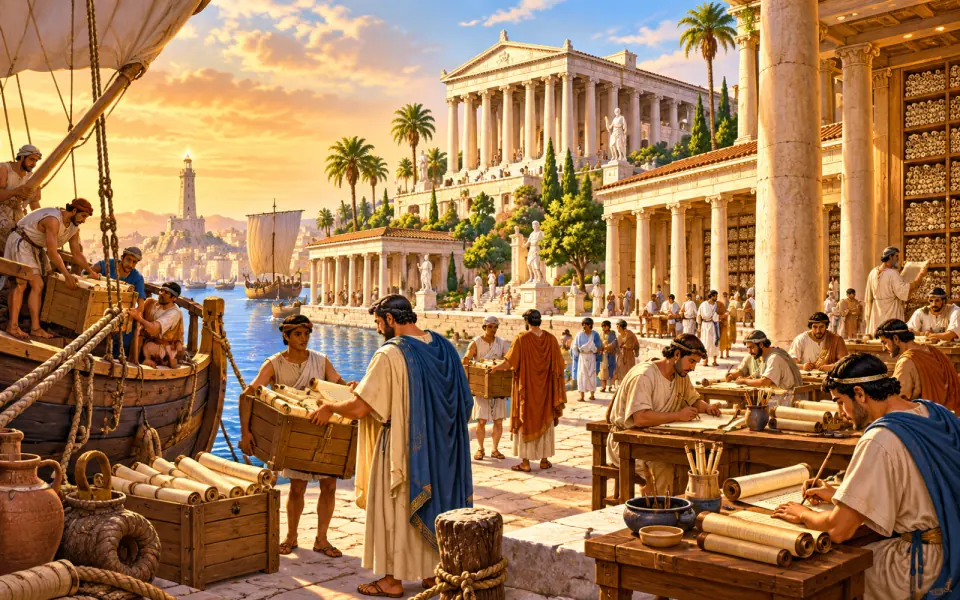
In Alexandria the Ptolemaic kings created the Museum, a centre of learning dedicated to the Muses, and next to it a vast library. The aim was to collect every book in the known world, written on papyrus scrolls. It is said that ships arriving in the harbour were searched and any books found on board were copied: the library kept the original and gave back the copy. According to ancient sources it came to hold hundreds of thousands of scrolls.
Why it matters It was the greatest centre of knowledge in the ancient world, where scientists and poets from all over the Mediterranean worked.
Source: Encyclopaedia Britannica, “Library of Alexandria”
Study card about 5 minutes of reading
The story
A new city for books
When Alexander the Great died, his generals divided the empire. In Egypt one of them, Ptolemy, took power, had himself called pharaoh and began a dynasty, the Ptolemies. He had at his disposal a new city, Alexandria, founded by Alexander on the sea, rich in trade and full of Greeks. Ptolemy I and his successors wanted to make it the capital of culture. For this they created the Mouseion, that is the “house of the Muses”, the goddesses of the arts and sciences. It was a place where scholars from every part of the Greek world could live and work. Next to the Mouseion rose the Library.
The project is probably credited to Ptolemy I, around 295 BC (the date is approximate), but the Library came into being mainly under his son Ptolemy II Philadelphus, who reigned from 283 BC, and it was he who filled its shelves. At its head was a superintendent appointed by the king. One tradition, which derives from a text called the “Letter of Aristeas” (about which scholars have doubts), credits Demetrius of Phalerum with the first organisation.
How a library was filled
In those days books were papyrus scrolls, copied by hand one by one. To gather all knowledge the Ptolemies used many means. According to an edict mentioned in the sources, books found on ships arriving in the port of Alexandria had to be handed over to the library: the owner received a copy, while the original stayed in the library. People spoke of the “books from the ships”. In this way the collection kept growing.
How many books were there? Nobody knows precisely. Modern scholars estimate about 490,000 scrolls in the time of Ptolemy II. To these was added a smaller library, that of the Serapeum, a temple in the city, with about 42,800 scrolls. But the numbers are uncertain, because a scroll could contain several works and many were duplicates.
The scholars
The Library was not a storehouse, but a laboratory. Scholars who changed culture worked there. Zenodotus of Ephesus, the first director, prepared a critical edition of Homer's poems, that is, he compared the different copies to look for the most reliable version, and arranged the books in alphabetical order. Callimachus of Cyrene probably compiled the first catalogue, the “Pinakes”. Among the librarians were also the poet Apollonius of Rhodes and the scientist Eratosthenes. In the 2nd century BC Aristophanes of Byzantium and Aristarchus of Samothrace brought the study of language and texts to a high level.
Other great names worked at the Mouseion: the mathematician Euclid, the doctor Herophilus, considered a founder of experimental medicine, and much later, in Alexandria, the scholar Hypatia. In Alexandria, moreover, the translation of the Hebrew Bible into Greek, the “Septuagint”, began in the 3rd century BC. It was a meeting place for different cultures.
The end: a long story
How did the Library end? Probably not with a single fire, as is often told. After the middle of the 2nd century BC, disorder and internal struggles gradually made the Mouseion and the Library lose importance. In 48 BC, when Julius Caesar was fighting at Alexandria, a fire in the harbour probably damaged a warehouse containing books. Ancient sources give very different figures: 40,000 books according to Seneca, 400,000 according to Orosius, 700,000 according to Aulus Gellius. But the Library survived in part: the geographer Strabo worked there between 25 and 20 BC, and the emperor Claudius enlarged the buildings.
Other blows came later. Around AD 270, during the emperor Aurelian's war against Zenobia, the royal palace quarter, where the library stood, was perhaps destroyed. In AD 391, with the edict of the emperor Theodosius I against the old cults, the Serapeum, that is the smaller library, was destroyed. Finally there is a story according to which in AD 642, after the Arab conquest, the general Amr ibn al-As burned the books on the orders of the caliph Umar. It is found in very late sources, and many scholars regard it as a legend.
Today in Alexandria there is a new library, the Bibliotheca Alexandrina, opened in 2002, which aims to recall the ancient one.
Why it happened
The Ptolemies wanted to make their kingdom, newly born and governed by a dynasty of Macedonian origin, prestigious. Having the greatest scholars and the largest collection of books in the world was a way of showing their power and legitimising their rule over Egyptians and Greeks.
There were practical reasons too. After Alexander's conquests, the knowledge of the Greeks, Egyptians, Babylonians and Persians had come into contact. It needed to be collected, translated, compared. Alexandria was the ideal place: a port open to the whole Mediterranean, where people and manuscripts arrived from everywhere. With wealth and power, the kings could afford to buy, copy and keep books.
What changed
The Library made Alexandria the capital of knowledge of the Hellenistic world. The scholars who worked there made discoveries and left working methods that are still at the base of research: the critical edition of a text, the catalogue by author, classification in alphabetical order, the comparison of manuscripts.
Many texts of antiquity have come down to us thanks to the work of copying and study done in those centuries. Even though most of the Library's books were lost, its idea, that it is useful to gather all knowledge in one place and make it available to those who study, has inspired libraries of every age.
Its history also teaches us something important about the loss of knowledge. We often think of a sudden great blaze, but in reality the end was slow: the support of rulers was lacking, institutions declined, books were no longer copied. Even today, preserving knowledge requires continuous care, not just buildings.
Key people and places
People
- Ptolemy I
- General of Alexander, first king of Egypt of the Ptolemaic dynasty: the project of the Mouseion and the Library is credited to him.
- Ptolemy II Philadelphus
- His son, who from 283 BC gave a decisive boost to the collection of books.
- Zenodotus of Ephesus
- First director of the Library, he prepared the critical edition of Homer.
- Callimachus of Cyrene
- Poet and scholar who compiled the first catalogue, the “Pinakes”.
- Eratosthenes
- Scientist and librarian, who enlarged the collection of scientific treatises.
Places
- Alexandria, Egypt
- The city on the Mediterranean founded by Alexander the Great where the Mouseion and the Library stood.
- Serapeum
- Temple of Alexandria with a smaller library, destroyed in AD 391.
- Bibliotheca Alexandrina
- The new great library of Alexandria, opened in 2002.
Good to know
- According to an edict, books found on ships in the port of Alexandria had to be handed over to the Library, which made a copy for the owner.
- It is estimated that the Library held about 490,000 papyrus scrolls in the time of Ptolemy II.
- The first catalogue by author, the “Pinakes”, was probably the work of Callimachus.
- The Greek translation of the Hebrew Bible, called the “Septuagint”, began in Alexandria in the 3rd century BC.
- The legend of the Arab fire of 642 was judged false as early as the 18th century by a scholar, Renaudot.
Find out more
- Wikipedia, “Library of Alexandria” en.wikipedia.org
- Wikipedia, “Mouseion” en.wikipedia.org
- Wikipedia, “Serapeum of Alexandria” en.wikipedia.org
- Bibliotheca Alexandrina, official site (in English) bibalex.org
Related events
- Euclid writes the Elementsabout 300 BC · Ancient GreeceEuclid worked in the Mouseion of Alexandria.
- The conquests of Alexander334–323 BC · Ancient GreeceAlexander founded the city where the Library was born.
- Aristotle founds the Lyceumabout 335 BC · Ancient GreeceAristotle, too, had gathered a library, in the Lyceum.
- Sappho, the poet of Lesbosabout 600 BC · Ancient GreeceThe scholars of Alexandria arranged Sappho's lines into books.
- The book with pages (the codex)about AD 300 · Ancient RomeThe codex, the book with pages, later replaced the papyrus scroll.
Before and after, in the era “Ancient Greece”
Event 23 of 25
 BeforeThe first Greek city-statesabout 800 BC
 BeforeThe ancient Olympic Gamesabout 776 BC
 BeforeThe Greek alphabetabout 750 BC
 BeforeLife in Spartaabout 700 BC
 BeforeSappho, the poet of Lesbosabout 600 BC
 BeforeThe reforms of Solonabout 594 BC
 BeforeThales studies natureabout 585 BC
 BeforePythagoras at Crotonabout 530 BC
 BeforeCleisthenes and democracyabout 508 BC
 BeforeThe Battle of Marathon490 BC
 BeforeThe Battle of Thermopylae480 BC
 BeforeThe theatre of Aeschylus472 BC
 BeforeThe Age of Pericles461–429 BC
 BeforeThe Parthenon447–432 BC
 BeforeThe Peloponnesian War431–404 BC
 BeforeHerodotus writes the Historiesabout 430 BC
 BeforeHippocrates and medicineabout 400 BC
 BeforeSocrates is condemned399 BC
 BeforePlato's Academyabout 387 BC
 BeforeAristotle founds the Lyceumabout 335 BC
 BeforeThe conquests of Alexander334–323 BC
 BeforeEuclid writes the Elementsabout 300 BC
- You are hereThe Library of Alexandriaabout 295 BC
 AfterArchimedes of Syracuseabout 250 BC
 AfterThe Antikythera mechanismabout 100 BC
Listen / Read next
- Music to read by: Cinematic JourneyEpic film-style music, no lyrics, by Ciro Simone IrmiciSpotifyYouTube Music
Meanwhile, elsewhere in the world
Other events of the era “Ancient Greece”
- The first Greek city-states
- The ancient Olympic Games
- The Greek alphabet
- Life in Sparta
- Sappho, the poet of Lesbos
- The reforms of Solon
- Thales studies nature
- Pythagoras at Croton
- Cleisthenes and democracy
- The Battle of Marathon
- The Battle of Thermopylae
- The theatre of Aeschylus
- The Age of Pericles
- The Parthenon
- The Peloponnesian War
- Herodotus writes the Histories
- Hippocrates and medicine
- Socrates is condemned
- Plato's Academy
- Aristotle founds the Lyceum
- The conquests of Alexander
- Euclid writes the Elements
- Archimedes of Syracuse
- The Antikythera mechanism
