Hippocrates and medicine
about 400 BC Island of Kos (Greece)
In short
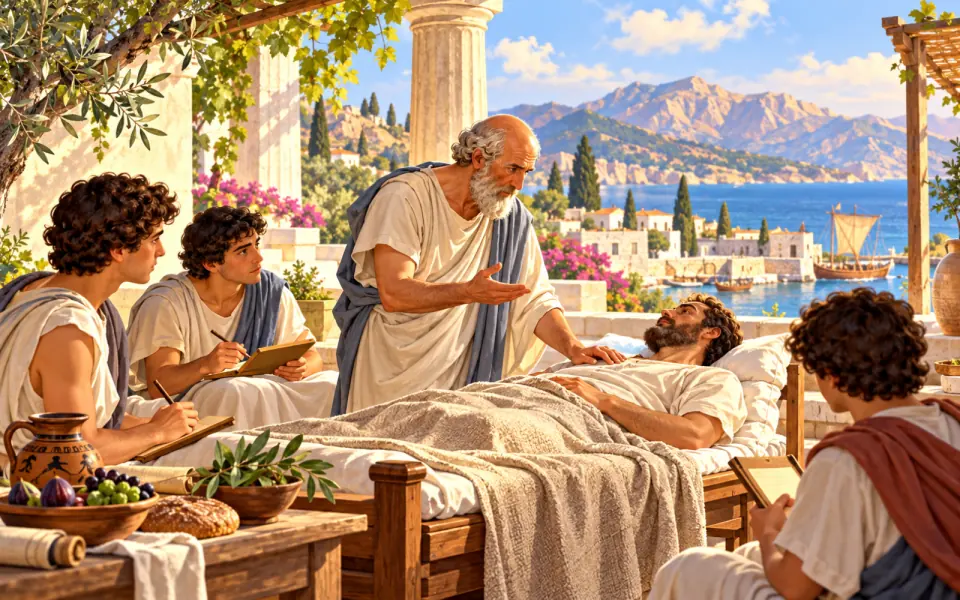
Hippocrates, a doctor born on the island of Kos, taught that illnesses have natural causes and are not punishments from the gods. To treat a patient you had to observe them carefully, listen to them and note down how the symptoms changed. He recommended rest, diet and clean air even before medicines. He and his students are credited with the oath from which the one doctors still take today comes.
Why it matters He gave medicine a method based on observation, which is still at the heart of doctors' work.
Source: Treccani, entry “Ippocrate”
Study card about 6 minutes of reading
The story
The doctor of Kos
Kos is a small Greek island in the Aegean, very close to the Turkish coast. Here, around 460 BC, Hippocrates was born. We know very little about his life. Plato and Aristotle remembered him as the most famous doctor of his time. According to the sources he practised and taught in various parts of Greece, including Athens and Thessaly, and died around 370 BC (some sources say 377). His family, according to tradition, belonged to the Asclepiads, a lineage said to descend from Asclepius, the god of medicine.
Almost everything else is open to debate. Scholars call it the “Hippocratic question”: Hippocrates was a real man, but the books that bear his name are many and come from different periods and authors. The “Hippocratic Corpus”, the collection of writings attributed to him, includes about seventy works. The oldest core dates from the end of the 5th and the beginning of the 4th century BC, others are later. The collection was probably formed at Alexandria, in the 3rd century BC, where very different texts were put together. So we do not know which ones he really wrote.
Medicine without magic
Before Hippocrates, in Greece part of the care of the sick was tied to religion, and Asclepius was the god to whom people turned. The texts of the Corpus show a different way of reasoning. Disease is not a punishment from the gods, but a natural event, with its own rules, which follows a course and passes through phases of worsening and improvement, the “crises”. One of the works in the Corpus harshly criticises healers who claim to cure with rites and spells, accusing them of quackery.
The causes, for these texts, are to be sought in the body and the environment: the climate, the place where one lives, above all diet and lifestyle. A very famous theory, set out in the treatise “On the Nature of Man”, attributed to a pupil named Polybus, says the body contains four “humours”: blood, yellow bile, black bile and phlegm. When these are in balance, there is health; when one of the four prevails, there is disease. Today we know the theory is not right, but it guided medicine for almost two thousand years.
Observing the patient
The strongest point of Hippocratic medicine is its method. The doctor must carefully observe the signs of the disease: the symptoms, but also the urine, the sweat, the breathing, the skin. He must look at the patient as a whole, with his way of life, not just the illness. With these observations he tries to make the diagnosis, that is, to recognise the illness, and the prognosis, that is, to predict how it will end. The records in which cases were noted, in the treatise “Epidemics”, are among the first examples of what we now call clinical histories.
Treatments were mostly dietary. Diet, for the Greeks, included the whole rule of life: food, exercise, baths. Drugs had a secondary role, mostly herbal infusions. Bloodletting and surgery were also practised, especially for fractures and dislocations. It was above all a medicine that let nature do its work: the doctor had to assist the body's healing power, an idea later summed up in the Latin formula vis medicatrix naturae, the “healing power of nature”.
The Oath
The most famous text linked to Hippocrates is the Oath. Those who swore it called on Apollo the physician, Asclepius, Hygieia and Panacea, and promised to treat their teacher like a father, to do good to the sick and not to harm them, not to give deadly drugs even if asked, and to keep secret what they saw or heard in the practice of the profession. Scholars are not sure it is Hippocrates' work: the text is probably from the 4th century BC or later, and may reflect the rules of a group of doctors with Pythagorean leanings. In antiquity it was not used as we use it today; it became a kind of moral code of the profession mainly in Christian times.
“Life is short”
A famous maxim is also linked to the Hippocratic tradition: “life is short”. It reminds us that the time for learning and for healing is little, and that the doctor must therefore use it well.
Why it happened
In the 5th century BC the Greeks were learning to explain nature without resorting to the gods. Philosophers like Thales had looked for natural causes for the phenomena of the sky and the earth. Doctors applied the same way of thinking to the human body: if the world has laws, illnesses must have them too.
In addition, Greece was a suitable place: small cities, many travellers, constant exchange of ideas. Doctors travelled from city to city, saw many different cases and compared their experiences. Writing these cases down, in books that could be discussed and corrected, made medicine a body of knowledge that grew over time.
What changed
From the Hippocratic school came the idea that medicine is a rational craft: you observe, you reason, you record cases. From the 3rd century BC the scholars of Alexandria collected and commented on the Corpus, and this tradition of commentary lasted until the 19th century. Galen, the great Roman doctor, considered himself an heir of Hippocrates, and for centuries European and Islamic medicine was built on his texts.
The theory of the four humours remained in use for a very long time, until the discovery of microbes and the study of the body with modern instruments replaced it. But the habit of carefully observing the patient, noting the symptoms, assessing the course of the illness and not promising impossible cures has remained.
The Oath is still a reference today. Italian doctors recite a modern text, updated by their federation in 2014, which takes up its principles: to treat every patient without discrimination, to respect professional secrecy, not to carry out acts aimed at causing death. It is an example of how an idea born more than two thousand years ago can still guide the behaviour of a profession.
Key people and places
People
- Hippocrates of Kos
- Greek doctor (about 460–370 BC), considered the founder of rational medicine in Greece.
- Polybus
- Pupil of Hippocrates, to whom the treatise on the nature of man with the theory of the four humours is attributed.
- Galen
- Doctor of the 2nd century AD, a great commentator on Hippocrates.
- Asclepius
- The Greek god of medicine: the Asclepiad doctors said they were his descendants.
Places
- Kos
- Aegean island where Hippocrates was born.
- Thessaly
- Region of northern Greece where Hippocrates practised.
- Alexandria, Egypt
- The city where, in the 3rd century BC, the collection of Hippocratic writings was probably put together.
Good to know
- The “Hippocratic Corpus” includes about seventy writings, but scholars think few are really by Hippocrates.
- For Hippocratic doctors the body contained four humours: blood, yellow bile, black bile and phlegm.
- The Oath begins by calling the gods of medicine as witnesses: Apollo the physician, Asclepius, Hygieia and Panacea.
- The maxim “life is short” is linked to the Hippocratic tradition: it was even taken up in an inscription on a tomb at Ostia.
- Italian doctors still recite an oath inspired by the ancient one, updated in 2014.
Find out more
- Wikipedia, “Hippocrates” en.wikipedia.org
- Wikipedia, “Hippocratic Oath” en.wikipedia.org
- Wikipedia, “Hippocratic Corpus” en.wikipedia.org
Related events
- Galen, a doctor in Romeabout AD 162 · Ancient RomeGalen carried on Hippocrates' work in the Roman world.
- The Medical School of Salernoabout AD 950 · Early Middle AgesThe Salerno Medical School inherited the Hippocratic tradition.
- Thales studies natureabout 585 BC · Ancient GreeceThales had opened the way to a natural explanation of phenomena.
- The Library of Alexandriaabout 295 BC · Ancient GreeceThe Hippocratic Corpus was collected at Alexandria.
- The discovery of penicillin1928 · Early 20th centuryPenicillin is an example of medicine based on observation and method.
Before and after, in the era “Ancient Greece”
Event 17 of 25
 BeforeThe first Greek city-statesabout 800 BC
 BeforeThe ancient Olympic Gamesabout 776 BC
 BeforeThe Greek alphabetabout 750 BC
 BeforeLife in Spartaabout 700 BC
 BeforeSappho, the poet of Lesbosabout 600 BC
 BeforeThe reforms of Solonabout 594 BC
 BeforeThales studies natureabout 585 BC
 BeforePythagoras at Crotonabout 530 BC
 BeforeCleisthenes and democracyabout 508 BC
 BeforeThe Battle of Marathon490 BC
 BeforeThe Battle of Thermopylae480 BC
 BeforeThe theatre of Aeschylus472 BC
 BeforeThe Age of Pericles461–429 BC
 BeforeThe Parthenon447–432 BC
 BeforeThe Peloponnesian War431–404 BC
 BeforeHerodotus writes the Historiesabout 430 BC
- You are hereHippocrates and medicineabout 400 BC
 AfterSocrates is condemned399 BC
 AfterPlato's Academyabout 387 BC
 AfterAristotle founds the Lyceumabout 335 BC
 AfterThe conquests of Alexander334–323 BC
 AfterEuclid writes the Elementsabout 300 BC
 AfterThe Library of Alexandriaabout 295 BC
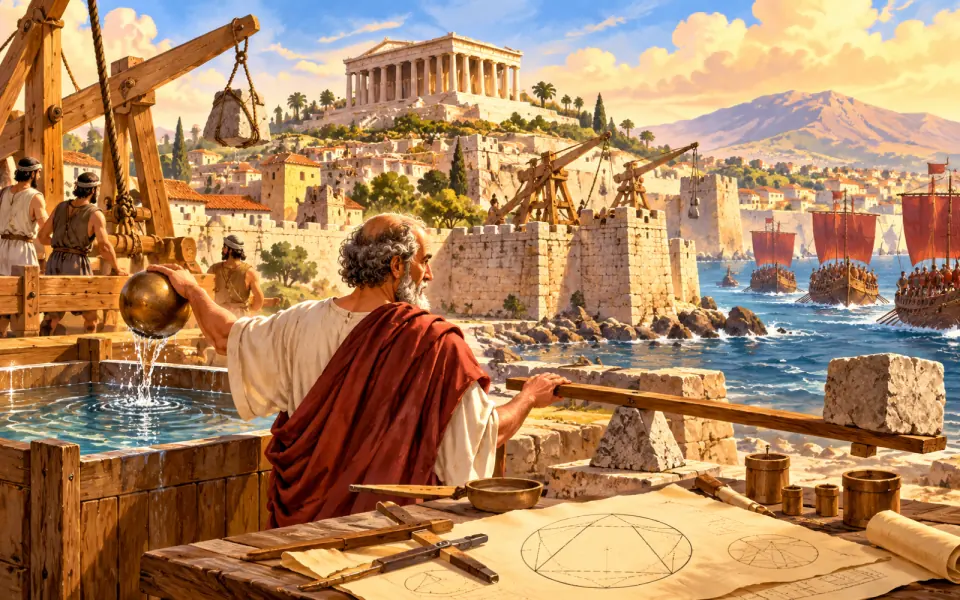 AfterArchimedes of Syracuseabout 250 BC
 AfterThe Antikythera mechanismabout 100 BC
Listen / Read next
- Music to read by: Cinematic JourneyEpic film-style music, no lyrics, by Ciro Simone IrmiciSpotifyYouTube Music
Meanwhile, elsewhere in the world


Other events of the era “Ancient Greece”
- The first Greek city-states
- The ancient Olympic Games
- The Greek alphabet
- Life in Sparta
- Sappho, the poet of Lesbos
- The reforms of Solon
- Thales studies nature
- Pythagoras at Croton
- Cleisthenes and democracy
- The Battle of Marathon
- The Battle of Thermopylae
- The theatre of Aeschylus
- The Age of Pericles
- The Parthenon
- The Peloponnesian War
- Herodotus writes the Histories
- Socrates is condemned
- Plato's Academy
- Aristotle founds the Lyceum
- The conquests of Alexander
- Euclid writes the Elements
- The Library of Alexandria
- Archimedes of Syracuse
- The Antikythera mechanism
