Socrates is condemned
399 BC Agora of Athens (Greece)
In short
Socrates spent his days in the squares of Athens asking questions: what is justice? what is courage? He said he knew only one thing, that he knew nothing, and he helped others to think for themselves. He wrote nothing down: we know him thanks to his students, above all Plato. In 399 BC he was accused of not respecting the city's gods and of corrupting the young, and he was sentenced to death.
Why it matters His death, which he accepted without running away, made him the symbol of people who stay true to their ideas.
Source: Treccani, entry “Socrate”
Study card about 6 minutes of reading
The story
The man who asked questions
Socrates was born in Athens in 470 or 469 BC. His father, Sophroniscus, was perhaps a sculptor, but this is not certain; his mother, Phaenarete, was a midwife. He married Xanthippe and had three sons. As a young man he served as a hoplite, the foot soldier with shield and spear: he took part in three campaigns of the Peloponnesian War, at Potidaea, Delium and Amphipolis. It is said that in war he stood out for courage and endurance.
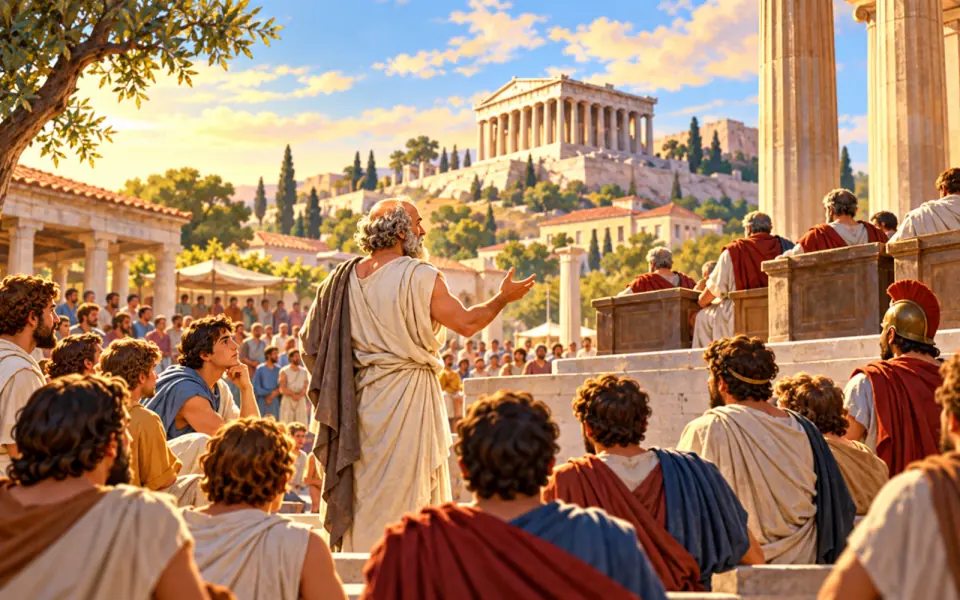
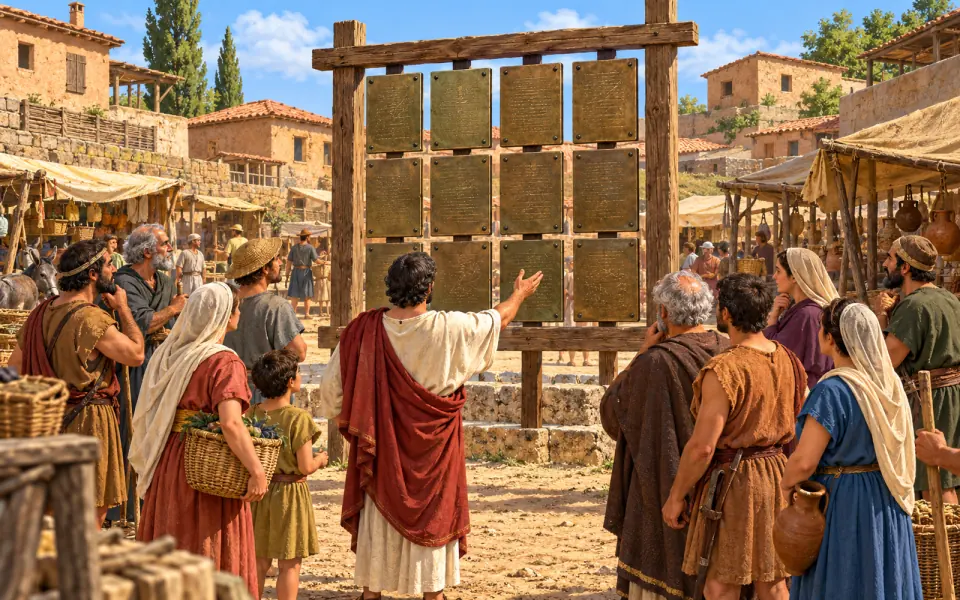
He was not a teacher like the others. He did not give lessons for money and did not write books. He spent his days in the agora, the square of Athens, stopping all kinds of people, politicians, craftsmen, young men, and asking questions: what is justice? what is courage? what is virtue? When someone answered, Socrates asked another question, then another, until the other person realised he did not really know what he thought he knew.
Knowing that you do not know
Why did he behave like this? The most famous story comes from Plato. A friend of Socrates, Chaerephon, went to the sanctuary of Delphi and asked the oracle of Apollo, the Pythia, who was the wisest man in Athens. The answer was: Socrates. He was surprised, because he said he knew nothing. So he began to question the Athenians who passed for wise, to understand what the oracle meant. He concluded that the others thought they knew and did not, while he at least knew that he did not know. He was wise only in this.
The method he used is called “maieutics”, which means “the art of the midwife”, like his mother. As a midwife helps babies to be born, Socrates wanted to help people bring out the ideas they already had inside, by reasoning with their own heads. That is why he used short, simple questions, in contrast with the long speeches of the sophists, the teachers of rhetoric who taught how to persuade. He often used irony, that is, he pretended not to know in order to make people think.
An awkward citizen
What Socrates did did not please everyone. Showing before young people that the powerful did not know what they claimed to know could be very irritating. Moreover, some of his followers had played an ugly part in the history of Athens. Critias had been the head of the Thirty Tyrants, the oligarchic regime imposed by Sparta after the war, while Alcibiades had betrayed Athens by going over to Sparta. When democracy returned to power, many looked with suspicion on the man who had been the teacher of those men.
The trial
In 399 BC Socrates was accused before the people's court. The official charge was not recognising the gods of the city and corrupting the young. The formal accuser was a certain Meletus, but behind him stood Anytus and Lycon, figures of the democratic regime. The jury probably consisted of 501 citizens. Socrates defended himself with a speech that Plato has handed down to us, the “Apology of Socrates”. He did not ask for mercy and did not change his way of speaking.
He was declared guilty, but narrowly: according to Plato thirty more votes would have been enough to acquit him (a count of 280 against 221 has been reconstructed). At that point the penalty had to be decided: the prosecution asked for death; according to custom, the accused could also propose an alternative. Socrates proposed to be kept at the city's expense in the Prytaneion, then to pay a fine of one mina and finally, at his friends' insistence, of thirty minas. The judges did not accept: with about 360 votes against 140 (traditional figures) they chose the death penalty, which was carried out with a drink of hemlock, a poison.
The last days
His friends organised a plan to get him out of prison. Socrates refused. In the dialogue “Crito” Plato tells his reasons: he had lived all his life under the laws of Athens and did not want to break them now, even though he thought the sentence unjust. In the “Phaedo” Plato describes the last moments, with the disciples around him talking about the soul.
How we know about him
Since Socrates wrote nothing, the Socrates we know is the one described by his pupils. Plato devoted almost all his dialogues to him. Xenophon wrote about him in a different way, and the comic playwright Aristophanes put him on stage in the comedy “The Clouds”, as a strange teacher with his head in the clouds. The three images do not match, and it is hard to separate the real man from the character. What remains clear is his method: asking questions, checking the answers, not settling for common opinions.
Why it happened
The trial was the fruit of a difficult moment. Athens had just come out of the Peloponnesian War, had lost it and had lived through the dictatorship of the Thirty Tyrants. Democracy had been restored, but there was fear and distrust. Anyone who could be linked to the tyrants or the traitors risked a great deal, and Socrates had been the teacher of both Critias and Alcibiades.
His character mattered too. Socrates questioned the convictions of the Athenians, including the most respected politicians and teachers, and could not stand superficial answers. For many it was a way of helping the city to think; for others, a dangerous provocateur who weakened respect for tradition and for the gods. The charges of impiety and of corrupting the young were the legal form of a feeling of hostility.
What changed
The death of Socrates left a deep mark, above all on Plato, who had been his pupil. Plato wrote his dialogues to defend his teacher's memory and continue his search, and later founded the Academy. From there came a chain of philosophers: Plato, Aristotle and all those who followed them.
Socrates has become a symbol. He stands for the idea that thinking freely and seeking truth are more important than personal safety, and that those who live in a community must respect its laws even when they find them unjust. That is why his case is still studied in schools, and many people have appealed to him when facing a power that wanted to silence them.
It also remains a warning. Athens, which boasted of its freedom of speech, condemned to death the most famous of its citizens for his ideas. It is a lesson in how careful democracies must be to protect dissent, especially in times of fear. Today, in everyday language, “Socratic method” and “Socratic irony” mean the way of making others think with questions.
Key people and places
People
- Socrates
- Athenian philosopher (470/469–399 BC) who sought truth by questioning people.
- Plato
- His pupil: in his dialogues he tells of his teacher's trial and death.
- Meletus, Anytus and Lycon
- Socrates' accusers: Meletus before the jury, the other two behind him.
- Chaerephon
- Friend of Socrates who asked the oracle of Delphi who was the wisest.
- Xanthippe
- Socrates' wife, mother of his three sons.
Places
- Agora of Athens
- The great square where Socrates talked with people.
- Delphi
- Sanctuary of Apollo, where the oracle gave its answer about Socrates.
- Potidaea, Delium and Amphipolis
- The places of the three military campaigns in which Socrates fought as a soldier.
Good to know
- The jury that judged Socrates was made up of 501 citizens.
- For him the only true wisdom was knowing that you know nothing.
- The word “maieutics” comes from the Greek for “midwife”, the trade of his mother Phaenarete.
- Socrates refused to escape from prison, even though his friends had already organised a plan.
- Socrates also appears in Aristophanes' comedy “The Clouds”, which made fun of him while he was still alive.
Find out more
- Wikipedia, “Socrates” en.wikipedia.org
- Wikipedia, “Plato” en.wikipedia.org
- Wikipedia, “Apology (Plato)” en.wikipedia.org
Related events
- Plato's Academyabout 387 BC · Ancient GreecePlato, a pupil of Socrates, founded the Academy.
- The Peloponnesian War431–404 BC · Ancient GreeceThe trial took place in the Athens that emerged from the Peloponnesian War.
- Aristotle founds the Lyceumabout 335 BC · Ancient GreeceAristotle was a pupil of Plato: Greek philosophy continues the search of Socrates.
- Cleisthenes and democracyabout 508 BC · Ancient GreeceThe Athenian democracy that condemned Socrates was born with Cleisthenes.
- The Age of Pericles461–429 BC · Ancient GreeceSocrates lived in the Athens of Pericles, the city where public discussion was a habit.
Before and after, in the era “Ancient Greece”
Event 18 of 25
 BeforeThe first Greek city-statesabout 800 BC
 BeforeThe ancient Olympic Gamesabout 776 BC
 BeforeThe Greek alphabetabout 750 BC
 BeforeLife in Spartaabout 700 BC
 BeforeSappho, the poet of Lesbosabout 600 BC
 BeforeThe reforms of Solonabout 594 BC
 BeforeThales studies natureabout 585 BC
 BeforePythagoras at Crotonabout 530 BC
 BeforeCleisthenes and democracyabout 508 BC
 BeforeThe Battle of Marathon490 BC
 BeforeThe Battle of Thermopylae480 BC
 BeforeThe theatre of Aeschylus472 BC
 BeforeThe Age of Pericles461–429 BC
 BeforeThe Parthenon447–432 BC
 BeforeThe Peloponnesian War431–404 BC
 BeforeHerodotus writes the Historiesabout 430 BC
 BeforeHippocrates and medicineabout 400 BC
- You are hereSocrates is condemned399 BC
 AfterPlato's Academyabout 387 BC
 AfterAristotle founds the Lyceumabout 335 BC
 AfterThe conquests of Alexander334–323 BC
 AfterEuclid writes the Elementsabout 300 BC
 AfterThe Library of Alexandriaabout 295 BC
 AfterArchimedes of Syracuseabout 250 BC
 AfterThe Antikythera mechanismabout 100 BC
Listen / Read next
- Music to read by: Cinematic JourneyEpic film-style music, no lyrics, by Ciro Simone IrmiciSpotifyYouTube Music
Meanwhile, elsewhere in the world
Other events of the era “Ancient Greece”
- The first Greek city-states
- The ancient Olympic Games
- The Greek alphabet
- Life in Sparta
- Sappho, the poet of Lesbos
- The reforms of Solon
- Thales studies nature
- Pythagoras at Croton
- Cleisthenes and democracy
- The Battle of Marathon
- The Battle of Thermopylae
- The theatre of Aeschylus
- The Age of Pericles
- The Parthenon
- The Peloponnesian War
- Herodotus writes the Histories
- Hippocrates and medicine
- Plato's Academy
- Aristotle founds the Lyceum
- The conquests of Alexander
- Euclid writes the Elements
- The Library of Alexandria
- Archimedes of Syracuse
- The Antikythera mechanism
