Manzoni's The Betrothed
1827 Milan, Italy
In short
Alessandro Manzoni, a writer from Milan, told the story of Renzo and Lucia, two young people from a village on Lake Como who are prevented from marrying by a bullying local lord, Don Rodrigo. The novel is set in the 17th century, amid famine, war and plague, when Lombardy was under Spanish rule. The first edition came out between 1825 and 1827; then Manzoni rewrote it in a language closer to the Florentine spoken at the time. The final edition was published between 1840 and 1842.
Why it matters It helped to build a shared Italian language, and it is still studied in every Italian school today.
Source: Treccani, entry “Promessi sposi, I”
Study card about 6 minutes of reading
The story
“That branch of Lake Como”
This is how the most famous novel in Italian literature begins: “That branch of Lake Como, which turns towards the south, between two unbroken chains of mountains, all coves and bays, according to the jutting out and drawing back of those mountains, suddenly narrows...”. Anyone who has studied it at school remembers this long sentence, and perhaps remembers how hard it was to read. But behind that novel, “The Betrothed” (“I promessi sposi”), there is a story full of adventure, humour and courage.
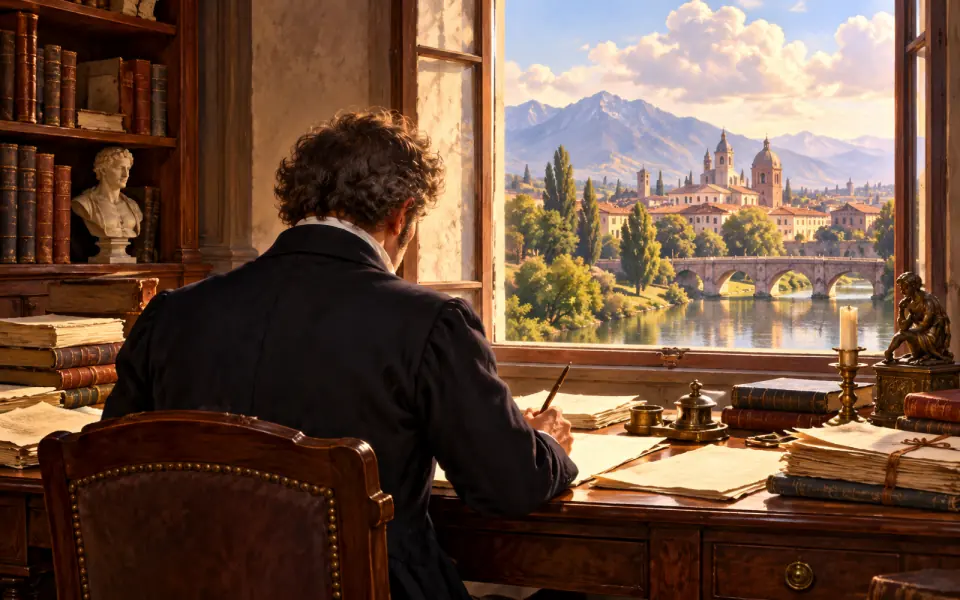
The author, Alessandro Manzoni, was born in Milan in 1785 into a noble family, and lived in a time of great change: the French Revolution, Napoleon, the Restoration. On his mother's side he was the grandson of Cesare Beccaria, the Enlightenment thinker who wrote “On Crimes and Punishments”. As a young man he lived in Paris, where he came to know the ideas of the Enlightenment, but after returning to Milan, following a spiritual crisis, he turned back to the Catholic faith, which influenced all his work.
A story from the 1600s
Manzoni worked on the novel for years, starting in 1821, writing a first version entitled “Fermo and Lucia”. He then reworked everything over several years, and between 1825 and 1827 he published the first edition of “The Betrothed”, in three volumes. The story is set in Lombardy in 1628–1630, when the country was ruled by the Spanish, a time of bullying, famine and plague. At the start Manzoni says that he found the story in an old 17th-century manuscript and has only rewritten it in language that is easier to understand: it was a literary trick, a game.
The main characters are two young people of humble background, Renzo, a silk spinner, and Lucia, an honest girl. They are about to get married, but a bullying local lord, Don Rodrigo, has fallen for Lucia and, because of a bet with his cousin, wants to stop the wedding. He sends his “bravi”, armed men, to threaten the village priest, Don Abbondio, a fearful man, who says: “This marriage is not to be, neither tomorrow, nor ever”. Don Abbondio, out of fear, refuses to perform the wedding.
Flight, riots and plague
With the help of a brave friar, Fra Cristoforo, Renzo and Lucia try to escape Don Rodrigo's persecution, and have to separate. Lucia takes refuge in a convent at Monza, where she meets the mysterious nun Gertrude, a victim of her family's demands. Renzo goes to Milan, where he finds himself in the middle of a popular revolt over the price of bread, in November 1628, and is mistaken for a ringleader of the rioters: he has to flee to another state.
Lucia, kidnapped by Don Rodrigo's men, is taken to the castle of a powerful lord, the Unnamed, a cruel man. But, shaken by her sadness and her prayers, the Unnamed has a crisis and is converted: he sets her free. Cardinal Federigo Borromeo, Archbishop of Milan, welcomes him with great kindness.
Then war and plague, brought by the foreign troops of the Landsknechts, devastate Lombardy. Milan is struck by a terrible epidemic, and Renzo, who has caught the disease and recovered, goes back to the city to look for Lucia in the lazzaretto, the hospital where the sick were crowded together. There he finds Fra Cristoforo, who dies caring for the sick, and Lucia, who has fallen ill and recovered. Don Rodrigo dies of plague. In the end, the two young people can marry.
A language for Italy
Manzoni did not only want to tell a story. At the time Italy was divided into several states, and there was no language spoken by everyone: each person used their own dialect, and written Italian was a literary language, far from the language of everyday life. Manzoni thought that a united Italy would need a common language, one that was alive and easy to understand.
So, after the first edition, he revised the whole novel, and in 1840–42 he published a new edition, “the Quarantana”, with illustrations by Francesco Gonin. To do this, he went to Florence, where, he said, the liveliest Italian was spoken, and he went “to rinse his clothes in the Arno”: he replaced many Lombard and literary words with Florentine ones. The novel became a model of the language for millions of Italians. For the first anniversary of Manzoni's death (1874), the composer Giuseppe Verdi wrote a great Requiem Mass for him.
Why it happened
Manzoni wrote the novel to make the readers of his day think. The Spanish 17th century, with its injustices and abuses, helped him to speak about the problems of the Italy of his own time, ruled by foreigners, and to tell of the suffering of ordinary people.
He was influenced by the historical novels of the Scottish writer Walter Scott, which were a great success in Europe, and by his religious beliefs: he believed that Providence, that is God's help, guided history, and that even the poor and the weak had dignity and worth.
What changed
“The Betrothed” is considered the first great Italian novel, and it has inspired writers, film-makers, comics and television serials. Many phrases have entered everyday language: “This marriage is not to be”, “Carneades! Who was he?”, “Farewell, mountains rising from the waters”.
The novel had an important effect on the language: it helped to create a common Italian, spoken and written, which later spread through school, military service and then radio and television. Manzoni, who became a senator of the Kingdom of Italy in 1860, was regarded as a father of the nation's literature.
It is still read and studied in Italian schools today. Some find it difficult, others love it for its irony and the depth of its characters: Don Abbondio, for example, is a portrait of someone who, out of fear, gives up doing his duty. It remains a work about injustice, hope and the ability of ordinary people to resist.
Key people and places
People
- Alessandro Manzoni
- Italian writer and poet (1785–1873): author of “The Betrothed”.
- Walter Scott
- Scottish writer (1771–1832): master of the historical novel, a source of inspiration for Manzoni.
- Francesco Gonin
- Piedmontese painter and illustrator (1808–1889): he made the illustrations for the “Quarantana”.
- Giuseppe Verdi
- Italian composer (1813–1901): he wrote the Requiem Mass in memory of Manzoni.
- Federigo Borromeo
- Archbishop of Milan (1564–1631): a real historical figure, who appears in the novel.
Places
- Lecco and Lake Como, Lombardy
- The places where the beginning of the novel is set.
- Casa del Manzoni, Milan
- The house where Manzoni lived for many years, now a museum.
Good to know
- The first edition of “The Betrothed” came out in 1825–27, the final one, with illustrations, in 1840–42.
- Manzoni went to Florence to “rinse his clothes in the Arno”, that is, to make the language more alive.
- The novel is set in Lombardy in 1628–1630, during Spanish rule and the plague.
- Verdi wrote his Requiem Mass in memory of Manzoni, who died in 1873.
- The sentence “This marriage is not to be” is one of the most famous in Italian literature.
Find out more
- Wikipedia, “The Betrothed” en.wikipedia.org
- Wikipedia, “Alessandro Manzoni” en.wikipedia.org
- Casa del Manzoni, Milan (in Italian) casadelmanzoni.it
- Wikipedia, “Walter Scott” en.wikipedia.org
Related events
- The Black Death1347–1352 · Late Middle AgesThe plague of 1630, described in the novel, recalls the Black Death of the 14th century.
- The European Enlightenmentabout 1720 · Age of revolutionsCesare Beccaria, the great Enlightenment thinker, was Manzoni's maternal grandfather.
- The unification of Italy1861 · Age of revolutionsA few decades later, Italy was united.
- Shakespeare's theatreabout 1590 · Early modern ageLike Shakespeare for English, Manzoni is a reference author for Italian.
Before and after, in the era “Age of revolutions”
Event 15 of 25
 BeforeNewcomen's steam engine1712
 BeforeThe European Enlightenmentabout 1720
 BeforeDiderot's Encyclopédie1751
 BeforeWatt's steam engine1769
 BeforeThe American Revolution1776–1783
 BeforeThe first hot-air balloon flight1783
 BeforeThe French Revolution1789–1799
 BeforeThe metric system1795
 BeforeJenner's vaccine1796
 BeforeVolta's battery1800
 BeforeNapoleon becomes emperor1804
 BeforeThe Congress of Vienna1815
 BeforeThe first public steam railway1825
 BeforeNiépce's photographabout 1826
- You are hereManzoni's The Betrothed1827
 AfterThe electric telegraph1844
 AfterThe revolutions of 18481848
 AfterDarwin publishes On the Origin of Species1859
 AfterThe Expedition of the Thousand1860
 AfterThe unification of Italy1861
 AfterThe labour movementabout 1864
 AfterCompulsory primary school (Coppino law)1877
 AfterA practical electric light bulb1879
 AfterThe first modern motor car1886
 AfterThe Lumière brothers' cinema1895
Listen / Read next
- Music to read by: Cinematic JourneyEpic film-style music, no lyrics, by Ciro Simone IrmiciSpotifyYouTube Music
Meanwhile, elsewhere in the world
Other events of the era “Age of revolutions”
- Newcomen's steam engine
- The European Enlightenment
- Diderot's Encyclopédie
- Watt's steam engine
- The American Revolution
- The first hot-air balloon flight
- The French Revolution
- The metric system
- Jenner's vaccine
- Volta's battery
- Napoleon becomes emperor
- The Congress of Vienna
- The first public steam railway
- Niépce's photograph
- The electric telegraph
- The revolutions of 1848
- Darwin publishes On the Origin of Species
- The Expedition of the Thousand
- The unification of Italy
- The labour movement
- Compulsory primary school (Coppino law)
- A practical electric light bulb
- The first modern motor car
- The Lumière brothers' cinema
