Niépce's photograph
about 1826 Saint-Loup-de-Varennes, France
In short
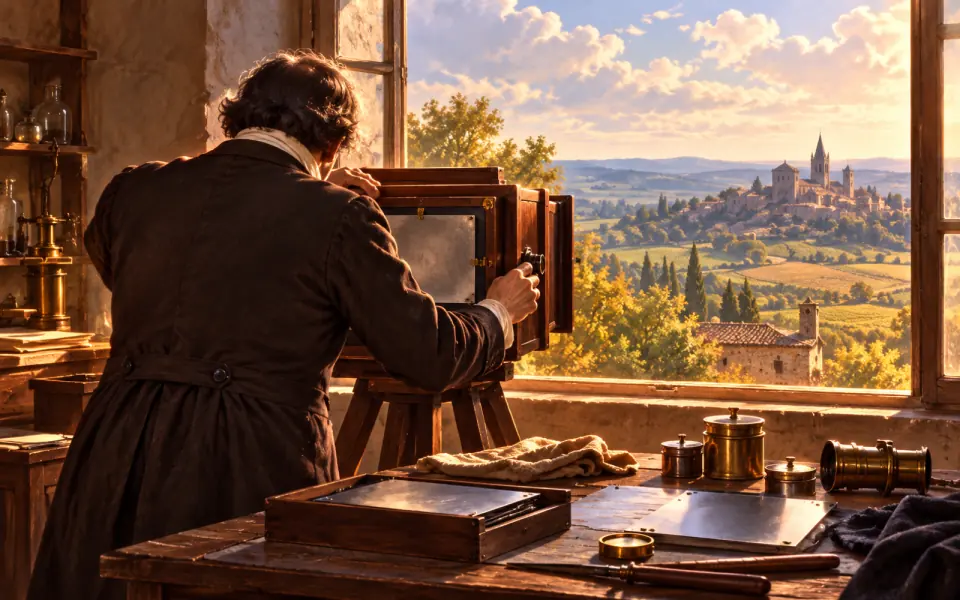
Nicéphore Niépce, a French inventor, was looking for a way to fix the images that form inside a camera obscura. He placed a pewter plate coated with bitumen, a substance that hardens in light, in front of the window of his country house at Saint-Loup-de-Varennes. After a very long exposure, hours or perhaps days, a view of the roofs and the courtyard appeared. It is the oldest surviving photograph of a real scene.
Why it matters From that blurry plate came photography, which has changed the way we remember and tell the story of the world.
Source: Harry Ransom Center, University of Texas at Austin, “The First Photograph”
Study card about 5 minutes of reading
The story
Catching the light
Since ancient times people had known about a curious effect: if there is a small hole in the wall of a dark room, an upside-down picture of whatever is outside, with its colours and movements, appears on the opposite wall. This is the idea behind the “camera obscura”, which means “dark room” in Latin. Arab scientists such as Ibn al-Haytham studied it carefully in the 11th century, and Renaissance painters such as Leonardo used it to understand perspective. Once a lens was added, the camera obscura became a portable device: a box in which you could see a landscape and trace it with a pencil.
But nobody knew how to fix that picture: the light came in and the image appeared on the wall, but it vanished as soon as the box was moved. What was needed was a substance that would change when light fell on it and keep the mark.
An inventor in the countryside
Joseph Nicéphore Niépce was born in 1765 in Chalon-sur-Saône, in France, into a wealthy family of lawyers. During the Revolution he was a soldier, then he went back to his lands and devoted himself to experiments: with his brother Claude he even invented an engine, the “pyréolophore”, which they used to drive a boat on the river. He was a passionate inventor, but he was also always short of money.
Around 1816 Niépce became interested in a new invention, lithography, a printing technique done by drawing on stone. He was not good at drawing, and his son, who used to do it for him, had left to join the army. So he began to look for a way to make light draw the pictures. He tried silver salts, which darkened in the light, but he could not fix them. Then he found a different substance: bitumen of Judea, a kind of natural asphalt which, when exposed to light, becomes hard and no longer dissolves in solvents.
“View from the Window at Le Gras”
Niépce coated a pewter plate with a thin layer of bitumen and placed it inside a camera obscura, in front of the window of his country house at Saint-Loup-de-Varennes, in Burgundy. He left it exposed for many hours, perhaps even days, while the sun moved across the sky. Then he washed the plate with lavender oil and white petroleum: the bitumen that had not received light dissolved, leaving only the part hardened by light. A picture appeared on the plate: rooftops, a courtyard, a piece of sky, blurred but recognisable. It was sometime between 1826 and 1827: the oldest photograph known had been born.
Niépce called his process “heliography”, meaning “writing with the sun”. The image, however, was faint, needed a very long exposure and was not easy to repeat. In 1829 he teamed up with another man who was studying the same thing, Louis Daguerre, a painter and inventor of light shows, in Paris. Niépce died in 1833, without seeing the success to come.
After Niépce
In 1839 Daguerre carried on and invented the “daguerreotype”: a silver plate polished like a mirror, made sensitive with iodine vapour and developed with mercury vapour, which gave a very sharp picture after only a few minutes of exposure. The French government bought the invention and gave it to the world on 19 August 1839: within a few months, photographers' studios were springing up everywhere. Meanwhile, in England, William Henry Fox Talbot invented a system using a paper negative, from which many copies could be printed: this is the principle of film photography.
In 1888 the American George Eastman launched the Kodak camera, small, with the film already inside, which anyone could use: its slogan was “You press the button, we do the rest”. Then came colour, instant photography, 35-millimetre film and, in 1975, the first digital camera, built by a Kodak engineer, Steven Sasson: it weighed about four kilos, recorded black-and-white pictures of very few pixels and took twenty-three seconds to save one.
Why it happened
Photography was born when two old branches of knowledge met: optics, that is the camera obscura, and chemistry, that is substances sensitive to light. In the 18th century and the early 19th century many compounds had been discovered that changed colour in light, such as silver salts.
The wish to fix images was an old one, and in the 19th century, an age of great interest in nature and realism, many people were looking for a way to do it. Niépce had the patience and the skill to try out different materials.
What changed
Photography changed the way people saw the world. For the first time it was possible to have faithful pictures of people, places and events: portraits were no longer a luxury for the rich, travellers could bring home pictures of faraway places, and newspapers showed wars and disasters. Painting, no longer obliged to copy reality, opened up to new paths, such as Impressionism.
Photography also played a part in science: in astronomy, in medicine with X-rays, in physics with the tracks of particles. In 1878 Eadweard Muybridge, using a row of cameras, managed to show in a series of photographs how a galloping horse lifts all four hooves off the ground: a step towards the cinema.
Today, with smartphones, far more than a trillion photographs are taken every year. Niépce's invention has become an everyday language; and anyone who uses it can ask, as history has taught us, what pictures really tell us, and how to recognise fake ones.
Key people and places
People
- Nicéphore Niépce
- French inventor (1765–1833): he made the oldest surviving photograph.
- Louis Daguerre
- French painter and inventor (1787–1851): he invented the daguerreotype in 1839.
- William Henry Fox Talbot
- English scientist and inventor (1800–1877): he invented the negative-positive system.
- George Eastman
- American businessman (1854–1932): he founded Kodak and made photography popular.
- Eadweard Muybridge
- English photographer (1830–1904): he made the famous series of photographs of horses in motion.
Places
- Saint-Loup-de-Varennes, Burgundy (France)
- The village where Niépce took the first photograph, at his home.
- Harry Ransom Center, Austin, Texas (United States)
- The university museum where the original plate is kept.
Good to know
- The first photograph, from 1826–27, needed an exposure of many hours, perhaps days.
- Niépce called his process “heliography”, meaning “writing with the sun”.
- The 1888 Kodak had the slogan “You press the button, we do the rest”.
- The first digital camera (1975) weighed about four kilos and took 23 seconds to record a picture.
- Far more than a trillion photographs are taken every year, almost all of them with a phone.
Find out more
- Harry Ransom Center, “The First Photograph” hrc.utexas.edu
- Wikipedia, “Nicéphore Niépce” en.wikipedia.org
- Wikipedia, “Louis Daguerre” en.wikipedia.org
- Wikipedia, “History of photography” en.wikipedia.org
Related events
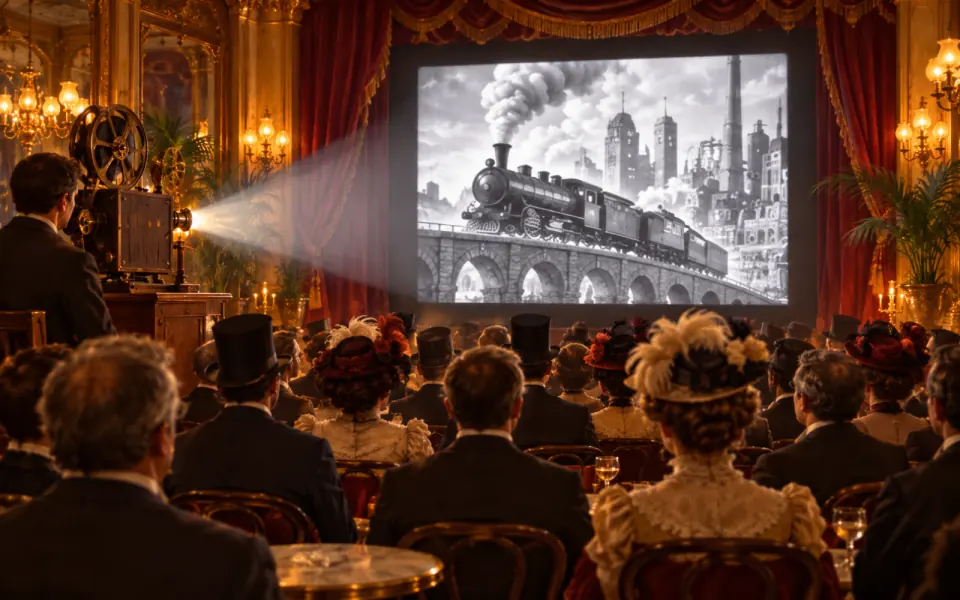
- The Lumière brothers' cinema1895 · Age of revolutionsThe Lumière brothers added movement to photography: the cinema.
- Talking pictures1927 · Early 20th centuryCinema with sound added a voice to the pictures.
- The modern smartphone2007 · TodayToday the smartphone is our camera.
- Leonardo designs machinesabout 1485 · Early modern ageLeonardo had studied the camera obscura four centuries earlier.
Before and after, in the era “Age of revolutions”
Event 14 of 25
 BeforeNewcomen's steam engine1712
 BeforeThe European Enlightenmentabout 1720
 BeforeDiderot's Encyclopédie1751
 BeforeWatt's steam engine1769
 BeforeThe American Revolution1776–1783
 BeforeThe first hot-air balloon flight1783
 BeforeThe French Revolution1789–1799
 BeforeThe metric system1795
 BeforeJenner's vaccine1796
 BeforeVolta's battery1800
 BeforeNapoleon becomes emperor1804
 BeforeThe Congress of Vienna1815
 BeforeThe first public steam railway1825
- You are hereNiépce's photographabout 1826
 AfterManzoni's The Betrothed1827
 AfterThe electric telegraph1844
 AfterThe revolutions of 18481848
 AfterDarwin publishes On the Origin of Species1859
 AfterThe Expedition of the Thousand1860
 AfterThe unification of Italy1861
 AfterThe labour movementabout 1864
 AfterCompulsory primary school (Coppino law)1877
 AfterA practical electric light bulb1879
 AfterThe first modern motor car1886
 AfterThe Lumière brothers' cinema1895
Listen / Read next
- Music to read by: Cinematic JourneyEpic film-style music, no lyrics, by Ciro Simone IrmiciSpotifyYouTube Music
Meanwhile, elsewhere in the world
Other events of the era “Age of revolutions”
- Newcomen's steam engine
- The European Enlightenment
- Diderot's Encyclopédie
- Watt's steam engine
- The American Revolution
- The first hot-air balloon flight
- The French Revolution
- The metric system
- Jenner's vaccine
- Volta's battery
- Napoleon becomes emperor
- The Congress of Vienna
- The first public steam railway
- Manzoni's The Betrothed
- The electric telegraph
- The revolutions of 1848
- Darwin publishes On the Origin of Species
- The Expedition of the Thousand
- The unification of Italy
- The labour movement
- Compulsory primary school (Coppino law)
- A practical electric light bulb
- The first modern motor car
- The Lumière brothers' cinema
