Darwin publishes On the Origin of Species
1859 London, England
In short
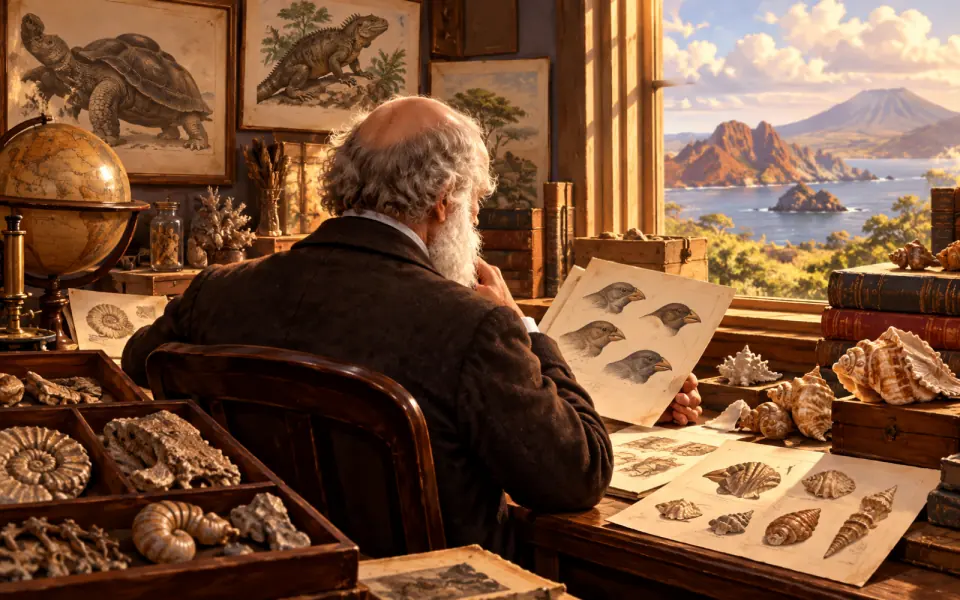
As a young man the English naturalist Charles Darwin sailed round the world on the ship Beagle, collecting animals, plants and fossils, including on the Galápagos Islands. For more than twenty years he studied those collections and arrived at an idea: species change slowly over time. The individuals best suited to their surroundings survive and have more young, and so they pass on their features: this is natural selection. In 1859 he published these ideas in the book On the Origin of Species.
Why it matters The theory of evolution explains the variety of life on Earth and is the basis of modern biology.
Source: Natural History Museum (London), “Charles Darwin”
Study card about 6 minutes of reading
The story
The voyage of the Beagle
Charles Darwin was born in 1809 in Shrewsbury, in England, into a well-off family: his grandfather and his father were doctors. Even as a boy, instead of studying, he preferred to collect insects, shells and minerals. His father sent him to study medicine at Edinburgh, but he could not bear the sight of blood, so he moved to Cambridge to become a clergyman. There, though, he became passionate about natural history, thanks to a professor of botany, John Henslow.
In 1831, aged twenty-two, Darwin had a unique opportunity: the British navy was looking for a young naturalist to accompany Captain Robert FitzRoy on a voyage around the world aboard the ship Beagle, to draw maps of coastlines. The voyage, planned to last two years, lasted almost five, from December 1831 to October 1836. Darwin suffered from seasickness, but he spent much of the time on land, in South America, collecting plants, animals, rocks and fossils.
In Patagonia he found the bones of gigantic extinct animals, similar to sloths and armadillos but much bigger than the living ones. In the Andes he found sea shells at enormous heights: the Earth changes, he thought, very slowly. On the Galápagos Islands, in the Pacific, he noticed that the giant tortoises, the mockingbirds and the small finches differed from island to island: different beaks and bodies, suited to the food of each place. Why?
An idea grows
Back in England, Darwin thought about it for years. At that time many people believed that each species had been created just as it is and never changed. Others, such as the Frenchman Lamarck, thought that living things did change, but did not explain well how. Darwin began to take notes, to carry out experiments, and to write to naturalists all over the world and to breeders of pigeons and dogs, to understand how domestic animals change.
In 1838 he read a book by the economist Thomas Malthus, which explained that population tends to grow faster than resources, so many individuals do not survive. It occurred to him: if in nature many more individuals are born than can live, those with characteristics better suited to the environment are more likely to survive and have offspring, and to pass those characteristics on. He called this mechanism “natural selection”.
For twenty years Darwin kept the idea almost secret, gathering evidence and studying, among other things, small crustaceans called barnacles for eight years. He was a shy, cautious man, and he feared controversy, partly because his wife Emma was very religious. But in June 1858 he received a letter from a young naturalist, Alfred Russel Wallace, who was working in Indonesia: Wallace had come up, independently, with the same idea. Darwin's friends arranged a joint presentation of the two works, in July 1858.
24 November 1859
Darwin made up his mind to write a book quickly and, on 24 November 1859, “On the Origin of Species by Means of Natural Selection” came out. All the available copies of the first edition (about 1,250) were ordered by booksellers before it even came out. The idea is simple. The individuals of a species are not all the same: they vary. Many of these differences are inherited from parents. In every generation more individuals are born than can survive, so there is competition. Those with more useful characteristics, for example skin better suited to the cold or a beak better suited to seeds, are more likely to survive and reproduce. So, over the generations, those characteristics become more common, and little by little, over very long periods of time, new species appear.
The book did not say much about humans, but everyone understood that the idea applied to us too. In 1871 Darwin published “The Descent of Man”, arguing that humans share common ancestors with the apes.
Controversy and agreement
The reception was mixed. Many scientists, such as Thomas Huxley, defended him with great energy: Huxley was called “Darwin's bulldog”. In June 1860, in Oxford, a famous debate set Bishop Samuel Wilberforce against Huxley. Others, especially among the clergy, opposed him, because he seemed to contradict the story in Genesis. In fact many believers, even then, thought that evolution and faith could go together.
Darwin, ill for much of his life, died in 1882 and was buried in Westminster Abbey, in London, near Isaac Newton.
Why it happened
Darwin's ideas came from a combination of things: his voyages and his direct observations; the discoveries of geology, which showed that the Earth was much older than people had thought, thanks to the studies of Charles Lyell; and the work of breeders, who change animals by choosing the best ones.
His patience and rigour counted too: he collected thousands of examples before publishing. But the idea was also “in the air”, as the coincidence with Wallace shows: in the 19th century science was discovering that nature has a history.
What changed
The theory of evolution by natural selection is the basis of modern biology. It explains why living things are so well adapted to their environment, why species are related to one another, and why there are fossils of vanished forms. Later came genetics, with the studies of Gregor Mendel, rediscovered in 1900, and the discovery of DNA, which explain how characteristics are inherited and how variations arise.
Today evolution can also be observed in the laboratory and in everyday life: bacteria that become resistant to antibiotics, or insects resistant to insecticides, are examples of natural selection. Fossils and DNA comparisons show that all living things are relatives, and that humans and chimpanzees share common ancestors.
There have been, and still are, debates and misunderstandings: for example, the expression “survival of the fittest”, which was not Darwin's but the philosopher Herbert Spencer's (although Darwin later used it), has often been misused to justify social injustice, something Darwin's ideas do not say. Every year on 12 February, Darwin's birthday, “Darwin Day” is celebrated.
Key people and places
People
- Charles Darwin
- English naturalist (1809–1882): he formulated the theory of evolution by natural selection.
- Alfred Russel Wallace
- British naturalist (1823–1913): he arrived independently at the same idea.
- Robert FitzRoy
- English officer and meteorologist (1805–1865): captain of the Beagle, he invented weather forecasts.
- Thomas Huxley
- English biologist (1825–1895): a defender of Darwin's ideas.
- Gregor Mendel
- Austrian monk and scientist (1822–1884): he discovered the laws of heredity.
Places
- Galápagos Islands, Ecuador
- The archipelago in the Pacific where Darwin observed animals during the voyage of the Beagle.
- Down House, Kent (England)
- The country house where Darwin lived and wrote “On the Origin of Species”.
Good to know
- The voyage of the Beagle, planned to last two years, lasted almost five.
- All 1,250 copies of the first edition of “On the Origin of Species” were ordered by booksellers before publication day.
- Darwin worked for eight years studying barnacles, small crustaceans.
- “Darwin Day” is celebrated on 12 February, his birthday.
- Darwin is buried in Westminster Abbey, near Isaac Newton.
Find out more
- Wikipedia, “Charles Darwin” en.wikipedia.org
- Wikipedia, “On the Origin of Species” en.wikipedia.org
- Wikipedia, “HMS Beagle” en.wikipedia.org
- The Complete Work of Charles Darwin Online darwin-online.org.uk
Related events
- The double helix of DNA1953 · TodayThe structure of DNA, in 1953, explained how characteristics are inherited.
- Newton publishes the Principia1687 · Early modern ageNewton, like Darwin, is buried at Westminster.
- Copernicus puts the Sun at the centre1543 · Early modern ageCopernicus had already changed our place in the universe.
- The discovery of penicillin1928 · Early 20th centuryBacteria resistant to antibiotics show evolution in action.
Before and after, in the era “Age of revolutions”
Event 18 of 25
 BeforeNewcomen's steam engine1712
 BeforeThe European Enlightenmentabout 1720
 BeforeDiderot's Encyclopédie1751
 BeforeWatt's steam engine1769
 BeforeThe American Revolution1776–1783
 BeforeThe first hot-air balloon flight1783
 BeforeThe French Revolution1789–1799
 BeforeThe metric system1795
 BeforeJenner's vaccine1796
 BeforeVolta's battery1800
 BeforeNapoleon becomes emperor1804
 BeforeThe Congress of Vienna1815
 BeforeThe first public steam railway1825
 BeforeNiépce's photographabout 1826
 BeforeManzoni's The Betrothed1827
 BeforeThe electric telegraph1844
 BeforeThe revolutions of 18481848
- You are hereDarwin publishes On the Origin of Species1859
 AfterThe Expedition of the Thousand1860
 AfterThe unification of Italy1861
 AfterThe labour movementabout 1864
 AfterCompulsory primary school (Coppino law)1877
 AfterA practical electric light bulb1879
 AfterThe first modern motor car1886
 AfterThe Lumière brothers' cinema1895
Listen / Read next
- Music to read by: Cinematic JourneyEpic film-style music, no lyrics, by Ciro Simone IrmiciSpotifyYouTube Music
Meanwhile, elsewhere in the world
Other events of the era “Age of revolutions”
- Newcomen's steam engine
- The European Enlightenment
- Diderot's Encyclopédie
- Watt's steam engine
- The American Revolution
- The first hot-air balloon flight
- The French Revolution
- The metric system
- Jenner's vaccine
- Volta's battery
- Napoleon becomes emperor
- The Congress of Vienna
- The first public steam railway
- Niépce's photograph
- Manzoni's The Betrothed
- The electric telegraph
- The revolutions of 1848
- The Expedition of the Thousand
- The unification of Italy
- The labour movement
- Compulsory primary school (Coppino law)
- A practical electric light bulb
- The first modern motor car
- The Lumière brothers' cinema
