The Black Death
1347–1352 Messina, Sicily, then the whole of Europe
In short
In the autumn of 1347 some Genoese ships arrived in Messina from the Black Sea and brought the plague with them. The disease was caused by a bacterium spread by rat fleas, but nobody knew that at the time. In a few years it spread all over Europe and killed about a third of the population, perhaps even more. The writer Giovanni Boccaccio described it in the Decameron, in which ten young people take refuge in the countryside and tell each other stories.
Why it matters After the epidemic there were not enough workers, and this changed the economy, wages and life in the countryside.
Source: Encyclopaedia Britannica, “Black Death”
Study card about 6 minutes of reading
The story
The ships at Messina
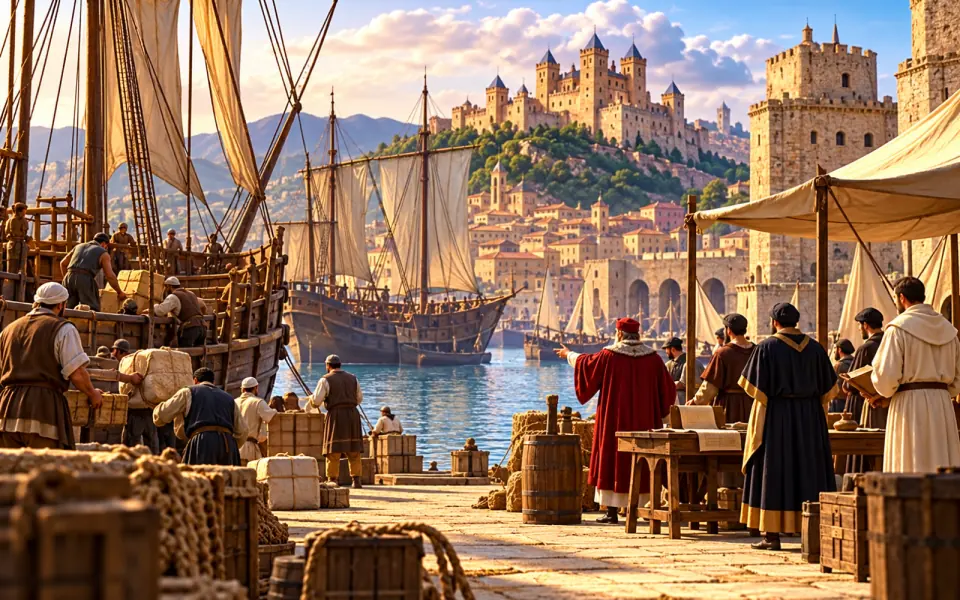
In October 1347 some Genoese galleys entered the port of Messina. They came from the Black Sea, where Genoa had colonies and warehouses, and carried sailors who were sick and dying. A Sicilian chronicler, the friar Michele da Piazza, tells that within a few days the illness passed from the sailors to the townspeople: those who fell ill had a very high fever, pains and swellings as big as an egg under the armpits or in the groin, and often died in three or four days. The people of Messina drove the ships away, but it was too late.
It was the plague, a disease that had not been seen in Europe for centuries. In the following four years it would kill one person in three, perhaps even more. Historians have called it the “Black Death”; those who lived through it called it simply “the great mortality”.
Where it came from
The plague was not born in Europe. In 2022 a group of scientists analysed DNA found in the teeth of people buried in 1338-1339 near Lake Issyk-Kul, in present-day Kyrgyzstan, in Central Asia: their gravestones say that they died of “pestilence”. The bacterium found is the ancestor of the one that, a few years later, devastated Europe.
From Central Asia the disease travelled along the trade routes, with the caravans, the goods and the rats. In 1346 the Mongol army of the Golden Horde was besieging Caffa, a Genoese town in Crimea. According to the account of the notary Gabriele de' Mussi of Piacenza, the besiegers, struck down by the plague, hurled the bodies of the dead over the walls with catapults. We do not know whether it really happened like that, but it is certain that from Caffa and the ports of the Black Sea ships carried the contagion to Constantinople, Egypt and Italy.
The contagion runs through Europe
From Messina the plague reached Genoa, Venice, Pisa and Marseille within a few weeks. In the spring of 1348 it arrived in Florence, then in Paris, in Spain and, in the summer, in England. In 1349 it reached Germany, Scandinavia and Ireland; between 1351 and 1353, Russia. It travelled at the speed of ships and carts: where merchants arrived, the disease arrived.
The towns, where people lived crowded together and rats were everywhere, were the worst hit. In Florence perhaps more than half the inhabitants died. Among the victims were famous people too: the Florentine chronicler Giovanni Villani, who broke off in the middle of a sentence in his chronicle, and Laura, the woman loved by the poet Francesco Petrarch: he himself noted that she had died at Avignon on 6 April 1348.
A disease nobody understood
Today we know that the plague is caused by a bacterium, Yersinia pestis, discovered only in 1894. It lives in rodents, especially black rats, and passes to humans through the bites of their fleas. In the “bubonic” form it makes the lymph nodes swell (the buboes); in the “pneumonic” form it attacks the lungs and is passed from person to person by coughing, and is almost always fatal if untreated.
In the 1300s nobody knew about bacteria. The doctors of the University of Paris, questioned by the King of France in 1348, explained that the fault lay with a conjunction of the planets and with a “corrupted air” that rose from the earth. People burned scented herbs, fled to the countryside, prayed. Some groups, the flagellants, went from town to town whipping themselves in public to ask God's forgiveness.
Fear also looked for people to blame. In many towns of Germany, Switzerland and France the Jews were falsely accused of poisoning the wells, and whole communities were killed. Pope Clement VI wrote that the accusation was absurd, because the Jews died of plague like everyone else, but it was not enough to stop the massacres.
Boccaccio and the Decameron
In Florence the writer Giovanni Boccaccio saw all this with his own eyes. A few years later he wrote the Decameron: in the introduction he describes the city full of the dead, abandoned houses, relatives who no longer dared to care for one another. Then he imagines ten young people, seven girls and three boys, who meet in the church of Santa Maria Novella and decide to leave Florence for a villa in the country. For ten days they each tell a tale a day: a hundred stories, funny, sad and cunning, which are one of the masterpieces of Italian literature.
After the storm
Around 1352 the great wave died down, but the plague did not disappear. It came back many times, every ten or twenty years, for more than three centuries: in 1630 it struck Milan (it is the plague told by Alessandro Manzoni in The Betrothed) and the last great epidemic in western Europe was that of Marseille, in 1720.
Why it happened
The bacterium had existed for thousands of years in the wild rodents of Central Asia. In the 1300s, however, the world was more connected than ever: the Mongol Empire had united Asia and the Silk Road carried goods, people and animals from China to the Black Sea, where Italian ships loaded them for Europe.
Europe, moreover, was fragile. After centuries of growth it was full of people, towns were crowded and dirty, and rats lived in warehouses and houses. Between 1315 and 1317 a great famine had weakened many people. And the medicine of the time could neither understand nor cure the disease: without knowing how it spread, it was impossible to stop it.
What changed
In a few years tens of millions of people died: between a third and a half of the inhabitants of Europe. Whole villages were abandoned, fields left uncultivated. It took about two centuries for the population to return to its former numbers.
With so few people, labour became precious. Peasants and craftsmen asked for higher wages and many lords had to grant them; where governments tried to freeze wages, as in England with the Statute of Labourers of 1351, revolts broke out, such as the English peasants' revolt of 1381. In western Europe serfdom began to disappear.
From the plague came ideas we still use. In 1377 the city of Ragusa (now Dubrovnik) obliged anyone arriving from infected places to stay isolated for thirty days; then the days became forty, and from “quaranta”, Italian for forty, comes the word “quarantine”. In 1423 Venice opened the first lazaretto, a hospital island for the sick. The health boards of the Italian cities were the first public health services in Europe.
Today plague still exists in some parts of the world (for example in Madagascar and the Democratic Republic of the Congo), but it is cured with antibiotics if caught in time. During the COVID-19 pandemic, in 2020, the world used again the same weapons invented in the 1300s: isolation and quarantine.
Key people and places
People
- Giovanni Boccaccio
- Florentine writer (1313-1375). He lived through the plague in Florence and described it in the introduction to the Decameron.
- Francesco Petrarca
- Poet (1304-1374). He lost to the plague Laura, the woman of the Canzoniere, and many friends.
- Giovanni Villani
- Merchant and chronicler of Florence. He died of plague in 1348 while writing the history of his city.
- Clement VI
- Pope at Avignon. In 1348 he defended the Jews against the false accusations of spreading the plague.
- Alexandre Yersin
- Swiss-French doctor: in 1894, in Hong Kong, he discovered the plague bacterium, which bears his name.
Places
- Caffa (now Feodosia, Crimea)
- Genoese colony on the Black Sea, besieged by the Mongols in 1346: the infected ships set out from here.
- Messina
- First port of western Europe where the plague arrived, in October 1347.
- Florence
- Boccaccio's city, hit in 1348: it lost perhaps more than half its inhabitants.
- Ragusa (Dubrovnik)
- Adriatic republic that in 1377 invented compulsory isolation for new arrivals.
Good to know
- The word “quarantine” comes from the forty days of isolation required of ships arriving at Venice.
- In 2022 DNA found in tombs in Kyrgyzstan showed where the Black Death set out from: Central Asia, around 1338.
- Boccaccio's Decameron has a hundred tales, told by ten young people over ten days to escape the plague of Florence.
- The plague bacterium is called Yersinia pestis, after Alexandre Yersin, who discovered it in 1894.
- The famous costume with the beaked mask is not from the 1300s: some doctors used it in the 1600s.
Find out more
- Wikipedia, “Black Death” en.wikipedia.org
- Wikipedia, “Yersinia pestis” en.wikipedia.org
- Wikipedia, “The Decameron” en.wikipedia.org
- Wikipedia, “Quarantine” en.wikipedia.org
- Wikipedia, “Flagellant” en.wikipedia.org
Related events
- Marco Polo sets off for Asia1271 · Late Middle AgesThe same trade routes travelled by Marco Polo brought the plague from Asia.
- The Hundred Years' War1337–1453 · Late Middle AgesThe plague broke out in the early years of the Hundred Years' War and interrupted it for a time.
- Manzoni's The Betrothed1827 · Age of revolutionsIn The Betrothed Manzoni tells of the plague of 1630 in Milan.
- The discovery of penicillin1928 · Early 20th centuryToday plague is treated with antibiotics, born with penicillin.
- The COVID-19 pandemic2020 · TodayIn 2020 the world used isolation and quarantine again.
Before and after, in the era “Late Middle Ages”
Event 23 of 25
 BeforeThe growth of medieval townsabout 1050
 BeforeThe East–West Schism1054
 BeforeThe Bayeux Tapestryabout 1070
 BeforeThe University of Bolognaabout 1088
 BeforeThe First Crusade1096–1099
 BeforeThe Italian communesabout 1100
 BeforeRomanesque cathedralsabout 1100
 BeforeWatermills and windmillsabout 1100
 BeforeGothic style at Saint-Denis1144
 BeforeHildegard of Bingenabout 1150
 BeforePaper arrives in Europeabout 1150
 BeforeFrederick Barbarossa1155
 BeforeFrancis of Assisiabout 1182
 BeforeFibonacci and the Liber abaci1202
 BeforeMagna Carta1215
 BeforeThe gold florin1252
 BeforeMarco Polo sets off for Asia1271
 BeforeSpectaclesabout 1286
 BeforeThe Hanseatic League and northern tradeabout 1300
 BeforeGiotto paints in Paduaabout 1305
 BeforeDante begins the Divine Comedyabout 1307
 BeforeThe Hundred Years' War1337–1453
- You are hereThe Black Death1347–1352
 AfterPublic mechanical clocksabout 1350
 AfterJoan of Arc1429
Listen / Read next
- Music to read by: Cinematic JourneyEpic film-style music, no lyrics, by Ciro Simone IrmiciSpotifyYouTube Music
Meanwhile, elsewhere in the world
Other events of the era “Late Middle Ages”
- The growth of medieval towns
- The East–West Schism
- The Bayeux Tapestry
- The University of Bologna
- The First Crusade
- The Italian communes
- Romanesque cathedrals
- Watermills and windmills
- Gothic style at Saint-Denis
- Hildegard of Bingen
- Paper arrives in Europe
- Frederick Barbarossa
- Francis of Assisi
- Fibonacci and the Liber abaci
- Magna Carta
- The gold florin
- Marco Polo sets off for Asia
- Spectacles
- The Hanseatic League and northern trade
- Giotto paints in Padua
- Dante begins the Divine Comedy
- The Hundred Years' War
- Public mechanical clocks
- Joan of Arc
