Newcomen's steam engine
1712 Dudley, England
In short
In English coal mines, water kept flooding the tunnels. Thomas Newcomen, a craftsman who sold iron tools, built a machine that used steam to move a great rocking beam connected to a pump. The first one worked in 1712 near Dudley, in England, and lifted water from dozens of metres down. It burnt a huge amount of coal, but in the mines there was no shortage of coal.
Why it matters It was the first truly useful steam engine, the first step towards the Industrial Revolution.
Source: Encyclopaedia Britannica, “Thomas Newcomen”
Study card about 5 minutes of reading
The story
Mines full of water
At the start of the 18th century, in England, more and more coal was being dug. Wood, which for centuries had been used to heat houses and to run forges and furnaces, was becoming scarce because forests were being cut down so fast; coal, plentiful under the ground in that country, was replacing it. But there was a big problem. When miners went deeper, the tunnels filled with water seeping out of the rock. To keep digging, the water had to be pumped out all the time.
This was done with human arms or with horse power, the horses walking round in circles to work the pumps: a slow and very expensive job. In many mines, sooner or later, it became impossible to dig any deeper, and the coal seams were left unused. More powerful machines were needed.
The blacksmith from Dartmouth
Thomas Newcomen was a blacksmith and ironmonger from Dartmouth, a port in Devon, in the south of England. He sold tools to the miners of Cornwall, the neighbouring county, and knew their problems at first hand. He was not a scientist and had not been to university, but he was good with his hands and full of ideas. Together with a friend who was a plumber, John Calley, he spent more than ten years experimenting with a machine that used steam.
Some things were already known: in 1698 a military engineer, Thomas Savery, had patented a steam pump called “the miner's friend”, but it worked badly and could explode. The French physicist Denis Papin, a few years earlier, had thought of a cylinder with a piston moved by steam. Newcomen brought these ideas together in a much safer and more practical machine.
How it worked
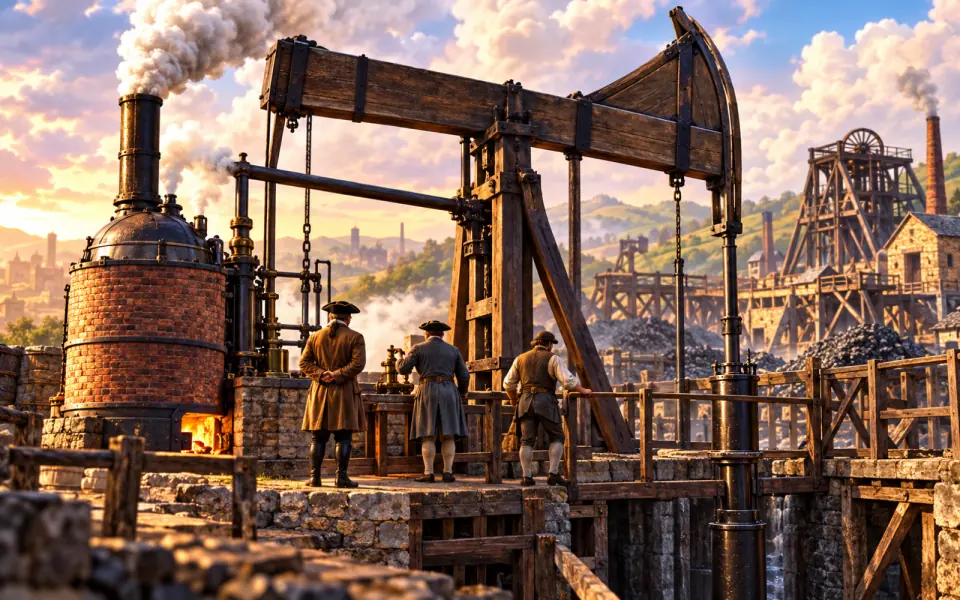
Newcomen's machine had a big boiler, in which water was boiled, and an upright cylinder with a piston that could slide up and down. The steam, at very low pressure, flowed into the cylinder and pushed the piston up. Then a jet of cold water made the steam condense, which means it turned back into tiny drops of water: inside the cylinder a partial vacuum formed, and the pressure of the outside air, like an invisible hand, pushed the piston down with great force. That is why the machine was called “atmospheric”. The piston was joined by a chain to an enormous wooden beam, which swung like a seesaw and worked the pump that drew water from the mine.
1712: the first machine at work
The first Newcomen engine we know of for certain started work in 1712 at a coal mine near Dudley Castle, in the Midlands. It made about twelve strokes a minute, and with every stroke it lifted a large amount of water from a depth of about fifty metres: more work than dozens of horses, day and night, without ever getting tired. It was huge and noisy, a great brick building with the wooden beam swinging above it, and it burned an enormous amount of coal, but in coal mines, where fuel was never short, that did not matter.
Because Savery's patent, which covered every machine for raising water with fire, was still in force, Newcomen had to join forces with him and share the profits, so he never became rich. He was a deeply religious man, a lay preacher in the Baptist church, and he never knew how much his invention would change the world.
Success came quickly. By the time Newcomen died, in 1729, more than a hundred engines were already working, in Britain and on the Continent: in France, Germany, Hungary and Sweden. In the second half of the 18th century hundreds had been built: they pumped water out of coal and tin mines and out of towns, and lifted water to turn the waterwheels of factories.
Why it happened
Newcomen's machine came from a practical need, pumping water out of mines, and from the fact that England had plenty of coal, iron and skilled craftsmen. At that time the country was rich in money, trade and curiosity about new technology.
Behind it also lay the scientific discoveries of the 17th century: the experiments of Torricelli, Pascal and Boyle, which had shown that a vacuum and air pressure exist, and the first studies of steam. Newcomen turned them into something practical.
What changed
Newcomen's machine was the first really useful steam engine, and it paved the way for the Industrial Revolution. By making it possible to dig deeper, it increased coal production, the fuel that would power the factories, railways and ships of the 19th century.
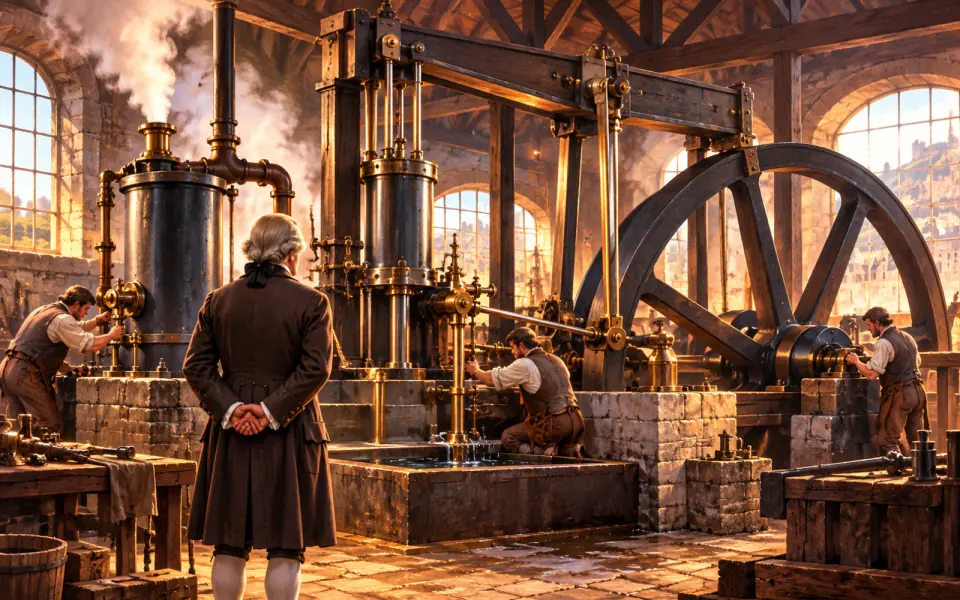
But it had one big fault: it used too much fuel, because the cylinder had to be heated and cooled again with every stroke. Around 1765 James Watt, who was repairing a model, had an idea for improving it, and in 1769 he patented an engine with a separate condenser that used much less coal: a decisive step.
Newcomen engines stayed in use for more than two centuries: the last one stopped working in the 20th century. One can still be seen today in the old village of Elsecar, in Yorkshire, where it worked until 1923.
Key people and places
People
- Thomas Newcomen
- English blacksmith and inventor (1664–1729): he built the first practical steam engine.
- John Calley
- English plumber (died 1717): he worked with Newcomen and helped him build the first engines.
- Thomas Savery
- English engineer (around 1650–1715): in 1698 he patented a steam pump, “the miner's friend”.
- Denis Papin
- French physicist (1647–1713): he came up with the piston moved by steam, and the pressure cooker.
- James Watt
- Scottish engineer (1736–1819): he improved Newcomen's engine with the separate condenser.
Places
- Dudley, Staffordshire (England)
- The town near which Newcomen's first engine worked in 1712.
- Dartmouth, Devon (England)
- Newcomen's home town, where a memorial engine commemorates his name.
Good to know
- Newcomen's machine was called “atmospheric” because it was the pressure of the air that pushed the piston down.
- It made about twelve strokes a minute and lifted water out of the mine shafts.
- Newcomen was a blacksmith and ironmonger, not a scientist.
- A Newcomen engine from 1795 worked until 1923 at Elsecar, in England.
- It burned so much coal that it was worth using only where coal was plentiful, that is, in the mines.
Find out more
- Wikipedia, “Thomas Newcomen” en.wikipedia.org
- Wikipedia, “Steam engine” en.wikipedia.org
- Wikipedia, “Newcomen atmospheric engine” en.wikipedia.org
Related events
- Watt's steam engine1769 · Age of revolutionsWatt improved Newcomen's engine in 1769.
- The first public steam railway1825 · Age of revolutionsThe steam engine led to the railway locomotive.
- Newton publishes the Principia1687 · Early modern ageNewton had described the laws of motion and of forces, the basis of mechanics.
- The first modern motor car1886 · Age of revolutionsAn internal combustion engine, like the one in the first car, was another turning point.
Before and after, in the era “Age of revolutions”
Event 1 of 25
- You are hereNewcomen's steam engine1712
 AfterThe European Enlightenmentabout 1720
 AfterDiderot's Encyclopédie1751
 AfterWatt's steam engine1769
 AfterThe American Revolution1776–1783
 AfterThe first hot-air balloon flight1783
 AfterThe French Revolution1789–1799
 AfterThe metric system1795
 AfterJenner's vaccine1796
 AfterVolta's battery1800
 AfterNapoleon becomes emperor1804
 AfterThe Congress of Vienna1815
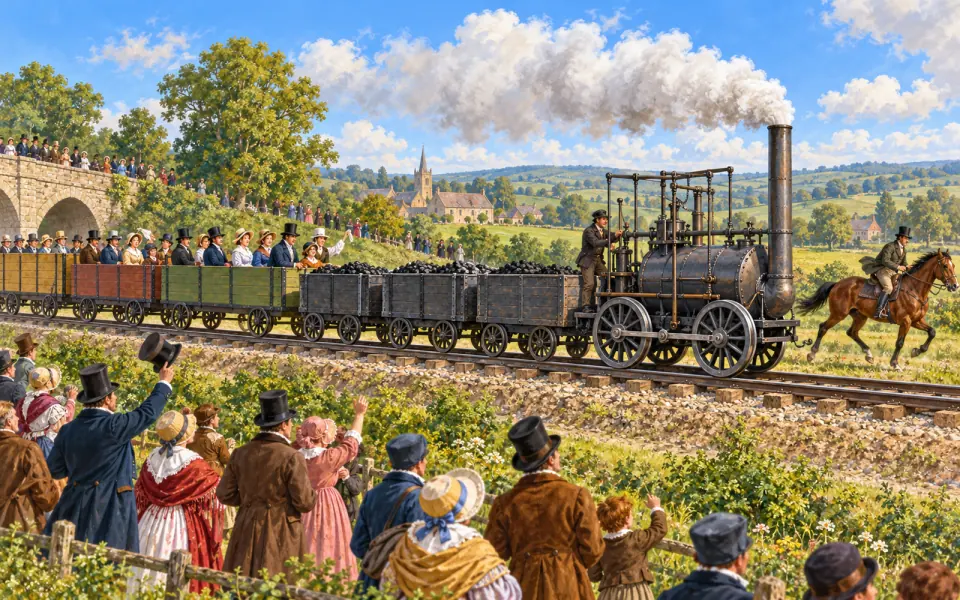 AfterThe first public steam railway1825
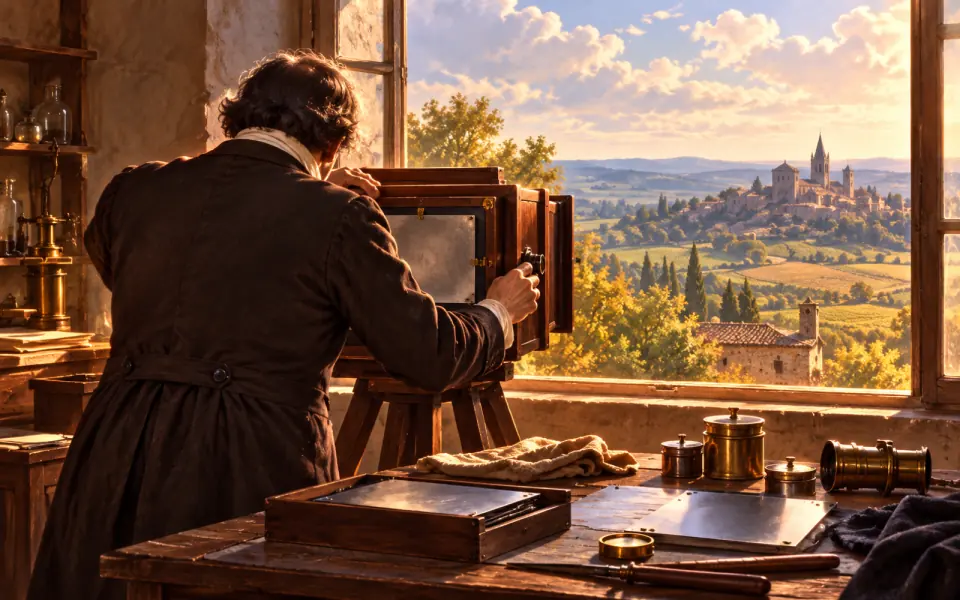 AfterNiépce's photographabout 1826
 AfterManzoni's The Betrothed1827
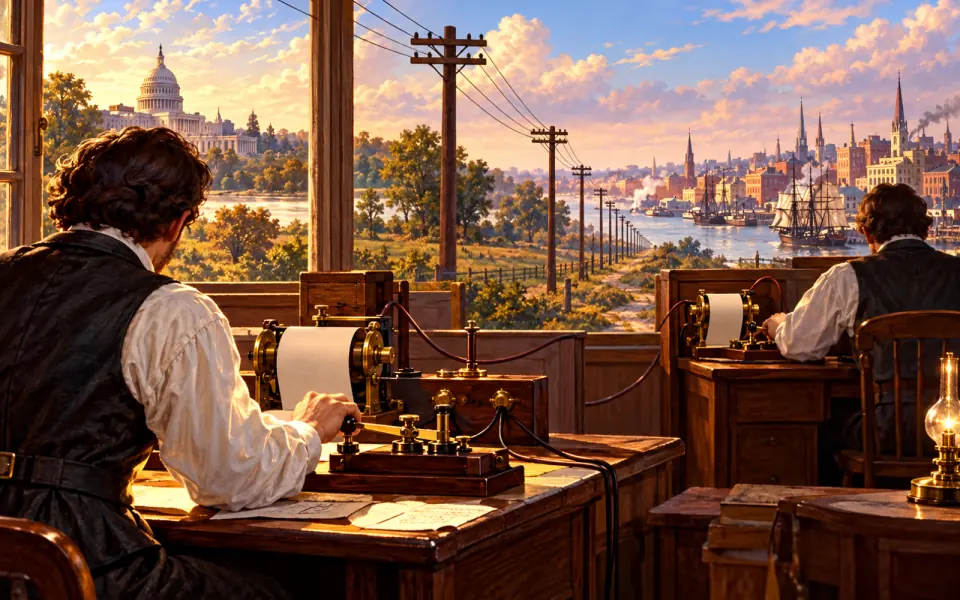 AfterThe electric telegraph1844
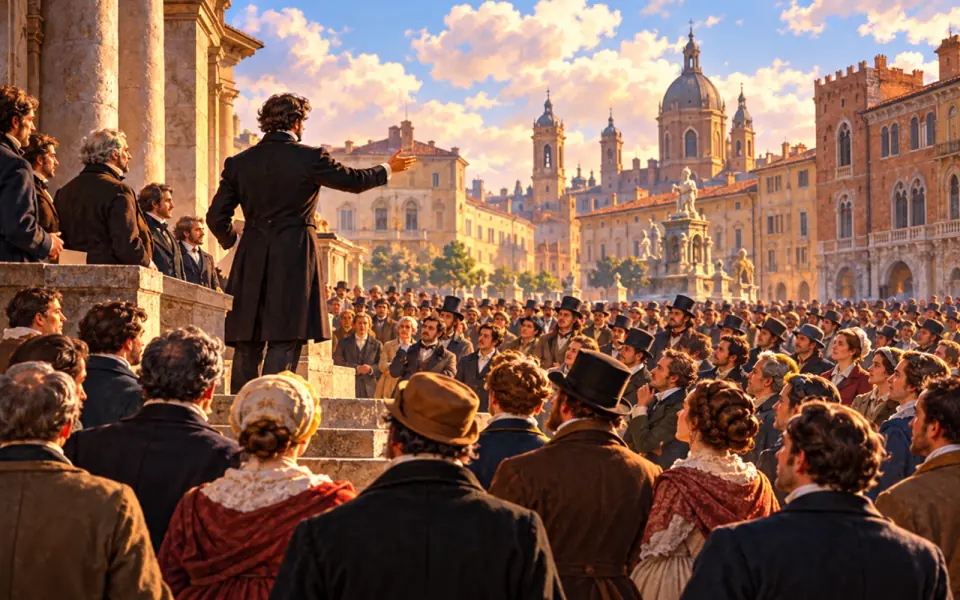 AfterThe revolutions of 18481848
 AfterDarwin publishes On the Origin of Species1859
 AfterThe Expedition of the Thousand1860
 AfterThe unification of Italy1861
 AfterThe labour movementabout 1864
 AfterCompulsory primary school (Coppino law)1877
 AfterA practical electric light bulb1879
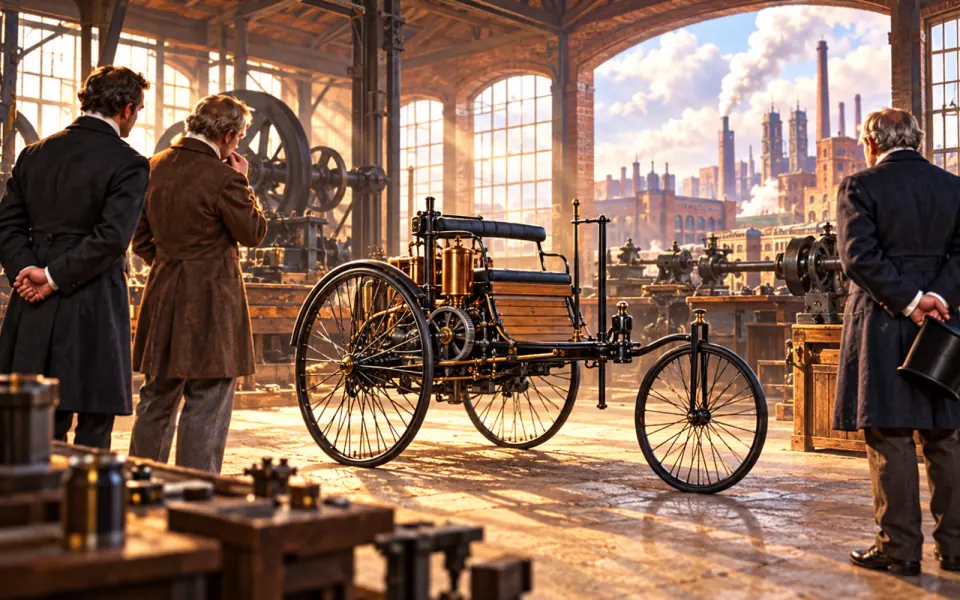 AfterThe first modern motor car1886
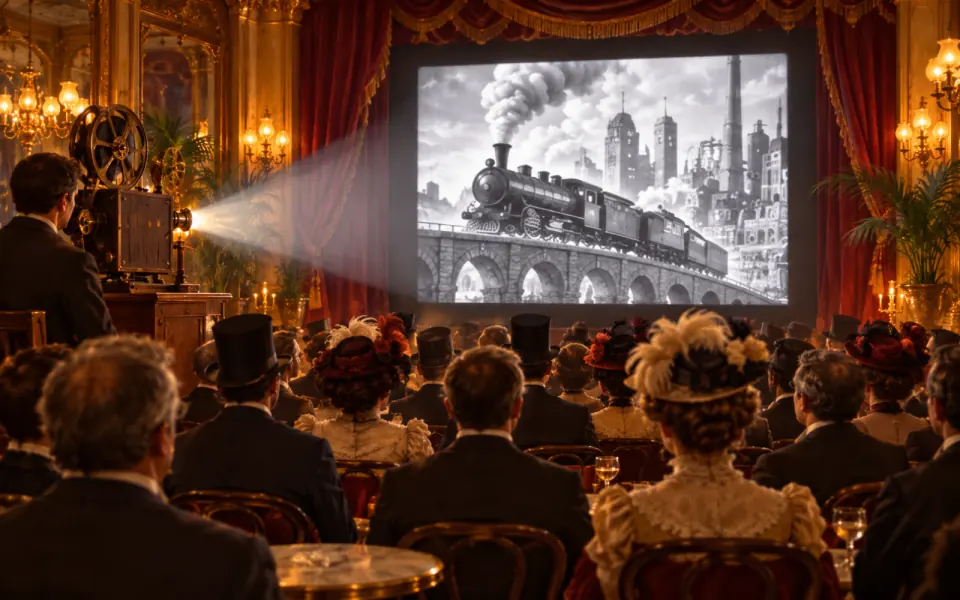 AfterThe Lumière brothers' cinema1895
Listen / Read next
- Music to read by: Cinematic JourneyEpic film-style music, no lyrics, by Ciro Simone IrmiciSpotifyYouTube Music
Meanwhile, elsewhere in the world
Other events of the era “Age of revolutions”
- The European Enlightenment
- Diderot's Encyclopédie
- Watt's steam engine
- The American Revolution
- The first hot-air balloon flight
- The French Revolution
- The metric system
- Jenner's vaccine
- Volta's battery
- Napoleon becomes emperor
- The Congress of Vienna
- The first public steam railway
- Niépce's photograph
- Manzoni's The Betrothed
- The electric telegraph
- The revolutions of 1848
- Darwin publishes On the Origin of Species
- The Expedition of the Thousand
- The unification of Italy
- The labour movement
- Compulsory primary school (Coppino law)
- A practical electric light bulb
- The first modern motor car
- The Lumière brothers' cinema
